Check Price Now
Table of Contents
- What is EN 1317 Crash Barrier Testing?
- Why EN 1317 Matters for Highway Projects
- Components Evaluated During EN 1317 Crash Testing
- EN 1317 Containment Levels Explained
- Working Width and Dynamic Deflection in EN 1317
- Impact Severity Levels (ASI) Explained
- How EN 1317 Crash Barrier Testing is Performed
- EN 1317 vs MoRTH and IRC Requirements
- How Procurement Teams Should Verify EN 1317 Compliance
- Common Misconceptions About EN 1317 Crash Barrier Testing
- Conclusion
- FAQs
Crash barriers must do more than meet material and dimensional specifications. They must also prove they can safely contain and redirect vehicles during a collision. That is where EN 1317 crash barrier testing plays a vital role. Recognised worldwide, EN 1317 is the leading standard for evaluating the performance of vehicle restraint systems under controlled crash conditions. Its importance is growing across Indian expressways, BOT projects, EPC contracts, and among manufacturers supplying international markets.
This guide explains how EN 1317 crash barrier testing works, its key performance criteria, containment levels, and what contractors and procurement teams should evaluate before selecting a compliant crash barrier system.
What is EN 1317 crash barrier testing?
EN 1317 crash barrier testing is the process used to evaluate how a crash barrier performs when struck by a vehicle under controlled conditions. Developed as the European crash barrier standard, EN 1317 provides a consistent framework for assessing the safety and performance of vehicle restraint systems used on roads, bridges, and highways.
Purpose of the standard: EN 1317 ensures that crash barriers can contain, redirect, or safely stop vehicles while reducing the risk of severe injuries and secondary collisions. Instead of focusing only on material strength, it measures how the complete barrier system performs during an impact.
Vehicle restraint systems: Steel guardrails, W-beam barriers, Thrie-beam barriers, concrete barriers, bridge barriers, and wire rope barriers. Each system undergoes testing based on its intended application and required performance level.
Why crash testing is essential: Crash barriers experience high-impact forces that cannot be accurately predicted through design calculations or material testing alone. Full-scale crash tests confirm whether a barrier can perform safely under realistic collision conditions before it is approved for use.
Laboratory testing vs real-world performance: Laboratory testing recreates controlled crash scenarios using specified vehicles, speeds, and impact angles to produce repeatable results. While actual road accidents vary, the EN 1317 testing standard provides a reliable benchmark for comparing crash-tested barriers and selecting suitable road restraint systems for different highway applications.
Why EN 1317 matters for highway projects

As road infrastructure projects become larger and more complex, contractors and consultants look beyond product specifications when selecting crash barriers. They want proven performance backed by recognised testing standards. EN 1317 crash barrier testing provides that confidence by demonstrating how a barrier system performs under defined impact conditions.
This makes it a valuable benchmark for highway safety, the protection of motorists, and consistent quality across different projects. It is also widely recognised in international infrastructure projects, making it relevant for companies working on global contracts or export markets.
EN 1317 compliance offers practical advantages for every stakeholder involved in highway construction and procurement, including:
EPC contractors: Select crash barrier systems with verified performance to improve project quality and meet client expectations.
NHAI vendors: Strengthen bids by supplying barriers supported by recognised crash test data.
DPR consultants: Recommend suitable barrier systems based on tested performance rather than product claims.
PMC teams: Verify compliance during quality checks and installation reviews.
Export manufacturers: Demonstrate adherence to an internationally recognised testing standard for overseas projects.
Using EN 1317-compliant barrier systems can also reduce project risk by improving design confidence and minimising uncertainties during approval and installation. It supports better safety performance throughout the asset’s life cycle and helps contractors remain competitive in tenders where verified crash performance is an important evaluation criterion.
Components evaluated during EN 1317 crash testing
EN 1317 crash barrier testing evaluates far more than whether a barrier stops a vehicle. The testing standard measures how the vehicle, barrier, and occupants respond throughout the collision. It also assesses whether the barrier creates additional hazards after the impact. Together, these performance criteria determine whether a crash barrier system is suitable for use on highways, bridges, medians, and other road infrastructure projects.
| Evaluation area | Component | What is assessed? | Why it matters |
|---|---|---|---|
| Vehicle behaviour | Redirection | Whether the barrier safely redirects the vehicle back towards the carriageway instead of allowing it to cross the barrier or leave the road. | Reduces the risk of severe crashes and protects opposing traffic. |
| Stability | Whether the vehicle remains upright and under control after impact. | Helps prevent secondary accidents and improves occupant safety. | |
| Roll-over prevention | Whether the impact causes the vehicle to overturn. | Lowers the likelihood of serious injuries and fatalities. | |
| Barrier behaviour | Deflection | The amount the barrier moves or bends during impact. | Confirms there is enough clearance behind the barrier for safe installation. |
| Structural integrity | Whether the barrier remains intact without major structural failure. | Ensures the system continues to perform during the collision. | |
| Post performance | How barrier posts behave under impact loads. | Prevents excessive collapse or failure of the support structure. | |
| Rail continuity | Whether the rails remain connected throughout the impact. | Maintains continuous vehicle containment and guidance. | |
| Anchorage | Whether end anchors and fixings stay securely in place. | Prevents barrier separation and loss of performance. | |
| Occupant safety | Deceleration | The forces experienced by vehicle occupants during the collision. | Lower impact forces reduce the risk of serious injuries. |
| Cabin intrusion | Whether any part of the barrier penetrates the passenger compartment. | Protects occupants from direct structural damage. | |
| Impact severity | The overall severity of the collision based on occupant risk indicators. | Confirms the barrier balances containment with occupant protection. | |
| Post-crash conditions | Detached parts | Whether components break away and become projectiles. | Prevents additional hazards for nearby vehicles and pedestrians. |
| Vehicle rebound | How the vehicle moves after leaving the barrier. | Reduces the risk of secondary impacts with other vehicles or roadside objects. | |
| Hazard to other traffic | Whether the barrier or vehicle obstructs adjacent lanes or creates new risks. | Supports safer traffic flow following the collision. |
Together, these assessments provide a complete picture of barrier performance rather than focusing only on strength. This comprehensive approach helps contractors, consultants, procurement teams, and road authorities compare crash-tested barrier systems and select solutions that deliver reliable safety in real highway applications.
EN 1317 containment levels explained
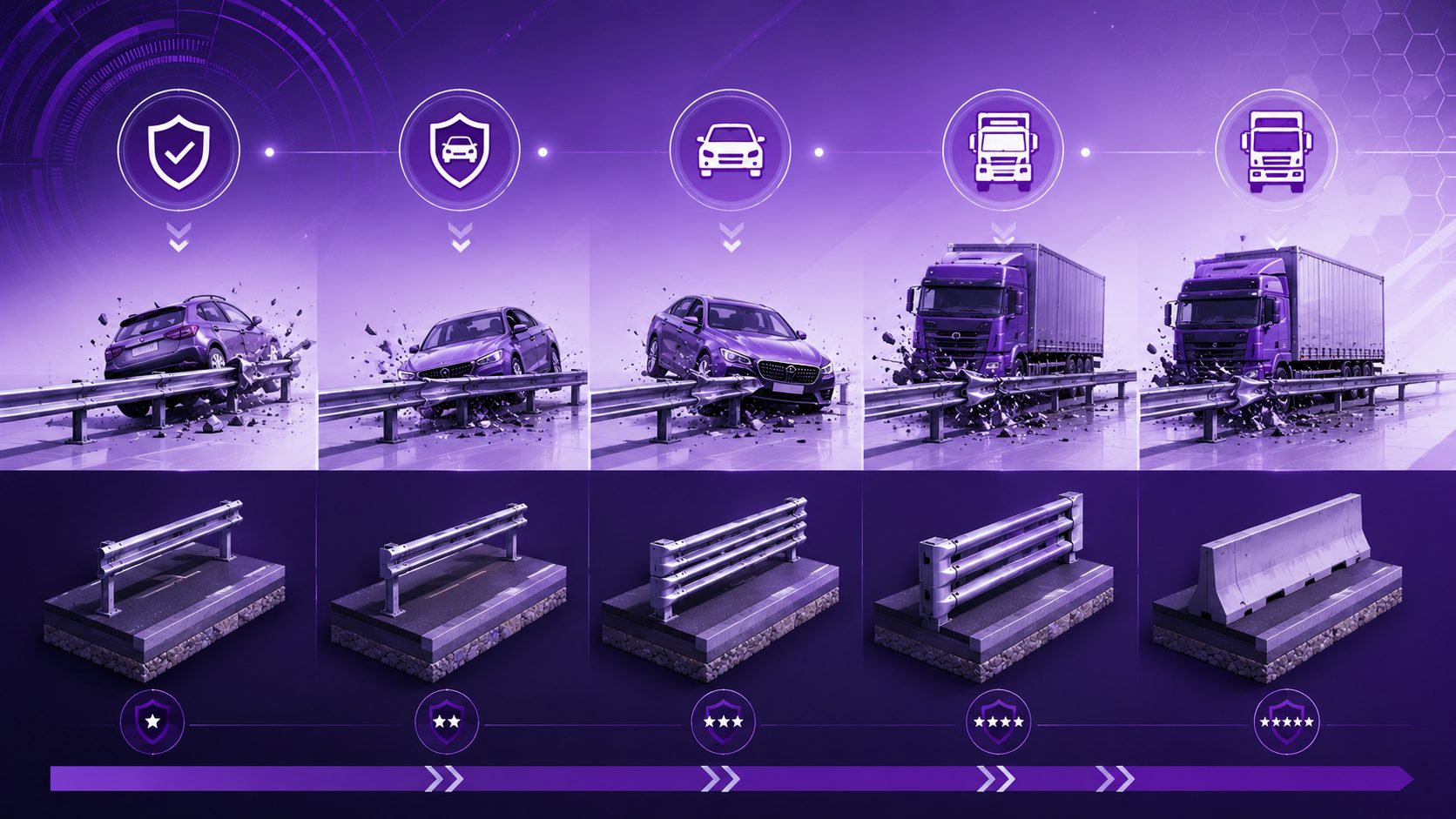
Containment level is one of the most important factors in EN 1317 crash barrier testing. It indicates the ability of a crash barrier to contain and redirect vehicles of different sizes and weights during an impact. A higher containment level does not automatically mean a barrier is better. The correct choice depends on the type of road, expected traffic, and the proportion of heavy commercial vehicles. Selecting the appropriate containment level helps improve road safety while avoiding unnecessary project costs.
| Containment level | Typical vehicle tested | Intended roads | Suitable applications |
|---|---|---|---|
| N1 (low containment) | Passenger cars and light vehicles | Low-speed roads with limited heavy vehicle movement | Service roads, urban roads, internal industrial roads, parking areas. |
| N2 (low containment) | Passenger cars and light commercial vehicles | Roads with moderate traffic volumes | State highways, secondary highways, median barriers, approach roads. |
| H1 (normal containment) | Cars and medium commercial vehicles | High-speed roads with mixed traffic | National highways, major arterial roads, divided highways and busy intercity routes. |
| H2 (high containment) | Heavy commercial vehicles and trucks | Highways carrying a significant percentage of heavy vehicles | Expressways, industrial corridors, logistics parks, freight routes and high-risk roadside locations. |
| H3 (very high containment) | Large heavy goods vehicles | Roads with high heavy vehicle traffic and greater safety requirements | Bridges, mountain roads, elevated sections, container freight routes and hazardous roadside areas. |
| H4a (very high containment) | Heavy trucks with higher impact energy | Critical transport infrastructure | Major bridges, expressway structures, tunnels, sharp curves and locations with severe consequences of barrier failure. |
| H4b (very high containment) | Maximum design test vehicle under EN 1317 | Roads requiring the highest level of containment | Heavy truck corridors, strategic freight routes, ports, large industrial zones and critical infrastructure projects. |
The containment level should always match the operating conditions of the road rather than simply choosing the highest available class. For example, an N2 barrier may be suitable for a state highway, while an H2 or H3 system is often preferred for busy expressways and industrial freight corridors. Structures such as bridges, elevated roads, and mountain highways may require H3, H4a, or H4b barriers because the consequences of vehicle penetration are significantly higher.
For EPC contractors, highway consultants, and procurement teams, understanding containment levels is essential when comparing EN 1317-compliant crash barrier systems and selecting the right solution for each project.
Working width and dynamic deflection in EN 1317
Selecting a crash barrier involves more than choosing the right containment level. EN 1317 crash barrier testing also measures how much a barrier moves during impact and how much space it needs to perform safely. These parameters help engineers select the right barrier for different road conditions and site constraints.
Working width
Working width is the maximum lateral distance a crash barrier moves during a collision. It includes both the barrier’s deflection and the movement of the impacting vehicle. This measurement helps determine the minimum clear space required behind the barrier to prevent it from striking nearby structures or roadside hazards.
Dynamic deflection
Dynamic deflection refers to the actual movement of the barrier itself when it absorbs the impact. Flexible barriers generally deflect more than rigid systems. Understanding this movement helps designers position barriers safely without compromising their performance.
Vehicle intrusion
Vehicle intrusion measures how far the impacting vehicle extends beyond the traffic-facing side of the barrier during a crash. This is particularly important where there is limited space behind the barrier or where sensitive infrastructure needs protection.
Understanding W1-W8 classifications
| Working width class | Maximum working width | Suitable installations |
|---|---|---|
| W1 | Up to 0.6 m | Bridges, tunnels, narrow medians, urban roads with very limited clearance. |
| W2 | Up to 0.8 m | Bridge approaches, retaining walls, elevated highways. |
| W3 | Up to 1.0 m | National highways, constrained road sections, embankments. |
| W4 | Up to 1.3 m | Highway medians, expressways with moderate clearance. |
| W5 | Up to 1.7 m | Wide medians, rural highways, open roadside installations. |
| W6 | Up to 2.1 m | High-speed roads with adequate setback behind the barrier. |
| W7 | Up to 2.5 m | Wide central reserves and roads with generous clear zones. |
| W8 | Up to 3.5 m | Large open areas where maximum barrier deflection can be accommodated. |
Impact severity levels (ASI) explained

The Acceleration Severity Index (ASI) is a key performance measure in EN 1317 crash barrier testing. It estimates the forces experienced by vehicle occupants during a collision with a crash barrier. While containment levels measure how well a barrier restrains a vehicle, the ASI indicates how safely the impact is managed for the people inside the vehicle.
| ASI class | Occupant risk | Performance level | Typical interpretation |
|---|---|---|---|
| Class A | Lowest | Best occupant protection | Produces the lowest impact forces and offers the highest level of occupant safety. |
| Class B | Moderate | Good occupant protection | Provides balanced crash performance and is widely used in highway applications. |
| Class C | Highest (within acceptable limits) | Acceptable occupant protection | Meets EN 1317 requirements but subjects occupants to higher impact forces than Class A or B. |
A lower ASI value generally means occupants experience lower deceleration forces during a collision, reducing the likelihood of serious injuries. For this reason, procurement teams and highway consultants often consider ASI alongside containment level when evaluating crash barrier systems.
It is also important to distinguish barrier strength from occupant protection. A barrier with a high containment level is designed to restrain heavier vehicles, but it does not automatically provide the lowest impact forces for occupants. The best-performing systems balance vehicle containment with low ASI values to deliver both structural performance and occupant safety.
How EN 1317 crash barrier testing is performed
EN 1317 crash barrier testing follows a standardised procedure to ensure every crash barrier system is evaluated under consistent and repeatable conditions. Each stage is carefully planned to measure barrier performance, occupant safety, and compliance with the testing standard.
Step 1: Preparing the test barrier
The crash barrier is installed according to the manufacturer’s specifications, including posts, rails, anchorages, and foundations. This ensures the test reflects the barrier’s intended field installation.
Step 2: Vehicle selection
A test vehicle is selected based on the required containment level. Different vehicle types, weights, and sizes are used to assess how the barrier performs under specific impact conditions.
Step 3: Instrumentation
The test vehicle is fitted with sensors and specialised equipment to measure impact forces, acceleration, and vehicle movement. High-speed cameras record the collision from multiple angles, while dummy measurements help evaluate the forces experienced by vehicle occupants.
Step 4: Impact speed
The vehicle is accelerated to the prescribed speed specified for the relevant EN 1317 test. Maintaining the correct speed is essential for producing valid and repeatable results.
Step 5: Impact angle
The vehicle strikes the barrier at a defined angle that represents realistic collision scenarios. This helps evaluate the barrier’s ability to contain and redirect the vehicle safely.
Step 6: Data recording
During the impact, engineers collect data on vehicle behaviour, barrier movement, occupant forces, and system performance. Every measurement contributes to the overall performance evaluation.
Step 7: Post-crash inspection
After the collision, engineers carry out detailed structural observations to assess barrier damage, rail continuity, post behaviour, detached components, and vehicle condition.
Step 8: Certification
If the barrier satisfies all required performance criteria, the test results form the basis for EN 1317 compliance documentation and certification reports that contractors, consultants, and procurement teams can use during project evaluation and product selection.
EN 1317 vs MoRTH and IRC requirements

In India, crash barrier selection is generally guided by the Ministry of Road Transport and Highways (MoRTH) specifications and Indian Roads Congress (IRC) guidelines. However, many contractors and consultants also consider EN 1317 crash barrier testing because it provides a recognised methodology for evaluating barrier performance through full-scale crash tests. Rather than replacing Indian standards, EN 1317 complements them by offering verified crash performance data that supports informed procurement and design decisions.
| Parameter | EN 1317 | MoRTH specifications | IRC guidelines |
|---|---|---|---|
| Primary focus | Crash testing and performance evaluation. | Material, design, installation and project specifications. | Road safety planning, design and engineering practices. |
| Approach | Defines a standardised crash testing methodology. | Specifies technical requirements for highway works. | Provides recommendations for safe road design and barrier application. |
| Performance assessment | Measures containment, working width, impact severity and occupant safety. | May specify required crash performance for certain applications. | References suitable barrier selection based on road conditions. |
| Testing requirement | Requires full-scale crash tests under controlled conditions. | May require compliant or approved barrier systems depending on project specifications. | Supports the use of tested barrier systems where appropriate. |
| Typical users | Manufacturers, testing agencies, consultants and procurement teams. | EPC contractors, NHAI vendors and executing agencies. | Highway engineers, DPR consultants and road authorities. |
When evaluating crash barriers, contractors should request the following documents from suppliers
- EN 1317 test reports from an accredited testing laboratory.
- Certification or compliance documents confirming the tested barrier configuration.
- Performance classifications, including containment level, working width and ASI.
- Installation manuals and technical drawings matching the tested system.
Reviewing these documents helps procurement teams verify that the supplied barrier corresponds to the system that was successfully tested, reducing technical risks during project execution and tender evaluation.
How procurement teams should verify EN 1317 compliance
Selecting an EN 1317-compliant crash barrier involves more than reviewing a product catalogue. Procurement teams should verify that the supplied system matches the barrier that was successfully tested and certified. Use the checklist below before finalising a purchase.
Accredited testing laboratory: Confirm the crash test was conducted by a recognised and accredited testing facility.
Test report availability: Request the complete crash test report instead of relying on marketing brochures.
Containment level: Verify that the barrier’s containment class matches the project’s safety requirements.
Working width: Ensure the working width is suitable for the available installation space.
ASI classification: Review the Acceleration Severity Index to understand occupant safety performance.
System drawings: Check that the supplied barrier configuration matches the tested design.
Galvanisation details: Verify the protective coating meets the project’s durability and corrosion resistance requirements.
Manufacturing quality: Confirm the manufacturer follows consistent quality control processes.
Installation manual: Ensure installation instructions correspond to the tested barrier system.
Maintenance recommendations: Review inspection and maintenance requirements to support long-term performance.
Common procurement mistakes
Common mistakes include selecting barriers based only on price, accepting incomplete compliance documents, overlooking working width requirements, assuming every W-beam barrier meets EN 1317, or purchasing a modified system that differs from the one originally crash tested. A thorough technical review helps reduce project risks and ensures the selected barrier delivers the expected safety performance.
Common misconceptions about EN 1317 crash barrier testing
Several misconceptions about EN 1317 crash barrier testing can lead to poor product selection and specification errors. Understanding the facts helps contractors, consultants, and procurement teams make better decisions.
| Misconception | Reality |
|---|---|
| Higher containment always means safer | The correct containment level depends on the road type, traffic volume, and vehicle mix. Higher is not always the most suitable choice. |
| Thicker steel always performs better | Barrier performance depends on the complete tested system, including rails, posts, spacing, and anchorages, not just steel thickness. |
| Passing one crash test covers every installation | Test results apply only to the specific barrier configuration that was evaluated. Design changes may require additional assessment or testing. |
| Imported barriers are automatically compliant | Imported systems must still provide valid EN 1317 test reports and compliance documents for the supplied configuration. |
| Any W-beam qualifies as EN 1317 | A W-beam barrier is EN 1317 compliant only if the complete system has successfully passed the required crash tests and meets the specified performance classifications. |
Conclusion
Selecting a crash barrier should be based on verified performance rather than appearance or cost alone. An informed decision considers the right containment level, working width, and ASI classification for the specific project environment. Reviewing certified test reports and supporting technical documents also helps minimise procurement risks and improve long-term reliability.
As highway infrastructure continues to expand in India and globally, EN 1317 crash barrier testing remains a trusted benchmark for evaluating crash barrier systems and supporting safer, more dependable road safety solutions.
Looking to procure steel?
Tata nexarc helps manufacturers, builders and MSMEs source certified steel products, compare prices, and choose the right grade as per IS codes—with complete traceability and procurement confidence.
FAQs
What is EN 1317 crash barrier testing?
What are EN 1317 containment levels?
What is the difference between EN 1317 and MoRTH specifications?
What is the ASI rating in crash barrier testing?
What is working width in EN 1317?
Are W-beam crash barriers tested under EN 1317?
Which containment level is suitable for highways?
How can buyers verify EN 1317 compliance?
Does EN 1317 apply to concrete crash barriers?
Why is EN 1317 certification important for EPC projects?
A product manager with a writer's heart, Anirban leverages his 6 years of experience to empower MSMEs in the business and technology sectors. His time at Tata nexarc honed his skills in crafting informative content tailored to MSME needs. Whether wielding words for business or developing innovative products for both Tata Nexarc and MSMEs, his passion for clear communication and a deep understanding of their challenges shine through.