Check Price Now
Table of Contents
- Introduction
- What is a Thrie Beam Crash Barrier?
- Understanding the Thrie-Beam Profile
- Components of a Thrie Beam Crash Barrier System
- Thrie Beam Barrier Specifications
- Thrie Beam Barrier Dimensions
- Thrie Beam Barrier Weight Chart
- Thrie-Beam vs Other Crash Barrier Types
- IRC and MoRTH Guidelines for Thrie-Beam Barriers
- Installation of Thrie Beam Barriers
- Factors Affecting Thrie Beam Barrier Cost in India
- Conclusion
- FAQs
Introduction
The thrie beam crash barrier plays an important role in improving road safety across India’s expanding highway and expressway network. It helps prevent vehicles from leaving the roadway and reduces the severity of collisions in high-risk areas.
Compared with a standard W-beam barrier, a thrie-beam crash barrier offers greater strength and impact resistance. This makes it suitable for highways, expressways, bridges, medians, and other vulnerable road sections. As a durable highway crash barrier and steel guardrail system, it supports effective vehicle containment and long-term protection. Most installations follow IRC and MORTH guidelines to ensure reliable performance and safety.
Key highlights
- Stronger than conventional W-beam barriers
- Used on highways, expressways, bridges, and medians
- Improves vehicle containment and impact absorption
- Designed to meet IRC and MoRTH requirements
- Functions as an effective road safety barrier and crash protection system
What is a thrie beam crash barrier?
A thrie-beam crash barrier is a type of roadside safety barrier designed to redirect vehicles during a collision and prevent them from leaving the roadway. It features a distinctive three-wave steel profile that provides greater structural strength than conventional guardrail systems. Road authorities and infrastructure developers commonly install thrie-beam barriers in locations where higher levels of protection are required, particularly on high-speed roads and critical structures. The system helps improve occupant safety while reducing damage caused by vehicle impacts.
Understanding the thrie-beam profile
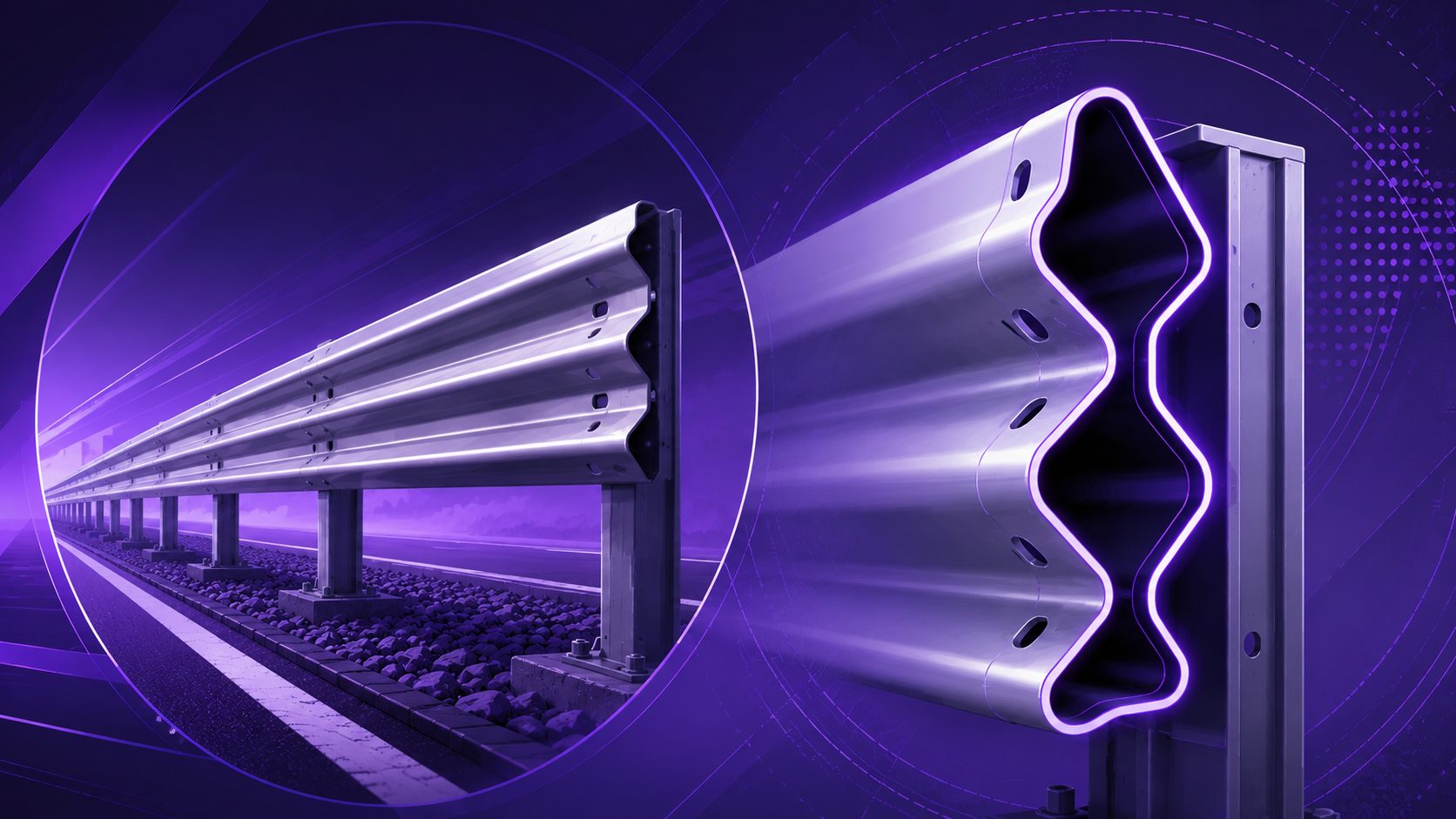
The defining feature of a thrie-beam guardrail is its three-wave corrugated steel profile. Unlike a conventional W-beam barrier, which uses two corrugations, a thrie-beam section incorporates an additional fold that increases the rail’s depth and rigidity. This helps the barrier distribute impact forces more effectively and improves its ability to contain and redirect vehicles.
Key advantages of the thrie-beam profile:
- Three-wave corrugated steel design
- Greater stiffness than a W-beam barrier
- Improved vehicle containment
- Suitable for high-risk and high-speed road sections
As a specialised steel crash barrier, the thrie-beam profile forms an important part of a modern highway safety barrier and vehicle restraint system used on bridges, elevated roads, and other critical stretches of roadway.
Components of a thrie beam crash barrier system
A thrie-beam crash barrier system comprises several components that work together to achieve the required performance under IRC and MORTH specifications. While the rail receives most of the attention, the overall effectiveness of the system depends on the quality, dimensions, and installation of every component.
Thrie-beam rail
The rail is the primary impact-bearing element of the system. Project specifications typically define the rail thickness, profile dimensions, steel grade, and galvanisation requirements. Contractors and procurement teams often evaluate these parameters to ensure compliance and long-term durability.
Steel posts
Steel posts provide the foundation for the barrier system. Depending on project requirements, contractors may use C-posts, sigma posts, or other approved sections. Post spacing, embedment depth, and alignment directly influence installation quality and barrier performance.
Spacer blocks
Spacer blocks maintain the specified offset between the rail and the post. They help achieve the required system geometry and allow the barrier to perform as intended during vehicle impact.
Fasteners and bolts
Bolts, nuts, and washers secure the various guardrail components. Procurement teams should verify coating quality, dimensions, and material specifications, as substandard fasteners can affect the integrity of the entire installation.
Terminal ends and transition sections
Terminal ends provide a safe termination point for the barrier system. Transition sections are commonly used where a thrie-beam barrier connects to bridge railings, concrete barriers, or other roadside protection systems specified within the project design.
Key procurement considerations
Before sourcing crash barrier components, stakeholders typically assess:
- Compliance with IRC and MoRTH requirements
- Galvanisation quality and coating thickness
- Manufacturing tolerances and dimensional accuracy
- Availability of matching accessories and fasteners
- Supplier production capacity and delivery timelines
Thrie-beam crash barrier specifications
For contractors, consultants, fabricators, and procurement teams, understanding thrie-beam crash barrier specifications is essential before material sourcing, tender participation, fabrication, or site installation. While project requirements may vary, most highway projects in India follow IRC and MoRTH guidelines, with specifications covering rail dimensions, steel thickness, galvanisation, and quality standards.
| Parameter | Typical specification |
|---|---|
| Material | High-strength steel |
| Thickness | 2.67 mm, 3.15 mm, or 4 mm |
| Standard rail length | 4.12 m |
| Effective length | 3.81 m |
| Overall height | Approx. 510 mm |
| Surface finish | Hot-dip galvanised |
| Applicable standards | IRC, MORTH, ASTM, AASHTO |
Manufacturing tolerances
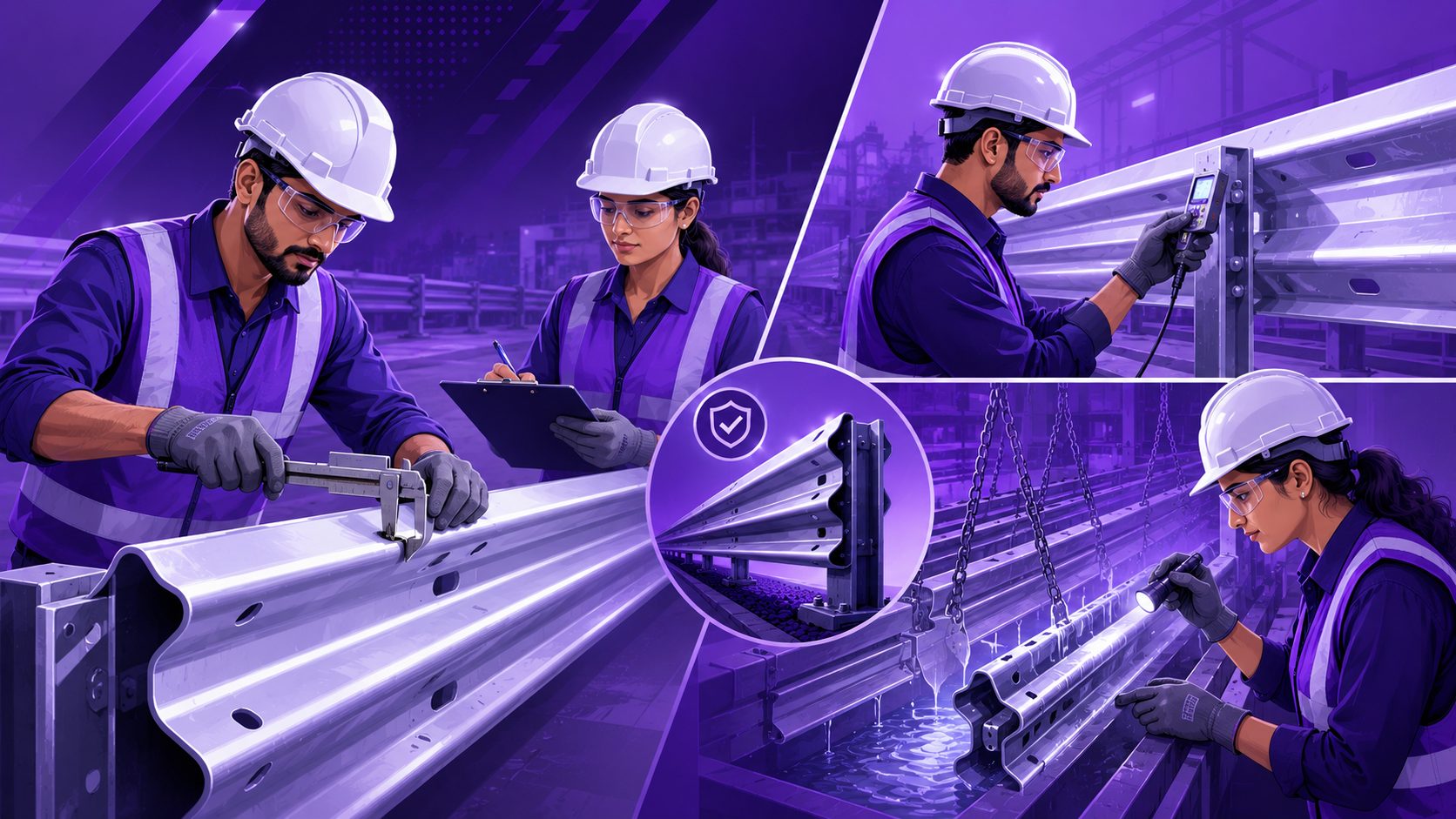
Manufacturers must maintain strict dimensional tolerances during roll forming and punching operations. Consistency in rail shape, hole positioning, and overall dimensions helps ensure proper fitment during installation and uniform behaviour along the barrier run.
Galvanisation requirements
Hot-dip galvanisation protects steel components from environmental exposure. The quality and uniformity of the zinc coating influence the barrier’s durability, particularly in regions exposed to moisture, pollution, or changing weather conditions.
Corrosion protection
Roadside barriers remain exposed to rain, dust, humidity, and vehicle emissions throughout their service life. Effective corrosion protection helps preserve structural integrity and reduces the risk of premature deterioration.
Quality testing
Manufacturers typically conduct inspections to verify dimensions, coating quality, material properties, and workmanship. These checks help confirm that the finished barrier meets the specified performance and quality requirements before installation.
Thrie beam crash barrier dimensions
Barrier dimensions play an important role in fabrication, installation, and project compliance. Standardised dimensions allow different components to fit together correctly while ensuring consistency across long stretches of roadway. For fabricators, consultants, and site engineers, understanding these measurements is essential when reviewing drawings, BOQs, and technical specifications.
| Parameter | Typical dimension |
|---|---|
| Overall width | Approx. 506 mm |
| Rail length | 4.12 m |
| Effective length | 3.81 m |
| Corrugation depth | Approx. 80–85 mm |
| Section profile | Three-wave corrugated steel section |
| Mounting hole spacing | As per approved design and project specifications |
| Rail overlap | Typically provided at splice connections |
Overall width
The overall width of a thrie-beam rail is greater than that of a conventional W-beam profile. This wider section contributes to the barrier’s distinctive three-wave design and forms a key part of standard thrie beam dimensions used across highway projects.
Corrugation depth
Corrugation depth refers to the distance between the crest and trough of the rail profile. This dimension influences the shape and stiffness of the barrier and is controlled during the manufacturing process to maintain profile consistency.
Section profile
The rail consists of three corrugations running along its length, creating the characteristic thrie-beam shape. Maintaining the correct profile is important for fabrication accuracy and compatibility with posts, spacer blocks, and other system components.
Mounting hole spacing
Manufacturers punch mounting holes at predetermined intervals to accommodate bolts and splice connections. Accurate hole spacing helps simplify assembly and ensures proper alignment during installation.
Rail overlap
Adjacent rails overlap at splice locations to create a continuous barrier line. Proper overlap positioning helps maintain continuity along the barrier run and allows individual rail sections to be securely connected.
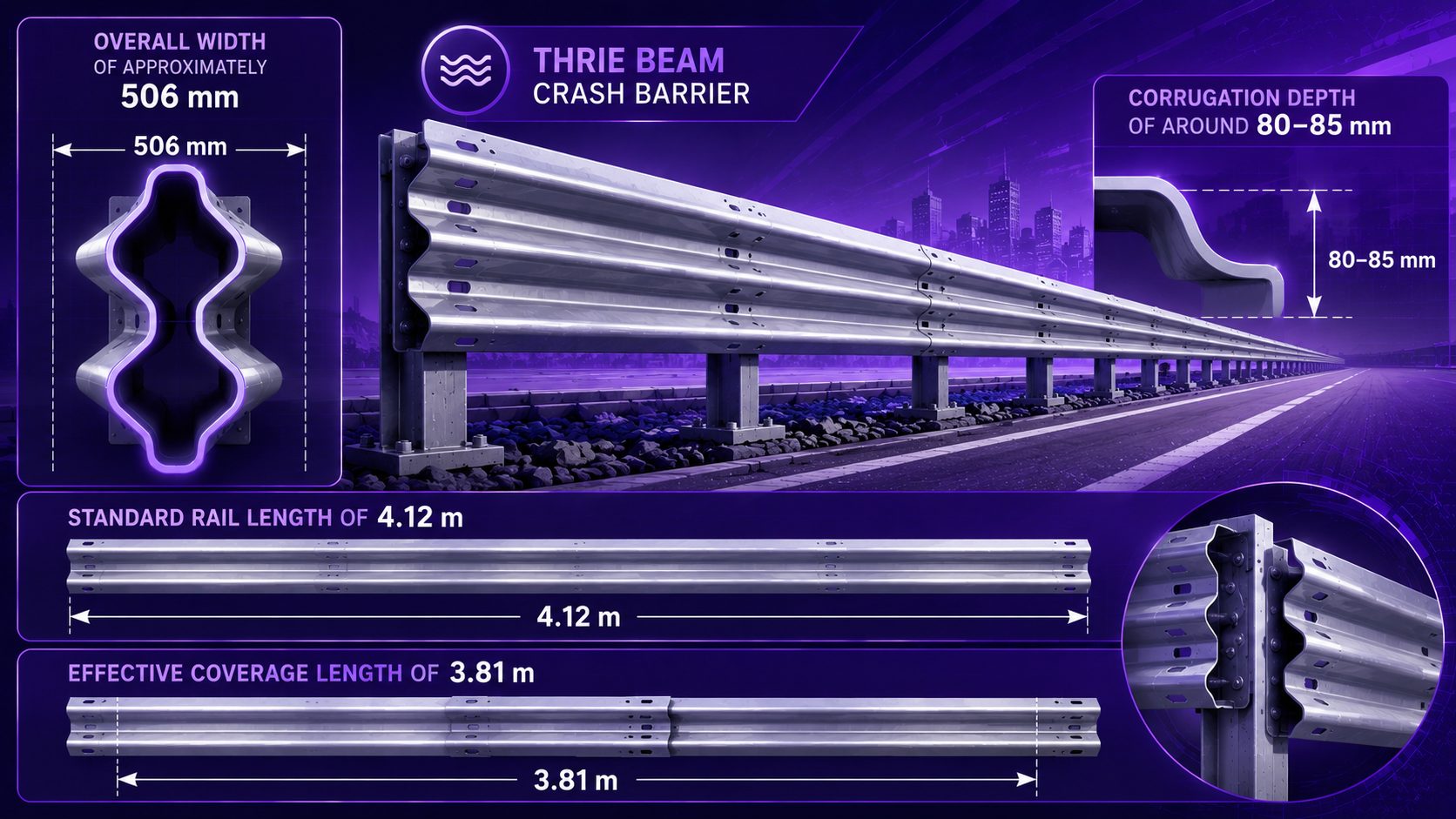
Key dimensions at a glance:
- Overall width of approximately 506 mm
- Three-wave corrugated steel profile
- Corrugation depth of around 80–85 mm
- Standard rail length of 4.12 m
- Effective coverage length of 3.81 m
Thrie beam crash barrier weight chart
The weight of a thrie-beam barrier directly affects fabrication requirements, transportation planning, material estimation, and project costs. Since rail thickness varies across projects, the thrie beam weight can differ significantly from one specification to another.
| Thickness | Approx. weight (kg/m) |
|---|---|
| 2.67 mm | 8.8–9.2 kg/m |
| 3.15 mm | 10.3–10.8 kg/m |
| 4.00 mm | 13.0–13.8 kg/m |
Actual weight may vary slightly depending on profile dimensions, steel grade, and manufacturing tolerances.
Weight per rail
Based on a standard rail length of 4.12 m, the approximate weight per rail is:
| Thickness | Approx. weight per rail |
|---|---|
| 2.67 mm | 36–38 kg |
| 3.15 mm | 42–45 kg |
| 4.00 mm | 54–57 kg |
Why weight matters
Transportation and logistics
Barrier weight influences vehicle loading capacity, freight costs, and unloading requirements at site. For large highway projects, even small weight differences can affect overall transportation planning.
Material estimation
Project teams often use the guardrail weight per metre to estimate total steel consumption for a barrier run. Accurate weight calculations also help when preparing BOQs, project estimates, and fabrication schedules.
Structural requirements
Heavier rail sections generally contain more steel and are commonly specified for applications that require thicker barrier profiles. Project drawings and tender specifications determine the appropriate thickness for each installation.
Quick reference
2.67 mm rail: approximately 9 kg/m
3.15 mm rail: approximately 10.5 kg/m
4.00 mm rail: approximately 13.5 kg/m
Standard rail length: 4.12 m
Weight varies with thickness, profile geometry, and manufacturing tolerances.
Thrie-beam vs other crash barrier types
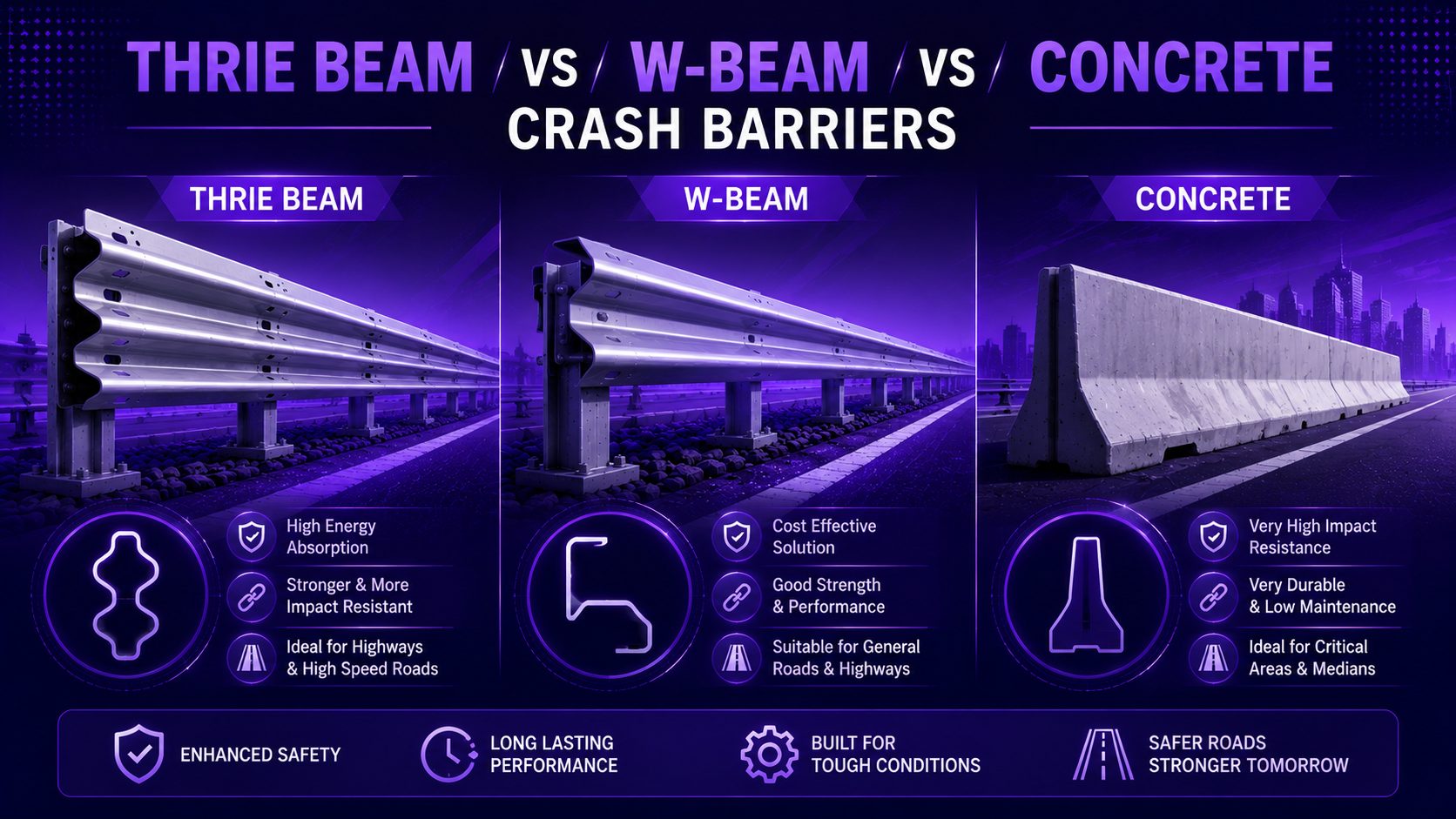
Selecting the right barrier system depends on road geometry, traffic volume, design speed, containment requirements, and project budget. While W-beam and thrie-beam barriers are the most widely used steel systems in India, concrete barriers are also common on expressways and median installations.
| Parameter | W-beam barrier | Thrie-beam barrier | Concrete barrier |
|---|---|---|---|
| Profile shape | Two-wave steel profile | Three-wave steel profile | Solid concrete section |
| Relative strength | Standard | Higher than W-beam | Very high |
| Vehicle containment | Moderate | Higher | Very high |
| Impact behaviour | Flexible | Flexible with greater rigidity | Rigid |
| Installation speed | Fast | Fast | Slower |
| Maintenance | Moderate | Moderate | Low |
| Initial cost | Lower | Higher | Higher |
| Typical applications | Highways, state highways, embankments. | Bridges, elevated roads, critical stretches. | Medians, expressways, urban corridors. |
| Suitable locations | General roadside protection | High-risk locations | Permanent median protection |
W-beam vs thrie-beam: Key differences
| Feature | W-beam | Thrie-beam |
|---|---|---|
| Corrugations | Two | Three |
| Rail depth | Lower | Higher |
| Rigidity | Lower | Higher |
| Preferred for critical locations | No | Yes |
| Typical project cost | Lower | Higher |
When should thrie-beam be preferred?
A thrie-beam system is often selected when project designers require a higher-performing steel barrier without switching to a concrete solution.
Common applications include:
- Bridge approaches and bridge-side protection
- Elevated roads and flyovers
- High-speed highway and expressway corridors
- Sharp curves with limited recovery space
- Deep embankments and steep roadside slopes
IRC and MoRTH guidelines for thrie-beam barriers
Most highway projects in India require compliance with applicable IRC crash barrier standards and MoRTH crash barrier guidelines. These standards define the requirements for barrier design, material quality, installation, and quality assurance.
| Requirement area | Primary reference | Typical focus |
|---|---|---|
| Barrier design | IRC | Selection, placement, and performance requirements. |
| Roadside safety provisions | IRC | Application based on road and site conditions. |
| Project-specific guidance | IRC:SP publications | Special cases and safety recommendations. |
| Material requirements | MoRTH | Steel quality, dimensions, and specifications. |
| Galvanisation standards | MoRTH | Corrosion protection requirements. |
| Installation criteria | MoRTH | Alignment, post spacing, and fitment requirements. |
| Testing and inspection | MoRTH | Quality control and compliance verification. |
Installation of thrie beam barriers
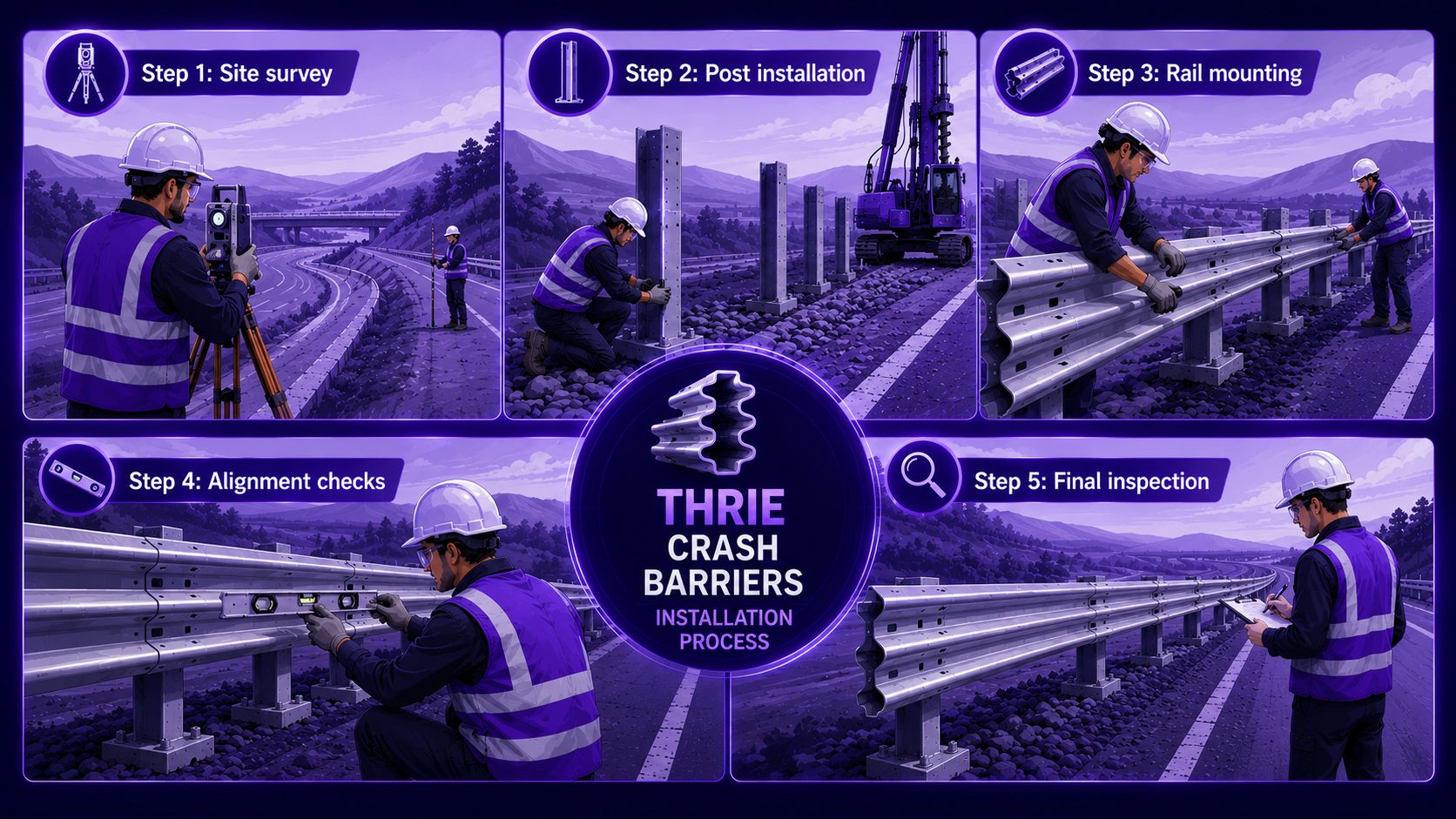
Proper crash barrier installation starts with a site survey to verify alignment, levels, and post locations. Contractors then install the posts according to the approved drawings, followed by spacer blocks and rail sections. Once the barrier run is assembled, teams check alignment, rail height, and splice connections before carrying out a final inspection. Following the specified guardrail installation process helps ensure consistent performance and compliance with project requirements.
Step 1: Site survey
Verify the layout, levels, and any obstructions before installation begins.
Step 2: Post installation
Maintain the specified post spacing, alignment, and embedment depth throughout the barrier run.
Step 3: Rail mounting
Install rail sections with the correct overlap and secure all connections as per project requirements.
Step 4: Alignment checks
Inspect the barrier line to ensure consistent height, positioning, and continuity.
Step 5: Final inspection
Review the completed installation against the approved drawings and project specifications.
Factors affecting thrie beam barrier cost in India
The thrie beam crash barrier price can vary significantly between projects. Material costs, project specifications, location, and installation requirements all influence the final crash barrier cost India.
Steel prices: Steel is the primary raw material and has the biggest impact on overall costs.
Zinc prices: Changes in zinc prices affect galvanisation expenses.
Barrier thickness: Thicker rails generally require more steel and cost more.
Project volume: Larger orders may benefit from economies of scale.
Transportation distance: Freight costs increase for projects located far from manufacturing facilities.
Installation complexity: Bridges, medians, and difficult terrain can increase installation costs.
Custom specifications: Special dimensions, coatings, or project-specific requirements may affect pricing.
As a result, the guardrail price per metre and overall highway barrier cost can differ considerably from one project to another.
Conclusion
For EPC contractors, consultants, fabricators, and procurement teams, selecting the right crash barrier involves more than meeting project specifications. Factors such as barrier type, dimensions, weight, installation requirements, and site conditions all influence project execution and long-term performance.
A thrie-beam crash barrier is often specified for locations that demand higher containment levels, making it a common choice for bridges, flyovers, expressways, and other critical road infrastructure projects. Understanding these considerations helps stakeholders make better design, sourcing, and project planning decisions.
Looking to procure steel?
Tata nexarc helps manufacturers, builders and MSMEs source certified steel products, compare prices, and choose the right grade as per IS codes—with complete traceability and procurement confidence.
FAQs
What is a thrie-beam crash barrier?
Why is a thrie-beam stronger than a W-beam?
What is the standard thickness of a thrie-beam barrier?
What is the standard length of a thrie-beam rail?
Are thrie-beam barriers galvanised?
Where are thrie-beam crash barriers used?
Which standards govern thrie-beam crash barriers in India?
How long does a galvanised thrie-beam barrier last?
What affects the cost of a thrie-beam crash barrier?
Can thrie-beam barriers be installed on bridges?
A product manager with a writer's heart, Anirban leverages his 6 years of experience to empower MSMEs in the business and technology sectors. His time at Tata nexarc honed his skills in crafting informative content tailored to MSME needs. Whether wielding words for business or developing innovative products for both Tata Nexarc and MSMEs, his passion for clear communication and a deep understanding of their challenges shine through.