Check Price Now
Table of Contents
- What is Bitumen Concrete?
- How Does Bitumen Concrete Work?
- Components of Bitumen Concrete Mix
- Where is Bitumen Concrete Used?
- Bitumen Concrete Layers in Flexible Pavement
- How Bitumen Concrete is Produced and Laid
- Bitumen Concrete Mix Design and Quality Control
- Advantages of Bitumen Concrete
- Common Challenges in Bitumen Concrete Construction
- Procurement Tips for Buying Bitumen Concrete Materials
- Conclusion
- FAQs
Bitumen concrete is one of the most widely used road surfacing materials in India because it delivers a strong, smooth and durable pavement for heavy traffic. It is commonly used on highways, airport runways, city roads, and other infrastructure projects where long-term performance matters.
Understanding how it is made and applied helps contractors and procurement teams make better project decisions. This guide explains its composition, construction process, key specifications, advantages, and procurement considerations that influence pavement quality and project costs.
What is bitumen concrete?
Bitumen concrete is a dense, hot-mix paving material used as the top or wearing layer of flexible pavements. It combines carefully graded aggregates with bitumen to create a strong, smooth, and durable surface that can withstand continuous traffic and varying weather conditions. In India, it is one of the most used materials for road surfacing on highways, expressways, airport runways, and urban roads.
You may also come across the term bituminous concrete, which refers to the same material. In some countries, it is also known asphalt concrete. While the name may differ, the composition and purpose remain the same: to provide a long-lasting pavement surface with good riding quality and structural performance.
A standard bitumen concrete mix consists of four main components
Bitumen binder: Coats and binds the aggregates into a cohesive mix.
Coarse aggregate: Provides strength and carries vehicle loads.
Fine aggregate: Fills the gaps between coarse particles for a dense mix.
Mineral filler: Improves stability, reduces voids, and enhances the bond between bitumen and aggregates.
Each material plays a specific role in achieving the right balance of strength, flexibility, and durability. When produced and laid correctly, bitumen concrete forms a smooth, waterproof surface that resists wear, distributes traffic loads effectively, and delivers reliable performance over its service life.
Takeaway: Bitumen concrete is a high-performance paving material that combines quality aggregates and bitumen to create durable, safe and long-lasting roads.
How does bitumen concrete work?

Bitumen concrete works by combining the strength of mineral aggregates with the flexibility of bitumen. Together, they form a dense pavement layer that supports traffic, protects the road structure, and provides a comfortable driving surface.
Here’s how each component contributes to pavement performance
Aggregates carry vehicle loads: Coarse and fine aggregates form the structural framework of the pavement and bear the weight of moving vehicles.
Bitumen binds the mix together: The bitumen coats each aggregate particle and holds the mix together, helping it act as a single, stable layer.
Load distribution: The bonded mix spreads traffic loads across the pavement, reducing stress on the lower layers and minimising the risk of surface damage.
Waterproofing: The bitumen creates a protective barrier that limits water penetration, helping preserve the strength of the pavement beneath.
Resistance to traffic wear: The dense mix withstands continuous tyre movement, reducing surface wear under regular traffic.
Improved driving comfort: A smooth, even surface enhances ride quality, improves tyre grip, and helps reduce road noise.
Strong bonding between the bitumen and aggregates is essential for long-term pavement performance. It helps prevent raveling, cracking, and premature surface failure, allowing the road to withstand heavy traffic and changing weather for longer.
Components of bitumen concrete mix
The performance of bitumen concrete depends on the quality and proportion of its individual materials. Each component performs a specific function, and together they create a dense, durable pavement capable of carrying heavy traffic and resisting weather conditions.
| Component | Function | Typical requirement |
|---|---|---|
| Bitumen | Binds all aggregates into a cohesive mix. | Suitable VG grade selected based on climate and traffic conditions. |
| Coarse aggregate | Carries vehicle loads and provides structural strength. | Hard, durable, angular and high-strength aggregates. |
| Fine aggregate | Fills gaps between coarse aggregates to improve density. | Clean, well-graded, and free from dust or impurities. |
| Mineral filler | Improves stability, reduces air voids, and strengthens the bond between bitumen and aggregates. | Cement, limestone dust, or approved mineral filler. |
Key considerations
Aggregate quality matters: Strong, durable aggregates improve load-bearing capacity and reduce the risk of cracking, polishing, and premature pavement failure.
Binder selection: The bitumen grade should suit the project’s traffic volume and climatic conditions to ensure adequate flexibility and durability.
Aggregate grading: A well-graded combination of coarse and fine aggregates creates a dense mix with fewer voids, improving pavement stability, and service life.
Importance of mineral fillers: Fillers occupy microscopic spaces between aggregates, enhance cohesion, and help produce a stronger, more stable pavement.
Common bitumen binder grades used in India
| Binder Grade | Typical applications |
|---|---|
| VG-30 | National highways, state highways, and most road construction projects. |
| VG-40 | Heavy traffic corridors, expressways, and high-load pavements. |
| PMB (Polymer Modified Bitumen) | Airports, bridges, high-stress roads, and specialised infrastructure projects requiring enhanced performance. |
Selecting high-quality materials is the first step towards achieving a durable, long-lasting bitumen concrete pavement that performs consistently under demanding traffic conditions.
Where is bitumen concrete used?

Bitumen concrete is widely used in infrastructure projects that require a durable, smooth, and long-lasting pavement. Its ability to withstand continuous traffic and varying weather conditions makes it the preferred choice for high-volume roads and transport infrastructure across India.
Common applications
National highways: Designed to handle heavy commercial vehicles and long-distance traffic.
Expressways: Provides a smooth, durable surface for high-speed travel.
State highways: Supports mixed traffic while ensuring reliable long-term performance.
Airport runways and taxiways: Offers the strength and surface quality needed for repeated aircraft movements.
City roads: Delivers a comfortable ride and withstands frequent stop-and-go traffic.
Industrial roads: Handles heavy trucks transporting raw materials and finished goods.
Container terminals: Resists concentrated axle loads from container handling equipment and trailers.
Toll roads: Performs well under continuous traffic with minimal maintenance disruptions.
Ports: Supports heavy freight movement and demanding operating conditions.
Logistics parks: Provides durable pavements for warehouses, distribution centers, and freight corridors.
Bitumen concrete performs well under a wide range of traffic loading conditions, from passenger vehicles and buses to multi-axle trucks and heavy commercial transport. Its strength, flexibility, and resistance to surface wear help maintain pavement quality even on roads that experience high traffic volumes every day.
Bitumen concrete layers in flexible pavement
A flexible pavement consists of multiple layers, with each layer performing a specific function. The Bitumen Concrete (BC) layer forms the topmost or wearing course and is the surface that comes into direct contact with traffic. Together, these layers distribute vehicle loads, protect the pavement structure, and extend the road’s service life.
| Pavement layer | Primary function |
|---|---|
| Subgrade | Forms the foundation and supports the entire pavement structure. |
| Granular Sub-base (GSB) | Improves drainage, distributes loads, and prevents moisture-related damage. |
| Base course | Provides structural strength and supports traffic loads. |
| Binder course | Connects the structural layers with the surface course and helps distribute loads evenly. |
| Bitumen Concrete (BC) wearing course | Creates a smooth, durable, skid-resistant, and waterproof riding surface. |
Key features of the BC layer
| Aspect | Why it matters |
|---|---|
| Position | The BC layer is placed at the top of the flexible pavement, making it the first layer to receive traffic loads and weather exposure. |
| Purpose | It provides a smooth riding surface while improving driving comfort, skid resistance, and overall pavement durability. |
| Thickness | The thickness of the BC layer varies depending on pavement design, expected traffic volume, axle loads, and project specifications. |
| Protection | It shields the underlying binder course, base and sub-base from water ingress, abrasion, and direct traffic wear, helping extend the life of the entire pavement structure. |
Although the BC layer is relatively thin compared to the lower pavement layers, it plays a critical role in overall road performance. A well-designed wearing course helps preserve the structural integrity of the pavement, reduces maintenance needs, and supports reliable performance under light, medium, and heavy traffic conditions.
How bitumen concrete is produced and laid
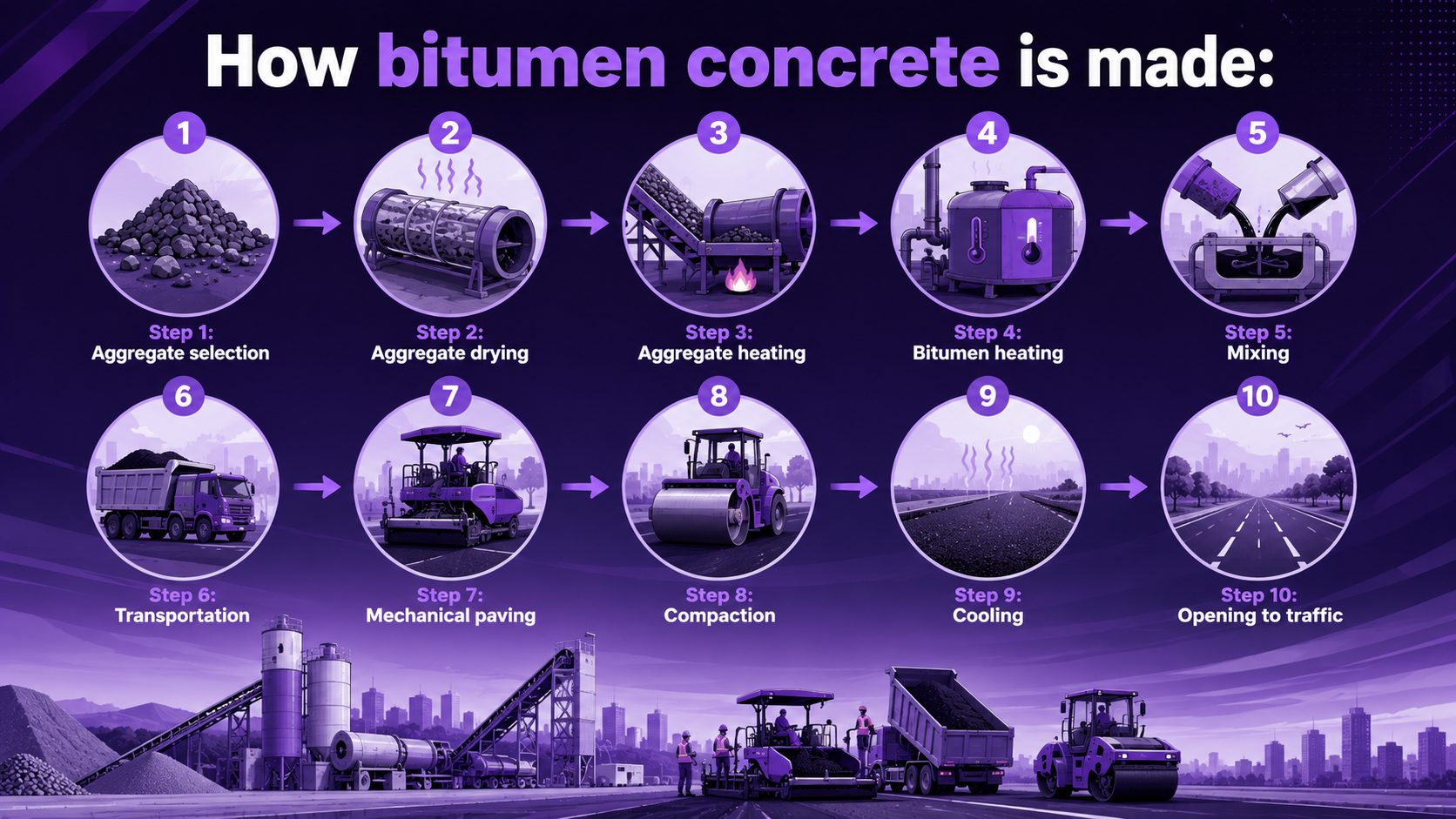
Producing and laying bitumen concrete requires careful control at every stage to achieve a durable and uniform pavement. Most highway projects use a Hot Mix Plant to prepare the mix before it is transported and laid at the project site.
Step 1: Aggregate selection
High-quality coarse and fine aggregates are selected based on project specifications. Clean, durable, and well-graded aggregates improve the strength, stability, and service life of the pavement.
Step 2: Aggregate drying
The aggregates are dried in the Hot Mix Plant to remove moisture. This allows the bitumen to coat every particle evenly and improves the overall quality of the mix.
Step 3: Aggregate heating
The dried aggregates are heated to the specified temperature. Proper heating ensures uniform mixing without damaging the aggregate properties.
Step 4: Bitumen heating
The bitumen binder is heated separately until it reaches the required viscosity. Maintaining the correct temperature helps achieve thorough coating and consistent workability.
Step 5: Mixing
The heated aggregates, bitumen, and mineral filler are blended in the Hot Mix Plant to produce a uniform bitumen concrete mix that meets project specifications.
Step 6: Transportation
The hot mix is transported to the construction site in insulated tippers. Temperature control during transit is important because excessive heat loss can reduce workability and affect final pavement quality.
Step 7: Mechanical paving
A paver finisher spreads the mix evenly to the specified width and thickness, creating a uniform surface ready for compaction.
Step 8: Compaction
Compaction begins immediately after paving while the mix remains within the recommended temperature range. A tandem roller performs the initial rolling, while a pneumatic roller improves density and achieves the required surface finish.
Step 9: Cooling and opening to traffic
The completed pavement is allowed to cool before it is opened to traffic. Proper cooling helps the layer stabilise and ensures it delivers the intended strength and riding quality.
Bitumen concrete mix design and quality control
A well-designed bitumen concrete mix ensures the pavement delivers the required strength, durability, and riding quality throughout its service life. The right combination of materials helps the pavement withstand traffic loads, resist deformation, and minimise maintenance costs. Before any road project begins, contractors must obtain approval for the mix that will be used throughout construction.
Marshall Mix Design
The Marshall Mix Design method is widely used in India to determine the most suitable combination of bitumen, aggregates and mineral filler. It helps engineers develop a mix that meets the project’s performance requirements while complying with applicable specifications.
Job Mix Formula (JMF)
The Job Mix Formula (JMF) is the approved mix recipe for a project. It specifies the proportion of each material, the binder grade, and key performance requirements. Contractors should strictly follow the approved JMF before and during project execution to maintain consistent pavement quality and comply with contract specifications.
Key quality parameters
| Parameter | Why it matters |
|---|---|
| Optimum binder content | Provides sufficient coating and flexibility without causing bleeding or insufficient bonding. |
| Air voids | Maintains pavement stability while allowing room for slight bitumen expansion under traffic. |
| Stability | Indicates the mix’s ability to withstand heavy traffic loads without excessive deformation. |
| Flow value | Measures the mix’s flexibility under load to balance strength and deformation resistance. |
| Density | Reflects how well the pavement has been compacted, directly influencing durability and service life. |
| Durability | Ensures the pavement can withstand traffic, weather, and ageing over an extended period. |
Quality control checklist
Before paving begins, confirm that the approved JMF requirements are consistently maintained:
✓ Binder content
✓ Aggregate grading
✓ Mixing and paving temperature
✓ Compaction
✓ Achieved density
Following an approved mix design and maintaining these quality parameters helps contractors deliver durable bitumen concrete pavements with consistent performance and a longer operational life.
Advantages of bitumen concrete
Bitumen concrete is the preferred surfacing material for many infrastructure projects because it combines durability, performance, and cost efficiency. These advantages make it a practical choice for EPC contractors, highway developers, and organisations executing government road projects.
| Benefit | Why it matters |
|---|---|
| Smooth riding surface | Improves driving comfort, reduces vehicle wear and enhances user experience. |
| High durability | Withstands heavy traffic and extends pavement service life when properly maintained. |
| Faster construction | Enables quicker project completion, helping contractors meet construction schedules. |
| Easy maintenance | Repairs can often be completed with minimal disruption, reducing lifecycle costs. |
| Better skid resistance | Improves tyre grip, particularly during wet conditions, enhancing road safety. |
| Cost-effective | Delivers strong long-term value for large infrastructure projects through lower maintenance and longer service life. |
For EPC contractors, bitumen concrete supports efficient project execution and helps achieve quality targets within tight timelines. For government tender participants, it meets the performance requirements specified for highways, urban roads, and public infrastructure. Highway developers benefit from a pavement that performs reliably under continuous traffic while reducing long-term maintenance requirements.
When designed, constructed and maintained correctly, bitumen concrete provides a durable, safe and economical pavement solution for roads carrying everything from everyday commuter traffic to heavy commercial vehicles.
Common challenges in bitumen concrete construction

Even a well-designed pavement can develop problems if practical challenges arise during construction or early service. Identifying and addressing these issues helps improve pavement performance and reduces the need for premature repairs.
Poor compaction: Leaves excessive air voids, reducing pavement strength and increasing the risk of cracking and moisture damage.
Incorrect binder content: Too much binder can cause bleeding, while too little can lead to raveling and early surface deterioration.
Aggregate segregation: Creates uneven areas within the pavement, resulting in weak spots and inconsistent performance.
Low-quality materials: Inferior aggregates or bitumen reduce durability and shorten the pavement’s service life.
Temperature loss: A mix that cools too quickly before laying or compaction may not achieve the required strength and finish.
Rain during paving: Moisture affects the bond between bitumen and aggregates, which can lead to reduced pavement durability.
Poor drainage: Standing water weakens the pavement structure over time and accelerates surface damage.
Heavy overloading: Vehicle loads beyond the design capacity can cause rutting, deformation and premature pavement failure.
Managing these practical challenges helps contractors deliver longer-lasting bitumen concrete pavements while reducing maintenance costs and improving overall road performance.
Procurement tips for buying bitumen concrete materials
The quality of bitumen concrete depends not only on how it is designed and laid but also on the quality and consistency of the materials procured. A structured procurement process helps contractors minimise project risks, maintain construction schedules, and achieve the required pavement performance.
| Procurement checklist | Why it matters |
|---|---|
| Verify bitumen grade | Ensure the specified grade, such as VG-30, VG-40 or PMB, matches the project’s climatic conditions and traffic requirements. |
| Check supplier certifications | Purchase from suppliers that comply with relevant quality standards and project requirements. |
| Confirm aggregate quality | Verify that aggregates meet the specified size, strength, cleanliness, and durability requirements. |
| Review laboratory reports | Examine material test reports to confirm compliance with project specifications before procurement. |
| Compare landed cost, not just base price | Consider freight, taxes, unloading, and logistics costs to determine the actual procurement cost. |
| Assess delivery schedules | Confirm that suppliers can deliver materials on time to avoid interruptions during construction. |
| Ensure compliance with project specifications | Cross-check every material against the approved contract specifications before placing orders. |
| Source from reliable suppliers | Choose suppliers with proven quality, consistent supply capacity, and dependable after-sales support for uninterrupted project execution. |
Conclusion
Bitumen concrete continues to be the preferred choice for modern road infrastructure because it balances performance, speed of execution, and long-term value. Successful projects depend on selecting the right materials, following an approved mix design, maintaining disciplined construction practices, and planning procurement well in advance. When these elements work together, roads perform more reliably and require fewer repairs over their service life. For contractors and infrastructure developers, a quality-first approach leads to better project outcomes, improved asset life, and lower lifecycle costs.
Looking to procure steel?
Tata nexarc helps manufacturers, builders and MSMEs source certified steel products, compare prices, and choose the right grade as per IS codes—with complete traceability and procurement confidence.
FAQs
What is bitumen concrete used for?
What is the difference between bitumen concrete and asphalt?
Which bitumen grade is commonly used for bitumen concrete?
What is the ideal thickness of a bitumen concrete layer?
Why is the Job Mix Formula (JMF) important?
What equipment is used to lay bitumen concrete?
What factors affect the quality of bitumen concrete?
Is bitumen concrete suitable for heavy traffic roads?
How does weather affect bitumen concrete construction?
How can contractors ensure consistent bitumen concrete quality?
A product manager with a writer's heart, Anirban leverages his 6 years of experience to empower MSMEs in the business and technology sectors. His time at Tata nexarc honed his skills in crafting informative content tailored to MSME needs. Whether wielding words for business or developing innovative products for both Tata Nexarc and MSMEs, his passion for clear communication and a deep understanding of their challenges shine through.