Check Price Now
Table of Contents
- What are Bitumen Grades?
- Why Bitumen Grades Matter in Road Construction Projects
- Types of Bitumen Grades Used in India
- VG Bitumen Grades Explained
- PMB vs CRMB vs VG Bitumen
- How to Select the Right Bitumen Grade
- Indian Standards and Quality Requirements for Bitumen Grades
- Common Mistakes When Selecting Bitumen Grades
- Conclusion
- FAQs
Bitumen grades determine how asphalt performs under different traffic loads, weather conditions and project requirements. Choosing the right grade helps improve pavement life, reduce maintenance costs and deliver long-lasting roads. Whether you are building highways, airport runways, industrial roads or urban streets, understanding VG, PMB, CRMB and penetration grades is essential for selecting the right binder.
This guide explains their applications, key differences, Indian standards and procurement considerations to help contractors, engineers and procurement teams make informed decisions.
What are bitumen grades?
Bitumen grades classify bitumen based on its physical and performance properties. They help engineers, contractors and procurement teams choose the right binder for a project’s traffic conditions, climate and pavement design. Selecting the appropriate grade improves road performance, extends pavement life and reduces long-term maintenance costs. This is why bitumen grades are a key part of highway specifications, government tenders, and infrastructure procurement.
Different grades are designed to perform under different operating conditions. Factors such as viscosity, temperature, traffic loading, and construction requirements determine which grade is most suitable for a particular project. For example, a road carrying heavy commercial vehicles requires a different grade from a rural road with light traffic. Likewise, roads in hot regions need binders that can resist deformation, while cooler areas require better flexibility.
| Selection factor | Why it matters |
|---|---|
| Viscosity | Determines how easily bitumen can be mixed, pumped, and laid during construction. |
| Temperature susceptibility | Measures how the binder performs under high and low temperatures. |
| Traffic loading | Higher traffic volumes and axle loads require stronger-performing grades. |
| Workability | Influences mixing, compaction, and paving efficiency at the construction site. |
When comparing bitumen grades, project teams typically assess
- Viscosity for proper handling and application.
- Resistance to rutting under heavy traffic.
- Fatigue performance to minimise cracking over time.
- Workability during asphalt production and paving.
- Performance in different climates to ensure long-term pavement stability.
Choosing the right bitumen grade at the specification stage helps contractors meet tender requirements, achieve the expected pavement performance, and optimise lifecycle costs. It also reduces the risk of premature failures and costly repairs after construction.
Why bitumen grades matter in road construction projects

Selecting the right bitumen grade is one of the most important decisions in road construction. It directly affects pavement performance, durability, and maintenance requirements throughout the asset’s lifecycle. Using an unsuitable grade may reduce construction costs initially, but it often leads to premature road failures and higher repair expenses. This is why contractors, consultants, and project engineers carefully evaluate grade requirements before submitting bids or placing procurement orders.
Choosing the wrong bitumen grade can result in
Premature cracking: The pavement becomes less flexible and develops cracks earlier than expected.
Rutting: Heavy traffic creates permanent wheel-path depressions on the road surface.
Bleeding: Excess binder rises to the surface, reducing skid resistance, and road safety.
Potholes: Weak pavement layers deteriorate faster under repeated traffic and moisture.
Reduced pavement life: Roads require rehabilitation much sooner than their intended design life.
Increased maintenance costs: Frequent repairs lead to higher operating and lifecycle expenses.
Factors to evaluate before finalising material specifications
Traffic category: Higher traffic volumes require grades with better load-bearing performance.
Project location: Regional conditions influence material selection and availability.
Climate: Temperature variations affect binder performance throughout the year.
Pavement design: Road thickness, layer composition, and expected loading determine the suitable grade.
Government specifications: Tender documents and project standards specify approved bitumen grades.
Lifecycle cost: Long-term durability often delivers better value than the lowest initial purchase price.
Selecting the appropriate bitumen grade helps deliver durable roads, meet project specifications and achieve better value over the entire service life of the pavement.
Types of bitumen grades used in India
India uses different bitumen grades to suit varying traffic loads, climatic conditions and pavement performance requirements. Government agencies, EPC contractors, highway consultants and procurement teams select grades based on project specifications, expected service life, and construction conditions. The most used categories include Viscosity Grades (VG), modified bitumen, and penetration grades.
| Bitumen grade | Classification basis | Common applications | Best suited for | Key advantage |
|---|---|---|---|---|
| VG 10 | Viscosity | Surface dressing, spray applications, cold region roads. | Low-temperature climates | Better workability and easier application. |
| VG 20 | Viscosity | Rural roads, district roads and moderate traffic pavements. | Moderate climates | Balanced performance for medium traffic. |
| VG 30 | Viscosity | National highways, state highways, urban roads and most flexible pavements. | Most Indian climatic conditions | Excellent balance of durability and performance. |
| VG 40 | Viscosity | Heavy traffic corridors, industrial roads, ports and container terminals. | High-temperature regions | High resistance to rutting and deformation. |
| PMB (Polymer Modified Bitumen) | Polymer modified | Expressways, bridges, airport pavements and premium infrastructure. | High-performance pavements | Improved flexibility, durability and fatigue resistance. |
| CRMB (Crumb Rubber Modified Bitumen) | Crumb rubber modified | High-stress roads, intersections, heavy commercial routes and overlays. | Heavy traffic conditions | Better crack resistance and longer pavement life. |
| Bitumen 60/70 | Penetration grade | Export markets, selected infrastructure projects and international specifications. | Various climates depending on design | Widely recognised penetration-based specification. |
Types of bitumen grades at a glance
Viscosity Grades (VG): The most widely used grading system in India. These grades classify bitumen based on viscosity, making it easier to select materials that perform well under specific temperatures and traffic loads. VG 30 is the preferred choice for most highway projects, while VG 40 is commonly specified for heavy-duty pavements.
Modified bitumen: PMB and CRMB contain performance-enhancing modifiers that improve elasticity, durability and resistance to rutting and cracking. They are commonly used for expressways, bridges, airports and other high-performance infrastructure where longer pavement life is a priority.
Penetration grades: Penetration grades such as Bitumen 60/70 classify the binder based on penetration values rather than viscosity. Although viscosity grading is now the preferred system for most Indian road projects, penetration grades are still specified in certain projects and international contracts.
Performance-based selection: Engineers and procurement teams select bitumen grades by considering traffic intensity, climate, pavement design, project specifications and lifecycle cost instead of relying solely on the purchase price. This approach improves pavement performance and reduces long-term maintenance requirements.
VG bitumen grades explained
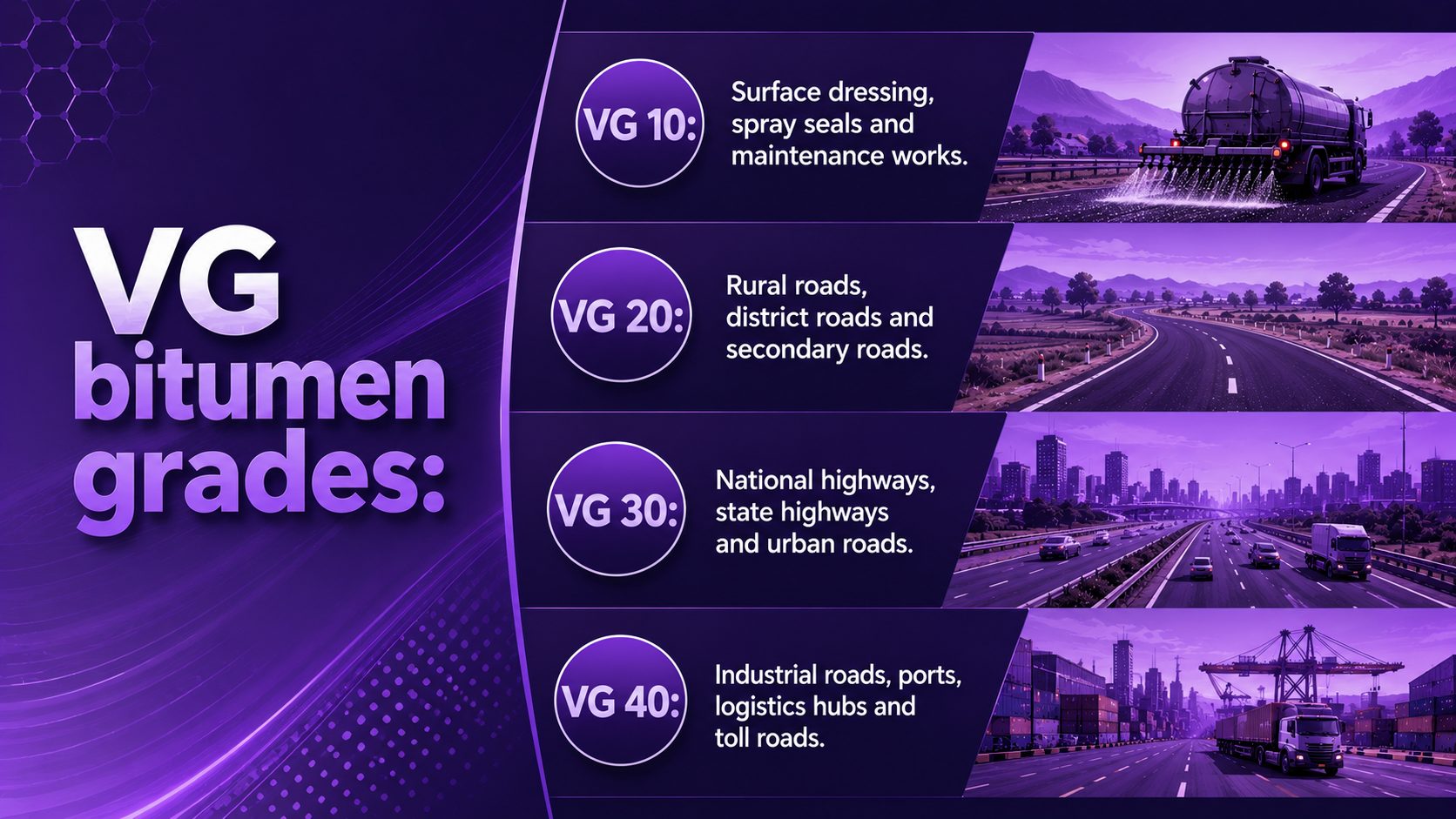
Although all VG bitumen grades are classified by viscosity, each grade is designed for different construction conditions. The choice depends on factors such as traffic intensity, ambient temperature, pavement type, and project specifications. Selecting the appropriate VG grade helps contractors achieve the required pavement performance while meeting tender requirements and optimising long-term maintenance costs.
| VG grade | Recommended projects | Traffic level | Suitable climate | Why choose it |
|---|---|---|---|---|
| VG 10 | Surface dressing, spray seals and maintenance works. | Low | Cold regions | Easy spraying and improved workability. |
| VG 20 | Rural roads, district roads and secondary roads. | Medium | Moderate climates | Balanced performance for medium-duty pavements. |
| VG 30 | National highways, state highways and urban roads. | Medium to Heavy | Most Indian regions | Reliable all-round performance for flexible pavements. |
| VG 40 | Industrial roads, ports, logistics hubs and toll roads. | Heavy | High-temperature regions | Superior resistance to rutting under heavy loads. |
Choosing the right VG grade
VG 10 is suitable when:
- Surface dressing or spray applications are specified.
- Construction takes place in colder regions.
- Easy handling and application are important.
Choose VG 20:
- Building rural and district roads.
- Traffic volumes are moderate.
- Climatic conditions are neither extremely hot nor cold.
VG 30 is suitable:
- Constructing national and state highways.
- Urban roads carry regular commercial traffic.
- Standard government specifications call for a viscosity-grade binder.
Choose VG 40:
- Roads experience frequent heavy axle loads.
- Projects are located in high-temperature regions.
- Industrial corridors, ports, or toll roads require enhanced rutting resistance.
India adopted viscosity grading for most road projects because it provides a more dependable basis for selecting binders according to traffic loading and climatic conditions. This performance-based approach helps engineers, consultants, and procurement teams specify materials that improve pavement durability and reduce lifecycle maintenance costs.
PMB vs CRMB vs VG bitumen
VG, PMB and CRMB bitumen are designed for different road construction requirements. While VG bitumen is the standard choice for most flexible pavements, PMB and CRMB offer enhanced performance for projects exposed to heavier traffic, higher stress, and demanding environmental conditions. The final selection depends on project specifications, expected pavement life, and budget.
| Property | VG bitumen | PMB | CRMB |
|---|---|---|---|
| Modifier | None | Polymer | Crumb rubber |
| Elastic recovery | Moderate | High | High |
| Fatigue resistance | Good | Excellent | Excellent |
| Rutting resistance | Good | Excellent | Very Good |
| Relative cost | Lowest | Highest | Medium |
| Typical projects | Highways, state roads and urban roads. | Expressways, bridges, airports and premium pavements. | Heavy traffic roads, industrial corridors and intersections. |
Which type should you choose?
Choose PMB when:
- Longer pavement life is a project priority.
- Roads experience high traffic speeds and continuous loading.
- Projects include expressways, bridges, and airport pavements.
- Higher initial material costs are justified by lower maintenance requirements.
Choose CRMB when:
- Roads carry frequent heavy commercial vehicles.
- Better resistance to cracking and repeated loading is required.
- Projects involve industrial roads, junctions, and high-stress pavements.
- A balance between performance and cost is important.
Choose VG bitumen when:
- Standard highways or urban road construction is planned.
- Tender specifications recommend viscosity-grade bitumen.
- Project budgets require a cost-effective solution.
- Traffic and climatic conditions do not require modified binders.
Procurement decisions should consider the total cost of ownership rather than only the purchase price. Although PMB and CRMB cost more than VG bitumen, their improved durability can reduce maintenance frequency, repair costs, and traffic disruptions over the pavement’s service life. For standard road projects, however, VG bitumen often provides the best balance between performance, availability, and overall project cost.
How to select the right bitumen grade

Choosing the right bitumen grade depends on project conditions rather than price alone. Contractors and procurement teams should evaluate the following factors before finalising material specifications.
Climate
Hot regions require grades with higher rutting resistance, while colder regions need better flexibility to minimise cracking. Areas with heavy rainfall benefit from binders with good moisture resistance.
Traffic
Traffic intensity plays a major role in grade selection. National highways and industrial corridors carrying heavy axle loads require higher-performance binders, while rural and low-volume roads can often use standard viscosity grades.
Pavement design
The bitumen grade should match the pavement type and project scope, whether it is new road construction, an overlay or a rehabilitation project. Following the pavement design improves long-term performance.
Tender specifications
Government tenders and project specifications often prescribe approved bitumen grades. Selecting a compliant grade helps avoid delays and quality issues during execution.
Procurement and quality
Source bitumen from reliable suppliers with consistent product quality and timely delivery. Always verify quality certificates and ensure proper storage to maintain performance before application.
Indian standards and quality requirements for bitumen grades
Compliance with recognised quality standards is essential to ensure consistent pavement performance, contractor acceptance and successful project execution. Government agencies and infrastructure developers specify quality requirements to maintain uniformity across road construction projects.
BIS viscosity grading system: Classifies bitumen into VG grades based on viscosity for reliable field performance.
Government quality requirements: Require bitumen to meet the applicable standards before use in road construction.
Ministry specifications: Project specifications define the approved bitumen grade and quality criteria for each application.
Laboratory testing: Confirms that the supplied bitumen meets the required physical and performance properties.
Batch consistency: Ensures every batch delivers uniform quality throughout the project.
Supplier compliance: Contractors should procure bitumen from suppliers who consistently meet specification requirements.
Quality assurance during procurement: Material verification before dispatch and delivery helps minimise quality-related risks.
Test certificates: Always review the manufacturer’s test certificates and supporting quality documentation before acceptance.
Storage and handling: Proper storage temperatures, contamination control and careful handling help preserve bitumen quality until application.
Following these quality requirements helps contractors reduce construction risks, achieve specification compliance and improve the long-term performance of road infrastructure.
Common mistakes when selecting bitumen grades
Choosing the wrong bitumen grade can increase maintenance costs, shorten pavement life, and create compliance issues during project execution. Avoid these common mistakes when evaluating materials for road construction.
| Mistake | Impact |
|---|---|
| Selecting only on price | May increase long-term maintenance and lifecycle costs. |
| Ignoring climatic conditions | Can lead to rutting, cracking, or poor pavement performance. |
| Not checking tender specifications | May result in non-compliance and material rejection. |
| Mixing incompatible grades | Can affect pavement quality and durability. |
| Poor storage practices | May reduce binder performance before application. |
| Buying from uncertified suppliers | Increases the risk of inconsistent product quality. |
| Ignoring quality documentation | Makes it difficult to verify compliance with project specifications. |
| Choosing the wrong modified binder | May add unnecessary costs or fail to meet performance requirements. |
Procurement tip: Compare bitumen grades based on project specifications, traffic conditions and lifecycle performance, not just the purchase price. Always source from reputable suppliers, verify test certificates and confirm material availability before placing bulk orders.
Conclusion
Understanding the differences between VG, PMB, CRMB and penetration grades helps contractors, engineers and procurement teams make better material decisions for every project. Take care to balance performance requirements, project budget, and expected service life rather than focusing only on upfront costs.
Procuring bitumen from reliable suppliers and ensuring compliance with applicable specifications supports consistent construction quality and reduces project risks. A well-informed selection process ultimately contributes to durable pavements, efficient execution, and better long-term value for infrastructure projects.
Looking to procure steel?
Tata nexarc helps manufacturers, builders and MSMEs source certified steel products, compare prices, and choose the right grade as per IS codes—with complete traceability and procurement confidence.
FAQs
What are bitumen grades?
Which VG bitumen grade is most commonly used in India?
What is the difference between VG 30 and VG 40?
When should PMB be used instead of VG bitumen?
What is CRMB bitumen?
Which bitumen grade is suitable for highways?
Is Bitumen 60/70 the same as VG 30?
How do climatic conditions affect bitumen grade selection?
What standards apply to bitumen grades in India?
How can contractors ensure they procure the correct bitumen grade?
A product manager with a writer's heart, Anirban leverages his 6 years of experience to empower MSMEs in the business and technology sectors. His time at Tata nexarc honed his skills in crafting informative content tailored to MSME needs. Whether wielding words for business or developing innovative products for both Tata Nexarc and MSMEs, his passion for clear communication and a deep understanding of their challenges shine through.