Table of Contents
The July 2026 GST collection reached ₹2.11 lakh crore, marking a 15.4% year-on-year increase and reflecting continued strength in India’s economy. Growth was supported by healthy domestic consumption, higher GST revenue from imports, and improved tax compliance. For MSMEs, these numbers are more than a government revenue update. They indicate business activity, consumer demand, and the overall pace of economic growth.

Understanding the latest GST collection trends can help businesses make better decisions on procurement, inventory planning, cash flow, and compliance.
July 2026 GST collection at a glance
The July 2026 GST collection reflects continued momentum in India’s economy. Gross GST revenue stood at ₹2,11,205 crore, registering a 15.4% year-on-year (YoY) growth. Higher domestic transactions, robust imports, and better tax compliance contributed to strong performance. The government also processed substantial refunds during the month, while net collections continued to record healthy growth.
July 2026 GST collection: Key highlights
Gross GST collection: ₹2,11,205 crore
Net GST collection (after refunds): ₹1,84,058 crore
Year-on-year growth: 15.4%
Domestic GST revenue growth: 10.1%
Import GST revenue growth: 28.8%
Total GST refunds issued: ₹27,147 crore
Increase over June 2026 collections: ₹16,393 crore (from ₹1,94,812 crore to ₹2,11,205 crore)
GST revenue break-up for July 2026
| Component | Amount (₹ crore) |
|---|---|
| CGST | 38,207 |
| SGST | 49,891 |
| IGST | 1,11,154 |
| Compensation cess | 11,953 |
| Total gross GST collection | 2,11,205 |
| Total refunds issued | 27,147 |
| Net GST collection | 1,84,058 |
What drove higher GST collections in July 2026?

Strong domestic demand
Higher consumer spending and steady business purchases continued to support GST collections in July 2026. Strong demand across sectors such as retail, automobiles, FMCG, and infrastructure increased taxable transactions, contributing to higher domestic GST revenue.
Manufacturing recovery
Manufacturing activity remained resilient, supported by infrastructure projects, industrial production, and stable order books. Increased production and movement of goods generated higher GST collections across the supply chain.
Continued growth in the services sector
The services sector, including IT, financial services, logistics, hospitality and professional services, maintained healthy growth. Rising service consumption and business-to-business transactions added to the overall GST revenue.
Higher import activity
GST collected on imported goods recorded strong growth, indicating higher imports of raw materials, capital goods, and finished products. Increased import volumes contributed significantly to the overall rise in GST collections during the month.
Improved GST compliance
Businesses continued to adopt better GST compliance practices, including timely return filing and accurate tax reporting. This helped improve tax collections while reducing errors and revenue leakages.
Better invoice matching
Greater use of e-Invoicing and automated invoice reconciliation enabled businesses to claim Input Tax Credit (ITC) more accurately. Improved invoice matching reduced mismatches and strengthened GST compliance across supply chains.
Digital tax administration
The GST ecosystem has become increasingly technology-driven, with automated return filing, online verification, and data analytics making tax administration more efficient. These digital initiatives have improved compliance while simplifying processes for businesses.
Anti-tax evasion measures
Ongoing data-driven enforcement and analytics by tax authorities helped detect fake invoicing, fraudulent ITC claims, and tax evasion. These measures widened the tax base and improved overall GST revenue collection.
Seasonal business activity
July typically sees higher business activity across several industries as companies replenish inventories and execute new orders after the first quarter. This seasonal momentum also supported stronger GST collections.
Month-on-month GST collection trend in FY 2026–27
India’s GST collections have remained above ₹1.9 lakh crore throughout the first four months of FY 2026-27, indicating sustained economic activity and improving tax compliance. While collections moderated in May and June following April’s record high, July witnessed a strong rebound, crossing ₹2.11 lakh crore. The consistent year-on-year growth reflects resilient domestic demand, healthy manufacturing and services activity, and higher GST collections from imports.
GST collection trend in FY 2026–27
| Month | Gross GST collection (₹ crore) | YoY growth |
|---|---|---|
| April 2026 | 2,43,286 | 12.6% |
| May 2026 | 1,94,811 | 16.4% |
| June 2026 | 1,94,812 | 13.9% |
| July 2026 | 2,11,205 | 15.4% |
What do these trends indicate?
Stable revenue momentum: GST collections have remained consistently strong, with each month recording collections above ₹1.9 lakh crore.
Healthy business activity: Sustained revenue growth points to continued consumption, manufacturing output, and services sector expansion.
Improving compliance: Wider adoption of e-Invoicing, timely return filing, and better invoice reconciliation continue to strengthen GST collections.
Positive outlook for businesses: Consistent GST growth generally signals stable economic activity, helping businesses plan production, inventory, and working capital with greater confidence.
State-wise GST collection highlights
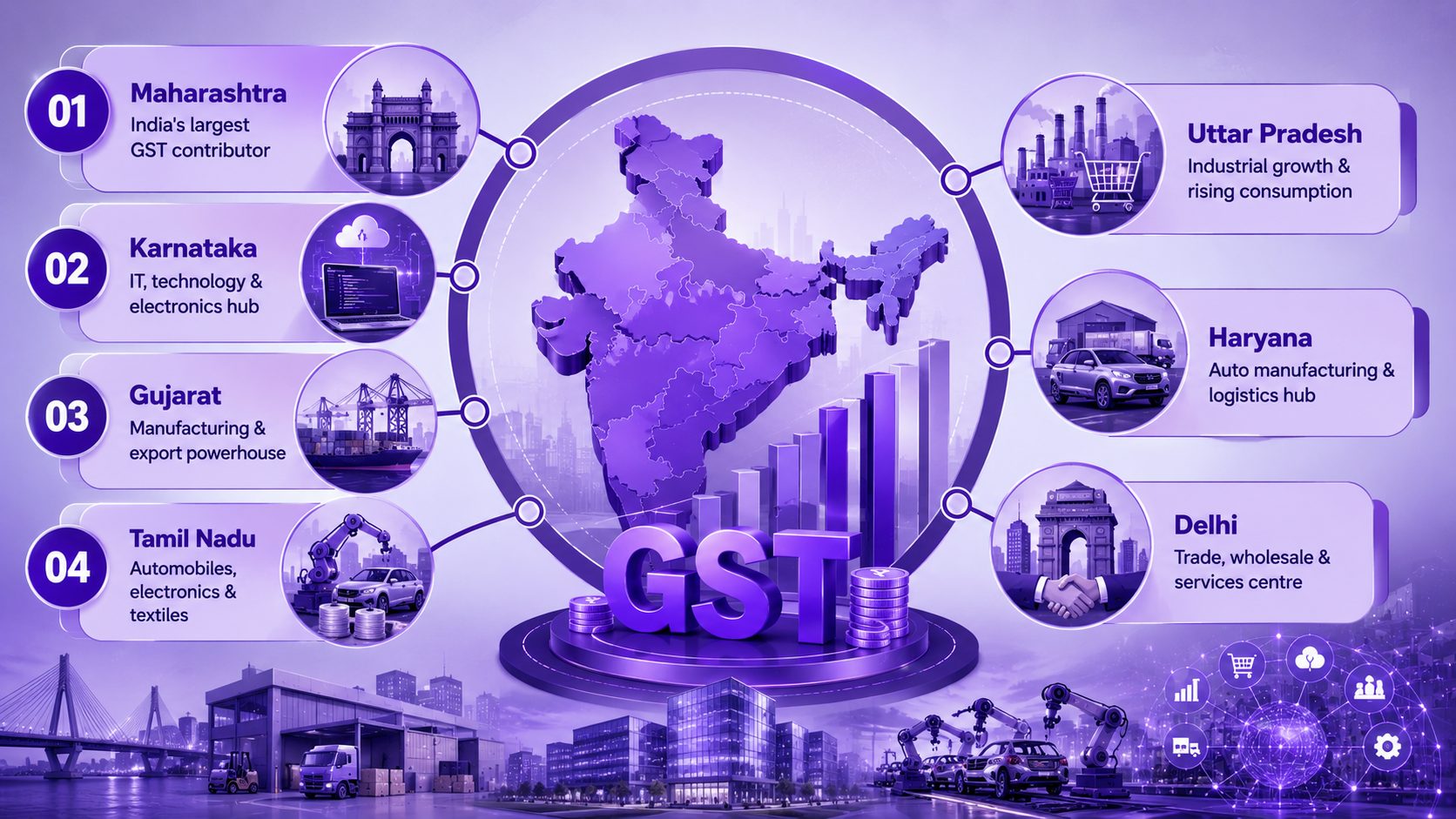
State-wise GST collections highlight where economic activity, manufacturing and consumption remain strongest. Maharashtra continued to lead the country in GST collections during July 2026, followed by Karnataka and Gujarat. These states benefit from diversified industrial bases, strong services sectors, large urban markets, and significant export-oriented industries.
Key state-wise highlights
Maharashtra: Maintained its position as India’s largest GST-contributing state, driven by Mumbai’s financial ecosystem, manufacturing clusters, and robust consumer demand.
Karnataka: Continued strong collections supported by the IT sector, technology services, electronics manufacturing, and growing startup activity.
Gujarat: Benefited from its manufacturing strength, ports, petrochemicals, engineering industries, and export-oriented businesses.
Tamil Nadu: Recorded healthy collections backed by automobiles, electronics, textiles, and industrial manufacturing.
Uttar Pradesh: Continued to see steady GST growth due to expanding industrial corridors, infrastructure development, and rising domestic consumption.
Haryana: Maintained strong revenue growth supported by automobile manufacturing, warehousing, logistics, and NCR-linked industries.
Delhi: Strong GST collections reflected high-value trade, wholesale markets, and service sector transactions.
What does this mean for businesses?
The concentration of GST collections in these states indicates where industrial production, consumer spending, and supply chain activity remain strongest. For MSMEs, manufacturers, and suppliers, these markets continue to offer significant opportunities for procurement, distribution, and business expansion. Monitoring state-wise GST trends can also help businesses identify regions with sustained economic momentum and stronger demand for goods and services.
What July 2026 GST collections mean for MSMEs
The strong GST collections in July 2026 indicate continued business activity across manufacturing, trade, and services. While monthly GST collections do not directly measure an individual business’s performance, they provide useful insights into broader economic trends. MSMEs can use these indicators to plan sales, procurement, inventory, and working capital more effectively.
| Business area | What July 2026 GST collections indicate | Action for MSMEs |
|---|---|---|
| Market demand | Higher GST collections generally reflect increased business transactions and consumer spending. | Review sales forecasts and prepare inventory for expected demand. |
| Manufacturing activity | Strong collections suggest continued production across industrial sectors. | Coordinate procurement and production schedules to avoid supply disruptions. |
| Supply chain health | Increased GST collections often indicate smoother movement of goods and stronger vendor activity. | Strengthen relationships with compliant suppliers and monitor lead times. |
| Working capital | Consistent economic activity can improve business cash flow, but delayed tax compliance can still affect liquidity. | File GST returns on time, reconcile invoices regularly and plan tax payments in advance. |
| Input Tax Credit (ITC) | Accurate invoice reporting remains essential for seamless ITC claims. | Match purchase invoices with GSTR-2B and resolve mismatches before filing returns. |
| Business finance | Banks and NBFCs often consider GST returns while assessing business performance and creditworthiness. | Maintain consistent GST filings to improve access to working capital and business loans. |
| Export businesses | Timely GST refunds support exporters by reducing working capital blockage. | File refund applications accurately and maintain complete export documentation. |
| Business expansion | Sustained GST growth signals positive economic momentum in several sectors. | Evaluate opportunities to enter new markets or expand product offerings based on demand trends. |
Key takeaway: Strong GST collections are a positive indicator of overall economic activity, but MSMEs should focus on timely compliance, accurate record-keeping, and efficient working capital management to fully benefit from the improving business environment.
Key takeaways for business owners and finance teams
File GST returns on time: Timely filing helps avoid penalties, interest charges and disruptions in Input Tax Credit (ITC) claims.
Reconcile GSTR-2B regularly: Match purchase invoices with GSTR-2B before filing returns to identify discrepancies and maximise eligible ITC.
Maintain vendor compliance: Work with GST-compliant suppliers to reduce invoice mismatches and minimise ITC-related risks.
Monitor ITC eligibility: Review Input Tax Credit claims periodically to ensure they comply with the latest GST provisions and documentation requirements.
Keep e-Invoices accurate: Generate and report e-Invoices correctly to ensure seamless GST compliance and avoid reporting errors.
Plan inventory based on demand: Use industry and GST collection trends to forecast demand, optimise inventory levels, and improve cash flow.
Track monthly GST collections: Follow official GST revenue reports to understand market trends, sector performance, and the overall business environment.
Stay updated on GST Council decisions: Monitor announcements on tax rates, compliance requirements, and procedural changes to prepare your business for regulatory updates.
Strengthen financial records: Maintain accurate books of accounts, tax invoices, and supporting documents to simplify audits and improve financial planning.
Leverage digital GST tools: Use GST-compliant accounting software and automated reconciliation tools to improve accuracy, save time, and enhance operational efficiency.
Conclusion
July 2026’s GST performance reinforces the importance of tracking monthly tax revenue as a reliable indicator of India’s economic direction. Beyond headline numbers, GST trends offer valuable insights into sectoral growth, consumption patterns and business confidence, helping MSMEs make more informed operational decisions.
By monitoring official GST updates alongside their own sales and compliance data, businesses can better anticipate market shifts, identify growth opportunities, and strengthen financial planning. Staying informed will remain essential as the GST landscape and business environment continue to evolve.
Empowering MSMEs to grow smarter
Tata nexarc delivers powerful solutions for MSMEs—discover tenders, logistics solutions, and streamline procurement. Everything your business needs, all in one place.
FAQs
What was India's GST collection in July 2026?
Is July 2026 the highest GST collection ever?
Why did GST collections increase in July 2026?
How do GST collections affect MSMEs?
Which sectors contributed to higher GST collections in July 2026?
Where can businesses check official GST collection data?
What was the net GST collection in July 2026?
Which state recorded the highest GST collection in July 2026?
Why should businesses track monthly GST collections?
How often does the Government of India release GST collection data?
A product manager with a writer's heart, Anirban leverages his 6 years of experience to empower MSMEs in the business and technology sectors. His time at Tata nexarc honed his skills in crafting informative content tailored to MSME needs. Whether wielding words for business or developing innovative products for both Tata Nexarc and MSMEs, his passion for clear communication and a deep understanding of their challenges shine through.