Table of Contents
- June 2026 GST Collection at a Glance
- Key Highlights from the June 2026 GST Collection
- GST Collection Trend in Q1 FY 2026–27
- Key Factors Behind the June 2026 GST Collection
- What the June 2026 GST Collection Means for MSMEs
- Sector-wise Trends Supporting GST Growth
- Key GST Compliance Updates to Remember
- Outlook for GST Collections in FY 2026–27
- Conclusion
- FAQs
The June 2026 GST collection reached ₹1,94,812 crore, recording a 13.9% year-on-year increase, according to provisional government data. The strong growth reflects steady business activity, higher import tax collections, and continued improvements in GST compliance. Businesses, MSMEs, policymakers, and investors closely track monthly GST collections because they offer an early indication of consumption, manufacturing, and overall economic momentum.

This article analyses the latest June 2026 figures, recent collection trends, and what they mean for businesses planning growth and managing compliance.
June 2026 GST collection at a glance
The June 2026 GST collection reflects another month of strong indirect tax receipts, pointing to steady business activity and improving tax compliance. Gross collections remained close to the ₹2 lakh crore mark, supported by healthy domestic transactions and robust import-related revenues. The latest figures also show continued growth over the same month last year, highlighting resilience across key sectors of the economy.
Key highlights
Gross GST collection: ₹1,94,812 crore
Year-on-year growth: 13.9%
Net GST collection (after refunds): ₹1,62,377 crore
Total refunds issued: ₹32,436 crore
June 2026 GST collection breakdown
| Component | Amount (₹ crore) |
|---|---|
| Gross GST collection | 1,94,812 |
| CGST | 37,376 |
| SGST | 45,116 |
| IGST | 1,12,320 |
| Compensation cess | 10,000 |
| Total refunds | 32,436 |
| Net GST collection | 1,62,377 |
Key highlights from the June 2026 GST collection
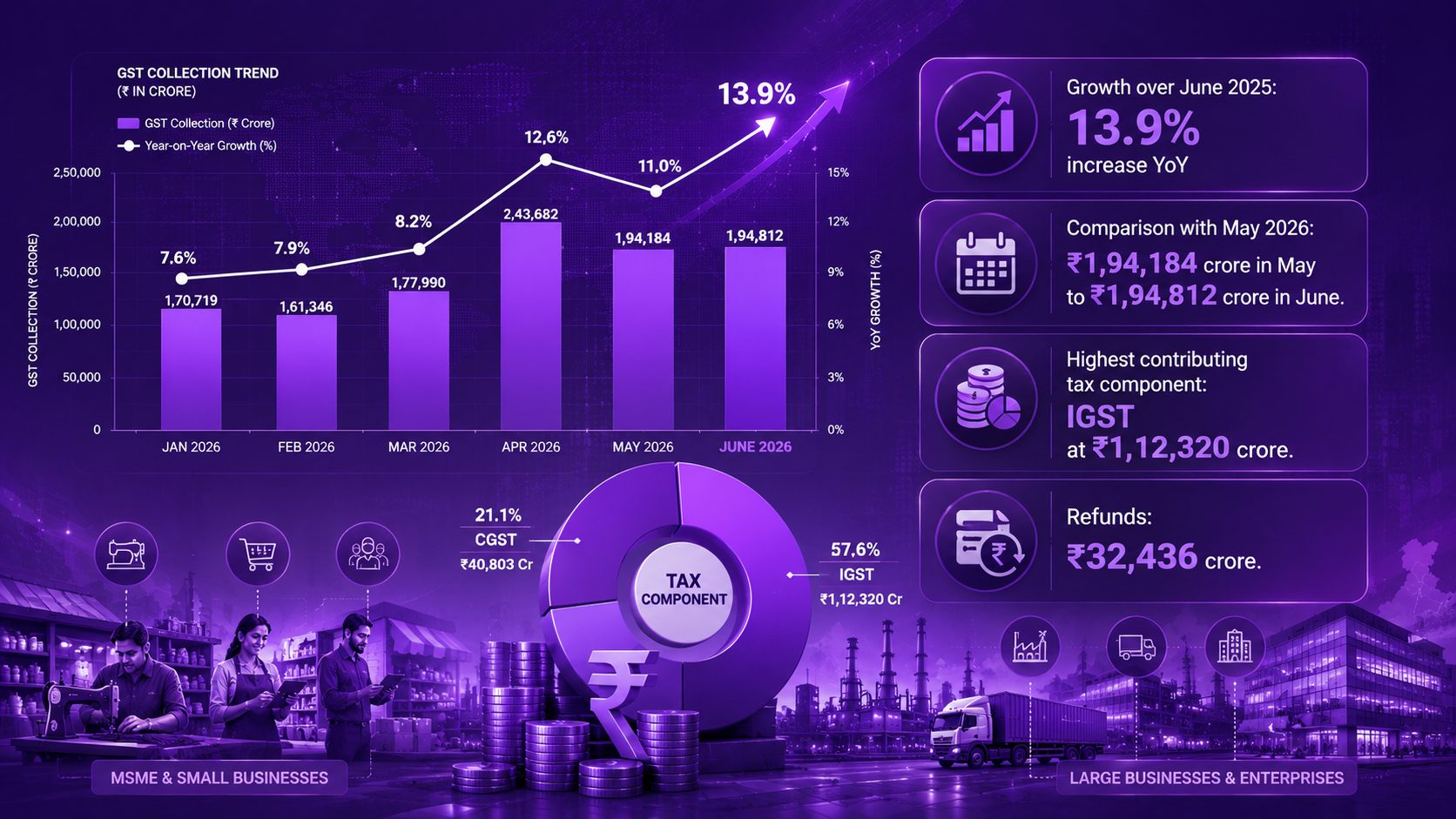
Growth over June 2025: Gross GST collections increased by 13.9% year on year, reflecting sustained economic activity and improved tax compliance.
Comparison with May 2026: Collections remained broadly stable, rising marginally from ₹1,94,184 crore in May to ₹1,94,812 crore in June.
Highest contributing tax component: IGST accounted for the largest share of collections at ₹1,12,320 crore.
Domestic versus import-driven collections: GST from imports recorded stronger growth than domestic revenues, indicating healthy trade activity alongside steady domestic demand.
Refund trends: The government issued ₹32,436 crore in refunds, supporting business liquidity while maintaining healthy net collections.
Compliance improvements: Continued adoption of digital compliance measures and timely return filing contributed to strong monthly collections.
Key economic signals: Consistently high GST collections point to resilient consumption, stable manufacturing activity, and sustained business confidence across sectors.
GST collection trend in Q1 FY 2026-27
The first quarter of FY 2026-27 started on a strong note, with GST collections remaining close to the ₹2 lakh crore mark after April’s record high. While monthly collections followed the usual seasonal pattern, they continued to reflect healthy business activity and improving tax compliance.
Key trends during the quarter
April 2026: Gross GST collection reached a record of ₹2,42,434 crore, driven by year-end business transactions and stronger compliance.
May 2026: Collections moderated to ₹1,94,184 crore as the seasonal spike eased but remained well above historical averages.
June 2026: Gross GST collection inched up to ₹1,94,812 crore, recording a 13.9% year-on-year increase and signalling sustained economic momentum.
GST collections during Q1 FY 2026-27
| Month | Gross GST collection (₹ crore) | YoY growth | MoM change |
|---|---|---|---|
| April 2026 | 2,42,434 | 12.6% | — |
| May 2026 | 1,94,184 | 3.2% | -19.9% |
| June 2026 | 1,94,812 | 13.9% | +0.3% |
Overall, the quarter reflects resilient consumer demand, stable manufacturing activity, and continued improvements in GST compliance. For MSMEs, consistently strong GST collections indicate a supportive business environment and can help gauge market demand, customer spending, and overall economic confidence.
Key factors behind the June 2026 GST collection

Stronger domestic demand
Steady consumer spending and higher business transactions continued to support GST collections in June. Demand across retail, services and consumer goods remained healthy, resulting in consistent tax revenues from domestic supplies.
Manufacturing and infrastructure activity
Manufacturing output and infrastructure projects remained key contributors during the month. Continued public and private investment in sectors such as construction, steel, cement and logistics generated higher business transactions across supply chains.
Higher import-related collections
GST collected on imports recorded stronger growth than domestic collections. This reflects healthy trade activity and increased imports of raw materials, capital goods, and industrial inputs that support manufacturing and infrastructure development.
Better compliance and digital adoption
Timely return filing, wider adoption of e-invoicing and stronger invoice matching has improved GST compliance over time. Digital tax administration has also made it easier for businesses to report transactions accurately and reduce revenue leakages.
Formalisation of businesses
More businesses are entering the formal economy through GST registration and digital compliance. Greater participation by MSMEs, together with sustained activity across manufacturing, services and trade, has broadened the tax base and contributed to stable monthly GST collections.
What the June 2026 GST collection means for MSMEs
The June 2026 GST collection is more than a government revenue figure. It offers valuable insights into business activity, market demand, and the overall economic environment. For MSMEs, these trends can support better financial planning and business decisions.
Business confidence: Strong GST collections indicate steady demand and continued economic activity. This can encourage businesses to invest, expand operations, and plan for future growth.
Credit availability: Consistent tax collections strengthen confidence in the economy, creating a positive environment for lending. MSMEs with good GST compliance may also find it easier to access business loans and working capital.
Working capital planning: Stable GST collections often reflect predictable business transactions. MSMEs can use these trends alongside their own sales data to plan inventory, cash flow, and procurement more effectively.
GST compliance expectations: As digital compliance continues to improve, businesses should focus on timely return filing, accurate invoicing and proper Input Tax Credit (ITC) reconciliation to avoid unnecessary disruptions.
Supply chain opportunities: Healthy collections across sectors indicate steady movement of goods and services. This can create new opportunities for MSMEs supplying manufacturers, infrastructure projects, and larger enterprises.
Manufacturing and exports: Continued activity in manufacturing and infrastructure supports demand for suppliers, while healthy trade activity can benefit export-oriented MSMEs through stronger business opportunities.
Government spending: Robust GST revenues improve the government’s fiscal position, supporting continued investment in infrastructure, public projects and schemes that indirectly benefit businesses and MSMEs.
Sector-wise trends supporting GST growth
The Government of India does not publish sector-wise GST collection figures. However, broader economic indicators suggest that several industries continued to support business activity and indirect tax collections during June 2026. Strong import-related GST collections, along with steady domestic demand, indicate healthy activity across manufacturing, trade, and services. The Department of Economic Affairs also reported continued expansion in both the manufacturing and services sectors during June.
Sector-wise business trends supporting GST growth
| Sector | Likely growth driver | Business impact |
|---|---|---|
| Manufacturing | Stable factory output and production | Higher demand for raw materials and industrial goods |
| Construction | Ongoing residential and commercial projects | Increased procurement of building materials and equipment |
| Infrastructure | Continued public capital expenditure | Strong demand across engineering and supply chains |
| Steel | Demand from infrastructure and manufacturing | Higher movement of steel and allied products |
| Retail & consumer goods | Steady consumer spending | Increased business transactions and GST collections |
| Logistics | Higher movement of goods | Improved supply chain efficiency and trade activity |
| Services | Expansion in business and consumer services | Sustained contribution to domestic economic activity |
| e-Commerce | Continued growth in online transactions | Greater tax compliance through digital transactions |
Together, these trends reflect broad-based economic activity rather than growth driven by a single industry. For MSMEs, continued demand across manufacturing, infrastructure, retail and services can create opportunities to expand supply chains, secure new customers, and strengthen business growth.
Key GST compliance updates businesses should remember

As GST compliance continues to improve across India, businesses should strengthen their own compliance practices to avoid disruptions, optimise cash flow and remain audit ready.
GST return filing: File returns on time to avoid late fees, interest and interruptions to input tax credit.
Invoice reconciliation: Regularly match purchase and sales invoices to identify and resolve discrepancies early.
Input Tax Credit (ITC): Reconcile ITC with supplier filings and claim only eligible credits.
e-Invoicing: Generate e-invoices accurately if your business falls within the applicable turnover threshold.
e-Way bills: Ensure e-way bills are generated correctly for the movement of goods to prevent delays and penalties.
Record maintenance: Maintain organised records of invoices, returns, and supporting documents for future reference and audits.
Refund claims: File eligible GST refund claims promptly to improve cash flow and reduce working capital pressures.
Consistent compliance not only helps businesses meet regulatory requirements but also strengthens supplier relationships, improves financial discipline, and supports smoother day-to-day operations.
Outlook for GST collections in FY 2026-27
| Indicator | Why it matters |
|---|---|
| Consumer demand | Drives sales and GST collections across sectors. |
| Government capital expenditure | Supports infrastructure, manufacturing and allied industries. |
| Festive season sales | Usually increase business transactions and tax collections. |
| Manufacturing growth | Indicates industrial activity and supply chain demand. |
| Export performance | Supports production and overall business confidence. |
| Inflation | Influences input costs, pricing and consumer spending. |
| Digital compliance | Improves tax reporting and revenue collection. |
| Economic outlook | Reflects overall business confidence and investment activity. |
Conclusion
The June 2026 GST collection is more than a monthly revenue update. It serves as a useful indicator of how India’s business environment is evolving and where opportunities may emerge. For MSMEs, tracking GST collection trends alongside internal business metrics can provide valuable context for planning procurement, managing inventory, and evaluating growth opportunities.
Combined with consistent GST compliance and sound financial planning, these insights can help businesses respond more confidently to changing market conditions and support sustainable long-term growth.
Empowering MSMEs to grow smarter
Tata nexarc delivers powerful solutions for MSMEs—discover tenders, logistics solutions, and streamline procurement. Everything your business needs, all in one place.
FAQs
What was the GST collection in June 2026?
Why is the June 2026 GST collection important?
How does GST collection affect MSMEs?
Which GST component contributed the most in June 2026?
How much was the net GST collection in June 2026?
Why do GST collections change every month?
How do higher GST collections benefit businesses?
Where can businesses check official monthly GST collection data?
Do higher GST collections mean better GST compliance?
What should businesses monitor alongside monthly GST collections?
A product manager with a writer's heart, Anirban leverages his 6 years of experience to empower MSMEs in the business and technology sectors. His time at Tata nexarc honed his skills in crafting informative content tailored to MSME needs. Whether wielding words for business or developing innovative products for both Tata Nexarc and MSMEs, his passion for clear communication and a deep understanding of their challenges shine through.