Table of Contents
- Introduction
- April 2026 GST Collection: Key Highlights
- MoM and YoY Trend Analysis
- What’s Driving GST Growth in April 2026?
- Sector-wise Impact
- Implications for MSMEs and Procurement Teams
- Compliance Trends and Policy Signals
- What this Means for Steel Supply Chains & Logistics
- Outlook for FY 2026–27: GST Growth Trajectory
- Conclusion
- FAQs
Introduction: Why April GST data matters for FY27 business trends
April sets the tone for the financial year. As the first data point of FY 2026-27, the April 2026 GST collection in India is a key indicator of business momentum. Collections have crossed ₹2 lakh crore, showing healthy year-on-year growth and a strong start to FY27.

For MSMEs, this is more than a headline number. Higher GST revenue signals improving demand, but also tighter compliance and faster tax outflows – both impacting working capital. Backed by continued infrastructure spending and steady consumption, the GST revenue for April FY27 gives an early, practical view of how trade and supply chains are moving on the ground.
April 2026 GST collection: Key highlights
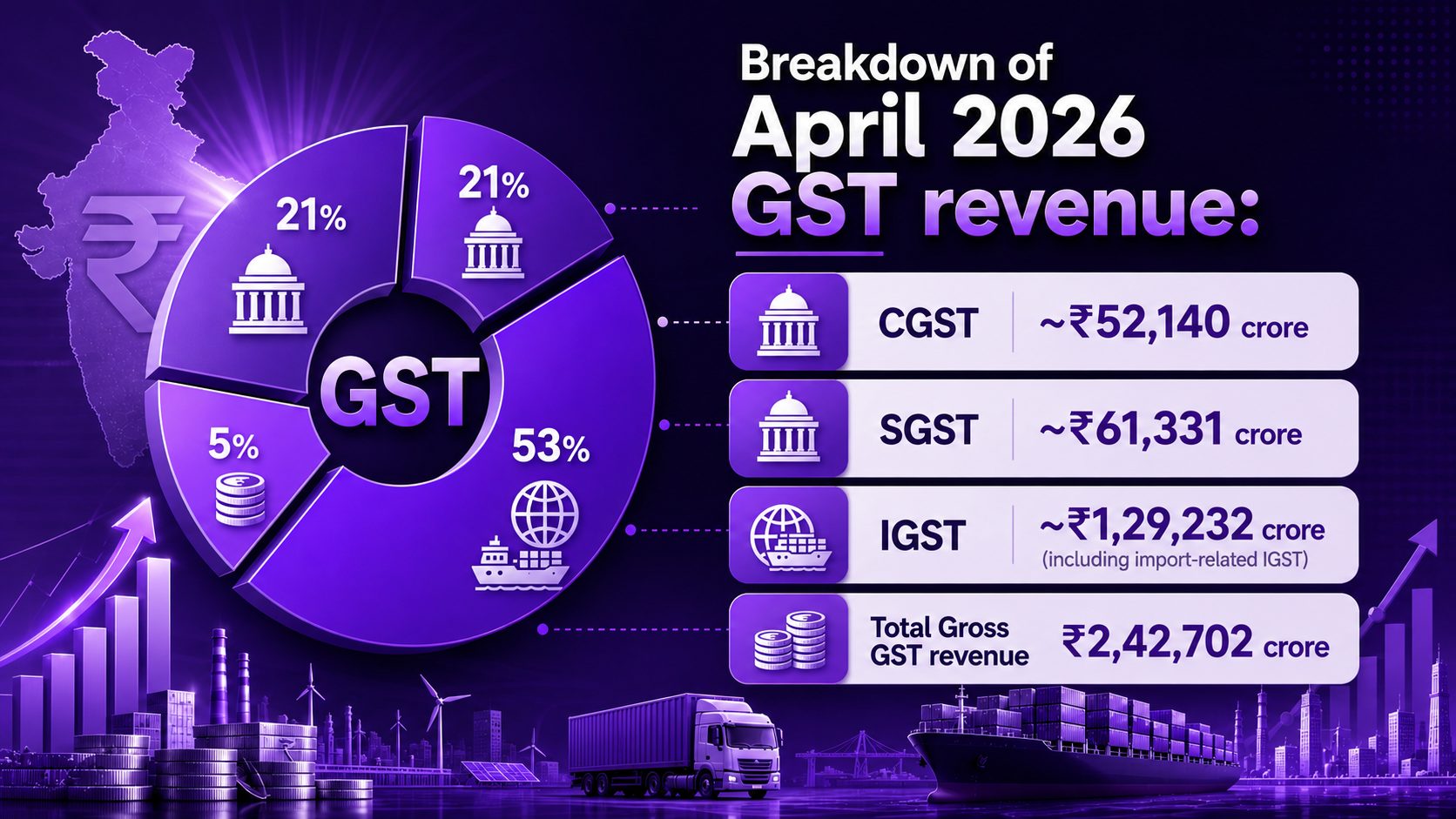
India’s latest GST collection data for April 2026 shows a strong start to FY27, with total collections at ₹2.43 lakh crore, marking a ~8.7% year-on-year growth over April 2025. The number is among the highest ever monthly GST collections recorded, reflecting both steady economic activity and tighter compliance.
Breakdown of GST revenue:
CGST: ~₹52,140 crore
SGST: ~₹61,331 crore
IGST: ~1,29,232 crore (including import-related IGST)
Total Gross GST revenue: ₹2,42,702 crore
A key trend this month is the high share of IGST, indicating strong import activity alongside domestic trade. At the same time, consistent growth in CGST and SGST suggests stable internal demand rather than a purely import-led spike.
From a business lens, this near-record collection is being driven by a mix of factors – improving compliance (e-invoicing, analytics), steady consumption in urban markets, and residual inflation effects on invoice values. For MSMEs and procurement teams, the GST April 2026 breakdown points to one clear signal: demand is holding, but tax discipline is becoming sharper.
Month-on-month and year-on-year trend analysis
The GST trends in India for 2026 show a familiar seasonal pattern, but with stronger underlying momentum this year. March typically records peak collections due to year-end reconciliations, while April reflects a reset in business activity.
| Period | GST collection (₹ lakh crore)* | Key insight |
| March 2026 | ~1.95–2.00 | Year-end spike driven by reconciliations and compliance catch-up. |
| April 2026 | ~2.43 | Record-high collection and strong start to FY27, indicating sustained economic activity and improved compliance. |
| April 2025 | ~1.85–1.90 | Lower base, indicating clear YoY growth trend. |
*Indicative ranges. Final numbers should be cross verified with official releases.
- Over the last 6-12 months, collections have consistently stayed near or above the ₹1.7 lakh crore mark, signalling a stable upward trend rather than sporadic spikes.
- From a seasonal lens, April usually dips after March. The fact that April 2026 remains elevated suggests that growth is not purely cyclical.
- The bigger question for businesses is whether this reflects real demand or improved compliance. The answer appears to be both. Stronger reporting systems and e-Invoicing are tightening leakages, while sectors like construction, manufacturing, and trade continue to support underlying demand.
- For MSMEs, this GST growth analysis in India points to a more formal, compliance-driven market environment going forward.
What’s driving GST growth in April 2026?
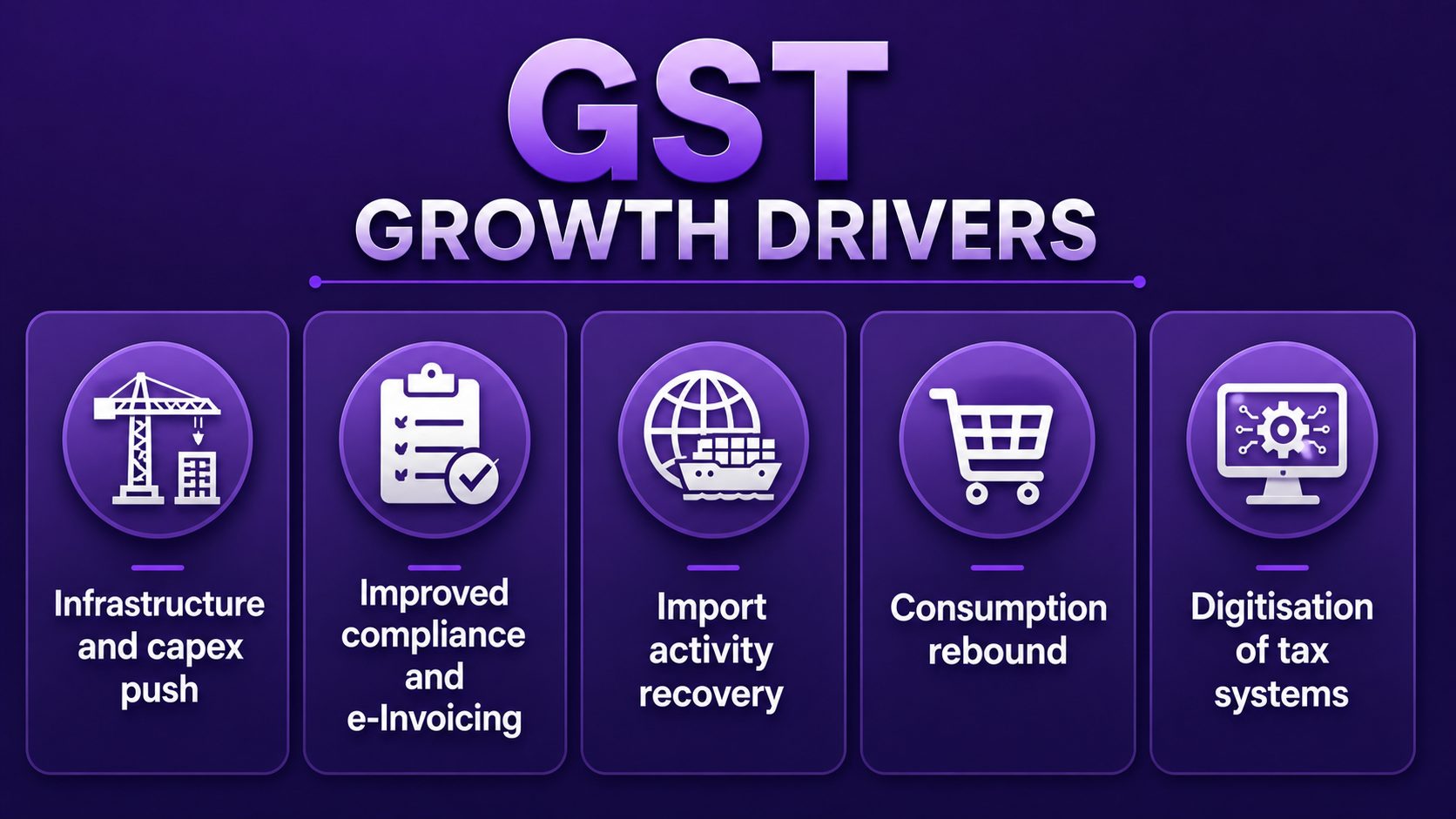
Infrastructure and capex push
Government-led spending on roads, railways, and urban projects continues to drive bulk demand. This is visible in higher offtake of steel, cement, and project-linked materials. For procurement teams, this translates into steady order pipelines and firmer pricing across construction supply chains.
Improved compliance and e-Invoicing
Tighter enforcement and wider adoption of e-Invoicing are reducing leakages. More transactions are being reported accurately, pushing up collections without a proportional rise in volumes. For MSMEs, this means stricter vendor compliance checks and less room for informal trade practices.
Import activity recovery
A higher share of IGST indicates stronger import flows, especially in raw materials and capital goods. This supports manufacturing and trading businesses, while also reflecting restocking cycles across sectors.
Consumption rebound
Urban demand remains stable, with early signs of rural recovery. Higher invoice values, partly influenced by inflation, are also contributing to GST growth. For retailers and distributors, this signals consistent movement of goods rather than sharp spikes.
Digitisation of tax systems
Data-led monitoring and analytics are improving tax tracking and reconciliation. This is making GST collections more predictable and less dependent on enforcement drives.
Together, these factors affecting GST collection in India show that growth is being supported by both real economic activity and stronger systems.
Sector-wise impact: What April 2026 GST collection means for key industries
The April numbers are not just macro indicators. They translate directly into on-ground business signals across sectors. The current GST impact on MSMEs in India and allied industries points to steady activity with tighter compliance.
| Sector | What the data signals | On-ground impact |
| Steel & construction | Strong capex and project demand | Better order visibility; stable pricing in bulk procurement. |
| Manufacturing MSMEs | Consistent invoice reporting | Improved order flow but stricter tax discipline. |
| Logistics & transporters | Higher GST = more goods movement | Increased freight demand; better fleet utilisation. |
| Retail & FMCG | Stable consumption trends | Steady inventory turnover; predictable demand cycles. |
Key sector insights
- Steel and construction are seeing sustained demand, driven by infrastructure projects and private capex. This supports long-term procurement planning.
- Manufacturing MSMEs are operating in a more formal ecosystem. Orders are stable, but compliance gaps are harder to manage.
- Logistics players are benefiting from higher movement of goods, reflected in consistent freight demand and route optimisation.
- Retail and FMCG show steady consumption rather than sharp spikes, indicating balanced demand across urban markets.
For businesses, the takeaway is clear: GST data is increasingly mirroring real economic activity, not just tax reporting. This strengthens its role as a reliable indicator for planning procurement, inventory, and distribution.
Implications for MSMEs and procurement teams
Working capital pressure is rising
Higher GST collections often mean faster and more consistent tax outflows. For MSMEs, this tightens working capital, especially in the first quarter when cash cycles are still stabilising. Delays in receivables can quickly create liquidity stress.
Stricter Input Tax Credit (ITC) discipline
ITC claims are now closely linked to supplier filings. Any mismatch or delay can block credit, directly increasing the cost of doing business. This makes internal reconciliation processes more critical than ever.
Vendor compliance is non-negotiable
Procurement teams can no longer rely on price alone. If a vendor is non-compliant, the buyer risks losing ITC. As a result, GST compliance is becoming a key criterion in vendor selection and retention.
Cash flow planning needs early attention
April sets the pace for the year. Businesses that align tax payments, receivables, and procurement cycles early are better positioned to avoid cash flow disruptions later in FY27.
Track vendor filings proactively
MSMEs should regularly monitor supplier GST returns and filing behaviour. This reduces ITC risks and ensures smoother credit flow across the supply chain.
Impact on procurement pricing
In sectors like steel and raw materials, compliant vendors may quote slightly higher prices but offer better tax efficiency. Over time, this improves net cost and reduces compliance risks.
Overall, the GST impact on small businesses in India is clear: stronger compliance systems are now essential for sustainable operations.

Compliance trends and policy signals
E-invoicing expansion
What’s happening: Thresholds continue to widen, bringing more MSMEs into the e-Invoicing net.
What it means: More transactions are tracked in real time, reducing scope for under-reporting.
AI-driven GST scrutiny
What’s happening: Advanced analytics are being used to detect mismatches and anomalies.
What it means: Errors are flagged faster, increasing the need for accurate filings and reconciliations.
Crackdown on fake invoicing
What’s happening: Enforcement actions against fraudulent ITC claims are intensifying.
What it means: Businesses must ensure their vendor network is fully compliant to avoid penalties.
Focus on widening the tax base
What’s happening: The government is prioritising higher compliance over rate increases.
What it means: Collections are rising through better reporting, not higher tax burden.
Bottom line for businesses
The latest GST compliance updates for 2026 in India point to one clear shift: tighter systems, not higher rates, are driving revenue growth.
What April 2026 GST collection means for steel supply chains & logistics
April’s GST data is a strong proxy for steel movement across the value chain – from mills to distributors to project sites. A higher April 2026 GST collection in India signals steady dispatches, active procurement, and sustained project execution.
Higher GST = Stronger steel dispatches
Elevated collections reflect consistent movement of structural steel, TMT bars, and flat products. For buyers, this indicates stable demand from infrastructure and construction projects.
E-Way Bill activity in steel movement
Steel is highly logistics-intensive, and E-way Bill generation closely tracks dispatch volumes. Stable trends suggest uninterrupted supply from plants to stockyards and end-users.
Interstate steel trade is smoother
With GST systems maturing, interstate movement of steel has become faster and more predictable. This reduces delays in large project deliveries and improves inventory planning.
Impact on freight and delivered cost
Strong demand supports freight rates, especially bulk routes like plant-to-project corridors. For procurement teams, logistics costs remain a key component of landed steel prices.
The April 2026 GST collection in India acts as an early indicator of steel demand and supply chain momentum for the coming months.

Outlook for FY 2026-27: GST growth trajectory
| Factor | Outlook | What it means for businesses |
| Monthly GST run rate | Likely to sustain around ₹1.8-2.1 lakh crore. | Indicates stable economic activity, but not runaway growth. |
| Inflation impact (risk) | May inflate invoice values without real volume growth. | Businesses should track volume vs value carefully. |
| Global demand (risk) | Exports and manufacturing could face pressure if global slowdown persists. | Export-linked sectors may see uneven demand. |
| Formalisation of economy (opportunity) | Continued shift from informal to formal trade. | More organised competition; compliance becomes a differentiator. |
| Domestic demand (Opportunity) | Infrastructure and consumption remain steady. | Supports sectors like steel, logistics, and FMCG. |
The GST forecast for India in 2026 suggests a balanced trajectory. Collections are expected to remain strong, but growth will likely be driven more by compliance and formalisation than sharp demand spikes. For MSMEs and procurement teams, this means planning for stable but disciplined growth, where cash flow management and compliance readiness will matter as much as market demand.
Conclusion
The April 2026 GST collection in India reinforces one thing – GST data is now a practical business intelligence tool, not just a tax metric. For MSMEs and procurement teams, the focus should be clear: track demand signals closely, tighten compliance systems, and align procurement with cash flow realities. Businesses that proactively monitor vendor filings and plan finances early will be better placed to manage risk and capture steady opportunities through FY27.
Empowering MSMEs to grow smarter
Tata nexarc delivers powerful solutions for MSMEs—discover tenders, logistics solutions, and streamline procurement. Everything your business needs, all in one place.
FAQs
What is the GST collection for April 2026 in India?
Why is April GST important in India?
What is considered a strong GST growth rate?
How does GST impact MSMEs?
Does higher GST mean higher inflation?
What sectors contribute most to GST in India?
What is IGST vs CGST?
How does GST affect logistics?
Is GST collection a sign of economic growth?
What should businesses track monthly?
Which states contributed the most to GST collection in April 2026?
A product manager with a writer's heart, Anirban leverages his 6 years of experience to empower MSMEs in the business and technology sectors. His time at Tata nexarc honed his skills in crafting informative content tailored to MSME needs. Whether wielding words for business or developing innovative products for both Tata Nexarc and MSMEs, his passion for clear communication and a deep understanding of their challenges shine through.