Check Price Now
Table of Contents
- What are Crash Barriers?
- Types of Crash Barriers and Their Uses
- Crash Barrier Grades, Specifications, and Material Standards
- Features of Modern Crash Barrier Systems
- Uses and Applications of Crash Barriers Across Industries
- Crash Barrier Testing and Safety Evaluation in India
- Factors to Consider When Choosing Crash Barriers
- Conclusion
- FAQs
Crash barriers are safety systems designed to reduce the impact of vehicle collisions and improve protection on roads and industrial sites. They play an important role in highways, expressways, bridges, warehouses, industrial zones, and major infrastructure projects. As road safety and impact protection become bigger priorities, choosing the right barrier system matters more than ever. This guide explains crash barrier types, materials, grades, features, applications, and key factors to consider before selection.
What are crash barriers? Understanding their purpose and function
Crash barriers are protective safety systems designed to reduce the impact of vehicle collisions and improve safety across transport and industrial environments. Engineers install them along roads, bridges, industrial sites, and high-risk zones to control vehicle movement and minimise accident severity.
Their main purpose is simple: absorb impact energy and reduce collision damage. Instead of allowing a vehicle to move into dangerous areas or collide with fixed structures, crash barriers help redirect movement and lower the force of impact.
Modern infrastructure projects rely on crash barriers to improve safety for both vehicles and pedestrians. They reduce the risk of vehicles crossing into opposite lanes, leaving the roadway, or entering restricted operational areas.
How crash barriers work
During an impact event, crash barriers manage collision energy through controlled resistance. Depending on the barrier type and material, the system may absorb force, redirect the vehicle, or slow its movement to reduce damage.
Key safety functions include:
- Reducing collision severity
- Preventing vehicle crossover into oncoming traffic
- Improving roadside protection
- Minimising risks near hazardous areas
- Protecting pedestrians and industrial assets
- Supporting safer traffic flow
Some crash barriers focus on preventing vehicles from crossing medians or road edges. Others primarily reduce crash intensity by controlling impact energy. Infrastructure planners often select barrier systems based on traffic conditions, vehicle volume, and site requirements.
| Installation Environment | Primary Purpose |
|---|---|
| Highways | Vehicle containment and lane protection |
| Expressways | Median and roadside safety |
| Bridges and flyovers | Edge protection and vehicle guidance |
| Industrial facilities | Asset and worker safety |
| Warehouses | Vehicle movement control |
| Parking areas | Collision protection |
| Construction zones | Temporary impact protection |
Crash barriers have become essential in modern infrastructure planning. As transport networks expand and industrial activity grows, reliable impact protection systems help improve long-term safety, reduce accident risks, and support more resilient infrastructure development.
Types of crash barriers and their uses
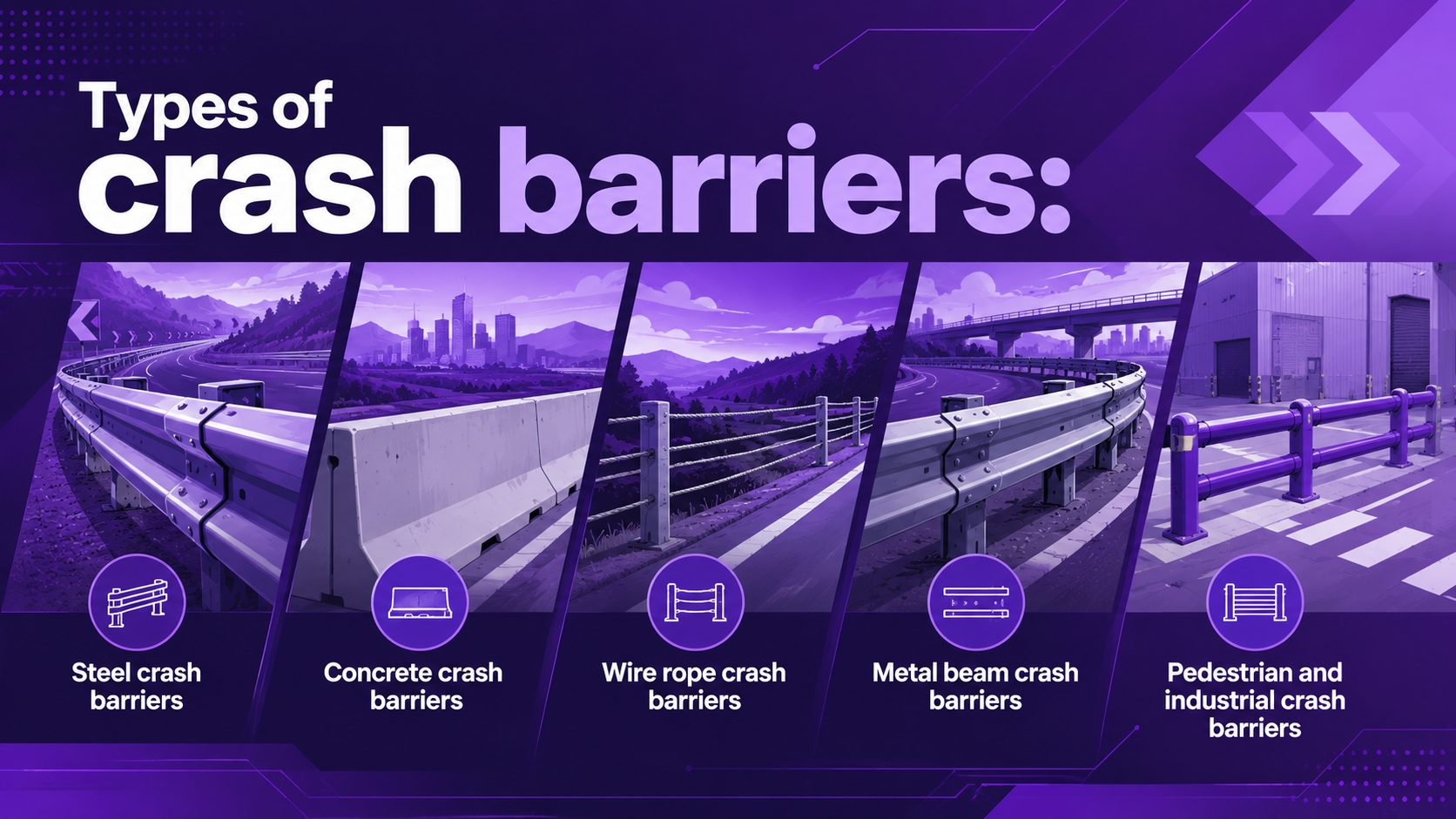
Different infrastructure environments require different crash barrier systems. Traffic conditions, road layouts, impact risks, and safety requirements influence barrier selection. Understanding the major crash barrier types helps infrastructure planners, contractors, and procurement teams choose suitable protection systems for specific applications.
Steel crash barriers
Steel crash barriers are among the most commonly used roadside safety systems. They offer durability, impact resistance, and long-term performance across highways and transport corridors.
Two widely used steel barrier designs include:
W-beam barriers – Feature a W-shaped profile and commonly support roadside and median protection.
Thrie-beam barriers – Use a three-wave design that provides greater strength and improved containment in higher-risk locations.
Steel systems work well in high-traffic environments because they balance structural strength with impact management.
Concrete crash barriers
Concrete crash barriers use rigid containment systems designed to control vehicle movement during severe impact events. Infrastructure projects often install them along highway medians, bridges, and flyovers where stronger containment becomes important. Their durable design also reduces maintenance requirements over long operational periods.
Wire rope crash barriers
Wire rope crash barriers use flexible steel cable systems that absorb impact energy during collisions. Unlike rigid systems, these barriers flex during impact to help reduce collision severity. They commonly support high-speed road networks and median protection applications.
Metal beam crash barriers
Metal beam barriers provide roadside protection and controlled vehicle redirection. Contractors often install them on highways, transport corridors, curves, and road edges where impact protection remains a priority.
Pedestrian and industrial crash barriers
Industrial crash barriers support worker safety and asset protection across warehouses, factories, and loading bays. These systems help manage vehicle movement and reduce collision risks in operational environments.
Performance comparison
Steel barriers – Highways, bridges, and expressways.
Concrete barriers – Medians and high-impact zones.
Wire rope barriers – High-speed road networks.
Metal beam barriers – Roadside infrastructure protection.
Industrial barriers – Warehouses, factories, and logistics facilities.
Crash barrier grades, specifications, and material standards
Selecting crash barriers involves more than choosing a barrier type. Procurement teams, infrastructure contractors, and MSME buyers often evaluate material quality, performance capability, and long-term durability before making purchasing decisions. Understanding grades, specifications, and material standards helps improve safety outcomes and lifecycle value.
Material grades commonly used
Steel remains one of the most commonly used materials in crash barrier manufacturing because of its strength and durability. Many projects use galvanised steel barriers to improve corrosion resistance and support long-term outdoor performance.
Procurement teams often assess:
- Steel quality and structural integrity
- Galvanised coating protection
- Corrosion resistance capability
- Expected maintenance requirements
Structural steel selection also influences impact performance and operational lifespan, especially in high-traffic environments.
Performance classifications
Crash barriers perform differently depending on traffic conditions, installation locations, and project requirements. Buyers often compare systems based on:
Containment capability – Ability to prevent vehicles entering hazardous areas.
Impact resistance levels – Performance under collision forces.
Energy absorption characteristics – Capacity to manage and distribute impact energy.
Projects with higher safety risks may require stronger containment capability and improved impact resistance.
Key specification factors
| Specification Factor | Why It Matters |
|---|---|
| Material thickness | Influences strength and structural stability |
| Coating quality | Improves corrosion resistance and service life |
| Tensile properties | Supports load-bearing capability during impact |
| Durability requirements | Affects maintenance needs and long-term value |
Compliance and project requirements
Procurement decisions should also consider compliance expectations and engineering requirements.
Key evaluation areas include:
- Highway and road safety standards
- Project-specific engineering requirements
- Material certification expectations
- Environmental exposure conditions
Reviewing these factors helps procurement teams and MSME buyers select crash barriers that balance safety performance, durability, and long-term infrastructure value.

Features of modern crash barrier systems
Modern crash barrier systems do more than create a physical safety barrier. They help manage collision impact, improve roadside protection, and support long-term infrastructure safety. Material selection, design quality, and engineering standards all influence how effectively a crash barrier performs over time.
High impact resistance
Crash barriers are designed to withstand collision forces and reduce accident severity. Strong impact resistance helps minimise vehicle damage and improves safety outcomes across highways, industrial sites, and transport corridors.
Energy dissipation capability
Modern barrier systems help absorb and distribute collision energy during impact events. This reduces crash intensity and lowers the risk of vehicles entering hazardous areas.
Corrosion resistance and weather durability
Outdoor infrastructure faces constant exposure to rain, heat, humidity, and changing weather conditions. Many crash barriers use galvanised steel or protective coatings to improve corrosion resistance and maintain structural performance.
Key benefits include:
- Reduced material degradation
- Better outdoor performance
- Lower maintenance requirements
- Longer service life
- Modular installation design
Many crash barrier systems use modular components that simplify installation and replacement. This design approach helps reduce downtime and supports faster project execution.
Structural strength and long-term reliability
Structural strength remains one of the most important crash barrier features. Stronger systems often perform better under repeated exposure to traffic conditions and environmental stress.
Material quality directly influences long-term performance. Higher-quality materials can improve:
- Durability
- Impact handling capability
- Corrosion protection
- Operational lifespan
Additional performance features
Modern crash barriers may also include:
- Visibility enhancement features for improved road guidance.
- Low maintenance requirements for reduced operating costs.
- Long operational lifespan for better lifecycle value.
- Adaptability across highways, bridges, warehouses, industrial facilities, and infrastructure projects.
Selecting barriers with suitable materials and performance features helps infrastructure planners and procurement teams improve safety outcomes while supporting long-term operational efficiency.
Uses and applications of crash barriers across industries
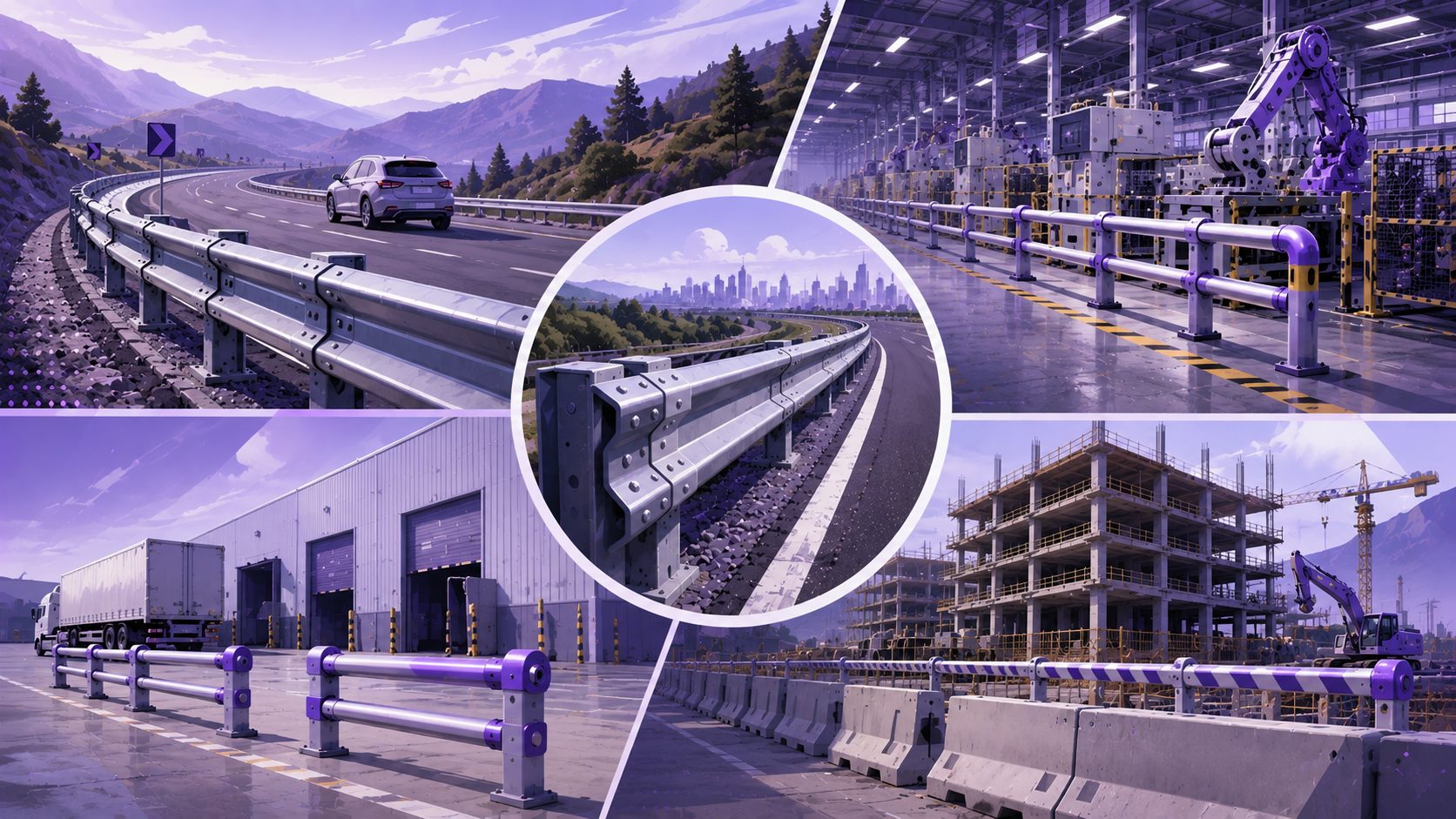
Crash barriers support safety across multiple sectors by controlling vehicle movement, reducing collision risks, and protecting people and infrastructure assets. Different environments require different crash barrier systems, making application-specific selection an important part of safety planning.
Crash barrier applications across industries
| Sector | Common applications | Primary purpose |
|---|---|---|
| Road and highway infrastructure | Medians, curves, road edges, bridges. | Vehicle containment and roadside safety. |
| Industrial and manufacturing facilities | Equipment protection, worker safety zones. | Asset protection and workplace safety. |
| Warehousing and logistics | Vehicle movement management, rack protection. | Collision prevention and operational efficiency. |
| Construction and infrastructure projects | Temporary safety control. | Site safety and traffic management. |
| Commercial spaces | Parking facilities, public movement areas. | Vehicle guidance and pedestrian protection. |
Road and highway infrastructure
Road networks remain one of the largest applications for crash barriers. Highways, expressways, bridges, and curved road sections use barriers to reduce accident severity and improve vehicle control. Median barriers also help prevent crossover incidents involving oncoming traffic.
Industrial and manufacturing facilities
Industrial environments use crash barriers to protect machinery, equipment, and operational areas. They also help establish worker safety zones in locations with heavy vehicle movement.
Warehousing and logistics
Warehouses and logistics facilities rely on crash barriers to manage forklift routes, separate operational zones, and protect storage infrastructure. Rack protection systems also reduce damage risks in high-activity areas.
Construction and commercial environments
Construction projects often use temporary crash barriers to improve traffic control and site safety. Commercial facilities install barriers in parking areas and public movement zones to improve safety and vehicle management.
Barrier selection often depends on application requirements. Factors such as traffic volume, vehicle type, environmental exposure, impact risk, and operational conditions influence which crash barrier system performs best in a specific environment.
Crash barrier testing and safety evaluation in India
Crash barriers used on roads and infrastructure projects undergo testing to assess their performance under impact conditions. These tests help evaluate whether a barrier can redirect vehicles safely, absorb collision energy, and maintain structural stability during an accident. Testing also supports compliance requirements for highway and infrastructure projects.
Some commonly referenced crash barrier evaluation tests and assessment areas include:
Vehicle impact testing – Assesses how barriers perform when struck by vehicles under controlled conditions using different vehicle categories.
Barrier deformation testing – Measures how much the barrier bends or deflects during impact while maintaining containment capability.
Containment performance evaluation – Checks whether the barrier prevents vehicles from crossing into hazardous areas or opposing traffic lanes.
Energy absorption assessment – Evaluates how effectively the barrier absorbs and distributes impact energy to reduce collision severity.
Occupant safety evaluation – Reviews vehicle movement behaviour and safety outcomes during impact testing.
Indian infrastructure projects may also consider testing requirements linked to highway safety specifications, project engineering requirements, and recognised crash performance evaluation frameworks.
Factors to consider when choosing crash barriers

Selecting the right crash barrier involves more than comparing materials or pricing. Procurement teams, infrastructure planners, and MSME buyers often evaluate operational requirements, safety performance, and long-term value before finalising suppliers.
Traffic conditions
Traffic volume, vehicle speed, and vehicle type influence crash barrier selection. High-speed roads and heavy traffic environments may require stronger containment systems.
Installation environment
Barrier requirements vary across highways, bridges, warehouses, industrial facilities, and construction sites. Site conditions often determine the suitable barrier design.
Required containment level
Different projects require different containment capabilities. Areas with higher impact risks may need barriers designed for stronger vehicle control.
Material durability
Durable materials support longer service life and lower replacement requirements. Material quality also affects long-term structural performance.
Corrosion exposure
Outdoor installations often face rain, humidity, and environmental exposure. Corrosion-resistant materials can improve durability and reduce maintenance requirements.
Maintenance expectations
Barrier systems with lower maintenance requirements may support better operational efficiency over time. Maintenance planning also affects ownership costs.
Lifecycle cost considerations
Procurement decisions should be considered more than the initial purchase price. Installation costs, maintenance expenses, and expected lifespan contribute to overall lifecycle value.
Compliance requirements
Projects often require compliance with safety specifications and engineering requirements. Verifying compliance expectations helps reduce procurement risks.
Supplier quality evaluation
Buyers should assess supplier capability, material consistency, manufacturing standards, and quality assurance processes before selection.
Project budget constraints
Project budgets influence material choices and barrier specifications. Balancing safety requirements with long-term value supports stronger procurement decisions.
Conclusion
Crash barriers play an important role in building safer transport and industrial environments. Choosing the right system requires careful evaluation of performance requirements, operating conditions, and project goals. Material quality and suitable specifications can influence durability, operational efficiency, and long-term value. Informed planning and supplier evaluation help businesses make better procurement decisions while supporting stronger safety outcomes, whether its highways, warehouses, or industrial facilities.
Looking to procure steel?
Tata nexarc helps manufacturers, builders and MSMEs source certified steel products, compare prices, and choose the right grade as per IS codes—with complete traceability and procurement confidence.
FAQs
What is a crash barrier?
What are the main types of crash barriers?
Where are crash barriers commonly installed?
What is the purpose of a crash barrier?
What are W-beam crash barriers?
Why is galvanisation important in crash barriers?
Are crash barriers used only on highways?
How do crash barriers improve safety?
What factors affect crash barrier selection?
Do crash barriers require testing?
A product manager with a writer's heart, Anirban leverages his 6 years of experience to empower MSMEs in the business and technology sectors. His time at Tata nexarc honed his skills in crafting informative content tailored to MSME needs. Whether wielding words for business or developing innovative products for both Tata Nexarc and MSMEs, his passion for clear communication and a deep understanding of their challenges shine through.