Check Price Now
Table of Contents
Crash barriers play a vital role in improving safety across roads, industrial facilities, and critical infrastructure. They help reduce accident impact, protect vehicles and people, and limit damage to surrounding assets. Today, highways, bridges, warehouses, factories, ports, and infrastructure projects rely on crash barriers to improve protection in high-risk areas. Different crash barrier types suit different environments and impact conditions. This guide explains the main types of crash barriers, their materials, applications, and the key factors to consider before selecting the right system.
What are crash barriers and why are they important?
Crash barriers are protective safety systems designed to reduce the impact of collisions involving vehicles, machinery, or moving equipment. They create a controlled barrier between traffic and surrounding areas to improve safety and reduce damage during accidents.
The primary purpose of a crash barrier is to absorb or redirect impact energy. Instead of allowing a vehicle to move into dangerous zones, a properly designed barrier helps guide it away from hazards or slows its movement in a controlled way. This function can lower accident severity and reduce risks to people and property.
Crash barriers also play an important role in preventing vehicle crossover incidents. On highways and expressways, median barriers help stop vehicles from crossing into oncoming traffic lanes. In industrial settings, barriers protect workers, equipment, storage areas, and operational infrastructure from accidental vehicle movement.
Modern infrastructure projects install crash barriers in a wide range of environments:
| Installation area | Purpose |
|---|---|
| Highways | Reduce collision severity and improve roadside safety |
| Expressways | Prevent cross-median accidents |
| Bridges | Protect vehicles from edge impacts |
| Industrial facilities | Protect workers and operational zones |
| Warehouses | Prevent equipment and vehicle damage |
| Parking structures | Improve vehicle movement safety |
| Ports | Protect assets and transport routes |
| Toll plazas | Improve traffic control and impact protection |
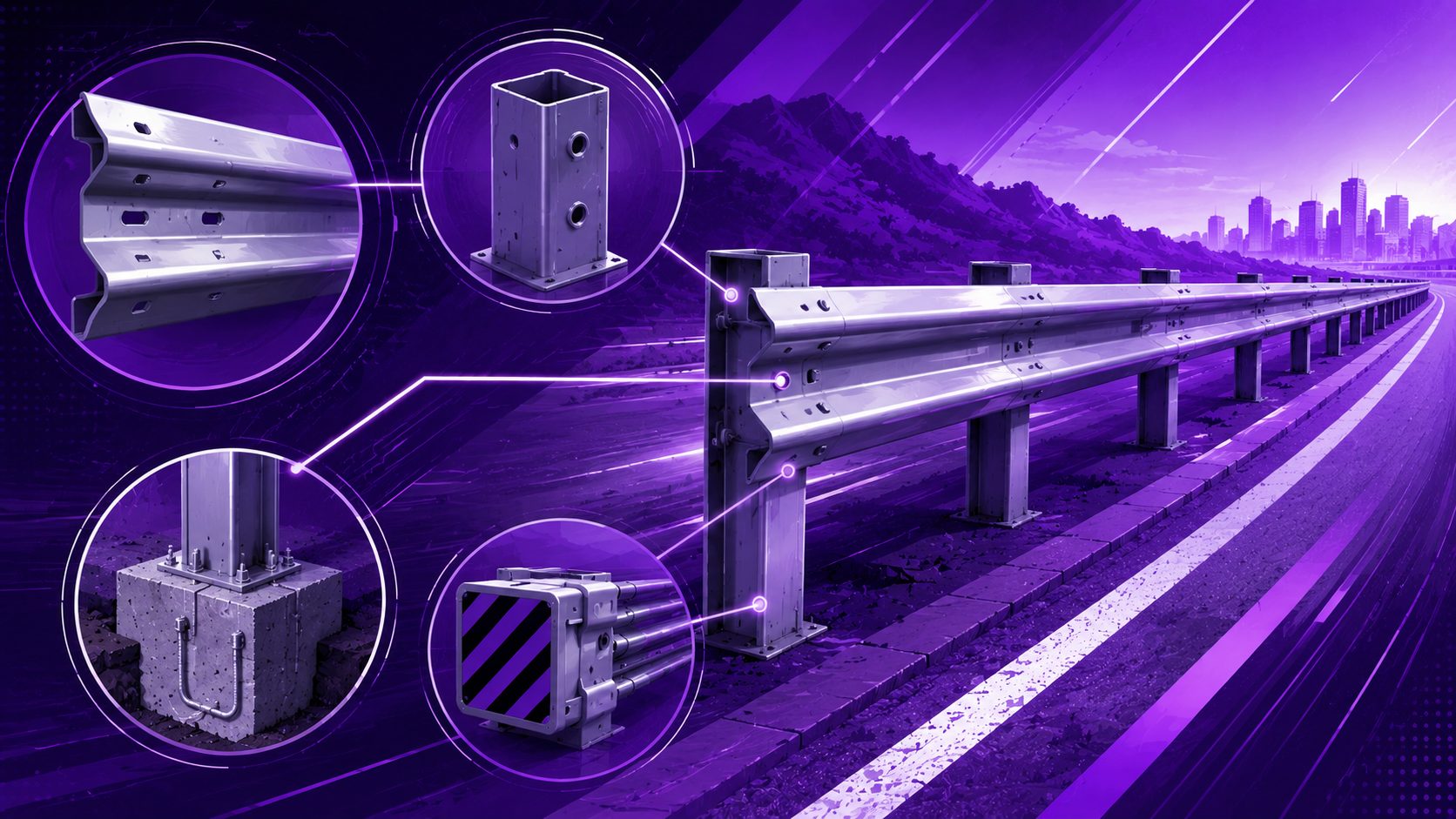
Although designs vary, most crash barrier systems contain several core components:
- Rails – guide and redirect vehicle movement.
- Posts – provide structural support.
- Anchoring systems – secure the barrier to the surface.
- Energy absorption elements – help reduce impact forces.
Barrier selection directly affects safety performance. Vehicle speed, traffic volume, installation environment, and impact requirements all influence which crash barrier type performs best. Choosing the right system improves protection, supports operational safety, and strengthens long-term infrastructure reliability.
Crash barrier types based on design
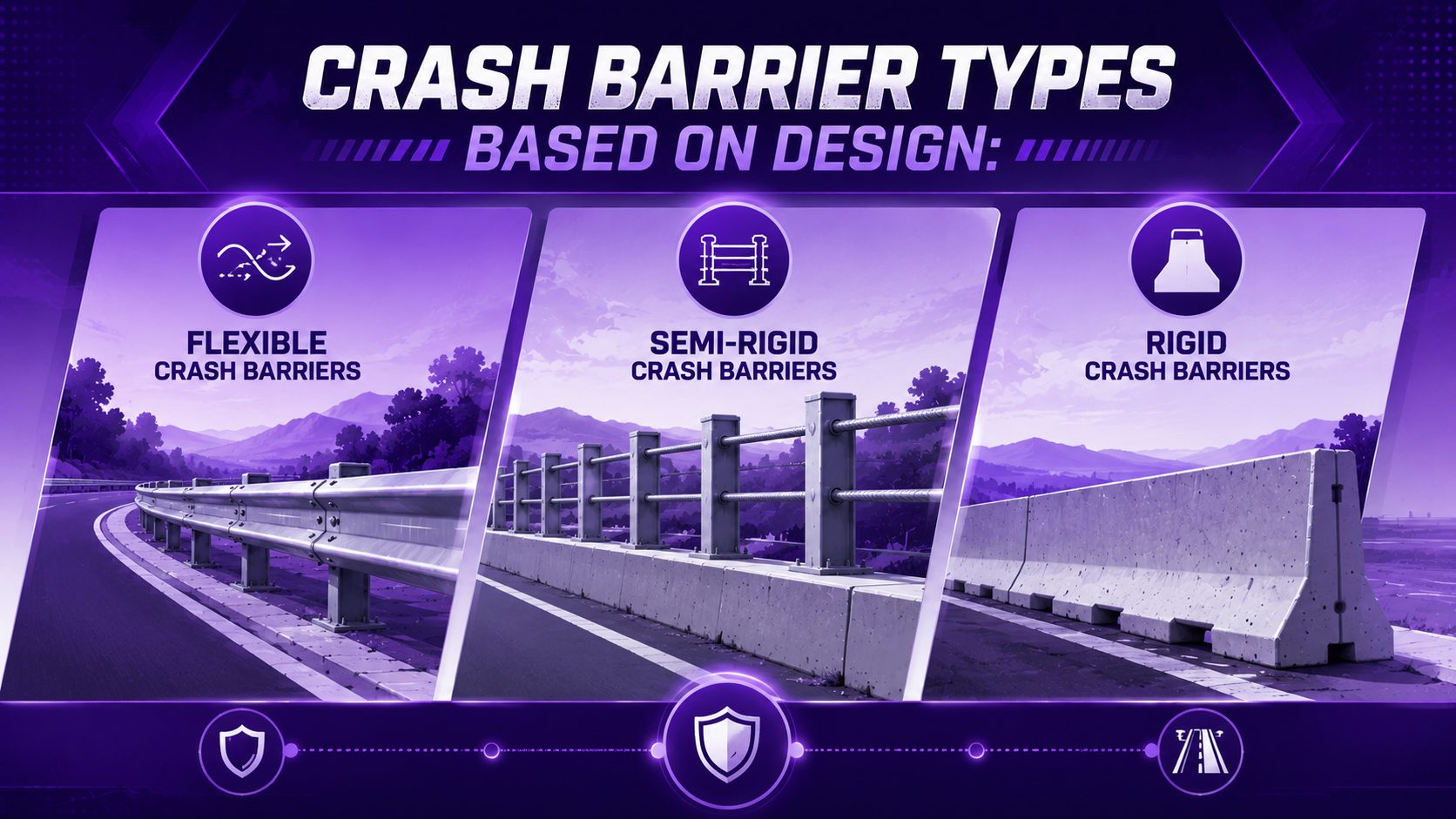
Crash barriers use different structural designs to manage impact forces and improve safety outcomes. The way a barrier absorbs, redirects, or resists impact determines where it performs best. The three main categories are flexible, semi-rigid, and rigid crash barriers.
Flexible crash barriers
Flexible crash barriers absorb impact energy by allowing controlled movement during a collision. These systems bend or deflect when a vehicle strikes them, helping reduce sudden impact forces.
Wire rope barriers and cable barrier systems are common examples. They use tensioned steel cables supported by posts to absorb collision energy and redirect vehicles safely.
These barriers often work well in:
- Highway medians
- High-speed roads
- Wide roadside areas
- Locations where space allows barrier movement
Flexible systems generally require more clearance behind the barrier because they move further during impact.
Semi-rigid crash barriers
Semi-rigid crash barriers provide a balance between flexibility and vehicle containment. They absorb some impact energy while maintaining stronger resistance against vehicle penetration.
Metal beam barriers are the most common category. Popular options include:
W-beam crash barriers – widely used on highways and roadside sections.
Thrie-beam crash barriers – designed with additional structural strength for higher containment needs.
Semi-rigid barriers usually require less deflection space than flexible systems while still reducing impact severity. Their versatility makes them suitable for highways, industrial zones, bridges, and infrastructure projects.
Rigid crash barriers
Rigid crash barriers resist movement during impact. These systems rely on structural strength rather than deflection to contain vehicles. Concrete crash barriers are the most common rigid barrier type. They show minimal movement during collisions and perform well in areas where available installation space is limited.
Common applications include:
- Bridges
- Highway medians
- Toll plazas
- Urban roads
- High-risk traffic corridors
The table below shows how containment behaviour differs across barrier designs:
| Barrier type | Impact behaviour | Space requirement |
|---|---|---|
| Flexible | High deflection | Higher |
| Semi-rigid | Moderate deflection | Medium |
| Rigid | Minimal deflection | Lower |
Barrier design selection depends on traffic conditions, available space, safety objectives, and installation requirements. Choosing the right design improves long-term safety performance and operational protection.
Crash barrier types based on material
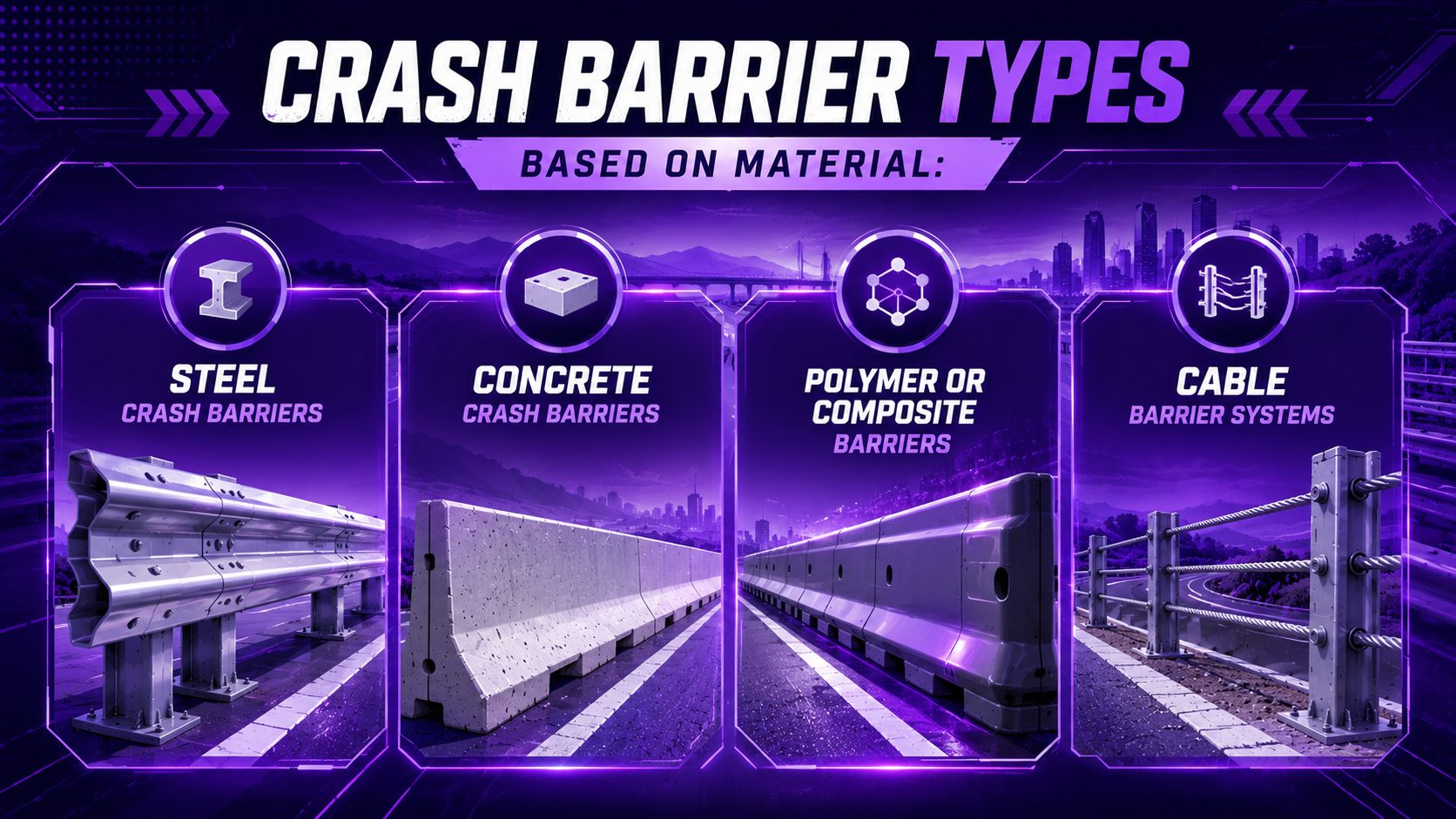
Crash barrier materials influence strength, durability, maintenance needs, and long-term performance. Different environments require different material properties, especially in infrastructure, industrial, and transport applications. Selecting the right material helps improve safety outcomes and supports long-term operational reliability.
Steel crash barriers
Steel crash barriers are among the most widely used safety systems across highways and infrastructure projects. They offer high strength and reliable impact performance while remaining cost-effective for large-scale installations.
Most highway crash barriers use galvanised steel to improve corrosion resistance and extend service life. The protective coating helps barriers withstand weather exposure and demanding outdoor conditions.
Steel barriers commonly appear in:
- Highways
- Expressways
- Bridges
- Industrial access roads
- Infrastructure corridors
Their balance of strength, durability, and scalability makes them a common choice for transport projects.
Concrete crash barriers
Concrete crash barriers prioritise durability and structural stability. These barriers resist movement during impact and work well in locations where strong vehicle containment is required. They suit permanent infrastructure environments because they require limited structural changes after installation. Concrete barriers also perform well in areas exposed to heavy traffic volumes.
Common applications include:
- Highway medians
- Bridges
- Toll plazas
- Urban road networks
Their long operational life often makes them suitable for fixed infrastructure projects.
Polymer or composite barriers
Polymer and composite barriers provide lightweight protection solutions for controlled environments. These systems often support industrial safety requirements where heavy-duty vehicle containment is not the primary objective. Industrial facilities and warehouses may use these barriers to protect equipment, storage areas, and pedestrian movement zones. Their lower weight can also simplify installation and repositioning.
Cable barrier systems
Cable barrier systems use steel cables under tension to absorb collision forces. Their flexibility helps reduce impact severity while redirecting vehicles safely. These systems commonly protect highway medians and roadside sections where space allows barrier movement during impact.
The table below highlights key material considerations:
| Material type | Key advantage | Common consideration |
|---|---|---|
| Steel | Strength and versatility | Periodic maintenance |
| Concrete | Durability | Higher installation weight |
| Polymer or composite | Lightweight handling | Application suitability |
| Cable systems | Energy absorption | Space requirements |
Material selection should consider environmental exposure, corrosion resistance, maintenance requirements, traffic conditions, and project lifespan to achieve reliable long-term performance.
Crash barrier types based on application area
Crash barrier requirements vary across environments because traffic movement, operational risks, and safety priorities differ from one location to another. Barrier selection depends on factors such as vehicle speed, impact exposure, available space, and protection requirements.
Highway crash barriers
Highway crash barriers protect vehicles from roadside hazards and reduce collision severity at higher travelling speeds. These systems often appear along road edges, medians, and curved sections where vehicles face increased accident risks.
Safety priorities include:
- Vehicle containment
- Impact energy management
- Reduced crossover accidents
Highway barriers typically require strong performance under high-speed traffic conditions.
Median crash barriers
Median crash barriers separate opposing traffic lanes to prevent vehicles from crossing into oncoming traffic. They play an important role on highways and expressways with heavy vehicle movement.
Operational requirements often focus on:
- Vehicle redirection
- Cross-median collision prevention
- Reliable containment performance
Barrier design selection depends on traffic speed, road width, and available installation space.
Bridge crash barriers
Bridge crash barriers protect vehicles from edge impacts and help improve safety on elevated structures. Space limitations often influence barrier design because bridges allow limited deflection areas.
Safety priorities usually include:
- Strong containment capability
- Structural stability
- Long-term durability
Bridge installations often require barriers designed for permanent infrastructure conditions.
Industrial safety barriers
Industrial facilities use crash barriers to protect workers, machinery, equipment, and operational zones. Vehicle movement inside factories, manufacturing sites, and logistics facilities creates different safety risks compared to public roads.
These barriers commonly support:
- Worker protection
- Equipment safety
- Vehicle route management
Warehouse protection barriers
Warehouses use protective barriers around storage systems, loading areas, and pedestrian pathways. Forklifts and material handling vehicles create regular movement risks that require dedicated protection systems. Operational priorities focus on reducing infrastructure damage and improving workplace safety.
Parking facility barriers
Parking structures use barriers to guide vehicle movement and reduce collision risks in confined environments.
Temporary construction zone barriers
Construction projects use temporary barriers to separate work areas from moving traffic. These systems prioritise flexibility, visibility, and worker protection while supporting changing site requirements.
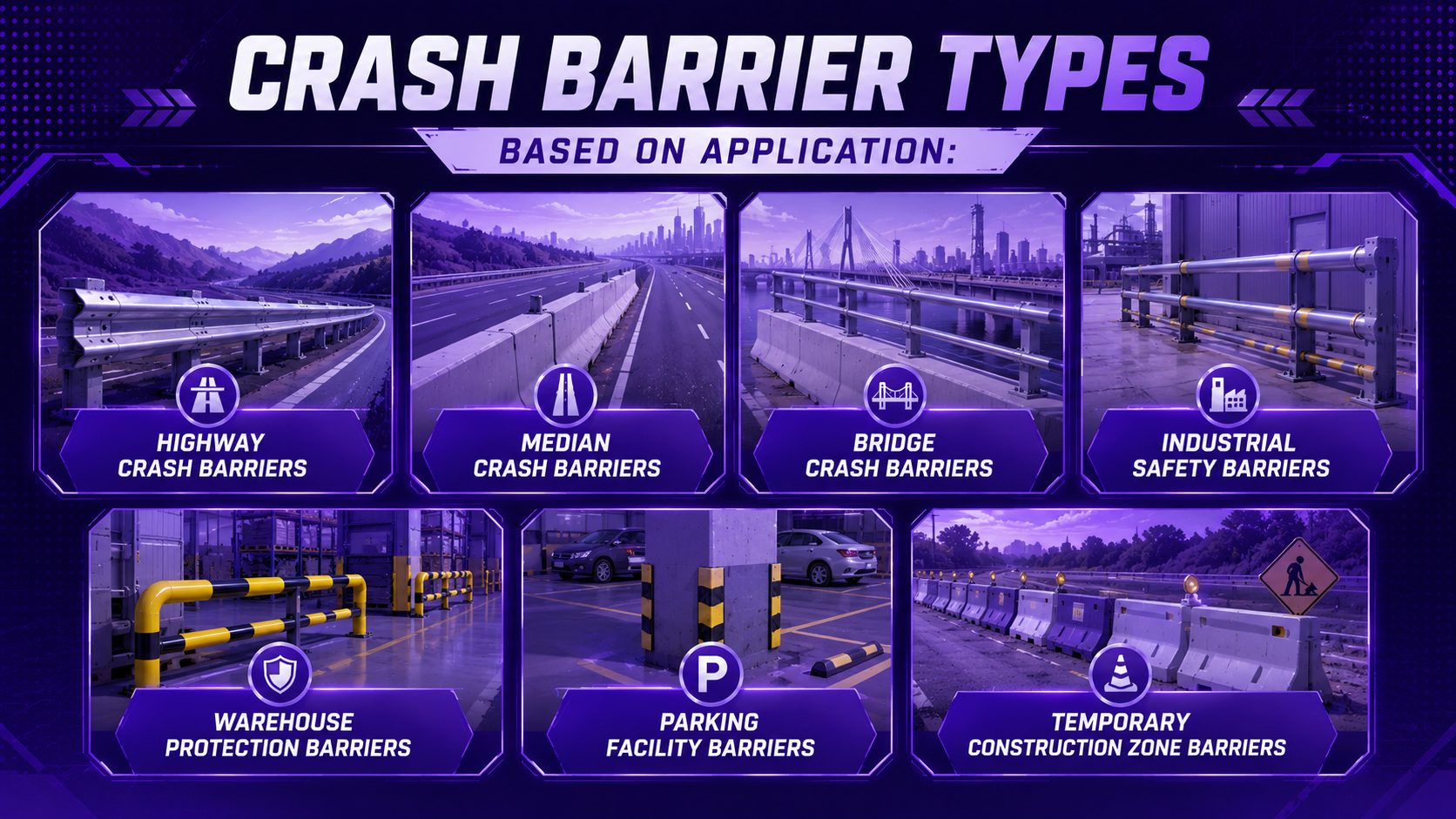
Different environments require different crash barrier solutions. Matching barrier design to operational conditions improves safety performance and long-term infrastructure protection.
How to choose the right crash barrier type
Selecting the right crash barrier involves more than choosing a material or design. Project requirements, operating conditions, and long-term performance all influence which barrier system delivers the best results. A barrier that performs well on a highway may not suit a warehouse, industrial facility, or bridge project.
Procurement teams, infrastructure planners, contractors, and MSMEs involved in steel purchasing or project execution should evaluate multiple factors before deciding.
| Selection Factor | Why it matters |
|---|---|
| Traffic conditions | Traffic volume, vehicle speed, and road layout influence barrier performance requirements. Higher-speed environments often require stronger containment capabilities. |
| Vehicle type and impact load | Heavy commercial vehicles, industrial equipment, and passenger vehicles create different impact forces. Barrier selection should align with expected loading conditions. |
| Installation location | Highways, bridges, warehouses, ports, and industrial facilities operate under different safety requirements. Installation conditions influence barrier design choices. |
| Deflection requirements | Some crash barriers move during impact while others remain largely fixed. Available space behind the barrier affects system suitability. |
| Safety standards and compliance | Projects should align barrier selection with relevant safety specifications and performance requirements to support reliable protection. |
| Maintenance needs | Some barrier systems require more frequent inspection, repair, or component replacement. Maintenance planning influences long-term operating costs. |
| Environmental exposure | Outdoor installations may face moisture, heat, corrosion, or heavy weather exposure. Material durability affects long-term performance. |
| Project budget and lifecycle cost | Initial purchase cost matters, but ownership costs across the barrier lifecycle often influence long-term project value. |
For MSMEs and infrastructure buyers, procurement planning should balance immediate project budgets with long-term ownership considerations. A lower upfront cost does not always deliver the best long-term outcome.
Infrastructure lifecycle thinking helps businesses evaluate durability, maintenance requirements, replacement timelines, and operational reliability before investing in a crash barrier system. A structured selection approach supports stronger safety performance and more efficient project planning.
Factors that affect crash barrier performance
Crash barrier performance depends on more than barrier design alone. Traffic conditions, environmental exposure, installation quality, and operational demands all influence how effectively a barrier absorbs impact energy and protects vehicles, people, and infrastructure.
Vehicle speed
Higher vehicle speeds generate greater impact forces during collisions. Barrier systems installed on highways and expressways often require stronger containment capability to manage higher-speed traffic conditions.
Vehicle weight
Impact requirements vary between passenger vehicles, heavy commercial vehicles, forklifts, and industrial transport equipment. Barrier selection should align with expected vehicle loads to improve safety performance.
Impact angle
The angle at which a vehicle strikes a barrier affects how collision forces spread across the system. Barrier performance can change significantly depending on impact direction and collision severity.
Road conditions
Road geometry, curves, slopes, traffic density, and surrounding infrastructure influence barrier effectiveness. Installation planning should consider operating conditions to support reliable protection.
Installation quality
Even high-quality crash barriers may not deliver expected performance if installation quality falls below project requirements. Correct placement, anchoring systems, and structural support play an important role in long-term safety outcomes.
Barrier material
Steel, concrete, cable systems, and composite materials behave differently under impact conditions. Material properties directly influence containment capability, durability, and energy absorption performance.
Weather exposure
Outdoor barriers face moisture, temperature changes, corrosion risks, and environmental wear over time. Material durability and protective finishes affect long-term barrier reliability.
Maintenance condition
Regular inspections and maintenance help preserve crash barrier performance. Damaged components, corrosion, or structural wear can reduce protection capability if left unaddressed.
Crash barrier safety depends on selecting the right system and maintaining it properly throughout its operational life. Understanding the factors affecting crash barriers helps infrastructure planners, contractors, industrial facilities, and procurement teams make stronger long-term decisions.
Conclusion
Crash barriers support safer transport networks and operational environments by addressing different protection needs across roads, industrial sites, and infrastructure projects. Design type, material selection, and installation conditions all influence how effectively a barrier performs over time. Selecting the right system helps strengthen long-term safety outcomes and reduce asset damage risks. Before procurement, project teams should evaluate operational requirements carefully to identify a crash barrier solution that aligns with performance expectations and site conditions.
Looking to procure steel?
Tata nexarc helps manufacturers, builders and MSMEs source certified steel products, compare prices, and choose the right grade as per IS codes—with complete traceability and procurement confidence.
FAQs
What are the main types of crash barriers?
Which crash barrier is best for highways?
What is the difference between W-beam and thrie-beam crash barriers?
Why do highways use median crash barriers?
Which material is commonly used for crash barriers?
How do crash barriers absorb impact energy?
Where are industrial crash barriers commonly installed?
What factors affect crash barrier performance?
Why is crash barrier maintenance important?
How do businesses choose the right crash barrier type?
A product manager with a writer's heart, Anirban leverages his 6 years of experience to empower MSMEs in the business and technology sectors. His time at Tata nexarc honed his skills in crafting informative content tailored to MSME needs. Whether wielding words for business or developing innovative products for both Tata Nexarc and MSMEs, his passion for clear communication and a deep understanding of their challenges shine through.