
Table of Contents
- What was Udyog Aadhaar?
- Why was Udyog Aadhaar Replaced by the Udyam Portal?
- Udyog Aadhaar vs Udyam Portal
- How to Verify an Old Udyog Aadhaar Registration
- Migrating from Udyog Aadhaar to the Udyam Portal
- Is Udyog Aadhaar Still Valid?
- Common Udyog Aadhaar Migration Issues and Solutions
- Conclusion
- FAQs
Many businesses in India still hold a Udyog Aadhaar Memorandum (UAM) issued before the MSME registration system changed. Since July 2020, the Government has replaced Udyog Aadhaar with the Udyam Portal as the official platform for MSME registration. As a result, many entrepreneurs continue searching for answers about their old UAM records, whether they remain valid, how to verify them, and if migration is required. Understanding the transition from Udyog Aadhaar to Udyam Portal is important for keeping your business records up to date and avoiding confusion.

This guide explains what changed, why the new system was introduced, how to verify an old Udyog Aadhaar registration, how migration works, and the common issues businesses may face during the transition.
What was Udyog Aadhaar?
Introduction: Udyog Aadhaar was the Government of India’s online registration system for Micro, Small and Medium Enterprises (MSMEs). It was introduced in September 2015 to make MSME registration faster, simpler, and completely paperless.
Udyog Aadhaar Memorandum (UAM): Businesses that completed the registration received a unique Udyog Aadhaar Memorandum (UAM) number and certificate. This served as proof of MSME registration under the system at the time.
Aadhaar-based registration: The process relied primarily on the business owner’s Aadhaar number and self-declared business information. It significantly reduced paperwork compared with the earlier Entrepreneur Memorandum (EM) registration process.
Who used Udyog Aadhaar?: Millions of proprietorships, partnership firms, companies, LLPs, co-operative societies, and other eligible enterprises registered through the Udyog Aadhaar portal to obtain MSME recognition.
Why many businesses still have a UAM certificate: Udyog Aadhaar remained the official MSME registration system until the launch of the Udyam Portal in July 2020. As a result, many businesses established before that date still possess a UAM certificate and may need to verify or migrate their legacy registration.
Related guides: Learn more about What is MSME Registration? and Udyam Registration to understand how the current MSME registration system works.
Why was Udyog Aadhaar replaced by the Udyam Portal?
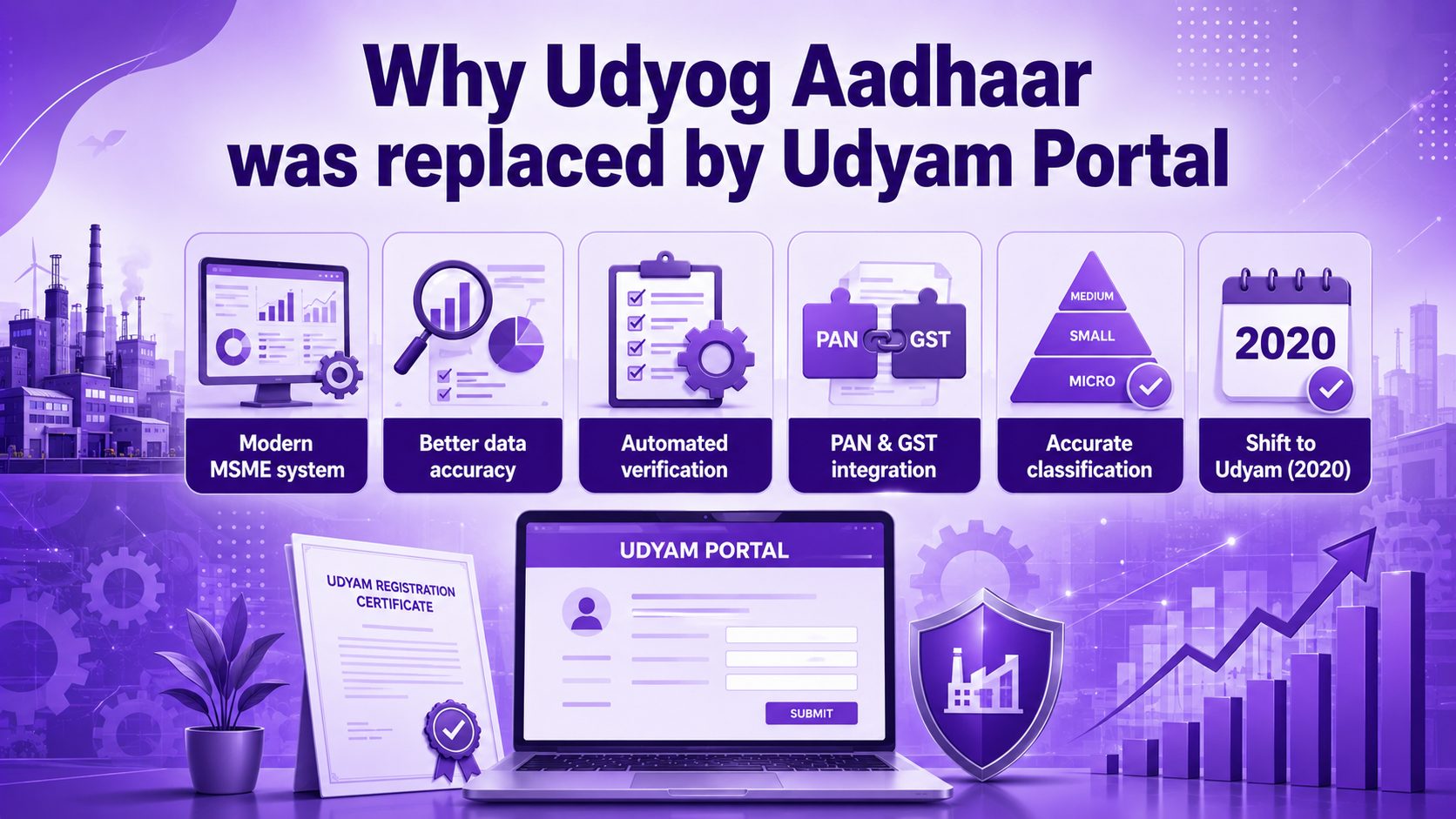
To modernise the MSME registration system
As India’s MSME sector expanded, the Government needed a more reliable and transparent registration framework. Udyog Aadhaar simplified MSME registration when it was introduced in 2015, but the growing number of enterprises highlighted the need for a system that could maintain more accurate and up-to-date business records.
To address the limitations of self-declared information
Udyog Aadhaar relied largely on information entered by applicants without automatic verification. While this made registration quick, it also increased the possibility of incorrect, outdated, or duplicate records. A more robust system was needed to improve the quality of MSME data.
To enable automated verification
The Udyam Portal introduced automated verification of key business details through government databases. This reduced manual validation, improved data accuracy, and made it easier to maintain consistent records throughout an enterprise’s lifecycle.
To integrate with PAN and GST databases
Unlike the earlier system, the Udyam Portal connects with PAN and GST records where applicable. This allows important business information to be validated automatically, reducing errors, and minimising the need for repeated document checks.
To improve MSME classification
The new system also supports more accurate enterprise classification by using verified financial information instead of relying only on self-declared details. This helps ensure that businesses are classified under the appropriate MSME category based on the prevailing government criteria.
The transition to the Udyam Portal
To support these improvements, the Government introduced the Udyam Registration system on 1 July 2020, replacing Udyog Aadhaar as the official MSME registration platform. Businesses with existing Udyog Aadhaar Memorandum (UAM) registrations were required to migrate to the new framework to align with the updated system.
Udyog Aadhaar vs Udyam Portal
Although both systems were introduced to simplify MSME registration, the Udyam Portal is an upgraded framework that offers better verification, improved data accuracy, and closer integration with government databases. The table below highlights the key differences between the two systems.
| Feature | Udyog Aadhaar | Udyam Portal |
|---|---|---|
| Launch year | September 2015 | July 2020 |
| Purpose | Simplified MSME registration through self-declaration | Unified and verified MSME registration system |
| Registration identifier | Udyog Aadhaar Memorandum (UAM) Number | Udyam Registration Number (URN) |
| Official registration document | Udyog Aadhaar Certificate (UAM Certificate) | Udyam Registration Certificate |
| Application basis | Aadhaar and self-declared business details | Aadhaar with automatic verification of business information |
| Verification | Limited verification of submitted information | Automated verification through linked government records |
| PAN integration | Not mandatory for all registrations | Integrated with PAN records for validation |
| GST integration | Not integrated | Integrated with GST records where applicable |
| Enterprise classification | Based largely on self-declared information | Based on verified investment and turnover data under the applicable MSME criteria |
| Government database integration | Minimal integration | Connected with Income Tax and GST databases for data validation |
| Data accuracy | Depended on applicant declarations | Improved through automated verification and periodic updates |
| Duplicate record control | Greater possibility of duplicate or inconsistent records | Better checks to reduce duplicate registrations |
| Migration support | No migration facility, as it was the original system | Dedicated migration support for eligible legacy UAM holders |
| Current status | Discontinued for new registrations | Official MSME registration platform currently in use |
Udyog Aadhaar served as the foundation for simplified MSME registration, while the Udyam Portal introduced a more reliable and data-driven framework. The transition ensured that enterprise records could be verified more accurately and maintained through a single official registration system.
How to verify an old Udyog Aadhaar Registration
Verifying an old Udyog Aadhaar registration helps confirm whether your legacy UAM record is available and whether the details match your business information. It is particularly useful before migrating to the Udyam Portal or when your UAM certificate is required for reference.
When is verification needed?
You may need to verify your Udyog Aadhaar registration if you:
- Want to migrate from Udyog Aadhaar to the Udyam Portal
- Cannot locate your UAM certificate
- Need to confirm your UAM number
- Want to check whether your legacy registration exists in the official records
- Information required
Before starting the verification process, keep the following details ready
| Required information | Purpose |
|---|---|
| Udyog Aadhaar Memorandum (UAM) Number | Identifies your legacy registration |
| Aadhaar Number | Helps verify the registered applicant |
| Registered mobile number | Required for OTP-based verification in certain services |
Online verification process
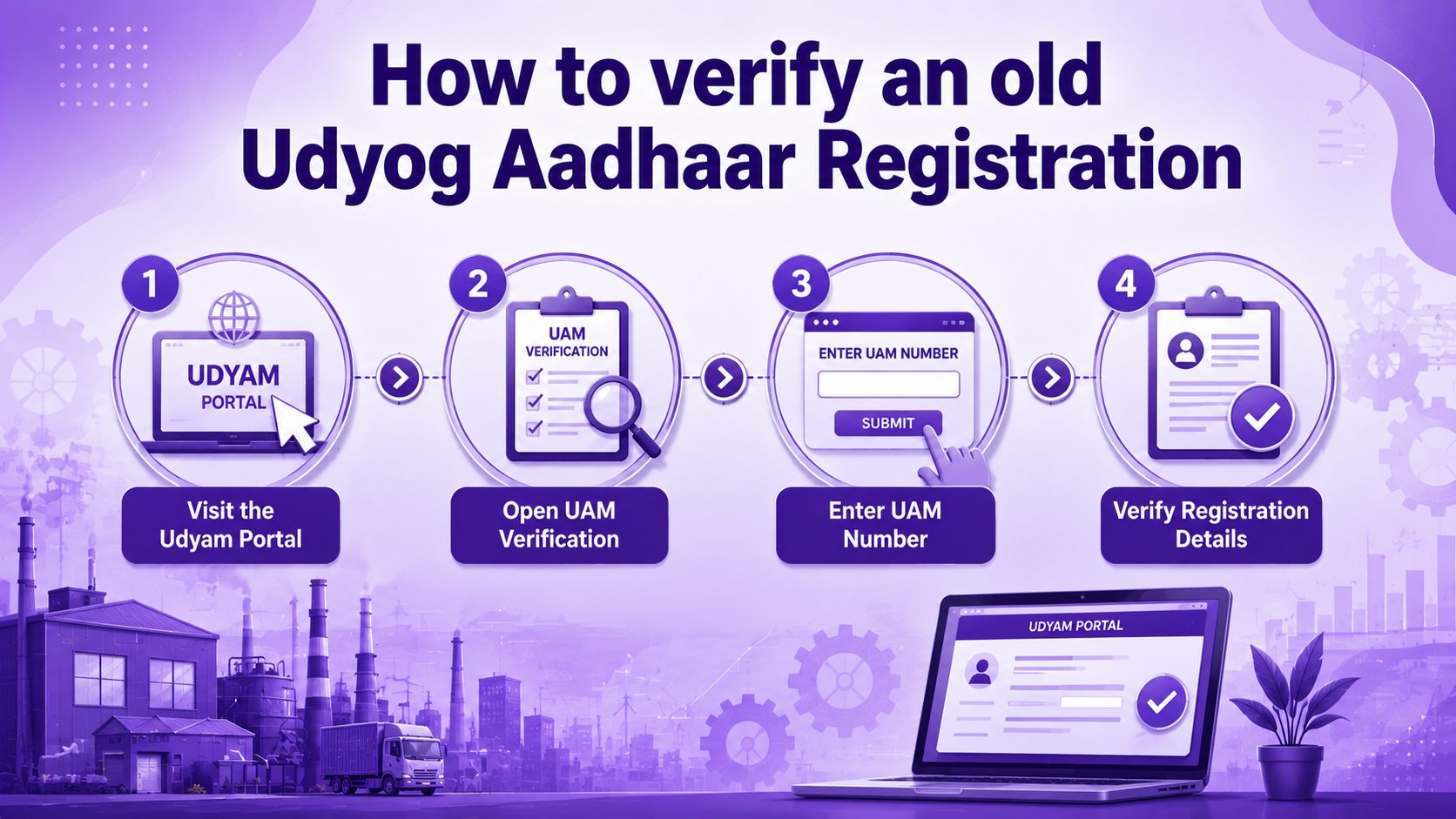
Step 1: Visit the official Udyam Registration Portal.
Step 2: Open the UAM Verification page.
Step 3: Enter your UAM number and complete the required verification.
Step 4: Submit the details to check whether the registration exists in the official database.
Forgot your UAM number?
If you cannot remember your UAM number, use the “Forgot UAM/Udyam Registration Number” service available on the official portal. After verifying your identity, you can retrieve your registration number using the details linked to your original application.
What if your records cannot be found?
If your UAM details are unavailable, first check that you have entered the correct information. If the issue continues, use the official recovery service or contact the Udyam helpdesk for assistance. Businesses that registered many years ago should also verify whether their legacy registration requires migration to the current Udyam framework.
Migrating from Udyog Aadhaar to the Udyam Portal
Businesses with an existing Udyog Aadhaar Memorandum (UAM) should migrate to the Udyam Portal to align their legacy registration with the current MSME registration framework. The migration process updates the registration under the new system without requiring businesses to continue using the discontinued Udyog Aadhaar platform.
Who should migrate?
Migration is generally applicable to enterprises that
- Hold a valid Udyog Aadhaar Memorandum (UAM)
- Were registered before the Udyam Portal was introduced in July 2020
- Need their MSME records to reflect the current registration framework
- Assisted migration
The official Udyam Portal provides a dedicated UAM Migration option along with an Assisted Migration facility. These services are designed to help eligible businesses move their legacy registration to the Udyam system while validating the required business details.
General migration workflow
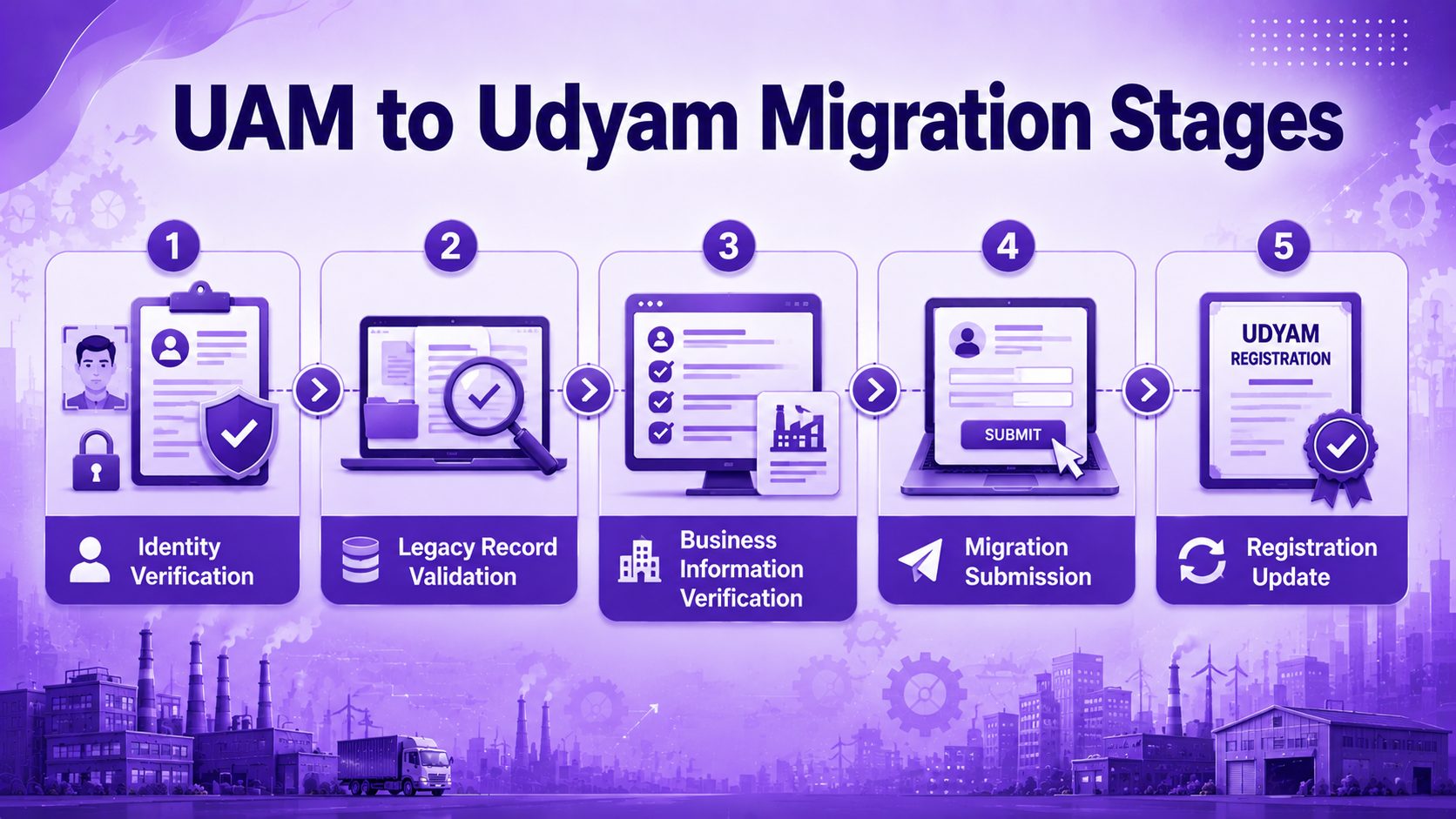
The migration process is straightforward and involves verifying existing records rather than creating a completely new registration.
| Stage | What happens |
|---|---|
| Identity verification | The applicant’s details are verified using the applicable credentials. |
| Legacy record validation | The existing UAM registration is matched with official records. |
| Business information verification | Relevant business details are validated through the required government databases. |
| Migration submission | The migration request is submitted for processing. |
| Registration update | The enterprise is brought under the Udyam Registration framework. |
What happens after successful migration?
Once the migration is completed successfully, the enterprise becomes part of the Udyam Registration system. The business can then use its updated registration details for future MSME-related requirements and services under the current framework.
Note: This section provides only an overview of the migration process. If you are looking for detailed instructions, read our step-by-step guide to Udyam Registration.
Is Udyog Aadhaar still valid?
Current legal position: Udyog Aadhaar is no longer the active MSME registration system in India. The Government introduced the Udyam Registration system on 1 July 2020, making it the official platform for MSME registration. Enterprises with earlier EM-II or Udyog Aadhaar Memorandum (UAM) registrations were required to re-register under the Udyam framework.
Can you apply for a new Udyog Aadhaar?: No. New Udyog Aadhaar registrations are no longer accepted. Businesses seeking MSME registration must use the Udyam Portal.
Can old Udyog Aadhaar certificates still be referenced?: Yes. Existing UAM certificates may still be useful as legacy records or for verifying previous registration details. However, they are no longer issued to new applicants.
Why should businesses complete migration?: Migrating ensures that your enterprise is reflected under the current MSME registration framework. It also helps keep business records aligned with the latest government system and reduces confusion when dealing with registration-related requirements.
What does this mean for banks and government departments?: Many banks, financial institutions and government authorities now expect businesses to provide their Udyam Registration details for MSME-related services, schemes or verification. Keeping your registration updated can make future interactions smoother and help avoid delays caused by relying only on legacy UAM records.
Common Udyog Aadhaar migration issues and solutions
Most businesses complete the migration without major difficulties. However, older registrations may have outdated contact details or information that no longer matches current government records. The table below outlines some of the most common issues and practical ways to resolve them.
| Migration issue | Possible reason | Practical solution |
|---|---|---|
| Forgot UAM number | The UAM certificate has been misplaced or the registration number is unavailable. | Use the official “Forgot UAM/Udyam Registration Number” service to retrieve your registration details. |
| Registered mobile number has changed | The mobile number linked to the original UAM registration is no longer active. | Follow the guidance provided on the official portal or contact the Udyam helpdesk if OTP verification cannot be completed. |
| Registered email is inaccessible | The email address is no longer in use or cannot be accessed. | Use alternative recovery options available on the official portal or seek assistance through the support channels. |
| Aadhaar details do not match | The Aadhaar information entered during migration differs from the official records. | Verify the Aadhaar details carefully and ensure the information matches exactly before submitting the request again. |
| PAN mismatch | Business or proprietor PAN details differ from the linked government records. | Check the PAN details for accuracy and update any inconsistencies before attempting migration. |
| Duplicate registration message | Another registration may already exist for the same enterprise or applicant. | Review existing MSME registrations and avoid creating multiple records for the same business. |
| Legacy UAM record cannot be found | The registration details entered are incorrect or the record needs further verification. | Recheck the UAM number and Aadhaar details. If the issue persists, contact the official Udyam support team for assistance. |
Most migration-related issues can be resolved by verifying the information entered and using the official recovery and support services. If your legacy registration still cannot be located, it is advisable to seek guidance from the Udyam helpdesk before attempting another migration request.
Conclusion
The transition from Udyog Aadhaar to Udyam Portal marked an important step in modernising India’s MSME registration framework. While many businesses still hold legacy UAM records, keeping those records aligned with the current system is equally important. If your enterprise was registered under the earlier framework, take the time to verify your registration details and complete migration where applicable. This helps ensure your business information remains current and ready whenever you need to access MSME-related services or official verification in the future.
Empowering MSMEs to grow smarter
Tata nexarc delivers powerful solutions for MSMEs—discover tenders, logistics solutions, and streamline procurement. Everything your business needs, all in one place.
FAQs
How can you verify your Udyog Aadhaar number?
How can I check my Udyam Registration certificate validity?
Can I verify Udyog Aadhaar if I lost the original certificate?
What if the mobile number linked to my Udyog Aadhaar is inactive?
Can I verify someone else’s Udyog Aadhaar Number?
Is there a deadline to verify Udyog Aadhaar?
Can I use Udyog Aadhaar for GST registration in 2025?
Will Udyog Aadhaar show up in government portals like GeM or Samadhan?
Most government portals now require a valid Udyam Registration. Existing UAM records may not be accepted for new registrations or updates.
Is there a helpline for Udyog Aadhaar-related issues?
Is Aadhaar QR scan required even for Udyog verification?
Priyanka is a seasoned content marketing professional with more than 6 years of experience crafting various forms of business and technology sector content. Her insightful writing tackles critical issues faced by small-scale manufacturing businesses. Priyanka's clear and concise communication empowers businesses to make informed decisions and thrive in today's dynamic business environment.


It is mentioned that businesses with previous UAM registration need to re-register on the Udyam portal. Is there a deadline for this re-registration process?
I’m still confused about the Udyam migration. I registered years ago with Udyog Aadhaar. If this new registration is mandatory, why does the verification portal for my old UAM number still exist? Does this mean I don’t have to re-register? Pls guide Thanks
Hey, don’t stress about the Udyam migration! Your old Udyog Aadhaar still works for now. But, if you want to unlock the full potential of your business, hop on over to Udyam. It’s like a free upgrade with way more perks.
Udyog adhaar number send me
216779770451
337/5/150 mittaPudur Mariamman Kovil Street Halli Muthu theru
Send me number Udyog Aadhar Number
My udyam certificate missing
216779770451
Mera udaymi ragistration nambar khogay hai