Table of Contents
- What is the MSME Amendment Act 2026?
- MSME Classification Changes: What Businesses Need to Watch
- Udyam Registration: What Changes for MSMEs?
- TReDS and Delayed Payments: A Major Change for MSME Cash Flow
- MSME Dispute Resolution: Faster Timelines and Stronger Recovery Mechanisms
- MSME Compliance Penalties: A Shift from Criminalisation to Monetary Penalties
- What the MSME Amendment Act 2026 Means for Businesses
- Conclusion
- FAQs
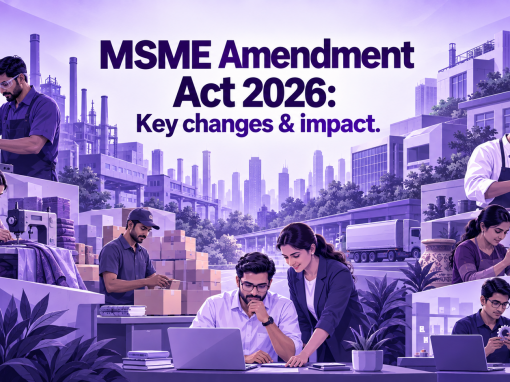
For many MSMEs, growth can bring new challenges. A business may outgrow its existing classification, struggle to keep its registration details updated, or wait months for payments from buyers. The MSME Amendment Act 2026 updates the MSMED Act, 2006 to address some of these concerns and modernise the framework for India’s growing MSME sector. The changes cover MSME classification, digital registration, delayed payments, and dispute resolution. But what changes for an MSME owner now, and which benefits will depend on government notifications and implementation?

What is the MSME Amendment Act 2026?
It is an update to the Micro, Small, and Medium Enterprises Development Act, 2006 (MSMED Act), rather than a completely new law. The original Act provides the legal framework for promoting, developing, and improving the competitiveness of MSMEs in India.
Why was it amended?
The government says the MSME sector has changed significantly since 2006, with wider use of digital systems, larger formal supply chains, and a growing number of registered enterprises. The 2026 changes aim to reduce payment-related constraints, make dispute resolution more time-bound, simplify compliance, and support MSME growth and competitiveness.
What does the amendment cover?
It changes selected provisions of the existing MSMED Act, including MSME classification, Udyam registration, delayed payments, dispute resolution, and compliance requirements.
What happens next?
The key distinction is between passing and implementation. Parliament passed the Bill in August 2026, and the government has outlined the reforms. Businesses must still track the relevant government notifications and commencement dates to understand when specific provisions take effect.
MSME classification changes: What businesses need to watch
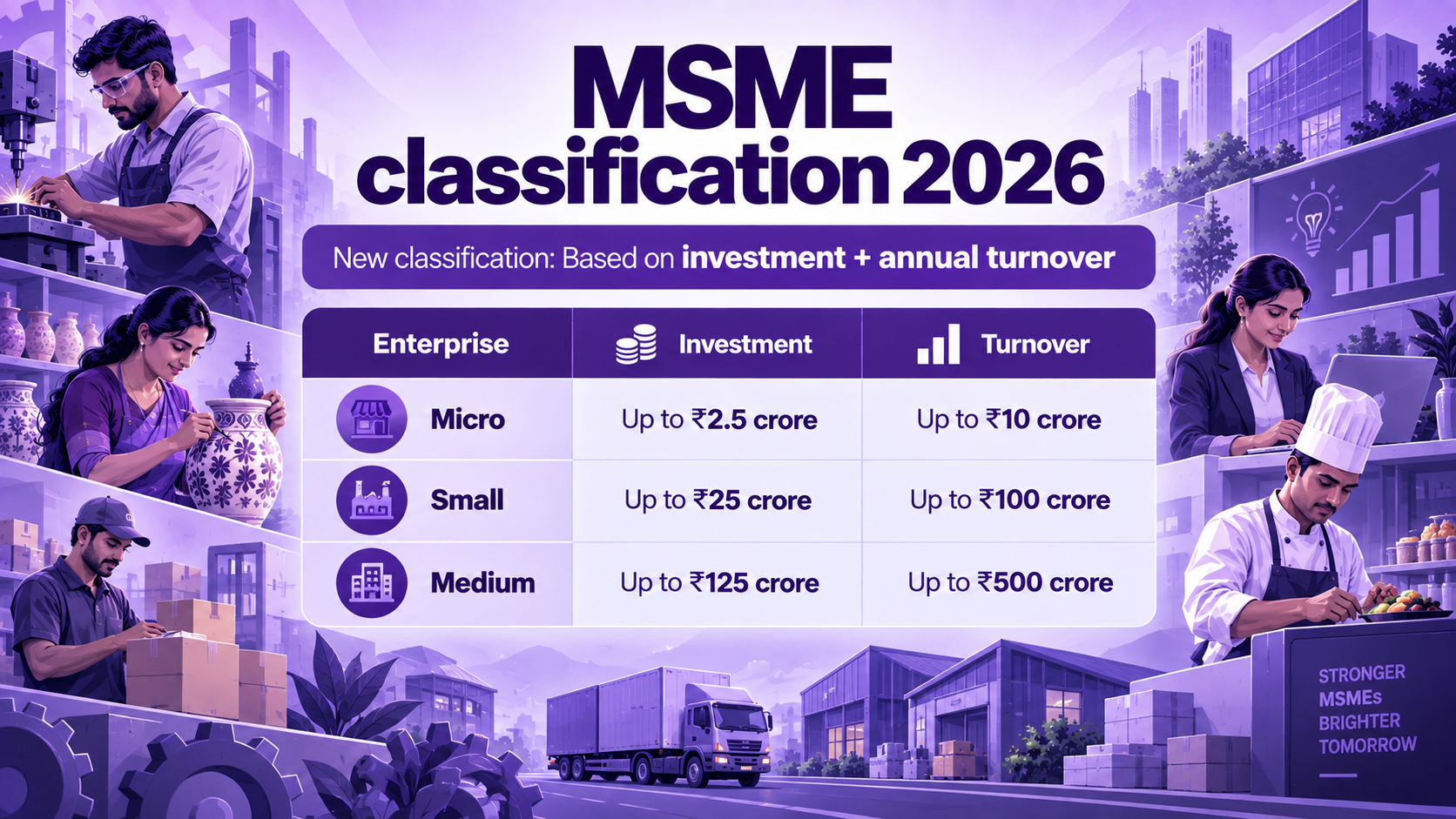
What is changing? The MSME Amendment Act 2026 puts the existing composite classification approach into the MSMED Act, with MSMEs classified using both investment in plant and machinery or equipment and turnover. This replaces the earlier statutory approach that focused on prescribed investment thresholds for manufacturing and services separately.
What are the current MSME limits? The limits already revised from 1 April 2025 are:
| Enterprise | Investment in plant & machinery/equipment | Annual turnover |
| Micro | Up to ₹2.5 crore | Up to ₹10 crore |
| Small | Up to ₹25 crore | Up to ₹100 crore |
| Medium | Up to ₹125 crore | Up to ₹500 crore |
The Ministry of MSME says these higher limits aim to help enterprises achieve greater scale, adopt technology, access capital and improve global competitiveness.
Why does classification matter?
Your MSME category can affect access to government schemes, priority-sector lending, public procurement preferences, and other MSME support measures. The classification also determines whether an enterprise falls within protections and benefits linked to its MSME status.
What should businesses watch?
Do not treat the 2026 amendment as a fresh change to the numerical limits. The important change is that the investment-and-turnover criteria now form part of the amended statutory framework. Businesses should therefore track their investment and turnover regularly and check their Udyam records against the applicable classification.
Udyam registration: What changes for MSMEs?
National digital registration: The MSME Amendment Act 2026 provides for free and voluntary MSME registration through a national digital platform. State Governments can also establish digital platforms for businesses seeking applicable state-level benefits.
Voluntary registration: Registration remains voluntary, but it can be important for businesses seeking recognised MSME status and access to eligible government schemes, benefits and protections under the MSME framework.
Udyam registration process: The official Udyam portal provides a free, paperless and online registration process based on self-declaration. It issues a permanent Udyam Registration Number and certificate, with no renewal required.
Updated business details: MSMEs should keep their Udyam information accurate and current, including details linked to investment, turnover, PAN, and GST records where applicable.
Access to MSME benefits: A valid Udyam registration helps establish MSME status when businesses apply for eligible government support, schemes, and other benefits. Businesses should use the official government Udyam portal for registration and related updates. (udyamregistration.gov.in)
TReDS and delayed payments: A major change for MSME cash flow
Delayed payments can put pressure on an MSME’s working capital even when orders and sales remain strong. The MSME Amendment Act 2026 strengthens the role of TReDS in invoice settlement, particularly for MSME suppliers to Central Public Sector Enterprises (CPSEs). The government had already mandated CPSEs to route MSME invoice settlements through RBI-authorised TReDS platforms from June 2026.
| Aspect | What MSMEs need to know |
| What is TReDS? | TReDS is an electronic platform that enables MSMEs to finance or discount trade receivables through multiple financiers. |
| Who can use it? | MSMEs participate as sellers, while corporates, government departments, and PSUs can participate as buyers. Banks, NBFC-factors and other permitted financial institutions can act as financiers. |
| What changes under the amendment? | CPSEs must route the settlement of invoices for goods and services procured from MSMEs through RBI-authorised TReDS platforms. |
| Which MSMEs benefit? | MSMEs supplying goods or services to CPSEs can benefit from the mandated TReDS settlement mechanism. |
| How does TReDS work? | The MSME or buyer creates a Factoring Unit containing invoice details, the counterparty accepts it, financiers submit bids, and the selected financier pays the MSME at the agreed discount or financing rate. The buyer then pays the financier on the due date. |
| Working-capital benefit | MSMEs can convert eligible receivables into funds earlier instead of waiting until the invoice due date. |
| Payment protection | TReDS can improve payment discipline and liquidity, but it does not guarantee that every invoice will be financed or remove every cause of delayed payment. |
| Cost consideration | Financing involves a discount or financing rate, so MSMEs should compare the cost with their working-capital requirements. |
| Recourse to MSME | RBI states that TReDS transactions are processed without recourse to MSMEs, subject to the applicable framework. |
| Scope beyond CPSEs | The amended framework also provides an enabling mechanism for States to encourage their public sector enterprises to use TReDS for invoice settlement. |
Practical takeaway: MSMEs supplying CPSEs should understand the TReDS process, maintain accurate invoice records and ensure they can use an RBI-authorised platform. This can improve access to working capital, but businesses should not treat TReDS as an automatic payment guarantee.
MSME dispute resolution: Faster timelines and stronger recovery mechanisms
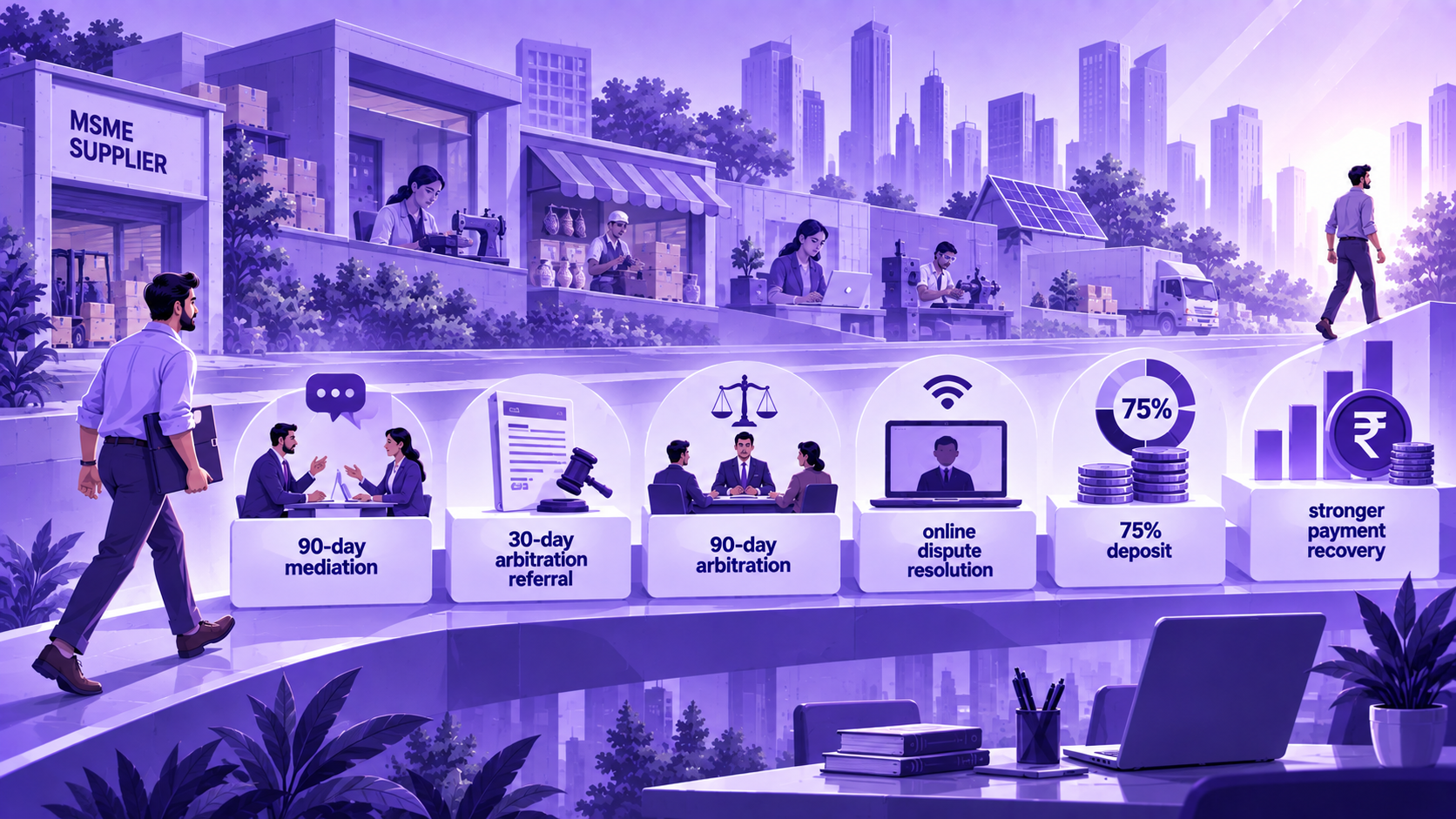
For a micro or small enterprise, a delayed payment dispute can quickly become a working-capital problem. The MSME Amendment Act 2026 introduces clearer timelines, online dispute resolution, and stronger recovery mechanisms for such cases.
| Change | What it means for MSMEs |
| Mediation: 90 days | The MSEFC or mediation service provider must complete mediation within 90 days from the date fixed for the first appearance. |
| Referral to arbitration: 30 days | If mediation ends without settlement, the MSEFC must refer the matter for arbitration within 30 days from the date of termination of mediation. |
| Arbitration: 90 days | The MSEFC or an alternative dispute resolution institution must make the arbitral award within 90 days from completion of pleadings. |
| Online dispute resolution | The amended framework provides for Online Dispute Resolution (ODR) to help MSEs resolve disputes in a timelier and more cost-effective manner. |
| Recovery of awards | A mediated settlement or arbitral award under Section 18 can be recovered as arrears of land revenue through the District Collector, Deputy Commissioner or another notified authority where the buyer’s assets are located. |
| 75% deposit requirement | A buyer challenging a Council order or award in court continues to face the requirement to deposit 75% of the awarded amount. |
| Payment during prolonged court cases | If an application set aside a decree, award or order remains pending for more than six months, the court must order payment of at least 50% of the awarded amount to the MSE supplier. |
| More MSEFCs | The amendment gives States greater flexibility to establish multiple Micro and Small Enterprises Facilitation Councils (MSEFCs) and make rules for their functioning. This can help distribute the dispute workload. |
What this means for MSME payment recovery
The changes aim to make the MSME payment dispute process more predictable. The 90-day timelines can reduce uncertainty around mediation and arbitration, while the revised recovery mechanism can strengthen an MSE supplier’s position after a settlement or award.
The timelines should not be treated as a guarantee that every dispute will close within 90 days. Actual recovery can still depend on the MSEFC, mediation provider, arbitrator, court proceedings, and implementation of the amended framework.
For MSMEs with unpaid invoices: Maintaining contracts, invoices, delivery records, acceptance documents, and payment correspondence will remain important when pursuing an MSEFC dispute or MSME payment recovery claim.
MSME compliance penalties: A shift from criminalisation to monetary penalties
What is changing: The MSME Amendment Act 2026 decriminalises certain offences under the MSMED Act and replaces conviction-based fines with a graded penalty approach. The government says the change aims to make compliance more proportionate and reduce the burden of criminal proceedings.
Non-filing or non-supply of information: These violations are decriminalised under the amended framework, removing the earlier conviction-based penalty.
Incorrect information: Businesses receive a warning for the first instance, followed by a penalty for the second, and subsequent instances.
Non-disclosure of unpaid MSME dues: Buyers receive a warning for the first instance, a penalty for the second, and a fine for the third and subsequent instances.
Adjudication: The revised framework introduces an administrative adjudication mechanism for specified contraventions, rather than relying on criminal prosecution for these violations.
What decriminalisation means: The changes reduce criminal consequences for specified compliance failures, but they do not remove the underlying compliance requirements. Businesses still need to provide accurate information and meet their reporting obligations.
What MSMEs should do: Keep registration and business information accurate, maintain supporting records, monitor applicable notifications, and respond promptly to warnings or penalties.
Key takeaway: Decriminalisation should not be treated as deregulation. The MSME Act penalties now follow a more graded approach, but businesses remain responsible for meeting the requirements that apply to them.
What the MSME Amendment Act 2026 means for businesses
The impact of the 2026 changes will vary by the type of MSME, its customers, and its payment cycle. The practical effects are likely to be most visible in classification, registration, receivables, and dispute handling.
| Change | What it could mean for MSMEs |
| Investment + turnover-based classification | Businesses can assess their MSME category using both investment and turnover criteria. |
| Classification framework in the Act | The statutory framework can better accommodate changes in MSME scale over time. |
| Digital registration | A national digital platform can make MSME registration more accessible and streamlined. |
| TReDS for CPSE procurement | Eligible MSME suppliers to CPSEs can use the mandated TReDS route to manage trade receivables and access financing. |
| 90-day mediation timeline | Payment disputes can move through mediation within a defined statutory timeframe. |
| Time-bound arbitration | Unresolved disputes can progress towards an arbitral award within a defined timeframe. |
| Online dispute resolution | Digital proceedings can reduce some procedural and logistical barriers. |
| Award recovery mechanism | Eligible mediated settlements and arbitral awards can benefit from a strengthened recovery route. |
| Revised penalties | Specified compliance violations move towards warnings and monetary penalties instead of criminal consequences. |
Manufacturers: Track investment in plant and machinery or equipment and turnover to determine the applicable MSME classification.
Traders and service businesses: Keep Udyam registration details and classification-related information accurate and updated.
MSME suppliers to CPSEs: Understand TReDS registration, invoice acceptance, and financing procedures to manage receivables effectively.
Businesses with unpaid invoices: Keep contracts, invoices, delivery records, and payment correspondence organised before pursuing the applicable MSEFC or dispute-resolution process.
Finance teams: Track receivables closely, particularly invoices due from large buyers and CPSEs, to identify cash-flow risks early.
Bottom line: The amendment can give MSMEs a more flexible classification framework, stronger payment infrastructure, and clearer dispute-resolution processes. The actual business impact will depend on the relevant provisions, notifications, and implementation.
Conclusion
The MSME Amendment Act 2026 brings three broad shifts for businesses: a more flexible classification framework, stronger digital and payment infrastructure, and more time-bound dispute resolution. The impact, however, will depend on how the amended provisions and related notifications take effect. MSMEs should therefore track government notifications, keep Udyam registration and business details updated, understand TReDS where applicable, and maintain accurate invoice and payment records. These steps can help businesses prepare for the changes and make better use of the protections and mechanisms available under the updated MSME framework.
Disclaimer: Information is based on official government sources available at the time of publication. MSMEs should check the official Udyam Registration portal and Ministry of MSME websites for the latest updates, notifications, and applicable provisions.
Empowering MSMEs to grow smarter
Tata nexarc delivers powerful solutions for MSMEs—discover tenders, logistics solutions, and streamline procurement. Everything your business needs, all in one place.
FAQs
When will the MSME Amendment Act 2026 come into force?
Has MSME classification changed in 2026?
What are the MSME classification limits in 2026?
What changes for Udyam registration in 2026?
What is TReDS for MSMEs?
Is TReDS mandatory for MSME suppliers?
What is the 90-day MSME dispute resolution rule?
What is the MSEFC under the MSME Act?
Has the MSME Act decriminalised penalties?
What should MSMEs do after the 2026 amendment?
A product manager with a writer's heart, Anirban leverages his 6 years of experience to empower MSMEs in the business and technology sectors. His time at Tata nexarc honed his skills in crafting informative content tailored to MSME needs. Whether wielding words for business or developing innovative products for both Tata Nexarc and MSMEs, his passion for clear communication and a deep understanding of their challenges shine through.