Check Price Now
Table of Contents
- What is LRPC Wire?
- What is LRPC Strand?
- LRPC Wire vs LRPC Strand: Key Differences
- LRPC Wire vs Strand: Which One Should You Choose?
- LRPC Wire and Strand Specifications Buyers Should Check
- LRPC Wire Price per kg vs LRPC Strand Price per kg
- How to Calculate LRPC Wire and Strand Weight
- LRPC Wire vs Strand: Applications by Project Type
- LRPC Wire vs Strand: Procurement Checklist for MSMEs
- Conclusion
- FAQs
LRPC wire vs LRPC strand is an important comparison when buying prestressing steel for construction projects. Both products help prestressed concrete carry high loads, but they differ in construction, handling, installation, and typical use. LRPC wire is generally a single-wire product, while LRPC strand consists of multiple wires twisted together. Both use low-relaxation prestressing steel to help retain prestressing force over time. The right choice depends on the structural application and the specified prestressing system. This guide covers their differences, specifications, applications, prices, weight calculations, and key procurement considerations.
What is LRPC wire?
LRPC wire stands for Low Relaxation Prestressed Concrete wire. It is a high-strength steel wire used to prestress concrete products and structural components. Manufacturers produce it as an individual wire with controlled dimensions and surface quality to meet the requirements of prestressing applications.
How it works: The wire receives tension before or during concrete production. Once the concrete gains sufficient strength, the wire transfers this force to the concrete and creates compression within it. This helps the finished product handle loads and reduce cracking during service.
Why low relaxation matters: LRPC steel wire loses only a small amount of its initial tension over time. This helps the concrete retain the required prestressing force for longer and supports consistent performance throughout the service life of the product.
Surface and finish: Manufacturers control the wire’s surface condition, diameter, straightness, and finish during production. Buyers should check these details against the project specification before placing an order.
Common LRPC wire applications
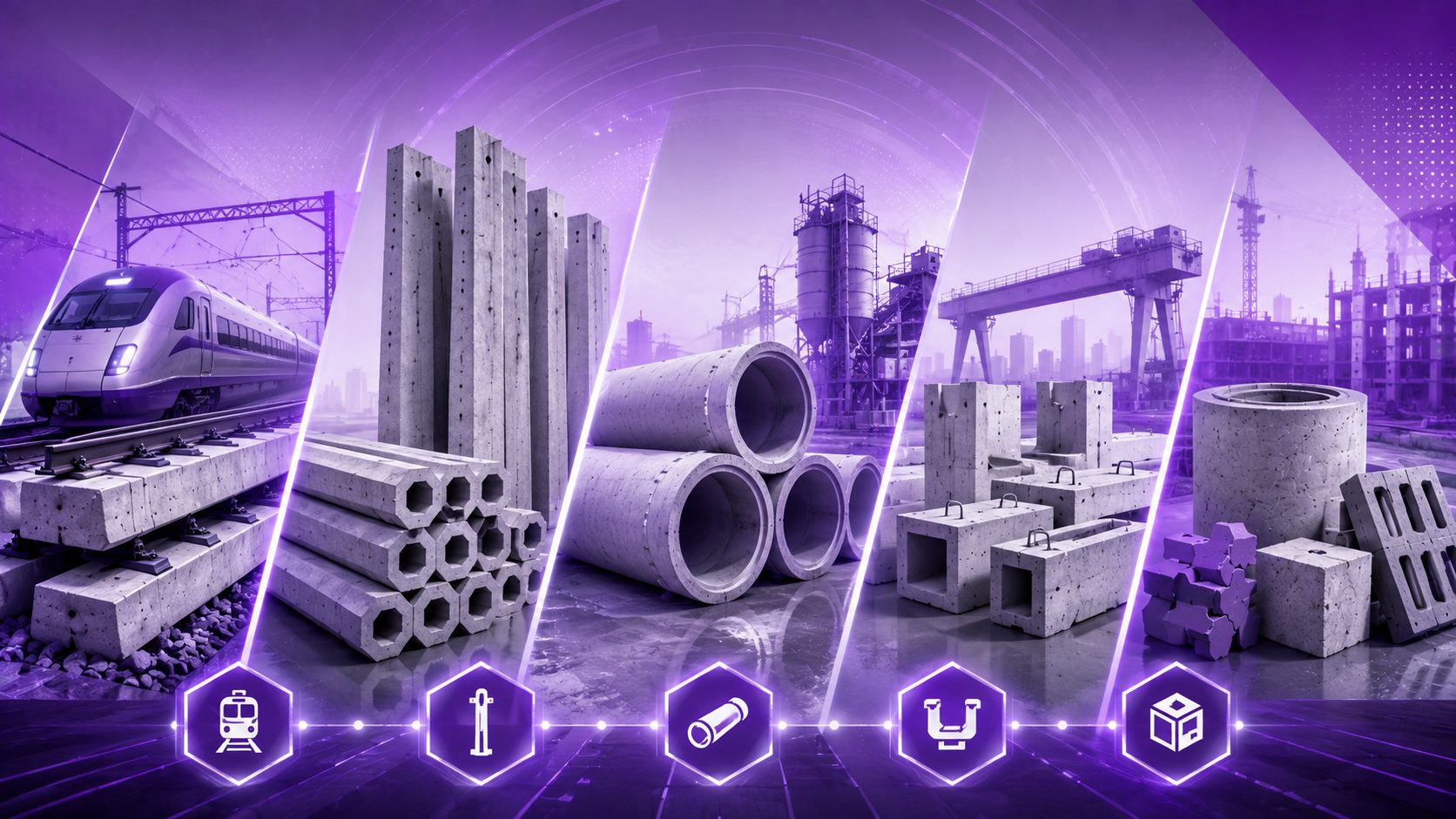
Railway sleepers: Used to provide the required prestressing force in concrete sleepers.
Precast concrete poles: Supports strength and load-bearing requirements in utility poles.
Prestressed pipes: Helps concrete pipes withstand internal and external loads.
Small precast structural components: Suitable for products that use individual prestressing wires.
Other concrete products: Used where the design specifically calls for prestressed concrete wire.
What is LRPC strand?
LRPC strand is a multi-wire prestressing product used to provide tensile force in prestressed concrete structures. Manufacturers generally make it by twisting individual high-strength steel wires around a central wire to form a compact strand. A 7-wire LRPC strand is a common configuration used in Indian construction and infrastructure projects.
How it works: The individual wires work together as one prestressing unit. Contractors tension the strand using suitable stressing and anchoring equipment, allowing it to transfer the required force to the concrete. This makes LRPC steel strand suitable for structural members that need significant and consistent prestressing force.
Why strands are used: Their multi-wire construction allows them to carry substantial prestressing loads while fitting into strand-based stressing systems. The final selection depends on the structural design, required force, and specified prestressing arrangement.
Handling and installation: Contractors normally supply, handle, cut, tension, and anchor strands using equipment designed for prestressing work. Buyers should confirm the required strand size, strength, length, coil condition, and compatibility with the project’s stressing system.
Common LRPC strand applications
Prestressed concrete beams: Used in structural members that require high prestressing force.
Bridge girders: Supports the construction of long and heavily loaded bridge members.
Flyovers: Used in prestressed structural components.
Highways: Supports major highway structures and related infrastructure.
Metro infrastructure: Used in various prestressed structural elements.
Precast slabs: Provides the required prestressing force in structural slabs.
Large-span structures: Helps support longer spans with controlled deflection.
Prestressed piles: Used where piles require high tensile and prestressing performance.

LRPC wire vs LRPC strand: Key differences
LRPC wire and LRPC strand serve different prestressing requirements. The choice should follow the project design, stressing method, and specified anchorage system, rather than a simple price comparison.
| Parameter | LRPC wire | LRPC strand |
| Basic construction | Single steel wire | Multiple steel wires twisted together |
| Product form | Individual wire | Multi-wire strand |
| Typical configuration | Individual prestressing wire | Commonly 7-wire strand |
| Flexibility | Relatively less flexible | More flexible than an individual wire |
| Installation | Used with individual wire prestressing systems | Used with strand-based prestressing systems |
| Load transfer | Transfers force through the individual wire | Transfers force through the combined strand |
| Typical applications | Railway sleepers, poles, and selected precast products. | Bridges, girders, slabs, piles, and major structures. |
| Handling | Relatively simple to handle as individual wires | Requires suitable equipment for handling and stressing |
| Anchorage system | Requires wire-compatible anchorage | Requires strand-compatible anchorage |
| Procurement basis | Diameter, strength, unit weight, and length. | Nominal diameter, strength, unit weight, and length. |
| Stressing equipment | Uses equipment designed for individual wires | Uses equipment designed for prestressing strands |
| Material quantity | Calculated for individual wires | Calculated based on strand unit weight and length |
| Best selection approach | Match the wire to the specified system and product | Match the strand to the specified system and structural member |
Which one should buyers choose?
There is no universal better option between LRPC wire and LRPC strand. Structural engineers specify the required product based on the design and prestressing system. Procurement teams should therefore confirm the product type, size, strength, anchorage compatibility, and stressing equipment before comparing quotations.
Price per kg should not drive the decision: A cheaper product may not suit the project’s stressing or anchoring system. Buyers should compare technically compliant products on a delivered cost, specification, certification, and total quantity basis.
LRPC wire vs strand: Which one should you choose?
Choose LRPC wire when
Design requirement: The project specifies individual prestressing wires.
Installation: The product requires separate wire installation and stressing.
Precast production: The manufacturing process uses individual prestressing wires.
Stressing system: The available equipment supports wire-based stressing and anchoring.
Choose LRPC strand when
Design requirement: The structural design specifies prestressing strand.
Anchorage: The project uses a strand-based anchoring system.
Structural application: The project involves bridges, girders, slabs, piles, or other large structural members.
Equipment: The contractor has suitable strand stressing and anchoring equipment.
Check these before placing an order
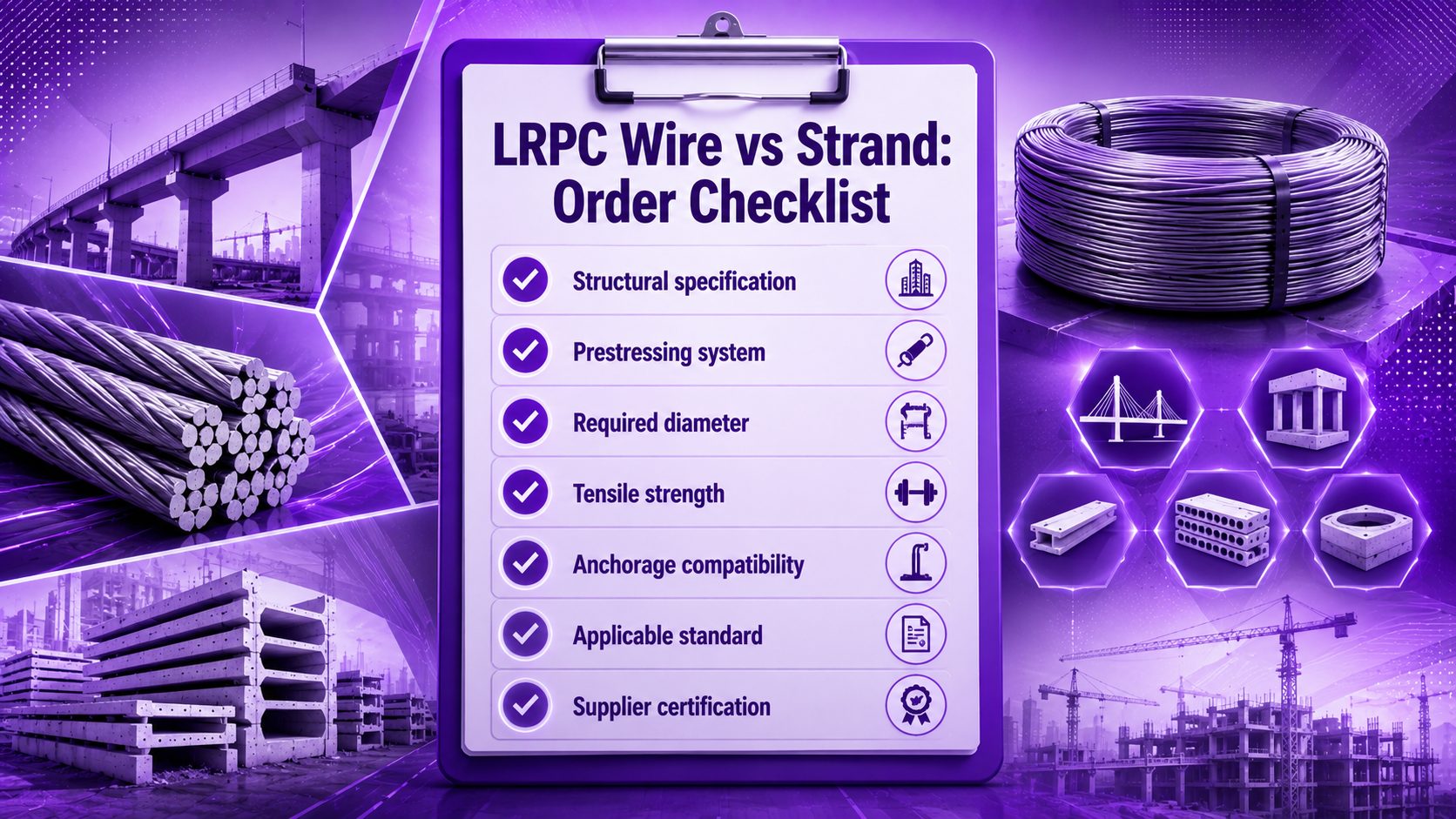
Structural specification: Confirm the exact product specified by the engineer.
Prestressing system: Match the product with the planned stressing method.
Required diameter: Check the specified wire or strand size.
Tensile strength: Confirm the required strength before comparing suppliers.
Anchorage compatibility: Ensure the product works with the selected anchorage system.
Applicable standard: Check the standard and project specification stated in the tender.
Supplier certification: Request relevant test certificates and quality documents.
Do not substitute LRPC wire for strand, or strand for wire, simply because one has a lower ₹/kg rate. The technically suitable product should come first, followed by the delivered purchase cost.
LRPC wire and strand specifications buyers should check
Buyers should check the technical specifications before comparing LRPC wire and strand quotations. The product must match the project requirements, applicable standards, and prestressing systems. A lower price does not offer value if the material fails to meet the required specifications.
| Specification | What buyers should check |
| Nominal diameter | Confirm the specified diameter and permitted tolerance. |
| Tensile strength | Check the required tensile strength against the project specification. |
| Characteristic strength | Verify the specified strength value for the selected product. |
| Elongation | Check the required elongation stated in the purchase specification. |
| Relaxation properties | Confirm the required low-relaxation performance and applicable class. |
| Unit mass | Check the manufacturer’s stated unit mass for quantity and cost calculations. |
| Cross-sectional area | Verify the specified area for material and prestressing calculations. |
| Surface condition | Check that the wire or strand has the required finish and no visible defects. |
| Dimensional tolerance | Confirm that dimensions remain within the specified limits. |
| Coil/reel requirements | Check coil or reel weight, dimensions, winding, and identification. |
| Test certificates | Request test results for the supplied batch. |
| BIS compliance | Verify BIS compliance where required by the project or applicable standard. |
| Batch/heat identification | Ensure the material can be traced to its production batch or heat. |
| Manufacturer’s inspection certificate | Request the relevant inspection and quality documents with the supply. |
Before placing an LRPC order, check:
Grade/designation: Match the product with the tender or project specification.
Diameter: Confirm the required wire or strand size.
Quantity: Calculate the total material requirement before ordering.
Unit weight: Verify the supplier’s stated value against the quotation.
Tensile strength: Confirm the specified strength before accepting the offer.
Relaxation class: Check the required low-relaxation classification.
Applicable standard: Follow the standard or specification stated in the tender.
Mill test certificate: Obtain the certificate for the supplied material.
Delivery conditions: Confirm packaging, handling, and delivery requirements.
Coil/reel dimensions: Ensure they suit the project’s storage and handling arrangements.
LRPC wire price per kg vs LRPC strand price per kg
LRPC wire and strand prices in India do not have one fixed rate. As of October 2026, available supplier quotations and indicative market estimates suggest that prices vary significantly by product type, diameter, specification, order size, and location. LRPC/PC wire may cost around ₹65–₹82 per kg, while LRPC strand may range from ₹57–₹70 per kg. These are indicative estimates, not a single nationwide rate. Tata Steel confirms that its Tata Wiron business manufactures low-relaxation PC strands and prestressed concrete wires, but manufacturer-specific prices require a current quotation.
| Product | Indicative October 2026 price | Main price factors |
| LRPC wire | ₹65–₹82/kg | Diameter, grade, strength, quantity, manufacturer, freight, and location. |
| LRPC strand | ₹57–₹70/kg | Strand diameter, configuration, grade, quantity, manufacturer, freight, and location. |
What changes the final price: Steel input costs, diameter, strength grade, order volume, manufacturer, location, freight, taxes, packaging, market conditions, and dealer margins can all affect the quoted rate. LRPC pricing also moves with steel and wire-rod prices.
For buyers: Compare quotations on a delivered ₹/kg basis, including freight, loading, unloading, taxes, and other applicable charges. Do not select wire or strand solely because its quoted ₹/kg rate is lower. Supplier listings themselves note that advertised prices can change with market conditions and may exclude freight and other charges.
How to calculate LRPC wire and strand weight
Weight calculation helps buyers estimate the material required for a project, plan transport, and check supplier quantities. For LRPC products, the most reliable approach is to use the manufacturer’s stated unit mass for the specified size. BIS requirements also include weight or mass checks for prestressing wire, while current manufacturer data for LRPC strand provides mass per metre for each designation.
LRPC wire weight calculation
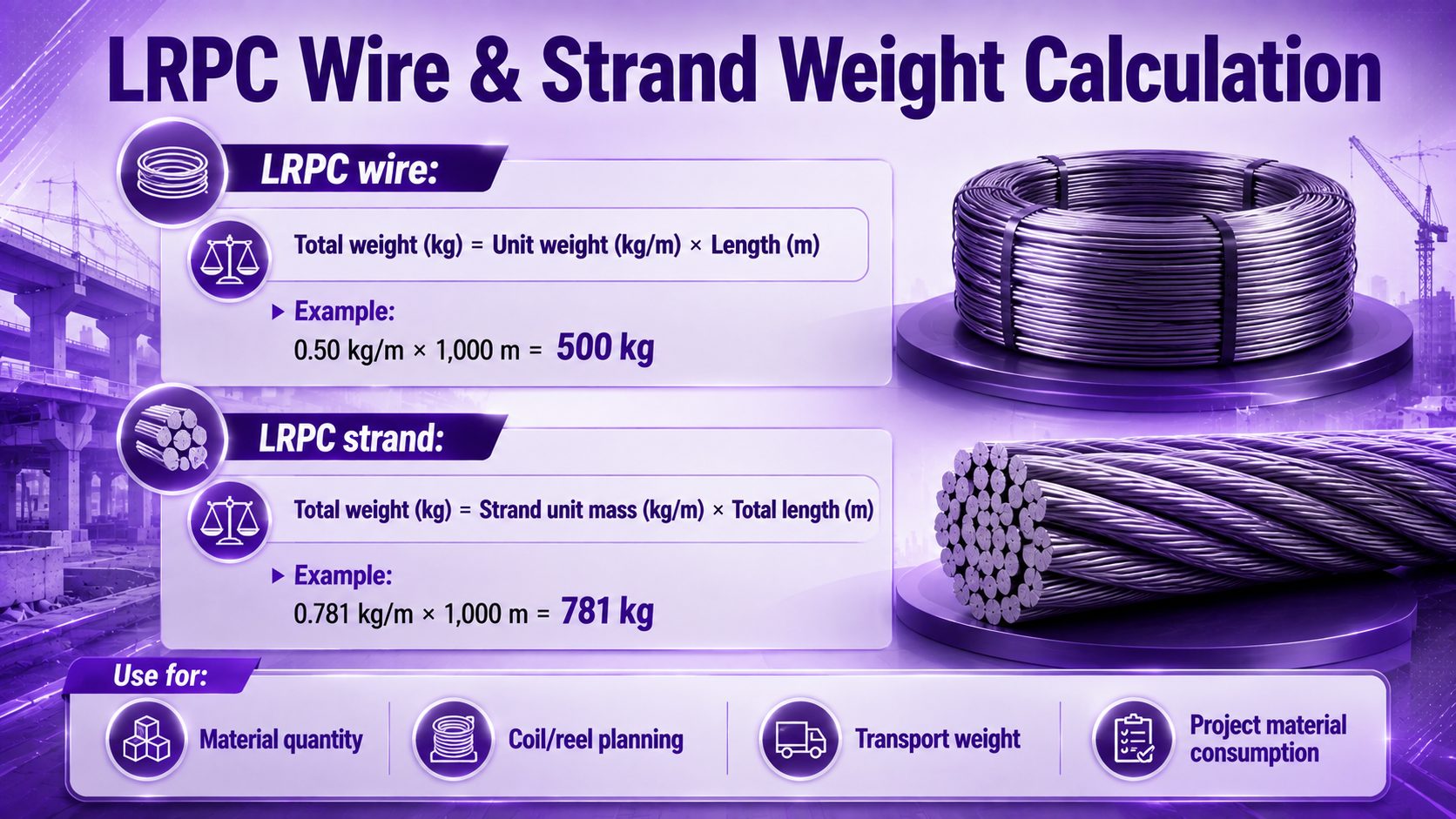
Basic formula: Total weight = Unit weight × Length
For example, if a hypothetical LRPC wire has a unit mass of 0.50 kg/m and the required length is 1,000 m:
Total weight = 0.50 × 1,000 = 500 kg
For theoretical calculations, buyers can derive the mass from the wire’s cross-sectional area, steel density, and length. However, use the manufacturer’s certified unit mass when preparing an actual purchase order.
LRPC strand weight calculation
Formula: Total weight = Strand unit mass × Total length
For example, a 12.7 mm LRPC strand listed by Usha Martin has a mass of 781 g/m, or 0.781 kg/m.
For 1,000 m:
Total weight = 0.781 × 1,000 = 781 kg
Why the calculation matters
Material quantity: Estimate the total wire or strand required.
Coils/reels: Work out the number required from the available coil or reel weight.
Transport: Estimate the shipment weight.
Project planning: Track material consumption against the required length.
LRPC wire vs strand: Applications by project type
The choice between LRPC wire and strand depends on the project design, prestressing method, and specified product. The following guide shows where buyers may commonly encounter each product:
| Project/application | More commonly considered |
| Railway sleepers | LRPC wire |
| Precast poles | LRPC wire |
| Prestressed pipes | Wire or strand, depending on design. |
| Bridge girders | LRPC strand |
| Flyovers | LRPC strand |
| Prestressed slabs | LRPC strand |
| Prestressed piles | LRPC strand |
| Large-span structures | LRPC strand |
| Precast structural components | Wire or strand, depending on design. |
Railway and precast products: Buyers may commonly find LRPC wire specified for railway sleepers, poles, and selected precast products that use individual prestressing wires.
Bridges and major structures: Contractors commonly use LRPC strand for bridge girders, flyovers, slabs, piles, and other structural members that require strand-based prestressing systems.
Project specification comes first: These application patterns should not replace the engineer’s specification. The structural design, required prestressing force, stressing equipment, and anchorage system should determine whether the project uses LRPC wire or LRPC strand.
Procurement tip: Do not assume that wire suits smaller projects and strands suit larger projects. Always confirm the specified product before requesting quotations.
LRPC wire vs strand: Procurement checklist for MSMEs
For MSMEs, buying LRPC wire or strand involves more than comparing the quoted ₹/kg rate. A clear specification helps avoid quantity mismatches, unsuitable material, and unexpected delivery costs.
Before placing an order, verify:
| Check | What to verify before ordering |
| Product | LRPC wire or LRPC strand as specified |
| Diameter | Required diameter and permitted tolerance |
| Grade | Correct grade or product designation |
| Strength | Required tensile strength |
| Relaxation | Specified low-relaxation requirement |
| Unit weight | Mass per metre stated by the supplier |
| Quantity | Required length and total material weight |
| Coil/reel | Size, weight, winding, and handling requirements. |
| Standard | Applicable BIS or project specification |
| Test certificate | Mill or batch test certificate |
| Delivery | Delivery location and expected schedule |
| Freight | Freight, loading, unloading, and other logistics costs. |
| GST | Applicable tax and whether it is included in the quoted rate |
| Payment | Advance, credit period, and other payment terms. |
Compare like with like: MSMEs should obtain at least two or three quotations and ensure every supplier has quoted against the same product, diameter, grade, quantity, specification, and delivery terms. This gives buyers a more meaningful comparison than looking at the headline ₹/kg rate alone.
Conclusion: LRPC wire vs strand – choose based on application
Choosing between LRPC wire and strand comes down to what the project needs, not simply what the supplier offers. Buyers should use the project requirements as the starting point and evaluate quotations against the same specifications. For MSMEs, a reliable supplier can also help maintain consistent quality and avoid procurement delays. Before finalising an order, compare compliant quotations, delivery commitments, and overall value to identify the most suitable LRPC wire or strand supplier for the project.
Looking to procure steel?
Tata nexarc helps manufacturers, builders and MSMEs source certified steel products, compare prices, and choose the right grade as per IS codes—with complete traceability and procurement confidence.
FAQs
What is the difference between LRPC wire and LRPC strand?
Is LRPC strand stronger than LRPC wire?
What is the price of LRPC wire per kg?
What is the price of LRPC strand per kg?
How is LRPC wire weight calculated?
How is LRPC strand weight calculated?
Which is better for prestressed concrete, wire or strand?
Where is LRPC wire commonly used?
Where is LRPC strand commonly used?
What should I check before buying LRPC wire or strand?
A product manager with a writer's heart, Anirban leverages his 6 years of experience to empower MSMEs in the business and technology sectors. His time at Tata nexarc honed his skills in crafting informative content tailored to MSME needs. Whether wielding words for business or developing innovative products for both Tata Nexarc and MSMEs, his passion for clear communication and a deep understanding of their challenges shine through.