Check Price Now
Table of Contents
- Green Steel Procurement in India: What is Being Proposed?
- Why is India Pushing for Green Steel?
- What Could a 25% Green-Steel Procurement Target Mean?
- India’s Green-Steel Framework in 2026
- What Does Green Steel Mean for Steel Manufacturers?
- What Does Green Steel Mean for MSMEs and Downstream Businesses?
- Will Green Steel Make Infrastructure More Expensive?
- How Businesses Can Prepare for Green Steel
- Green Steel in India: What Happens Next?
- Conclusion
- FAQs
Green steel procurement in India: What is being proposed?
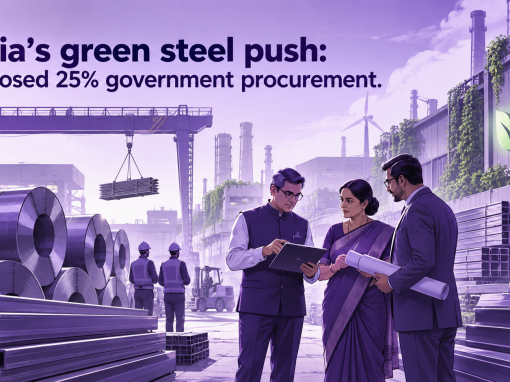
A proposed FY28 mandate: The government is considering mandatory procurement of green-rated steel for central government projects and centrally sponsored schemes, potentially from FY2027–28. A draft proposal reported in 2025 suggested minimum procurement requirements based on India’s three green-steel ratings. However, the proposal has not been notified as a mandatory requirement.
Proposed green-steel mix: The reported draft Cabinet note proposed minimum procurement of 20% three-star, 5% four-star and 1% five-star green-rated steel. These figures should be treated as proposed requirements, not final government rules.
| Green-steel rating | Reported proposed minimum |
| 3-star | 20% |
| 4-star | 5% |
| 5-star | 1% |
Where it could apply: The proposal could cover steel purchased for central government projects and centrally sponsored schemes, subject to the final scope and procurement rules. The reported proposal also considered projects where the value of iron and steel procurement exceeds ₹1 crore.
Why it matters: Public procurement could create a significant early market for certified lower-emission steel. The Ministry of Steel’s own roadmap also considers green public procurement as a potential demand-creation mechanism, although its proposed framework and the reported FY28 Cabinet proposal should not be treated as the same policy.
What is confirmed today: India’s Green Steel Taxonomy is already notified, and the Ministry has a certification framework for three-, four- and five-star steel. But the government has not yet implemented the proposed mandatory procurement requirement.
Why is India pushing for green steel?
| Key driver | What it means for India |
| High carbon footprint | Steel is a hard-to-abate sector and accounts for about 10–12% of India’s total carbon emissions. Its energy-intensive production processes and use of carbon-heavy inputs make decarbonisation difficult. |
| Rapidly rising steel demand | India’s finished steel consumption reached 163.7 million tonnes in 2025–26, up from 77 million tonnes in 2014–15. Demand is rising with infrastructure development, urbanisation, and manufacturing growth. |
| Net-zero by 2070 | India has committed to achieving net-zero emissions by 2070. The Ministry of Steel has therefore made decarbonising steel a key part of its longer-term climate strategy. |
| Infrastructure needs more low-carbon materials | Steel is central to construction, transport, manufacturing, and infrastructure. Lower-emission steel can help businesses and public projects reduce the carbon footprint of these activities as sustainability requirements become more important. |
| Production alone will not create a market | Increasing the supply of green steel will not be enough if buyers do not have a clear reason to choose it. Green steel procurement can help create demand by giving producers a potential market for certified lower-emission steel. |
| Policy can support the transition | India’s Green Steel Taxonomy provides a framework for defining and rating lower-emission steel. The Ministry of Steel also identifies renewable energy, energy efficiency, green hydrogen, material efficiency, and other measures as part of the sector’s decarbonisation pathway. |
| A growing industrial opportunity | India is expanding both steel production and infrastructure. Creating demand for lower-emission steel could encourage investment in cleaner technologies while helping Indian producers prepare for changing requirements in domestic and global markets. |
The demand gap: The challenge is not only how India produces greener steel. It is also how quickly buyers adopt it. This is why government procurement is being considered a potential way to create an early market for green steel.
What could a 25% green-steel procurement target mean?
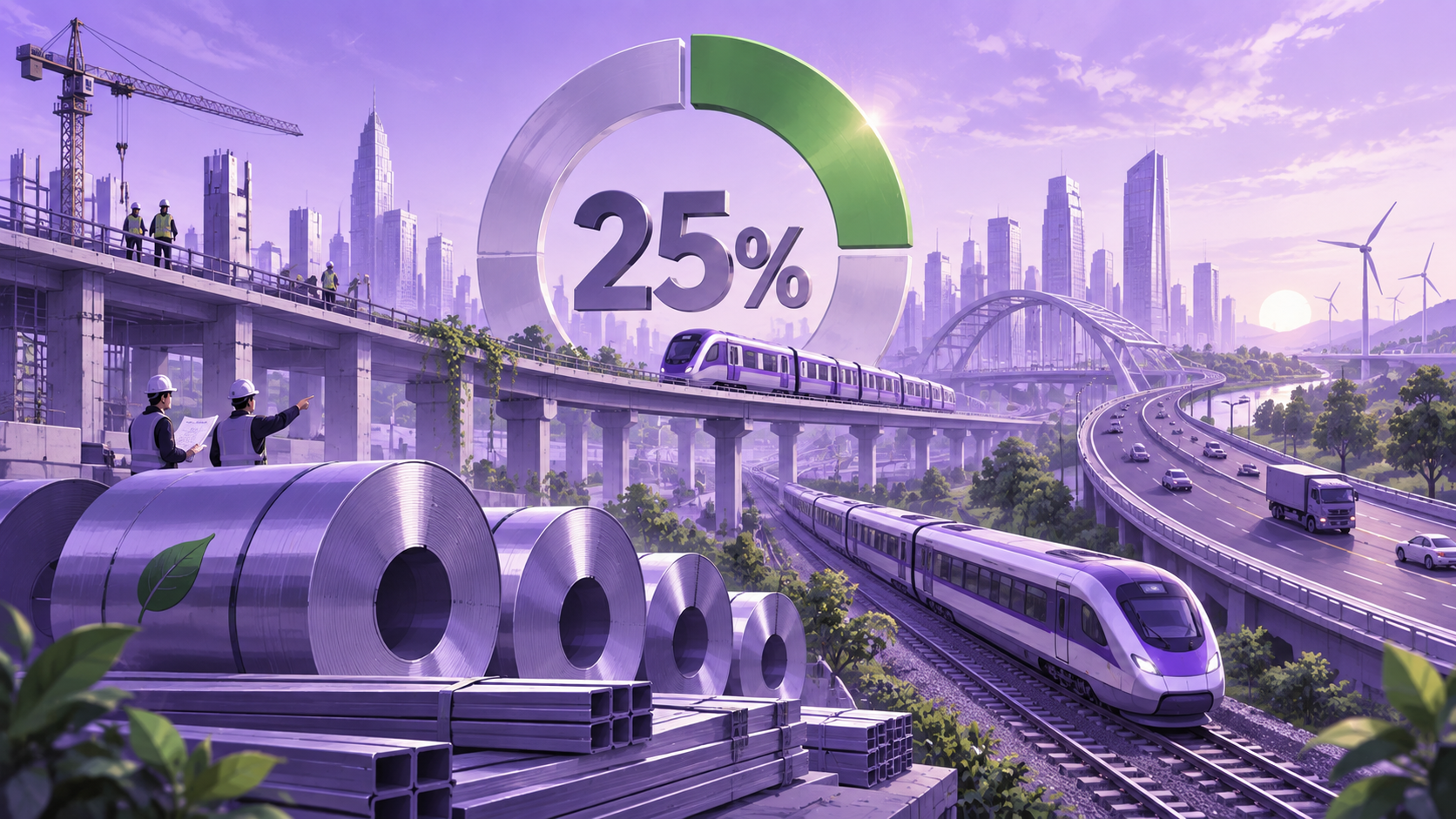
A potential procurement requirement
If the proposed 25% requirement moves forward, government buyers could be expected to source a defined share of their steel from certified green-steel producers. However, the exact percentage, scope, and implementation rules are not finalised yet. The Ministry of Steel’s roadmap supports developing a Green Public Procurement framework, but the government has not notified a mandatory procurement target.
Government infrastructure projects
The biggest potential impact would be on projects that use large volumes of steel. These could include railways, roads and highways, metros, public buildings, defence infrastructure, and other public-sector construction, depending on the final policy. India already has a large pipeline of central infrastructure projects across transport, housing, power, and other sectors.
A new market for green steel
Government procurement could give producers a more predictable pool of buyers for lower-emission steel. This could improve the investment case for cleaner production and encourage more manufacturers to seek green-steel certification.
From demand to wider adoption
The logic is straightforward: government demand can create an early market, stronger demand can support investment, and greater production can improve availability for other buyers. Over time, this could help green steel move beyond government projects into wider construction and manufacturing supply chains.
Rules will determine the impact
The eventual effect will depend on the final procurement framework. Authorities would need to define eligible steel, certification requirements, emissions thresholds, tender conditions, and monitoring mechanisms before any mandatory requirement could take effect.
India’s green-steel framework in 2026
Green Steel Taxonomy: India released its Taxonomy of Green Steel in December 2024 and notified it in the e-Gazette later that month. The framework defines green steel using the emissions intensity of finished steel and creates a common basis for measuring its environmental performance.
What counts as green steel: Under the taxonomy, steel qualifies for a green rating when its emissions intensity is below 2.2 tonnes of CO₂ equivalent per tonne of finished steel. The framework assigns three ratings based on emissions intensity: three-star, four-star, and five-star green steel.
Green steel certification: Certification gives producers a recognised way to demonstrate that their steel meets the taxonomy’s requirements. The National Institute of Secondary Steel Technology (NISST) serves as the nodal agency for measurement, reporting and verification, and for issuing green steel certificates and star ratings.
Why certification matters: A common certification system can help buyers identify qualifying green steel, give producers a standard way to report performance and support future green steel procurement. It also provides a basis for verifying claims rather than relying only on a supplier’s description of a product as green.
Certification is already expanding: The framework has moved beyond policy design. As of 31 March 2026, 89 steel units had received green steel certification, covering 12.34 million tonnes of production. The Ministry of Steel’s latest update also reports 90 certified units during FY 2025–26, covering 12.4 million tonnes, reflecting further certification activity during the year.
| Green steel indicator | Latest position |
| Certified units as of 31 March 2026 | 89 |
| Certified production as of 31 March 2026 | 12.34 MT |
| Green Steel Taxonomy released | December 2024 |
| Certification and MRV agency | NISST |
What this means for procurement: The taxonomy and certification system provide the measurement framework that any future government procurement policy can use. However, they do not themselves create a mandatory 25% procurement requirement. That requirement remains a proposed policy direction rather than an implemented mandate.
What does green steel mean for steel manufacturers?
A shift in production: The move towards green steel will require manufacturers to lower emissions across the steelmaking process. India’s decarbonisation roadmap identifies several routes, from cleaner power to greater use of scrap and emerging technologies.
| Green steel lever | What it can involve |
| Renewable electricity | Using renewable power can reduce emissions linked to electricity consumption. |
| Energy efficiency | Upgrading equipment and improving processes can reduce energy use per tonne of steel. |
| Scrap-based steelmaking | Increasing scrap use can reduce dependence on emissions-intensive primary steel production. |
| Electric arc furnaces | EAFs can use scrap and electricity to produce steel, with emissions depending partly on the electricity source. |
| Lower-carbon DRI | Producers can explore lower-emission direct reduced iron routes, including those using hydrogen. |
| Green hydrogen | Hydrogen could replace some fossil-fuel use in future steelmaking processes, although large-scale adoption still faces cost and infrastructure challenges. |
Better measurement: Green steel production will also require reliable emissions data. Manufacturers will need to measure and report the emissions associated with their steel rather than rely only on broad claims about cleaner production.
Certification adds credibility: India’s Green Steel Taxonomy and certification framework gives producers a recognised method to demonstrate their emissions performance. This can become particularly important if green steel procurement requirements are introduced for government or other large projects.
What manufacturers should prepare for: Businesses can start by improving emissions measurement, assessing cleaner energy options, increasing process efficiency, and understanding the certification requirements. The competitive advantage may increasingly come not just from making lower-carbon steel, but proving how low its emissions are.
What does green steel mean for MSMEs and downstream businesses?
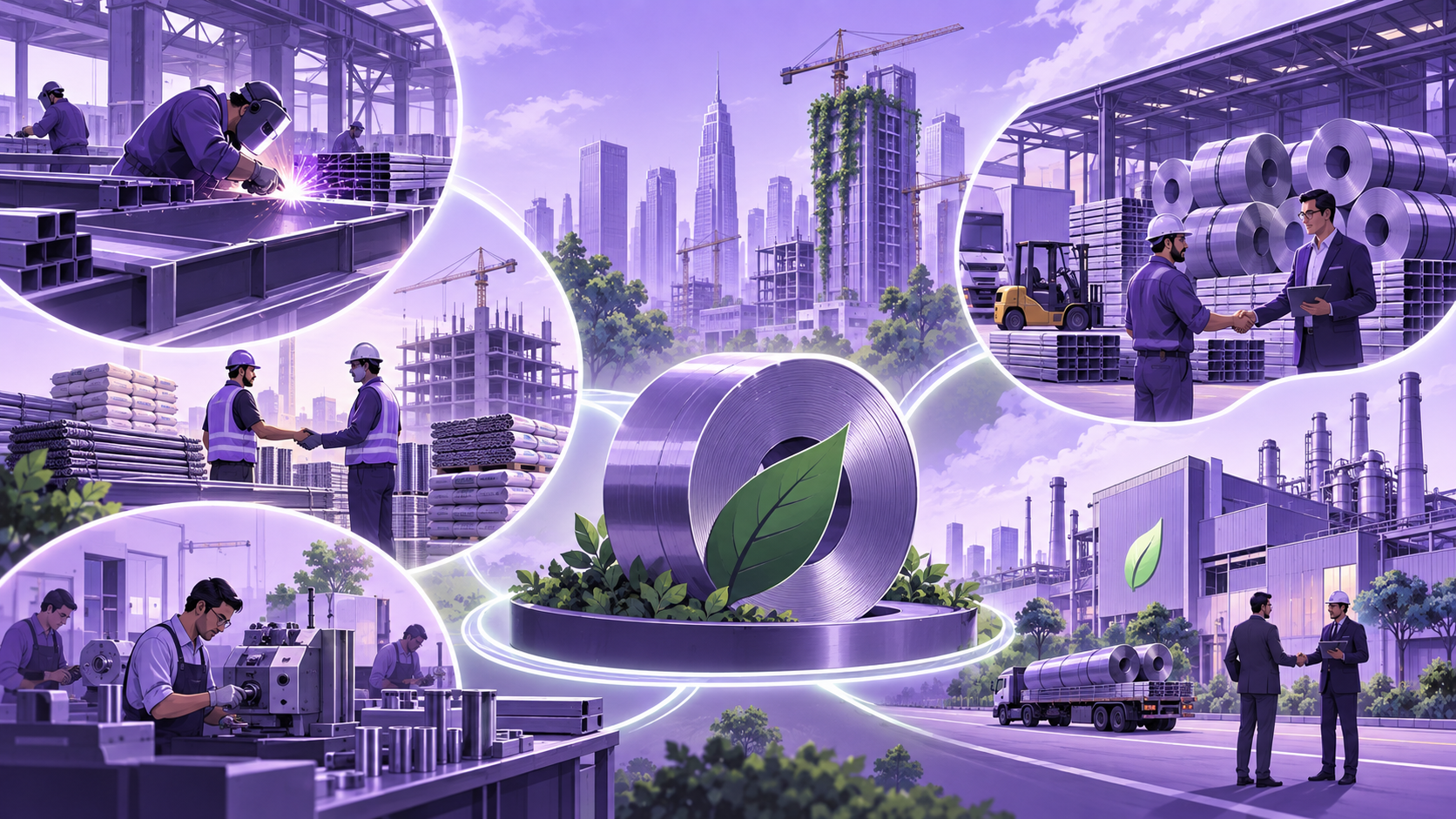
A change in buyer requirements: For MSMEs, the impact may come through customers rather than directly from government policy. Fabricators, engineering companies, component makers, and construction suppliers that work with large infrastructure companies may increasingly face requests for information about the steel they source.
Where pressure could build
Fabricators and component manufacturers: May need to provide details about the grade, source, and environmental credentials of the steel they use.
Construction suppliers: Could face green-material specifications in projects linked to government or large institutional buyers.
Steel traders and distributors: May need to identify reliable sources of certified green steel and maintain clearer product documentation.
MSMEs supplying large companies: Could face additional supplier requirements if larger buyers introduce their own emissions or sustainable-sourcing criteria.
Potential challenges: Businesses may need stronger documentation, better material traceability, and access to certified products. Lower-emission steel could also carry a price premium, depending on availability, production route, and market demand.
But there is an opportunity: As demand develops, MSMEs that can reliably source and document certified steel could become more attractive to larger buyers.
| Potential challenge | Potential opportunity |
| More supplier documentation | Become an approved supplier for sustainability-focused buyers |
| Need for traceable material | Offer better-documented steel products |
| Access to certified steel | Build relationships with certified green steel suppliers |
| Possible cost premium | Differentiate through sustainable sourcing |
What should a small buyer or supplier do? Start by asking suppliers about certification, emissions data, and traceability. Businesses that understand these requirements early can be better prepared if green steel procurement becomes part of more government-linked and large infrastructure projects.
Will green steel make infrastructure more expensive?
A potential cost premium: Green steel can cost more than conventional steel because lower-emission production often requires new technology, cleaner energy and higher upfront investment. The Ministry of Steel’s roadmap notes that the premium varies significantly by production route and technology.
Project type matters: The impact on the overall green steel infrastructure cost will depend on how much steel a project uses, the share of green steel required, and the procurement model adopted.
The steel premium is not the project premium: A higher green steel price in India would not necessarily translate into an equally large increase in the total cost of an infrastructure project. Steel represents only one part of the overall project budget.
Potential budget impact: The Ministry of Steel’s roadmap assesses the possible budgetary impact of green steel procurement across public-sector infrastructure projects and notes that the additional cost would depend on the procurement pathway and green-steel premium.
A 2026 assessment: A study on public procurement of green steel estimated that using green steel in selected government projects could increase total project costs by around 0.2% to 1.2%, depending on the project and procurement scenario. This provides useful context, although the estimate is based on specific scenarios rather than a fixed cost impact for all projects.
What this means for buyers: Businesses should therefore assess the cost of green steel at the project level, rather than assume that any increase in the steel price will directly translate into the same percentage increase in the final project cost.
How businesses can prepare for green steel
The proposed procurement framework is not yet mandatory, but businesses can start preparing for potential changes in buyer requirements. A practical green steel procurement strategy can also help companies respond faster as demand for certified lower-emission steel develops.
| Step | What businesses should do | Why it matters |
| 1. Track policy changes | Follow government notifications, procurement guidelines, and tender specifications related to green steel. | The proposed 25% requirement has not been finalised, so businesses need to track how the framework develops. |
| 2. Check supplier emissions data | Ask green steel suppliers for information on emissions intensity and how they measure it. | Reliable data helps buyers compare products and meet future customer requirements. |
| 3. Verify certification | Check whether the steel has been certified under India’s Green Steel Taxonomy and carries the applicable rating. | Certification provides a recognised basis for assessing green-steel claims. |
| 4. Build supplier options | Identify multiple suppliers that can provide certified or lower-emission steel. | A wider supplier base can reduce sourcing risks if demand increases. |
| 5. Plan for the cost premium | Include possible green-steel price differences when preparing project estimates and bids. | Early costing helps businesses avoid unexpected material costs at the tender stage. |
| 6. Maintain traceability | Keep records of steel grade, supplier, certification, and relevant emissions information. | Clear documentation can support compliance and customer audits, particularly for businesses serving large infrastructure buyers. |
Start with supplier conversations: Businesses do not need to wait for a final mandate to assess their supply chain. Asking suppliers about green steel certification, emissions data, and traceability can help identify gaps early.
Prepare, but do not overcommit: Since the 25% procurement proposal is still under consideration, businesses should avoid treating it as a current compulsory requirement. Instead, they can build the information, supplier network, and costing processes needed to respond if green-steel procurement requirements expand.
Green steel in India: What happens next?
The future of green steel in India is moving from policy discussion towards market creation. The key developments so far are:
| Timeline | Development | What it means |
| 2025 | 25% procurement proposal: A possible requirement for government projects to source 25% of their steel from green-steel producers was discussed. | The proposal could create significant demand, but it is not yet a mandatory requirement. |
| 2026 | Taxonomy and certification: India has established its Green Steel Taxonomy and certification framework. By 31 March 2026, 89 units had received certification covering 12.34 MT of production. | Buyers have a recognised framework for identifying and verifying green steel. |
| 2026 onward | Focus on demand: Industry bodies have called for stronger green-steel procurement requirements. | Government procurement could become an important way to build an early market. |
| 2030–31 | Potential demand: An industry recommendation estimated potential demand of up to 24 MT of certified green steel by 2030–31 if mandatory procurement is introduced. | This is a potential scenario, not a government-approved target. |
What comes next: The next stage of India’s green steel policy will depend on how the government develops procurement rules, certification requirements and implementation timelines.
The focus is shifting from how India will produce green steel to who will buy it, under what standards, and at what cost.
Conclusion
India’s green steel market is moving towards greater transparency, measurable emissions, and stronger buyer expectations. For steelmakers, suppliers, and MSMEs, this could reshape how products are sourced, evaluated, and sold.
While the proposed 25% government procurement requirement is not yet final, businesses can prepare for a market where verified sustainability credentials increasingly influence purchasing decisions. Keeping track of the evolving green steel procurement framework can help businesses identify new opportunities, manage sourcing risks, and stay ready as India’s green steel policy develops.
Looking to procure steel?
Tata nexarc helps manufacturers, builders and MSMEs source certified steel products, compare prices, and choose the right grade as per IS codes—with complete traceability and procurement confidence.
FAQs
What is green steel procurement in India?
Is India mandating 25% green steel procurement?
What is India's Green Steel Taxonomy?
How is green steel certified in India?
What qualifies as green steel in India?
Which government projects could use green steel?
Will green steel increase infrastructure costs?
How will green steel affect MSMEs?
How can businesses prepare for green steel procurement?
What is the future of green steel in India?
A product manager with a writer's heart, Anirban leverages his 6 years of experience to empower MSMEs in the business and technology sectors. His time at Tata nexarc honed his skills in crafting informative content tailored to MSME needs. Whether wielding words for business or developing innovative products for both Tata Nexarc and MSMEs, his passion for clear communication and a deep understanding of their challenges shine through.