Table of Contents
- September 2026 GST Collection: Key Figures at a Glance
- Gross GST Revenue in September 2026
- September 2026 GST Collection vs September 2025
- What Drove GST Revenue Growth in September 2026?
- What September GST Collections Say About India’s Economy
- What These Numbers Mean for MSMEs
- GST Collection Trend in FY 2026–27 So Far
- What Should MSMEs Track After the September GST Data?
- Conclusion
- FAQs
The September 2026 GST collection reached ₹2,03,521 crore, marking a 14.7% year-on-year increase and taking monthly gross revenue above the ₹2 lakh crore mark again. The rise offers a useful indicator of tax activity across businesses and trade. For MSMEs, the numbers also provide context for tracking demand, sales, and market activity. At the business level, GST trends matter for compliance, input tax credit, cash-flow planning, and pricing decisions. This latest collection data therefore offers useful signals for MSMEs planning their next business moves.

September 2026 GST collection: Key figures at a glance
| Particulars | September 2026 |
| Gross GST collection | ₹2,03,521 crore |
| Year-on-year growth | 14.7% |
| September 2025 collection | ₹1,77,365 crore |
| Total refunds | ₹27,001 crore |
| Net GST revenue after refunds | ₹1,76,520 crore |
| Financial year | FY 2026-27 |
The September 2026 GST figures show gross GST revenue of ₹2,03,521 crore, compared with ₹1,77,365 crore in September 2025. This represents a 14.7% year-on-year increase. Gross collections include GST revenue from domestic transactions and IGST collected on imports. Domestic gross revenue stood at ₹1,37,996 crore, while import-related revenue stood at ₹65,525 crore.
The government reported total refunds of ₹27,001 crore for the month. After refunds, net GST revenue stood at ₹1,76,520 crore, up 18.1% year on year. Gross and net figures therefore measure different stages of GST revenue and should not be treated as the same.
Gross GST revenue in September 2026
India collected ₹2,03,521 crore in gross GST revenue in September 2026, up 14.7% from ₹1,77,365 crore in September 2025. The collection crossed the ₹2 lakh crore mark for the month. GST data covers revenue from domestic transactions as well as IGST collected on imports.
| Key September 2026 figures | Amount |
| Gross GST collection | ₹2,03,521 crore |
| Year-on-year growth | 14.7% |
| GST revenue after refunds | ₹1,76,520 crore |
How does GST collection work?
GST follows a dual structure that divides tax collection between the Centre and the States. The main components are:
- CGST: Collected by the Central Government on intra-state supplies.
- SGST: Collected by the State Government on intra-state supplies.
- IGST: Collected by the Centre on inter-state supplies and imports, with the revenue shared according to the GST settlement mechanism.
- Compensation cess: Levied on specified goods under the applicable provisions.
The government describes GST as a destination-based tax on the supply of goods and services. Its collection data also provides a high-frequency signal of economic activity, although changes in revenue can reflect consumption, trade, taxpayer expansion, reporting, and compliance rather than consumption alone.
September 2026 GST collection vs September 2025
| GST revenue metric | September 2025 | September 2026 | YoY change |
| Gross domestic revenue | ₹1,25,334 crore | ₹1,37,996 crore | +10.1% |
| GST revenue from imports | ₹52,031 crore | ₹65,525 crore | +25.9% |
| Total gross GST revenue | ₹1,77,365 crore | ₹2,03,521 crore | +14.7% |
| Total refunds | ₹27,848 crore | ₹27,001 crore | -3.0% |
| Net GST revenue | ₹1,49,517 crore | ₹1,76,520 crore | +18.1% |
| April–September gross GST revenue | ₹11,17,088 crore | ₹12,46,278 crore | +11.6% |
The September 2026 GST collection increased by ₹26,156 crore from the same month last year. Domestic GST revenue grew 10.1%, while revenue from imports increased 25.9%. Refunds also declined by 3%, which contributed to the faster 18.1% growth in net GST revenue. The government’s GST data shows that the rise reflects multiple factors, including domestic transactions, imports, and the wider tax base. It should not be treated as a direct measure of consumption growth.
What drove GST revenue growth in September 2026?
Domestic economic activity
Gross GST revenue from domestic transactions rose 10.1% year on year to ₹1,37,996 crore in September 2026. This points to continued tax-generating activity across domestic supplies of goods and services. However, GST collections alone cannot measure overall consumption or economic growth.
A wider GST taxpayer base
India’s GST taxpayer base has expanded significantly since the tax was introduced. The government reported 1.65 crore registered GST taxpayers as of May 2026, compared with 66.5 lakh in 2017. A larger taxpayer base can support higher collections by bringing more businesses and transactions into the formal tax system.
Stronger import-linked GST revenue
GST revenue from imports increased 25.9% to ₹65,525 crore in September 2026. This growth contributed significantly to the overall rise in collections. Import-linked GST mainly forms part of IGST, which also applies to inter-state supplies. Higher import-linked collections can lift GST revenue, but they do not by themselves indicate stronger domestic business conditions.
Digital compliance and better reporting
GST relies on digital systems for registration, return filing, invoice reporting, and other compliance processes. The government links the expansion of these systems with stronger reporting, tax discipline, and formalisation. Recent government data also shows that GST collections have become a high-frequency indicator of economic activity.

What September GST collections say about India’s economy
A high-frequency economic indicator: GST collections provide a timely view of taxable economic activity because businesses report transactions and pay GST through the tax system.
A signal of business activity: Rising collections can point to stronger activity in taxable goods and services, although the data does not measure every part of the economy.
A reflection of formalisation: A growing GST taxpayer base can increase reported economic activity as more businesses enter the formal tax system.
Not a standalone growth measure: GST revenue should not serve as a substitute for GDP or other broader measures of economic performance.
Use multiple indicators: Businesses should read GST trends alongside GDP growth, industrial production, manufacturing activity, retail and wholesale demand, exports, imports, inflation, and government expenditure.
Several factors influence collections: Changes in GST revenue can reflect consumption, trade, imports, taxpayer registrations, compliance, and reporting practices.
GST collections indicate taxable economic activity: It offers a useful and timely signal of taxable economic activity, but businesses should combine it with wider economic and sector-specific indicators before drawing conclusions.
What does the September 2026 GST collection mean for MSMEs?
The latest GST figures offer useful signals for MSMEs, but businesses should not treat higher collections as a direct measure of their own demand. MSMEs can use the data alongside sector trends, customer orders, and operating costs when making business decisions.
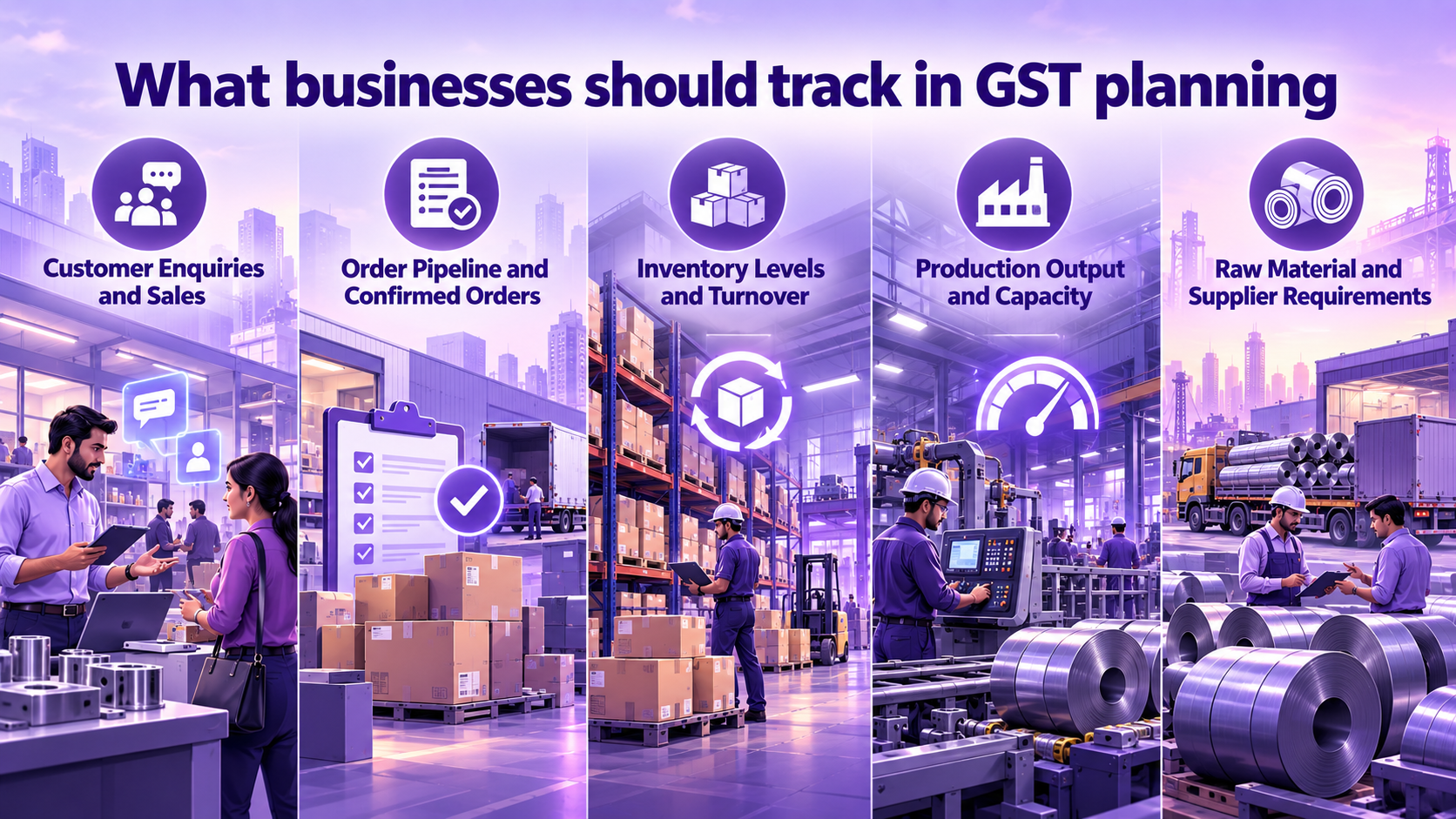
Business demand and order planning
Higher GST collections can indicate continued taxable economic activity across India. MSMEs can use this broader signal when reviewing their own business outlook.
| Area to review | What MSMEs can track |
| Demand | Customer enquiries and sales |
| Orders | Pipeline and confirmed orders |
| Inventory | Stock levels and turnover |
| Production | Output and capacity needs |
| Procurement | Raw material and supplier requirements |
National GST data can vary significantly across industries and regions, so MSMEs should combine it with their own sales and market data.
Working capital and cash flow
GST affects the timing and value of tax payments, input tax credit, and business receipts. MSMEs should therefore assess their GST position alongside their cash-flow requirements.
Input tax credit needs closer attention
MSMEs can protect their working capital by maintaining accurate purchase records and monitoring eligible input tax credit.
- Match purchase invoices with records.
- Check supplier compliance where required.
- Reconcile input tax credit regularly.
- Track available and claimed credit.
- Resolve discrepancies promptly.
This matters particularly for businesses buying raw materials, components, steel, machinery, and services.
Pricing and procurement decisions
GST should form part of pricing and procurement calculations for manufacturers, traders, and other MSMEs. Businesses should assess the tax component along with supplier prices, input costs, and payment terms before finalising purchases.
Compliance remains a priority
The expansion of digital GST systems has strengthened online registration, return filing, and invoice reporting. Accurate records and timely compliance can help MSMEs reduce errors and manage their GST obligations more effectively. The government has also highlighted GST reforms aimed at simplifying compliance and supporting smaller businesses.
GST collection trend in FY 2026-27 so far
The GST collection 2026 month-wise trend shows sustained revenue growth during the first six months of FY 2026-27. The official GST data cited by the Government of India records strong collections through the period, with September crossing ₹2 lakh crore again.
| Month | Gross GST collection | YoY growth |
| April 2026 | ₹2,43,930 crore | 9.4% |
| May 2026 | ₹1,94,184 crore | 9.0% |
| June 2026 | ₹1,94,812 crore | 13.9% |
| July 2026 | ₹2,11,205 crore | 16.3% |
| August 2026 | ₹1,99,853 crore | 14.8% |
| September 2026 | ₹2,03,521 crore | 14.7% |
The GST collection FY 2026-27 trend shows that monthly revenue remained close to or above ₹2 lakh crore in most months. The government also reported cumulative GST collections of around ₹4.37 lakh crore for April-May 2026, confirming the strong start to the financial year.
For MSMEs, the month-wise trend provides a broader view than a single month’s figure. Businesses can compare GST trends with their own sales, order volumes, sector demand, and cash-flow position before making procurement or production decisions.
What should MSMEs track after the September GST data?
Monthly GST trends: Track collection patterns to understand broader changes in taxable business activity.
Sales and GST liability: Monitor sales, output tax, and payment obligations to plan cash flow.
Input tax credit: Check eligible ITC and reconcile it regularly with purchase records.
Supplier compliance: Ensure suppliers issue valid invoices and meet applicable GST requirements.
E-invoicing and e-way bills: Follow the applicable requirements based on business type and transaction value.
GST rates and exemptions: Track rate changes that could affect product pricing and margins.
Sector demand: Compare national GST trends with demand in your specific industry and market.
Input and procurement costs: Monitor raw material prices, supplier rates, and other operating costs.
Working capital: Factor GST payments, ITC timing, and customer payment cycles into cash-flow planning.
Key takeaway: GST data can support business planning, but MSMEs should combine it with their own sales, costs, orders, and sector-level data.
Conclusion
The latest GST numbers offer MSMEs a useful view of the wider business environment, but their value lies in how businesses apply them. MSMEs can use monthly GST trends to benchmark market conditions, review business assumptions, and identify changes that may affect future decisions. The focus should remain on translating broad economic signals into practical actions, from adjusting forecasts to reviewing procurement strategies. As FY 2026-27 progresses, tracking monthly GST collections alongside industry-specific indicators can help MSMEs make better-informed and more timely business decisions.
Empowering MSMEs to grow smarter
Tata nexarc delivers powerful solutions for MSMEs—discover tenders, logistics solutions, and streamline procurement. Everything your business needs, all in one place.
FAQs
What was India’s GST collection in September 2026?
How much did GST collection grow in September 2026?
What was the GST collection in September 2025?
What was the net GST revenue in September 2026?
How much GST revenue came from domestic transactions?
How much GST revenue came from imports in September 2026?
How much GST was refunded in September 2026?
What does the September 2026 GST collection indicate?
What does the September 2026 GST collection mean for MSMEs?
What was the cumulative GST collection up to September 2026?
A product manager with a writer's heart, Anirban leverages his 6 years of experience to empower MSMEs in the business and technology sectors. His time at Tata nexarc honed his skills in crafting informative content tailored to MSME needs. Whether wielding words for business or developing innovative products for both Tata Nexarc and MSMEs, his passion for clear communication and a deep understanding of their challenges shine through.