Check Price Now
Table of Contents
- What is a Bitumen Sheet?
- How Does a Bitumen Sheet Work for Waterproofing?
- Types of Bitumen Sheets
- Where are Bitumen Sheets Used?
- Key Components and Technical Specifications to Check
- Bitumen Sheet Price in India
- How to Install a Bitumen Sheet
- How to Choose the Right Bitumen Sheet for Your Project
- Bitumen Sheet vs Liquid Waterproofing
- Common Mistakes to Avoid When Using Bitumen Sheets
- Conclusion
- FAQs
A bitumen sheet is a ready-to-install waterproofing membrane used to stop water from reaching and damaging critical parts of a structure. Contractors commonly apply it to roofs, foundations, basements, retaining walls, bridge decks, and other concrete surfaces that face regular moisture exposure. In large construction and infrastructure projects, effective waterproofing helps prevent seepage, concrete deterioration, and costly repair work. Choosing the right bitumen waterproofing sheet therefore becomes an important specification and procurement decision for engineers, contractors, and project teams.
What is a bitumen sheet?
A bitumen sheet is a pre-manufactured waterproofing membrane designed to create a protective barrier against water and moisture. Manufacturers produce these sheets by combining bitumen with reinforcing materials and, in many cases, polymers that improve their performance under different site conditions.
The bituminous compound acts as the waterproof layer, while reinforcement materials such as polyester or fibreglass give the membrane added strength and stability. Modern products also modify the bitumen to improve flexibility, heat resistance, and overall durability.
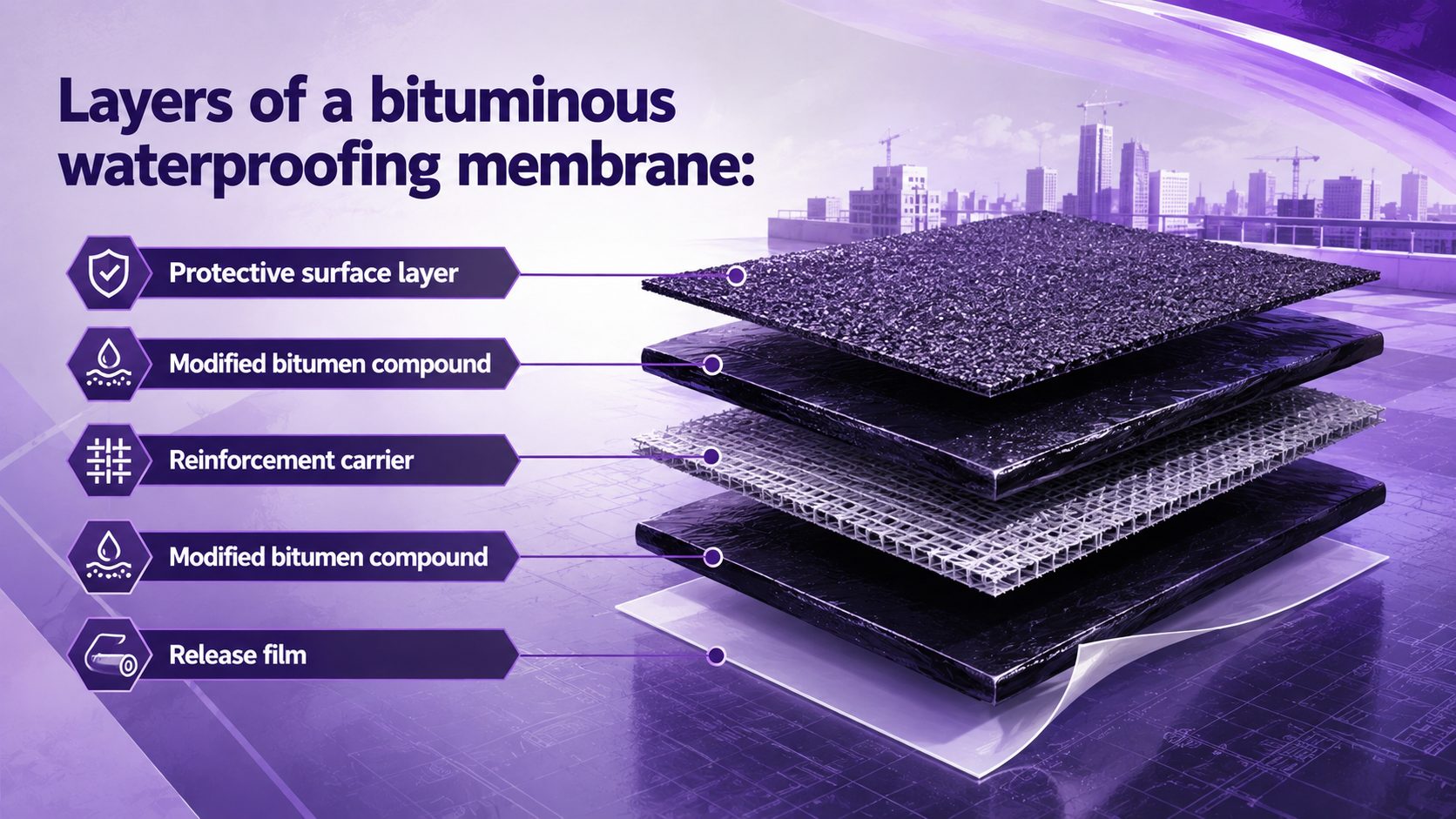
A typical bituminous waterproofing membrane consists of several layers
Protective surface layer – shields the membrane from external exposure.
Modified bitumen compound – provides the main waterproofing barrier.
Reinforcement carrier – adds strength and helps the sheet retain its shape.
Modified bitumen compound – creates an additional protective layer.
Release film – protects the membrane before installation.
Basic bituminous sheets mainly rely on the waterproofing properties of bitumen. Modern modified bitumen membranes offer more controlled performance for demanding construction applications. Since manufacturers produce them with a consistent thickness and layered structure, they can provide more uniform waterproofing coverage than loose or liquid bituminous materials applied directly on site.
How does a bitumen sheet work for waterproofing?
Forms a continuous waterproof barrier: A bitumen sheet creates a continuous layer over the prepared surface. Once installed and bonded correctly, the membrane blocks water and moisture from reaching the underlying concrete or structural layer.
Prevents water penetration: The waterproofing membrane for concrete acts as a protective barrier between the structure and external moisture. This helps reduce the risk of water seepage through exposed surfaces.
Reinforcement adds strength: The reinforcement layer improves tensile strength and dimensional stability. It helps the membrane maintain its shape during handling and under normal structural movement.
Performs under changing temperatures: Polymer-modified bitumen can improve flexibility and resistance to temperature changes. This allows the membrane to perform more reliably under varying sites and environmental conditions.
Joints and surface preparation matter: A bitumen membrane waterproofing system performs only when installers prepare and seal critical areas correctly. Waterproofing failures often occur at:
- Overlap and construction joints
- Corners and surface transitions
- Pipe penetrations
- Poorly prepared or uneven surfaces
Proper overlap between adjoining sheets also helps maintain a continuous waterproof layer. This makes installation quality and surface preparation critical to the overall performance of the system.
Types of bitumen sheets
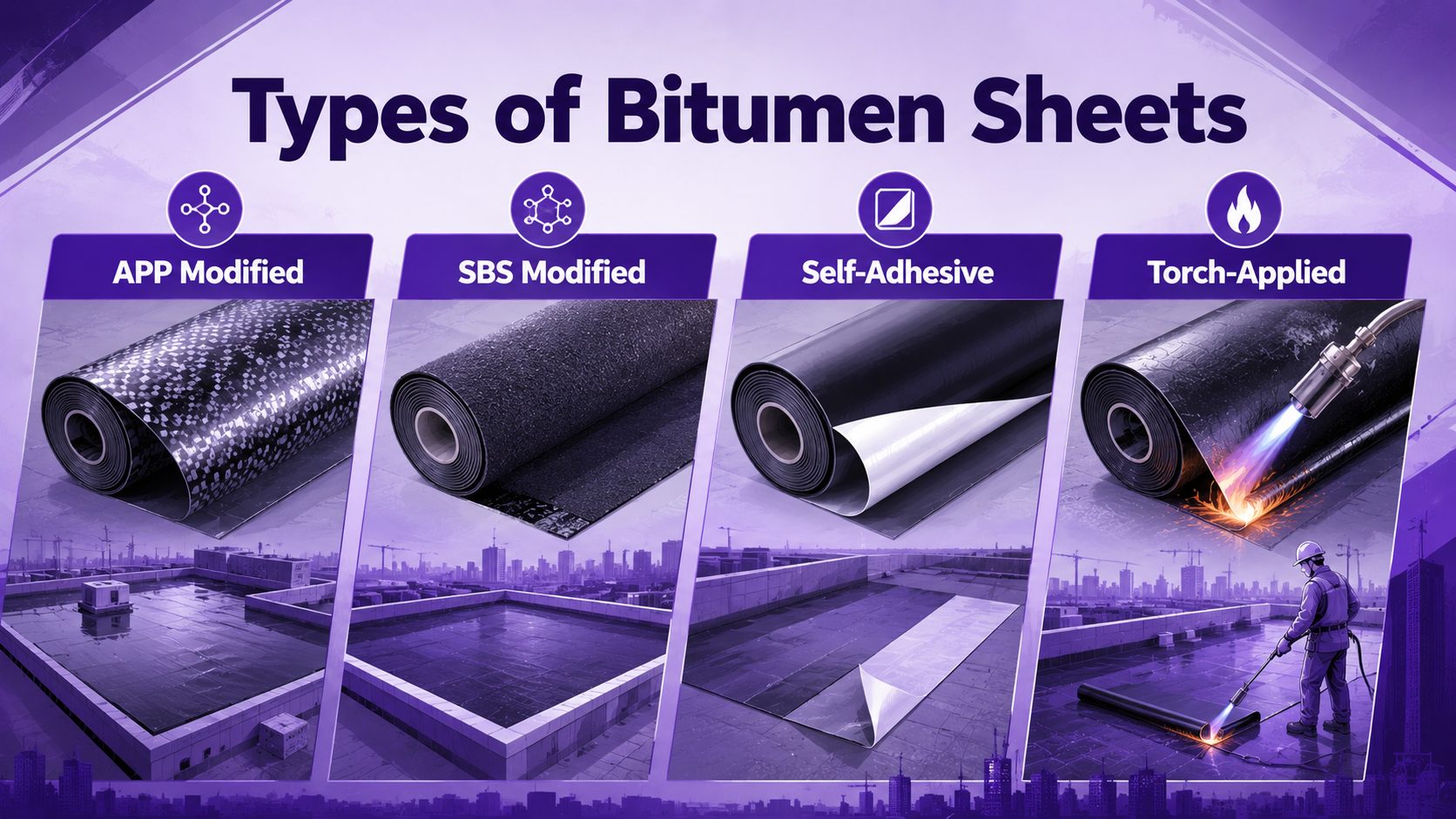
Different types of bitumen sheets suit different waterproofing conditions. The right choice depends on factors such as temperature exposure, structural movement, installation conditions, and project specification. The four common options are APP-modified, SBS-modified, self-adhesive, and torch-applied membranes.
APP modified bitumen sheets
APP stands for Atactic Polypropylene, a polymer added to bitumen to improve its resistance to high temperatures. APP membranes work well in areas exposed to strong heat and sunlight. Contractors commonly use them for terraces, flat roofs, and other exposed waterproofing surfaces.
SBS modified bitumen sheets
SBS stands for Styrene-Butadiene-Styrene. SBS membranes offer greater flexibility and elasticity than conventional bituminous sheets. They can suit structures where thermal movement or temperature changes may cause the surface to expand, contract, or move.
Self-adhesive bitumen sheets
Self-adhesive membranes come with a factory-applied adhesive layer. Installers can apply them without extensive torch heating, which makes them useful where open-flame work is restricted. However, the surface must remain clean, smooth, and properly prepared to achieve effective bonding.
Torch-applied bitumen membranes
Torch-applied or torch-on membranes use heat to bond the sheet to the prepared surface. They can provide strong adhesion when trained installers apply them correctly. Contractors often use these membranes for large waterproofing areas, but installation requires proper safety controls and skilled handling.
| Type | Key characteristic | Typical application | Selection consideration |
|---|---|---|---|
| APP membrane | High heat resistance | Roofs and terraces | Climate and exposure |
| SBS membrane | High flexibility | Foundations and structures | Movement and temperature |
| Self-adhesive bitumen membrane | No torch required | Sites with open-flame restrictions | Surface preparation |
| Torch-on membrane | Heat-bonded application | Large waterproofing areas | Skilled installation and safety controls |
Where are bitumen sheets used?
Bitumen sheet applications extend across building, infrastructure and industrial projects where concrete or structural surfaces need protection from water and moisture. The most suitable membrane depends on the exposure conditions and performance requirements of each structure.
| Construction area | Application | Why waterproofing is required |
|---|---|---|
| Buildings and commercial structures | Flat roofs | Helps protect the roof slab from rainwater penetration and prolonged moisture exposure |
| Terraces | Creates a waterproof layer below protective finishes or exposed surfaces. | |
| Podiums | Helps manage water exposure above occupied or underground spaces. | |
| Basements | Acts as a basement waterproofing membrane to protect below-ground concrete from moisture and water ingress. | |
| Infrastructure projects | Bridge decks | Helps protect structural surfaces from water penetration before the next construction layer is applied. |
| Bridge approach structures | Supports waterproofing at areas exposed to rainwater, drainage and surface runoff. | |
| Retaining walls | Helps reduce moisture penetration from surrounding soil and groundwater. | |
| Underground structures | Protects structural surfaces exposed to persistent ground moisture. | |
| Tunnels and associated structures | May provide waterproofing protection where the project design and specifications permit its use. | |
| Civil and industrial construction | Foundations | Helps protect below-ground structural elements from moisture exposure |
| Water-retaining or moisture-prone structures | Provides an additional barrier where continuous moisture exposure is a concern. | |
| Industrial roofs | Supports long-term roof waterproofing across factories and production facilities. | |
| Warehouses and logistics facilities | Helps protect large roof areas and other exposed structural surfaces from water ingress. |
Project teams should select the waterproofing system based on water pressure, surface orientation, structural movement, temperature exposure, and mechanical protection requirements. These factors determine whether a particular bituminous membrane can meet the demands of the intended application.
Key components and technical specifications to check
For engineers, consultants and procurement teams, bitumen sheet specifications should go beyond thickness and price. A membrane with the same thickness as another product may perform differently because of its polymer content, reinforcement quality, and manufacturing consistency. Reviewing the technical data sheet against project requirements can help teams select a suitable waterproofing membrane.
| Parameter | What to check | Why it matters |
|---|---|---|
| Membrane thickness | Thickness specified for the application. | Influences durability and suitability for the intended use. |
| Reinforcement type | Polyester, fibreglass or another carrier. | Affects tensile strength, flexibility and dimensional stability. |
| Tensile strength | The membrane’s resistance to pulling forces. | Indicates its ability to withstand stresses during service. |
| Elongation | How much the membrane can stretch before failure. | Important where limited surface or thermal movement may occur. |
| Heat resistance | Performance under elevated temperatures. | Important for exposed surfaces and hot climatic conditions. |
| Low-temperature flexibility | Ability to remain flexible at lower temperatures. | Helps assess performance under changing temperature conditions. |
| Water absorption and impermeability | Resistance to water penetration. | Indicates the membrane’s core waterproofing performance. |
| Dimensional stability | Resistance to shrinkage, expansion or distortion. | Helps maintain consistent coverage over time. |
| Surface finish | Sanded, mineral-coated, aluminium-faced, or other finishes. | Can provide additional protection against UV exposure and environmental conditions. |
| Roll dimensions and coverage | Roll width, length and effective coverage after overlaps. | Helps estimate material requirements and procurement quantities. |
Procurement teams should compare these waterproofing membrane specifications with the project design, consultant requirements, and site conditions. They should also check product certifications, test data, and manufacturer documentation before finalising the purchase.
Bitumen sheet price in India
As of October 2026, bitumen sheet prices in India can vary widely by membrane type, thickness, reinforcement and order quantity. Market listings indicate that 3 mm APP membranes commonly fall around ₹120–₹230 per sq. metre, although prices may be higher or lower depending on the brand, city, and purchase volume.
Suppliers may quote prices per square metre, per roll or per unit. Many membranes come in rolls, often measuring around 1 m × 10 m, but the usable coverage can reduce after allowing for overlaps. Procurement teams should therefore compare the effective coverage area rather than relying only on the quoted roll price.
| Type of bitumen sheet | Typical specification | Indicative price range* | Suitable application |
|---|---|---|---|
| APP modified membrane | 3 mm | ₹120–₹230 per sq. m | Roofs, terraces, and general waterproofing. |
| APP modified membrane | 4 mm | ₹160–₹300 per sq. m** | Heavy-duty waterproofing applications. |
| SBS modified membrane | Varies by specification | ₹150–₹280 per sq. m** | Applications requiring greater flexibility. |
| Self-adhesive membrane | 1–4 mm | ₹180 onwards per sq. m | Areas where flame-free installation is preferred. |
*Indicative market ranges as of October 2026. Actual quotations can vary by supplier, location, quantity, and specification. The 3 mm APP range is supported by current market listings, while the 4 mm APP and SBS ranges should be treated as budgeting estimates for pending project-specific quotations.
**Higher-specification products and smaller orders may attract higher rates.
Price changes based on sheet thickness, APP or SBS modification, reinforcement material, surface finish, manufacturer, roll size, order quantity, location, and freight. The lowest price per roll may not deliver the lowest project cost. A lower-priced membrane may offer less usable coverage or require additional protection and installation work. Compare the price against the technical specification, effective coverage area, and installation requirements before finalising procurement.
How to install a bitumen sheet
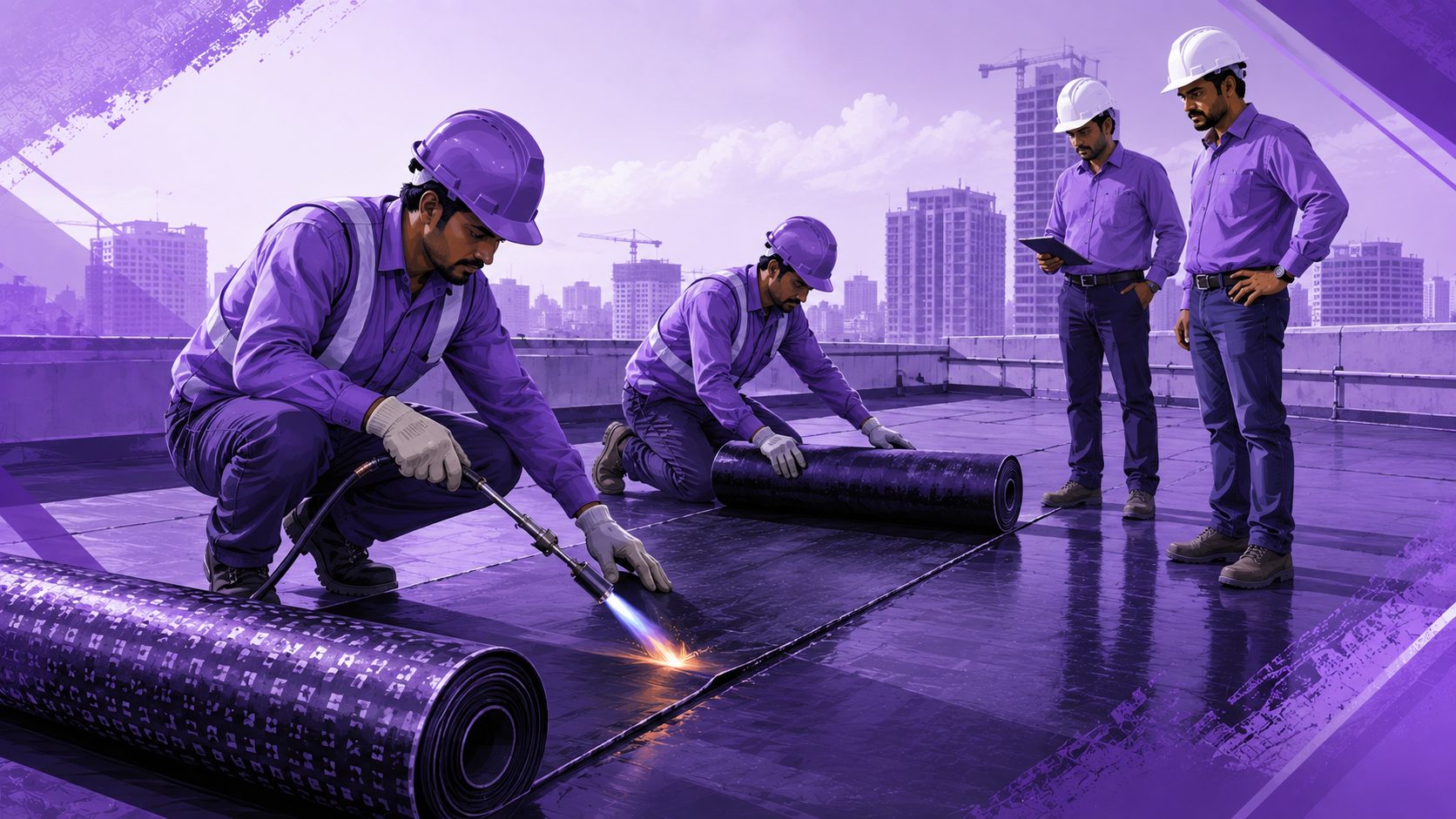
A bitumen sheet installation requires careful surface preparation, correct bonding, and proper treatment of joints. The exact process may vary by membrane type, so installers should always follow the manufacturer’s technical instructions and project specifications.
Step 1: Prepare the surface
Ensure the substrate is clean, dry, and stable. Remove dust, loose particles, oil, and other contaminants that may affect adhesion. Repair cracks, holes, and major uneven areas before waterproofing begins.
Step 2: Apply primer where required
Apply a compatible primer if the selected waterproofing system requires it. The primer helps improve bonding between the substrate and the bitumen membrane.
Step 3: Position and align the sheet
Plan the roll layout before bonding the membrane. Position each sheet carefully and maintain the specified overlaps. Give extra attention to corners, joints, and changes in surface direction.
Step 4: Bond the membrane
For torch-applied membranes, installers use controlled heat to bond the sheet to the surface. Self-adhesive membranes use a factory-applied adhesive layer and do not require torch heating.
Step 5: Seal overlaps and critical areas
Secure and seal overlaps to maintain continuous waterproofing. Check joints, edges, pipe penetrations, and vertical transitions carefully, as these areas may be more vulnerable to water ingress.
Step 6: Inspect the finished waterproofing layer
Inspect the completed surface for:
- Wrinkles or trapped air
- Incomplete bonding
- Open or poorly sealed joints
- Cuts, punctures or other damage
A proper bitumen waterproofing process depends on both the selected membrane and the quality of installation.
How to choose the right bitumen sheet for your project
Choosing the right bitumen sheet starts with the project conditions, not the product price. Engineers, contractors, and procurement teams should assess the following questions before finalising the waterproofing material.
What surface requires waterproofing?
Identify whether the membrane will protect a roof, basement, foundation, retaining wall or another structural surface. Each application may have different performance requirements.
Will the membrane remain exposed?
Check whether the membrane will remain exposed or receive protective screeding, flooring, soil, or another construction layer. The exposure condition can influence the required surface finish and protection.
What temperature conditions will it face?
Consider local temperatures and heat exposure. The selected membrane should suit the expected site and service conditions.
Is structural or thermal movement expected?
Assess whether the surface may expand, contract, or experience movement. This can affect the required flexibility and elongation properties.
Does the project require torch application?
Check whether the site permits open-flame work. Where it does not, a self-adhesive, or other flame-free solution may be more suitable.
What does the project specification require?
Review the DPR, consultant specifications, and tender documents before selecting a membrane. These documents may define the required material type and performance criteria.
Quick procurement checklist
Before placing an order:
- Confirm the membrane type and thickness.
- Verify the reinforcement material.
- Review technical data sheets and test information.
- Check compatibility with the substrate and adjoining materials.
- Review storage and handling requirements.
- Compare the total installed cost, not only the roll price.
A structured bitumen membrane selection process can help project teams avoid unsuitable materials, specification mismatches, and unnecessary rework.
Bitumen sheet vs liquid waterproofing
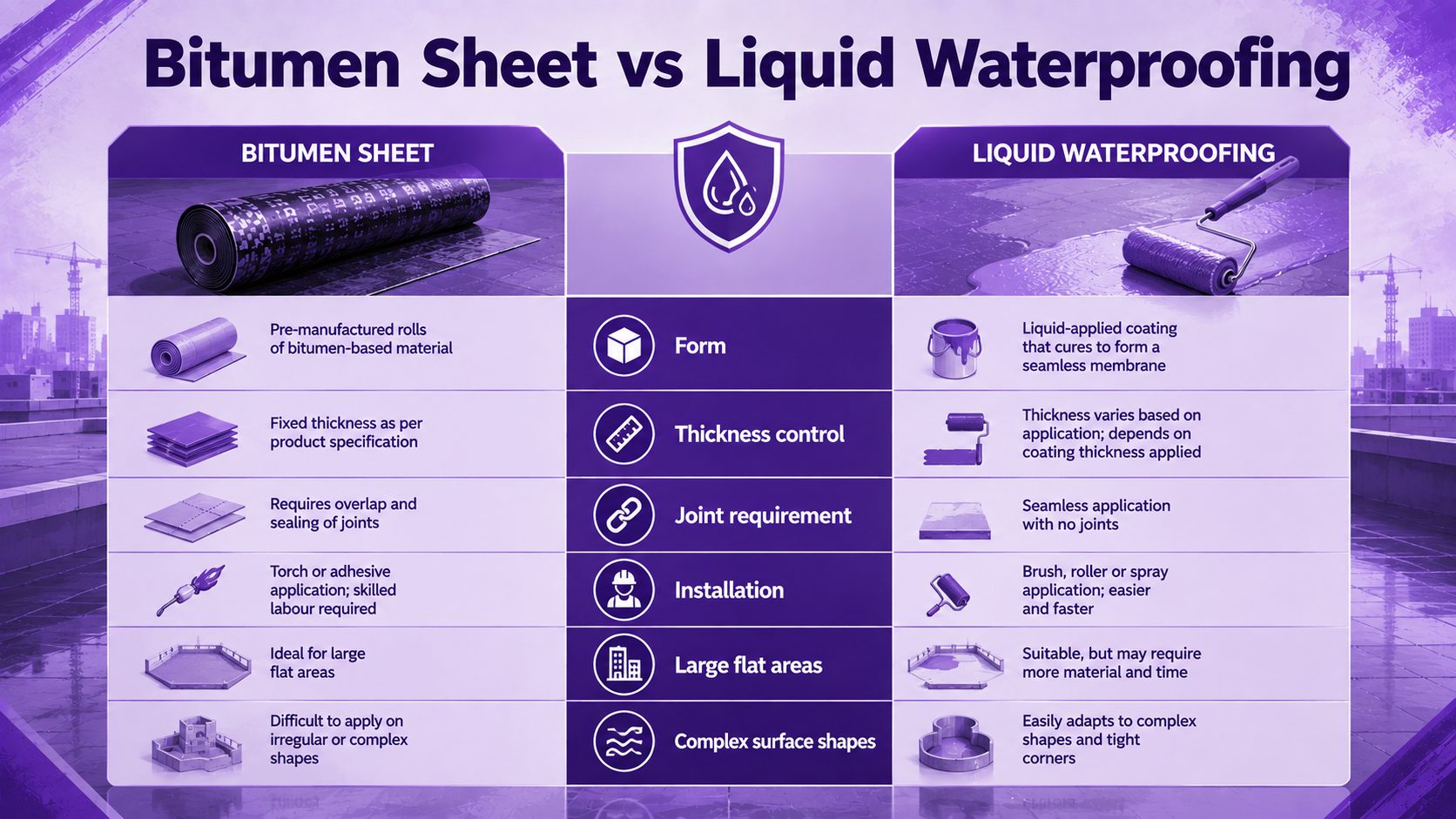
Both systems protect structures from water ingress, but they differ in form, application, and performance control. A bitumen sheet comes as a pre-manufactured membrane, while liquid waterproofing is applied directly to the surface and forms a coating after curing.
| Factor | Bitumen sheet | Liquid waterproofing |
|---|---|---|
| Form | Pre-manufactured membrane | Applied as a liquid coating |
| Thickness control | Factory controlled | Depends on the application and number of coats |
| Joint requirement | Requires overlap treatment | Can create a seamless coating |
| Installation | Requires correct positioning and bonding | Depends on the product and surface condition |
| Large flat areas | Suitable for consistent coverage | Suitability depends on the product and project requirements |
| Complex surface shapes | May require additional detailing | Can adapt more easily to irregular surfaces |
The choice between a bitumen membrane and liquid membrane depends on the surface geometry, project size, exposure conditions, and required durability. Teams should also consider installation access and the specifications defined in the project documents. Neither option works as a universal solution, so the selected system should match the structure and site requirements.
Common mistakes to avoid when using bitumen sheets
Poor material selection and execution can increase the risk of waterproofing membrane failure. Site engineers, QA teams and project managers should watch for these common issues:
Choosing only based on price: A cheaper membrane may not meet the project’s performance requirements.
Installing on damp surfaces: Moisture and poor surface preparation can affect membrane bonding.
Incorrect overlap treatment: Poorly sealed overlaps can create paths for water ingress.
Weak detailing at corners and penetrations: These critical areas need careful waterproofing treatment.
Using the wrong membrane for exposed conditions: Temperature, UV exposure, and site conditions can affect performance.
Damaging the membrane during later work: Subsequent construction activities can puncture or tear the waterproofing layer.
Improper storage before installation: Heat, sunlight or poor handling can affect the condition of the membrane before use.
Avoiding these bitumen membrane installation mistakes can help reduce rework, leakage issues, and long-term maintenance costs.
Conclusion
A bitumen sheet can influence both the durability and maintenance demands of a structure. The right choice depends on where the membrane will be used, how the surface will perform under temperature and movement, and what the project specifications demand. For contractors and procurement teams, the key is to compare the membrane’s actual performance data, usable coverage, and installation needs before placing an order. This can help avoid material mismatches, site-level failures, and unnecessary waterproofing costs over the project’s lifecycle.
Looking to procure steel?
Tata nexarc helps manufacturers, builders and MSMEs source certified steel products, compare prices, and choose the right grade as per IS codes—with complete traceability and procurement confidence.
FAQs
What is a bitumen sheet used for?
What is the difference between a bitumen sheet and a bitumen membrane?
Which is better: APP or SBS bitumen sheet?
What is the price of a bitumen sheet in India?
What is the difference between a 3 mm and 4 mm bitumen sheet?
Can a bitumen sheet be used for basement waterproofing?
How long does a bitumen sheet last?
Can bitumen sheets be applied without a torch?
What causes bitumen sheet waterproofing to fail?
How do I choose the right bitumen sheet?
A product manager with a writer's heart, Anirban leverages his 6 years of experience to empower MSMEs in the business and technology sectors. His time at Tata nexarc honed his skills in crafting informative content tailored to MSME needs. Whether wielding words for business or developing innovative products for both Tata Nexarc and MSMEs, his passion for clear communication and a deep understanding of their challenges shine through.