Check Price Now
Table of Contents
- What is Bitumen?
- Key Properties of Bitumen
- Types of Bitumen Used in India
- Bitumen Grades and Their Specifications
- Why Bitumen is Widely Used in Indian Road Projects
- Bitumen Specifications and Standards in India
- Factors Affecting Bitumen Prices in India
- How to Choose the Right Bitumen Grade for Your Project
- Leading Bitumen Manufacturers and Suppliers in India
- Future Trends in the Indian Bitumen Industry
- Conclusion
- FAQs
Bitumen is one of the most widely used materials in India’s infrastructure sector. It serves as the binding agent in roads, highways, expressways, airport runways, and several waterproofing applications. As the country continues to invest in highway infrastructure, urban development, and industrial projects, the demand for high-quality bitumen remains strong.
Known for its durability, flexibility, and water-resistant properties, it plays a critical role in building long-lasting pavements and protecting structures from moisture damage. Different bitumen grades are designed for specific climatic conditions, traffic loads, and project requirements. Choosing the right grade can improve performance, reduce maintenance costs, and increase asset life.
This guide covers the types of bitumen used in India, their applications, specifications, prices, and key factors to consider before procurement.
What is bitumen?
It is a petroleum-derived binding material widely used in road construction, waterproofing, and infrastructure projects. It is a dark, sticky, and highly viscous substance that helps bind aggregates together to create durable road surfaces. Thanks to its strong adhesive properties and water resistance, bitumen plays a vital role in highways, airport runways, bridges, and industrial applications across India.
Definition and composition
Bitumen is a by-product of crude oil refining. It consists mainly of complex hydrocarbons along with small amounts of sulphur, oxygen, and nitrogen compounds. Its unique composition gives it the flexibility and durability required for road construction.
Some key physical properties of bitumen include:
- Strong adhesion to aggregates
- Excellent waterproofing capability
- High durability under traffic loads
- Flexibility to withstand temperature variations
- Resistance to wear and weathering
How bitumen is manufactured
The manufacturing process begins with crude oil refining at petroleum refineries. During refining, crude oil is heated and separated into different products based on their boiling points.
The heavier residue left after the initial refining process undergoes vacuum distillation. This process removes lighter components under reduced pressure, leaving behind bitumen with the desired consistency and performance characteristics.
Manufacturers also carry out strict quality control measures to ensure the bitumen meets industry standards for viscosity, penetration, softening point, and durability before it reaches the market.

Bitumen vs asphalt: What’s the difference?
Many people use the terms bitumen and asphalt interchangeably, but they are not the same. Bitumen is the binding material that holds aggregates together. Asphalt is the finished mixture made by combining bitumen with aggregates such as crushed stone, sand, and gravel.
In simple terms:
Bitumen = Binder
Asphalt = Bitumen + aggregates
While bitumen provides the adhesive and waterproofing properties, asphalt forms the final road surface used on highways, streets, airport runways, and other paved areas. Understanding the difference between asphalt and bitumen helps contractors, engineers, and procurement teams select the right materials for their projects.
Key properties of bitumen
Bitumen remains one of the most widely used road construction materials because of its ability to bind aggregates, resist water, and withstand varying traffic and weather conditions. These properties help create durable road construction materials that offer long service life and lower maintenance requirements.
Adhesion and binding strength
This paving material acts as a strong binder that holds aggregates together in asphalt mixes. Good adhesion helps prevent surface deterioration, reduce aggregate loss, and improves the overall strength of the pavement.
Waterproofing characteristics
One of the most important bitumen properties is its ability to resist water penetration. This waterproofing capability protects the pavement structure from moisture damage, which can weaken roads and lead to premature failures.
Flexibility and durability
This road construction material can flex under traffic loads without cracking easily. This flexibility allows roads to accommodate minor ground movements and changing loads while maintaining their structural integrity over time.
Temperature resistance
Road surfaces often experience significant temperature variations throughout the year. It can perform across a wide temperature range when the appropriate grade is selected. This helps minimise issues such as cracking in colder conditions and rutting in hotter climates.
Workability and ageing resistance
It offers good workability during mixing, transportation, and laying operations. It also resists ageing and oxidation, helping roads maintain their performance and service life for longer periods with proper maintenance.
| Property | Importance in road construction |
|---|---|
| Adhesion and binding strength | Holds aggregates together and improves pavement stability |
| Waterproofing characteristics | Protects roads from moisture-related damage |
| Flexibility and durability | Reduces cracking and extends pavement life |
| Temperature resistance | Supports performance under varying climatic conditions |
| Workability | Enables efficient mixing, paving, and compaction |
| Ageing resistance | Helps maintain long-term pavement performance |
These properties make this paving material a preferred choice for highways, urban roads, airport runways, and other infrastructure projects where durability, reliability, and cost-effectiveness are essential.
Types of bitumen used in India
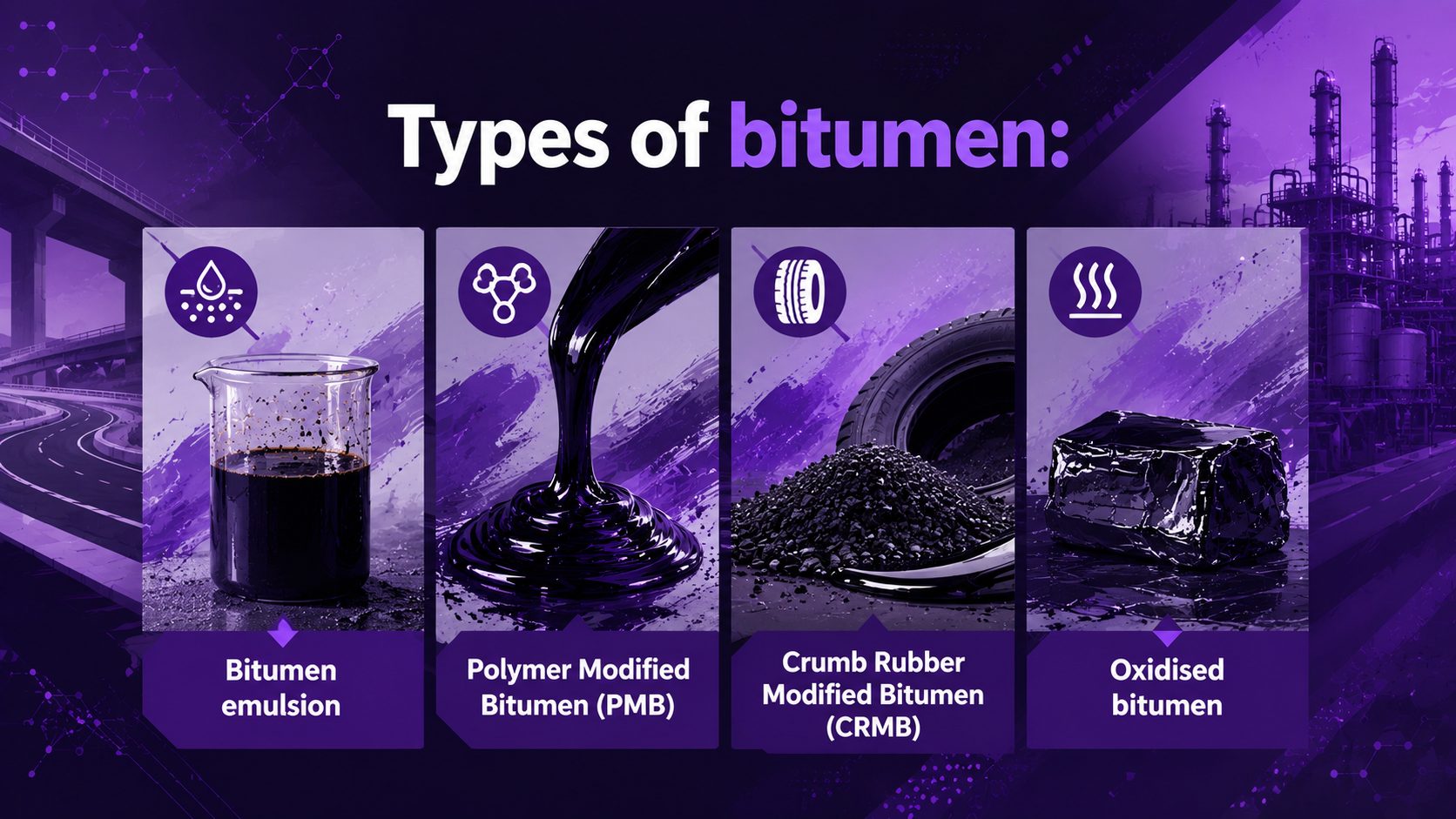
Different types of bitumen are used across road construction, highway infrastructure, waterproofing, and industrial applications. The right choice depends on traffic load, climate, performance requirements, and project specifications.
| Type | Key characteristics | Common applications |
|---|---|---|
| VG-10 | Lower viscosity and good workability | Surface dressing, spray applications, road maintenance works. |
| VG-20 | Balanced strength and flexibility | Roads with moderate traffic and climatic conditions. |
| VG-30 | Most commonly used road construction grade | National highways, state highways, expressways, urban roads. |
| VG-40 | Higher stiffness and rutting resistance | Heavy traffic corridors, industrial roads, high-temperature regions. |
| Bitumen Emulsion | Can be applied at lower temperatures | Rural roads, maintenance works, surface dressing. |
| PMB | Enhanced flexibility and durability | High-traffic highways, bridges, expressways. |
| CRMB | Modified with recycled rubber | Heavy-duty pavements and sustainable road projects. |
| Oxidised Bitumen | Higher hardness and temperature resistance | Waterproofing, roofing, pipe coatings, industrial applications. |
Bitumen emulsion
Bitumen emulsion is a mixture of bitumen, water, and emulsifying agents. It is widely used in rural road construction, maintenance works, and surface dressing because it can be applied at lower temperatures.
Polymer Modified Bitumen (PMB)
PMB contains polymers that improve flexibility and pavement performance. It offers better rutting resistance, reduces cracking, and helps extend pavement life on heavily trafficked roads.
Crumb Rubber Modified Bitumen (CRMB)
CRMB uses recycled rubber from waste tyres to enhance pavement performance. It improves durability, increases resistance to cracking, and supports sustainable road construction practices.
Oxidised bitumen
Oxidised bitumen is mainly used outside road construction. Its excellent waterproofing and temperature-resistant properties make it suitable for roofing, waterproofing systems, industrial flooring, and pipe coatings.
Bitumen grades and their specifications
| Grade | Key characteristics | Typical specification focus |
|---|---|---|
| VG-10 | Lower viscosity | Better workability in cooler conditions |
| VG-20 | Medium viscosity | Balanced flexibility and strength |
| VG-30 | Standard paving grade | Suitable for most highway projects |
| VG-40 | Higher viscosity | Greater resistance to deformation |
| PMB | Polymer-modified | Enhanced flexibility and durability |
| CRMB | Rubber-modified | Improved fatigue and rutting resistance |
Key specifications to evaluate
When selecting bitumen, engineers and procurement teams typically assess:
- Viscosity
- Penetration value
- Softening point
- Ductility
- Flash point
- Elastic recovery (for modified bitumen)
Why specifications matter
Bitumen specifications help ensure consistent quality, better pavement performance, and compliance with project requirements. Choosing a grade based on both performance requirements and technical specifications can reduce maintenance costs and extend pavement life.
Why bitumen is widely used in Indian road projects
Bitumen continues to be the preferred material for road construction across India due to its cost efficiency, ease of use, and suitability for a wide range of infrastructure projects. From national highways and expressways to urban roads and rural connectivity programmes, bitumen plays a key role in supporting the country’s growing transportation network.
Cost-effectiveness
Bitumen offers a cost-effective solution for road construction when compared with many alternative paving materials. Its relatively lower initial cost and efficient maintenance requirements make it a practical choice for large-scale infrastructure projects.
Ease of maintenance
Roads built with bitumen can be repaired, resurfaced, and strengthened without extensive reconstruction. This helps reduce maintenance costs, minimise traffic disruptions, and extend pavement life.
Fast construction cycles
Bitumen pavements can be laid and opened to traffic relatively quickly. Faster construction timelines help contractors meet project schedules and reduce delays, particularly on highway and urban infrastructure projects.
Adaptability to Indian climate
India experiences a wide range of climatic conditions, from high temperatures in western regions to cooler temperatures in northern states. Different bitumen grades allow engineers to select materials that suit local weather conditions and traffic requirements.
Compatibility with flexible pavements
Bitumen is the primary binder used in flexible pavement construction. Flexible pavements can distribute traffic loads efficiently while offering smoother riding surfaces and easier maintenance. This makes them a popular choice for highways, urban roads, and industrial access routes.
Bitumen specifications and standards in India

Bitumen used in road construction must comply with established quality standards to ensure safety, durability, and long-term pavement performance.
MoRTH specifications
The Ministry of Road Transport and Highways (MoRTH) defines specifications for bitumen grades, material quality, and construction practices used in road projects across India.
BIS standards
The Bureau of Indian Standards (BIS) sets quality requirements for bitumen through standards such as IS 73 for paving bitumen and other relevant specifications for modified bitumen products.
NHAI quality requirements
National highway projects typically require bitumen to meet MoRTH specifications, approved testing requirements, and project-specific quality criteria.
Testing parameters
Several key parameters are evaluated during bitumen testing to verify quality and performance.
| Parameter | Purpose |
|---|---|
| Penetration value | Measures the hardness or consistency of bitumen |
| Softening point | Indicates the temperature at which bitumen begins to soften |
| Ductility | Assesses the material’s ability to stretch without breaking |
| Viscosity | Measures resistance to flow and helps determine suitable applications |
| Flash point | Indicates the temperature at which bitumen vapours may ignite |
These bitumen specifications and testing parameters help contractors, engineers, and procurement teams select materials that meet project requirements and regulatory standards.
Factors affecting bitumen prices in India
Several factors influence the bitumen price in India, causing rates to vary across regions, grades, and market conditions.
Crude oil prices: Since bitumen is a petroleum-based product, fluctuations in global crude oil prices directly impact its cost.
Refinery production: Changes in refinery output, maintenance shutdowns, or supply constraints can affect bitumen availability and pricing.
Transportation costs: Freight charges, fuel prices, and delivery distances can significantly influence the final landed cost of bitumen.
Seasonal demand: Demand often rises during peak road construction seasons, which can lead to temporary price increases.
Government infrastructure spending: Large-scale investments in highways, expressways, and public infrastructure projects can increase demand and influence market prices.
Grade and quality requirements: Premium products such as PMB and CRMB typically cost more than conventional VG grades due to additional processing and performance benefits.
How to choose the right bitumen grade for your project
Selecting the right bitumen grade can improve pavement performance, reduce maintenance costs, and help ensure long-term durability. Contractors, engineers, and procurement teams should evaluate project requirements before making a purchase decision.
Key factors to consider
Traffic load: Roads carrying heavy commercial vehicles generally require higher-performance grades than roads with light traffic.
Climatic conditions: Temperature variations can affect pavement performance, making grade selection important for different regions.
Project specifications: Always review project documents, tender requirements, and applicable standards before selecting a grade.
Lifecycle costs: Consider long-term maintenance and performance costs rather than focusing only on the initial purchase price.
Compliance requirements: Ensure the selected bitumen complies with relevant MoRTH, BIS, and project-specific quality standards.
| Project type | Recommended bitumen type |
|---|---|
| Rural roads and maintenance works | Bitumen emulsion |
| Urban roads and moderate traffic roads | VG-20 or VG-30 |
| National highways and expressways | VG-30 |
| Heavy traffic corridors | VG-40 |
| High-stress roads and bridges | PMB |
| Sustainable pavement projects | CRMB |
| Waterproofing and roofing works | Oxidised bitumen |
Leading bitumen manufacturers and suppliers in India

India’s bitumen market is supported by major public-sector oil companies with extensive refining capacity and nationwide supply networks. These manufacturers play a critical role in meeting the growing demand from highway, urban infrastructure, and industrial projects.
Indian Oil Corporation
Indian Oil is one of the largest bitumen manufacturers in India. The company operates multiple refineries and supplies bitumen across the country through an extensive distribution network.
Bharat Petroleum Corporation Limited
BPCL produces and supplies various bitumen grades for road construction and infrastructure projects. Its refinery network supports supply requirements across several regions.
Hindustan Petroleum Corporation Limited
HPCL is a major supplier of paving and industrial bitumen products. The company serves contractors, infrastructure developers, and government projects through its established distribution channels.
What to consider when selecting a supplier
- Manufacturing capability and production capacity
- Distribution network and delivery reach
- Product quality and standards compliance
- Supply reliability and availability
- Technical support and after-sales assistance
Choosing an established bitumen supplier can help ensure consistent product quality, timely deliveries, and smooth project execution.
Future trends in the Indian bitumen industry
The future of the bitumen industry in India will be shaped by sustainability goals, infrastructure expansion, and advances in pavement technology. The following trends are expected to influence demand and usage in the coming years.
| Trend | Expected impact |
|---|---|
| Sustainable road construction | Greater focus on reducing environmental impact and improving resource efficiency |
| Warm mix asphalt technologies | Lower energy consumption, reduced emissions, and improved construction efficiency |
| Recycled pavement materials | Increased use of reclaimed asphalt pavement (RAP) and circular construction practices |
| Smart highways and infrastructure expansion | Higher demand for durable paving materials across road and logistics networks |
| Modified bitumen adoption | Growing use of PMB and CRMB for improved pavement performance and longer service life |
India’s expanding highway network, urban development projects, and focus on sustainable road construction are expected to drive innovation across the bitumen sector. As project requirements become more demanding, the adoption of advanced bitumen technologies and modified grades is likely to increase.
Conclusion
Bitumen remains a critical material for supporting India’s expanding transportation and infrastructure network. As project requirements become more specialised, understanding bitumen grades, specifications, and quality parameters becomes increasingly important. Selecting the right product can improve pavement performance, optimise lifecycle costs, and support long-term asset durability. By sourcing materials from reliable suppliers and ensuring compliance with applicable standards, contractors and procurement teams can make informed decisions that contribute to successful project outcomes.
Looking to procure steel?
Tata nexarc helps manufacturers, builders and MSMEs source certified steel products, compare prices, and choose the right grade as per IS codes—with complete traceability and procurement confidence.
FAQs
What is bitumen used for?
What is the difference between bitumen and asphalt?
Which bitumen grade is used for highways in India?
What is VG 30 bitumen?
What factors affect bitumen prices?
What are the different types of bitumen?
Is bitumen waterproof?
What standards govern bitumen quality in India?
How is bitumen manufactured?
How do I select the right bitumen grade for a road project?
A product manager with a writer's heart, Anirban leverages his 6 years of experience to empower MSMEs in the business and technology sectors. His time at Tata nexarc honed his skills in crafting informative content tailored to MSME needs. Whether wielding words for business or developing innovative products for both Tata Nexarc and MSMEs, his passion for clear communication and a deep understanding of their challenges shine through.