Check Price Now
Table of Contents
- What are Concrete Crash Barriers?
- How Do Concrete Crash Barriers Work?
- Types of Concrete Crash Barriers Used in Highway Projects
- Key Components and Design Features
- Specifications and Standards in India
- Applications Across Infrastructure Projects
- Benefits for EPC Contractors and Infrastructure Developers
- Concrete vs Steel Crash Barriers
- Selection and Procurement Factors
- Conclusion
- FAQs
India’s expanding network of highways, expressways, bridges, and urban roads has increased the focus on road safety infrastructure. As traffic volumes continue to rise, project developers and contractors are placing greater emphasis on systems that can reduce the severity of accidents and improve road user safety.
Concrete crash barriers have become a widely used solution for managing vehicle impact and preventing cross-over collisions. Their durability and low maintenance requirements make them suitable for a wide range of infrastructure projects. Many highway authorities and project owners also specify these barriers in line with IRC and NHAI standards to support safer road design and long-term performance.
What are concrete crash barriers?
Concrete crash barriers are protective structures installed along roads, highways, bridges, and medians to help control the movement of vehicles during an accident. These barriers form an important part of modern road safety infrastructure and are commonly used in locations where strong impact resistance and long-term durability are required.
Unlike ordinary road dividers, concrete crash barriers are specifically designed to improve safety during vehicle collisions. Their shape and construction help keep vehicles within their designated carriageway, reducing the risk of more severe incidents.
The primary functions of concrete crash barriers include:
- Preventing vehicles from crossing into opposing traffic lanes.
- Separating traffic streams on high-speed corridors.
- Protecting motorists near bridges, flyovers, and elevated roads.
- Enhancing safety in high-risk sections of road networks.
- Supporting compliance with road safety requirements in infrastructure projects.
Traffic dividers mainly guide traffic and separate lanes, whereas concrete safety barriers serve as vehicle restraint systems that help manage collision impacts. This distinction makes concrete crash barriers a preferred choice for many highway, expressway, and large-scale road construction projects.
How do concrete crash barriers work?

These barriers are designed to manage the movement of a vehicle after a collision. Instead of allowing the vehicle to continue into oncoming traffic, roadside hazards, or adjacent lanes, they help guide it back towards its original path.
When a vehicle strikes the barrier, the structure absorbs and redistributes part of the impact force. This process reduces the likelihood of sudden vehicle overturning or uncontrolled movement. The barrier’s shape also helps redirect the vehicle along the roadway rather than bringing it to an abrupt stop.
The process typically follows this sequence:
Impact → Containment → Redirection → Reduced severity
Key ways these systems improve safety include:
- Limiting vehicle movement after a collision
- Reducing the risk of cross-median accidents
- Improving vehicle containment on high-speed roads
- Providing reliable impact resistance in critical locations
- Supporting overall crash barrier performance and road safety outcomes
Types of concrete crash barriers used in highway projects
Different highway projects require different barrier systems based on traffic conditions, road design, construction timelines, and safety requirements. The following are some of the most commonly used concrete barrier types across highways, expressways, bridges, and construction zones.
Cast-in-situ concrete crash barriers
Contractors construct cast-in-situ barriers directly at the project site using formwork, reinforcement, and concrete. These barriers are commonly used in permanent highway and urban infrastructure projects where the alignment is fixed. Since construction takes place on-site, teams can adapt the design to suit specific road layouts and project requirements.
Precast concrete crash barriers
Precast concrete crash barriers are manufactured in a controlled facility and transported to the project location for installation. This approach helps improve quality consistency and reduces on-site construction activities. Many contractors prefer precast solutions because they enable faster project execution and minimise traffic disruption during installation. They are widely used in expressway, bridge, and urban road projects.
Median concrete barriers
Median barriers are installed between opposing traffic lanes to reduce the risk of vehicles crossing into oncoming traffic. They are commonly used on high-speed highways and access-controlled expressways where traffic separation is critical. Their robust construction makes them suitable for locations with heavy traffic volumes.
Bridge parapet barriers
Bridge safety barriers are installed along the edges of bridges, flyovers, and elevated road structures. Their primary purpose is to prevent vehicles from leaving the carriageway during an accident. These barriers also help protect road users in areas with limited recovery space.
Temporary concrete barriers
Temporary barriers are used in construction zones, maintenance areas, and traffic diversion routes. They help separate moving traffic from work zones and improve safety for both motorists and workers. Unlike permanent RCC crash barriers, these units can be relocated as project requirements change, making them a practical option for short-term traffic management.
Key components and design features of concrete crash barriers
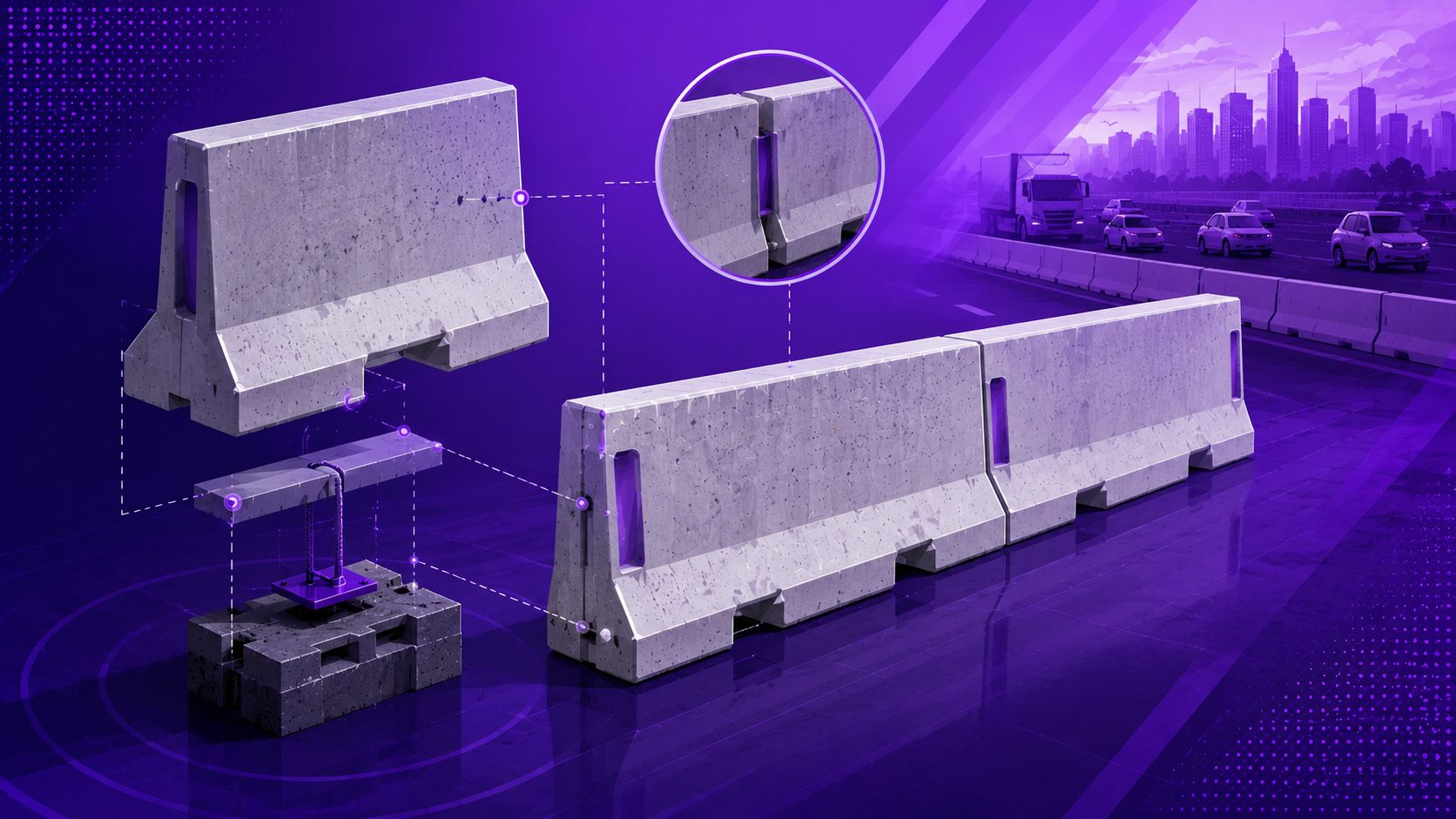
The effectiveness of a crash barrier depends on its design, dimensions, and construction quality. Engineers select specific design features based on road type, traffic conditions, and project requirements. The following elements play an important role in overall barrier performance.
| Component | Description |
|---|---|
| Barrier profile | The shape of the barrier influences how a vehicle reacts during a collision. Proper profiling helps guide vehicles back towards the roadway. |
| New Jersey barrier | One of the most widely used profiles in highway projects. Its sloped face helps reduce vehicle climb and improves redirection. |
| F-shape barrier | Similar to the New Jersey profile but designed with a lower impact point. It can improve vehicle interaction in certain road safety applications. |
| Barrier height | Height varies based on project specifications and intended application. It influences containment capability and safety performance. |
| Base width | A wider base improves stability and structural strength. |
| Reinforcement | Steel reinforcement enhances durability and helps the structure withstand impact forces. |
| Concrete grades | Project specifications often define the required concrete strength to ensure long-term performance. |
| Drainage considerations | Proper drainage prevents water accumulation around the barrier and supports pavement longevity. |
These factors form the foundation of effective concrete barrier design and help ensure reinforced concrete barriers meet project and safety requirements.
Concrete crash barrier specifications and standards in India
Road safety infrastructure projects must comply with established design and construction requirements to ensure consistent performance. Contractors, consultants, and procurement teams should review the applicable standards before selecting or installing barrier systems.
Applicable standards
Several organisations provide guidelines for the design, installation, and quality assessment of crash barriers in India.
| Standard | Purpose |
|---|---|
| IRC standards | Provide guidance on road safety design, vehicle restraint systems, and barrier applications. |
| NHAI requirements | Define project-specific requirements for national highway and expressway projects. |
| MoRTH specifications | Outline material, construction, and quality control requirements for road infrastructure works. |
These standards help ensure that barriers meet highway safety standards and perform effectively under real-world conditions.
Material and performance requirements
Project specifications may vary, but most requirements focus on durability, structural strength, and construction quality.
Key considerations include:
- Specified concrete grades based on project requirements
- Adequate steel reinforcement to improve structural integrity
- Compliance with approved design drawings and dimensions
- Quality control during manufacturing and installation
- Regular testing and inspection throughout project execution
Installation teams should also verify:
- Alignment and positioning of barrier sections
- Surface finish and dimensional accuracy
- Joint quality between adjacent sections
- Compliance with approved construction specifications
Following IRC crash barrier standards and NHAI crash barrier specifications helps reduce quality issues and supports long-term performance across highways, expressways, bridges, and other infrastructure projects.
Applications of concrete crash barriers across infrastructure projects
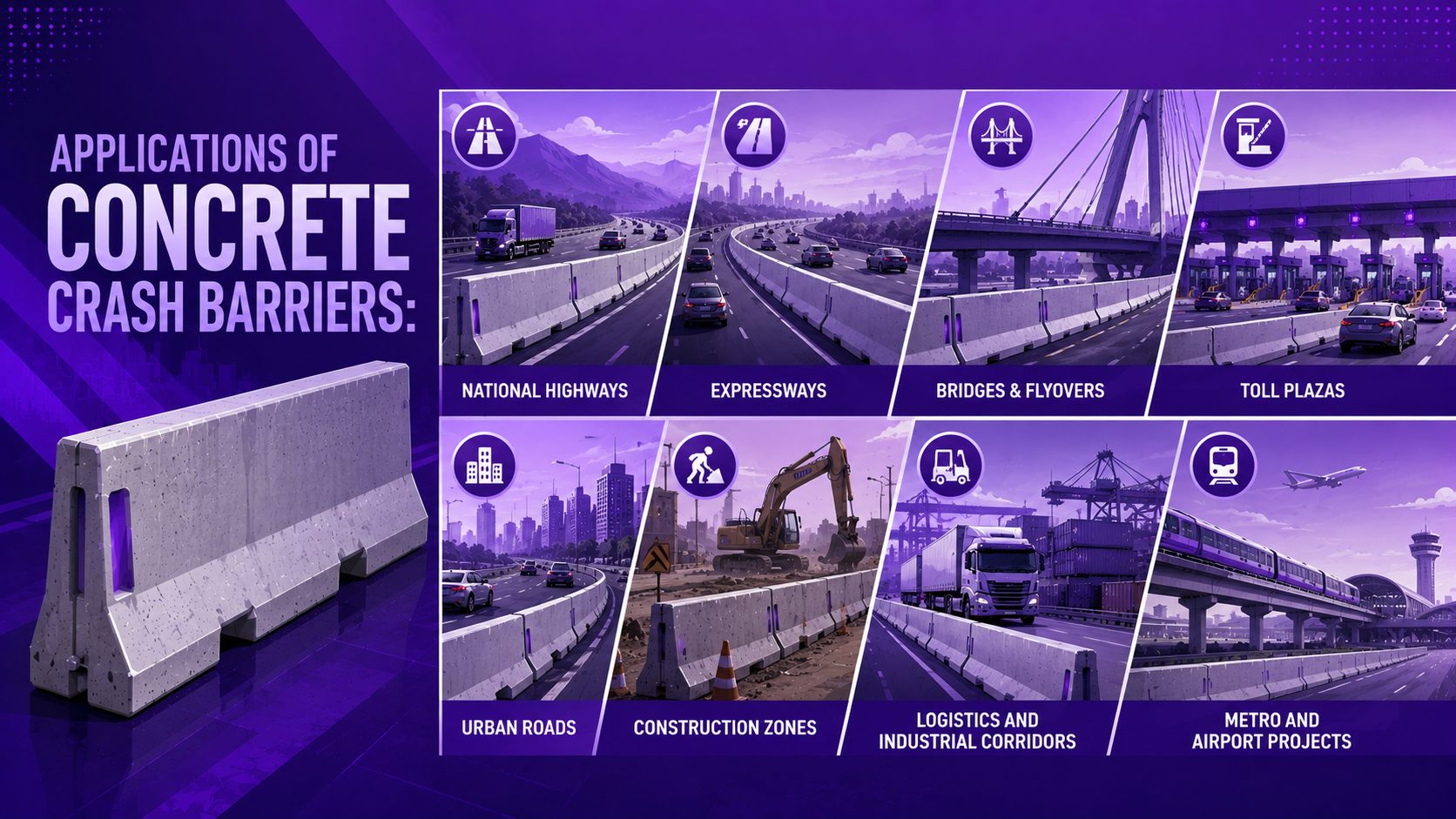
Concrete barriers are used across a wide range of infrastructure projects to improve traffic management, support safer vehicle movement, and enhance road safety outcomes.
National highways: Help separate traffic streams and improve safety on high-volume road corridors.
Expressways: Expressway safety barriers help manage vehicle movement on high-speed, access-controlled roads.
Bridges and flyovers: Provide protection along elevated structures where recovery space is limited.
Toll plazas: Guide vehicles into designated lanes and support smoother traffic flow.
Urban roads: Assist with traffic segregation and improve safety in congested road environments.
Construction zones: Protect workers and motorists while supporting road construction safety during ongoing project activities.
Logistics and industrial corridors: Help manage heavy commercial vehicle traffic and reduce operational risks.
Metro and airport projects: Support safer access roads and traffic control around major transport infrastructure developments.
Benefits for EPC contractors and infrastructure developers
For contractors and project developers, barrier selection is not only about safety. Long-term performance, maintenance requirements, and compliance with project specifications also influence procurement decisions.
Enhanced road safety
These barriers help reduce the risk of vehicles entering opposing traffic lanes or leaving the roadway. Their robust construction makes them suitable for locations with high traffic volumes and operating speeds.
Low maintenance requirements
Unlike some alternative barrier systems, concrete barriers require minimal upkeep after installation. This reduces maintenance interventions and associated operational disruptions.
Long service life
Concrete structures can withstand years of exposure to traffic loads and environmental conditions. This makes them a preferred choice for long-term infrastructure projects.
Improved compliance with project specifications
Many national highway, expressway, bridge, and urban road projects include barrier requirements within their tender documents. Selecting compliant systems helps contractors meet project obligations more effectively.
Lower lifecycle costs
While the initial investment may vary by project, reduced maintenance and longer service life often contribute to lower ownership costs over time.
Weather and corrosion resistance
These durable highway barriers perform reliably in diverse climatic conditions. Their resistance to corrosion and environmental exposure also supports their use as long-life road safety systems across different regions.
Concrete crash barriers vs steel crash barriers: Which is better?
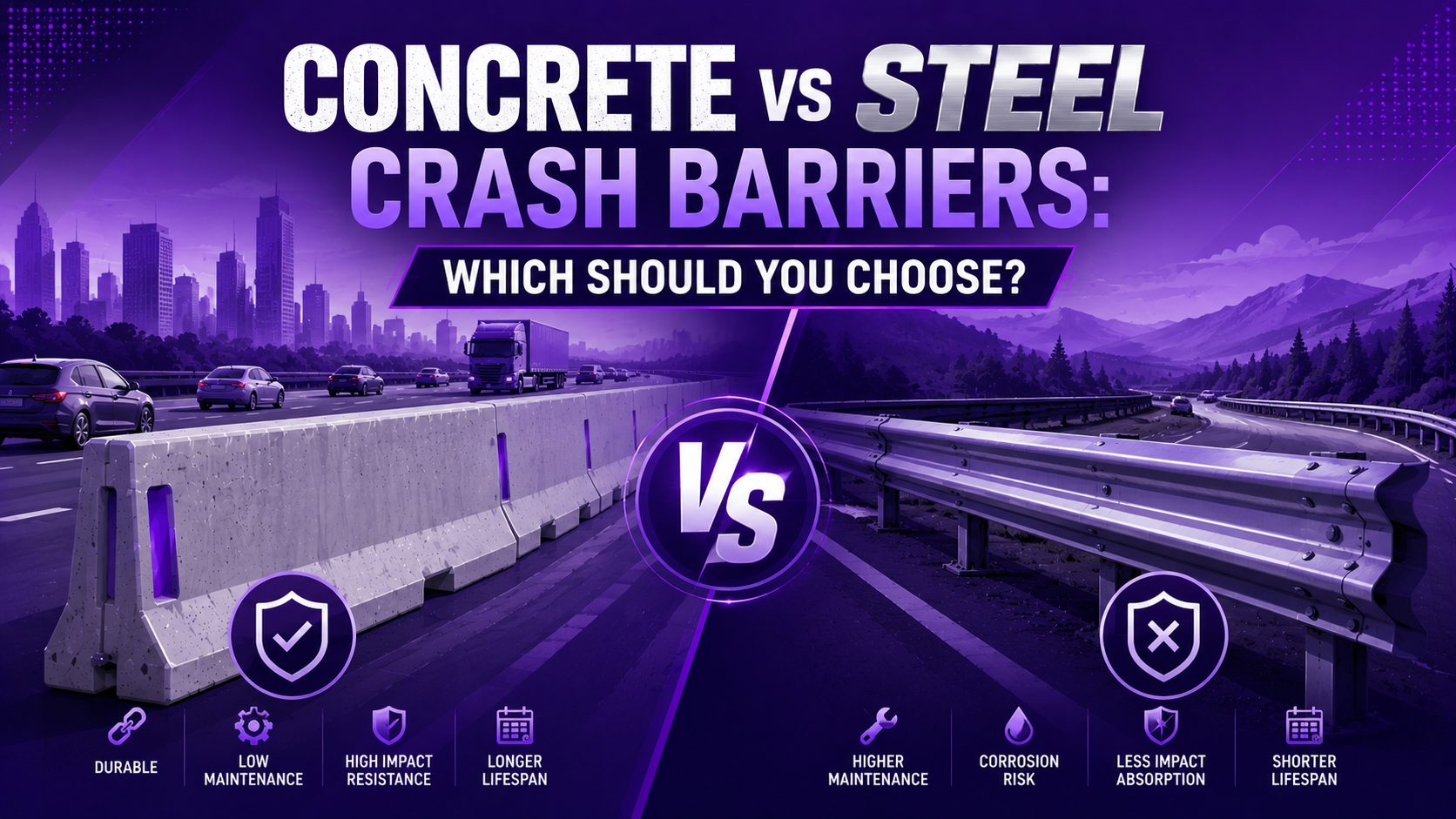
The choice depends on the project location, traffic conditions, maintenance expectations, and budget considerations. Both systems serve different purposes within highway infrastructure projects.s
| Parameter | Concrete crash barriers | Steel crash barriers |
|---|---|---|
| Initial cost | Typically higher upfront cost | Generally lower upfront cost |
| Maintenance | Minimal maintenance requirements | May require periodic repairs and replacement after impacts |
| Durability | High durability and long service life | Good durability but depends on coating condition |
| Deflection | Very low deflection during impact | Higher deflection due to flexible design |
| Repairability | Repairs can be more complex if damaged | Individual sections are often easier to replace |
| Typical applications | Medians, expressways, bridges, urban corridors. | Road edges, embankments, curves, and roadside protection. |
Which option should you choose?
- Choose concrete barriers for high-speed corridors, medians, bridges, and projects that prioritise long-term durability.
- Choose steel barriers for roadside protection where controlled flexibility is required.
- Evaluate traffic volume, road geometry, maintenance requirements, and project specifications before selecting.
In the debate of concrete vs steel crash barriers or W-beam vs concrete barriers, there is no single solution for every project. The best choice depends on the intended application and overall highway barrier comparison criteria.
Selection and procurement factors
Selecting crash barriers requires more than comparing products. Contractors, consultants, and procurement teams should evaluate project-specific requirements to ensure the chosen system aligns with safety, performance, and budget objectives.
Key factors to consider include
Road category: Highways, expressways, bridges, and urban roads may require different barrier configurations.
Design speed: Higher-speed corridors often demand stronger containment capabilities.
Traffic volume: Roads with heavy vehicle movement may require more robust solutions.
Median width: Available space can influence barrier type and placement.
Terrain conditions: Road geometry, embankments, and site conditions affect barrier selection.
Project budget: Consider both initial procurement costs and long-term maintenance expenses.
Project timelines: Precast solutions may help accelerate installation schedules.
Tender requirements: Ensure compliance with approved drawings and highway project specifications.
Procurement checklist
Before finalising a purchase, verify the following:
✓ Compliance certifications and approvals
✓ Concrete grade verification
✓ Dimensional accuracy
✓ Testing and inspection records
✓ Manufacturing and supply capabilities
✓ Delivery schedules and logistics support
✓ Installation assistance, if required.
✓ Tender and specification compliance
A structured approach to selecting crash barriers helps reduce procurement risks and ensures the system meets project requirements from installation through long-term operation.
Conclusion
Concrete crash barriers play an important role in modern road safety infrastructure by helping improve vehicle containment across highways, expressways, bridges, and urban road networks. Their durability, low maintenance requirements, and suitability for high-traffic environments make them a preferred choice for many infrastructure projects.
However, selecting the right system requires careful consideration of project specifications, safety requirements, and applicable IRC guidelines. As modular precast solutions, high-performance materials, and smart highway infrastructure continue to evolve, these barriers are expected to remain a key component of safer and more efficient transport networks.
Looking to procure steel?
Tata nexarc helps manufacturers, builders and MSMEs source certified steel products, compare prices, and choose the right grade as per IS codes—with complete traceability and procurement confidence.
FAQs
What is the purpose of a concrete crash barrier?
Where are concrete crash barriers commonly used?
Are concrete crash barriers suitable for high-speed roads?
What is the difference between a concrete crash barrier and a road divider?
Which is better for highway medians: concrete or steel barriers?
Are precast concrete crash barriers better than cast-in-situ barriers?
Do concrete crash barriers require regular maintenance?
What factors affect the cost of concrete crash barriers?
Are concrete crash barriers used in temporary traffic management?
How can contractors choose the right crash barrier system?
A product manager with a writer's heart, Anirban leverages his 6 years of experience to empower MSMEs in the business and technology sectors. His time at Tata nexarc honed his skills in crafting informative content tailored to MSME needs. Whether wielding words for business or developing innovative products for both Tata Nexarc and MSMEs, his passion for clear communication and a deep understanding of their challenges shine through.