Check Price Now
Table of Contents
- What are Median Barriers and Why are They Important?
- NHAI Framework for Median Barrier Design and Installation
- Standards Governing Median Barriers in India
- Types of Median Barriers Used in NHAI Projects
- How NHAI Selects the Right Median Barrier
- Material and Construction Requirements
- Crash Testing and Performance Requirements
- NHAI Installation Guidelines for Median Barriers
- Inspection, Maintenance, and Compliance Considerations
- Procurement Checklist for EPC Contractors and NHAI Vendors
- Conclusion
- FAQs
Median barriers play a critical role in improving highway safety and reducing the risk of severe cross-median collisions. As India’s national highway network continues to expand, compliance with NHAI median barrier rules has become increasingly important for EPC contractors, highway consultants, infrastructure developers, and procurement teams. NHAI crash barrier standards help ensure that highway median barriers provide reliable vehicle containment, effective redirection, and long-term performance under varying traffic conditions.
This guide explains the key standards, approved barrier types, installation requirements, and safety guidelines that govern road safety barriers in India, helping project stakeholders make informed design, procurement, and construction decisions.
What are median barriers and why are they important?
Median barriers are among the most important road safety features used on modern road networks. They separate opposing traffic streams and help reduce the severity of crashes. As traffic volumes and vehicle speeds continue to increase, highway authorities rely on median crash barriers to improve divided carriageway safety and support safer road operations.
Definition
A median barrier is a protective structure installed within the central median of a road. Its primary purpose is to separate vehicles travelling in opposite directions. A median barrier on highways can be made from steel, concrete, wire rope, or other approved systems, depending on the road’s design requirements and traffic conditions.
Safety benefits on highways
Highway safety barriers help control vehicle movement when a driver loses control. Instead of allowing a vehicle to enter the opposing carriageway, the barrier redirects it back towards its original path. This improves overall road safety and helps reduce the impact of crashes on busy corridors with high traffic speeds.
Prevention of cross-median accidents
Cross-median accidents occur when a vehicle crosses the central divider and enters oncoming traffic lanes. These crashes often result in severe injuries and significant vehicle damage. Road restraint systems such as median barriers create a physical separation between traffic streams, helping prevent dangerous head-on collisions and improving safety for all road users.
NHAI framework for median barrier design and installation
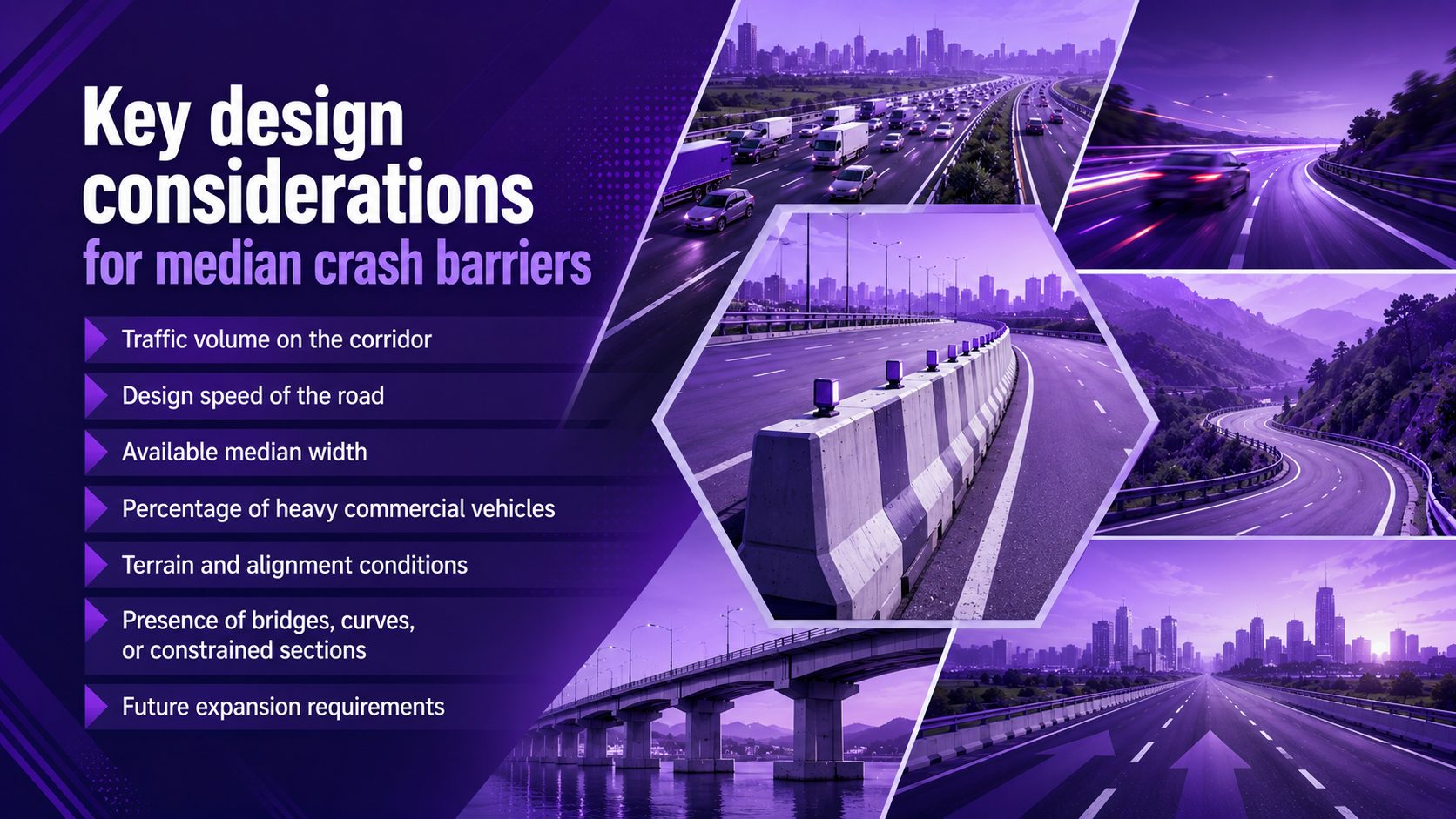
The selection of a median barrier is not a one-size-fits-all decision. NHAI follows a structured approach that considers road geometry, traffic conditions, and safety risks before determining the most suitable system for a project. During the planning and design stage, engineers assess multiple factors to ensure the chosen solution delivers effective protection while remaining practical to install and maintain.
NHAI’s role in highway safety
NHAI integrates safety considerations into highway development from the earliest stages of project planning. The authority evaluates corridor-specific risks and incorporates appropriate safety measures into project designs, tender documents, and construction requirements. This helps create a consistent approach to safety across the national highway network.
How IRC and MoRTH specifications influence barrier selection
To maintain consistency, NHAI relies on established guidance from the Indian Roads Congress (IRC) and the Ministry of Road Transport and Highways (MoRTH). These frameworks help project teams assess suitable solutions based on road characteristics, expected traffic behaviour, and operational requirements.
Key design considerations
Before selecting a system, engineers typically evaluate:
- Traffic volume on the corridor
- Design speed of the road
- Available median width
- Percentage of heavy commercial vehicles
- Terrain and alignment conditions
- Presence of bridges, curves, or constrained sections.
- Future expansion requirements
| Project factor | Influence on selection |
|---|---|
| Traffic volume | Determines overall safety demand |
| Design speed | Influences performance requirements |
| Median width | Affects the type of system that can be installed |
| Heavy vehicle movement | Impacts containment needs |
| Site conditions | Helps identify location-specific risks |
By assessing these factors together, project teams can select a solution that aligns with safety objectives, operational requirements, and long-term road performance.
Standards governing median barriers in India
Selecting the right system is only one part of compliance. Contractors, suppliers, and project teams must also ensure that materials, fabrication, testing, and installation meet the requirements specified in project documents. Compliance helps streamline approvals, maintain quality, and reduce the risk of corrective work during execution.
Design standards
Design requirements are typically defined through applicable IRC guidelines and project-specific drawings. These documents establish how and where safety systems should be incorporated within a road project and provide the technical basis for execution.
Material and galvanisation standards
Material specifications determine the quality of steel, components, and protective coatings used in construction. Galvanisation requirements are particularly important because they help protect steel components from corrosion and extend service life in varying environmental conditions.
Testing requirements
Many projects require systems that have demonstrated proven performance through recognised testing procedures. Testing records help verify that the selected system meets the expected safety and performance criteria before deployment on site.
Inspection and documentation requirements
Inspection plays a vital role throughout procurement and construction. Project teams often review manufacturing records, coating reports, material certificates, and installation checks to confirm compliance with contract requirements.
| Compliance area | Typical evidence required |
|---|---|
| Design compliance | Approved drawings and design documents |
| Material quality | Material test certificates |
| Galvanisation | Coating test reports and inspection records |
| Performance verification | Testing reports and approvals |
| Installation quality | Site inspection reports |
| Project documentation | Quality records and compliance submissions |
Project approval requirements
Before final acceptance, contractors are generally required to submit supporting documentation demonstrating that the installed system complies with project specifications. Complete and accurate records help simplify inspections and support smoother project approvals.
Types of median barriers used in NHAI projects
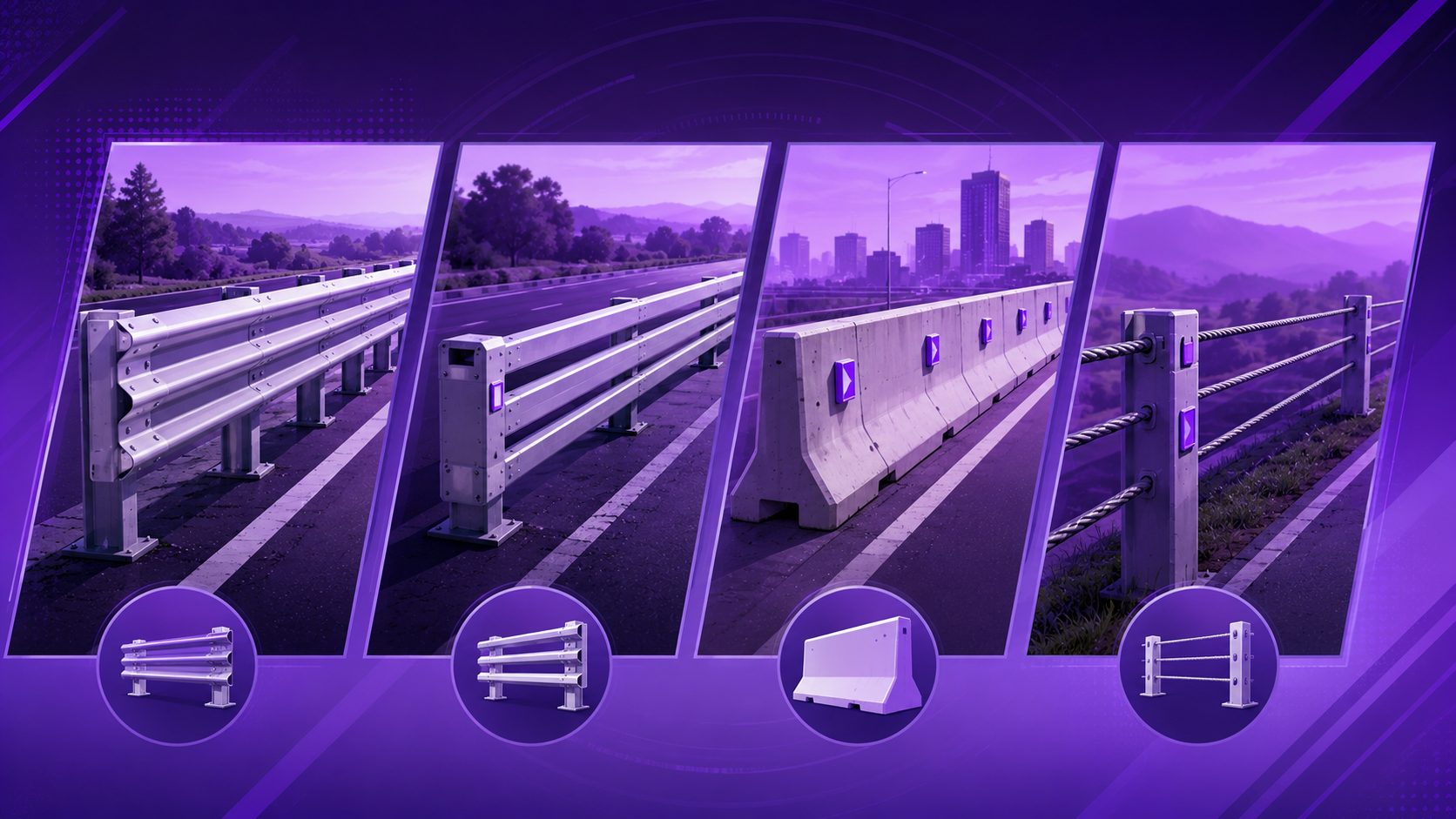
NHAI projects use different types of median barriers depending on traffic conditions, available space, safety objectives, and project requirements. Each system offers distinct advantages and is suited to specific applications. Understanding these differences helps contractors, consultants, and procurement teams select the most appropriate solution during project planning and execution.
| Barrier type | Material | Key characteristics | Typical applications | Advantages |
|---|---|---|---|---|
| W-beam crash barrier | Galvanised steel | Corrugated two-wave profile mounted on steel posts | National highways, state highways, divided carriageways. | Cost-effective, widely used, relatively easy to install and repair. |
| Thrie beam crash barrier | Galvanised steel | Three-wave profile offering greater rail height and strength | High-speed corridors, bridge approaches, critical locations. | Higher containment capability and improved vehicle redirection. |
| Concrete median barrier | Reinforced concrete | Rigid barrier with minimal deflection during impact | Expressways, urban corridors, narrow medians. | Durable, low maintenance, suitable where space is limited. |
| Wire rope safety barrier | Steel wire ropes and posts | Flexible system that absorbs impact energy through cable tension | Wide medians and selected high-speed roads. | Reduces impact forces and can provide effective vehicle containment. |
| Hybrid barrier systems | Combination of steel and concrete components | Designed for project-specific requirements | Interchanges, structures, transition zones. | Allows customised solutions for complex road environments. |
W-beam crash barriers
The W beam crash barrier remains one of the most widely used highway safety products in India. Its balance of performance, availability, and cost makes it a common choice for many highway projects.
Thrie beam crash barriers
A thrie beam crash barrier offers greater strength than a standard W-beam system. Project teams often consider it for locations that require enhanced protection due to higher speeds or increased risk exposure.
Concrete median barriers
Concrete median barriers are commonly used where limited space restricts barrier deflection. They are frequently seen on expressways, urban road corridors, and other locations with constrained medians.
Wire rope safety barriers
Wire rope safety barriers use tensioned steel cables to absorb impact energy. They are generally suitable for locations where sufficient space is available for controlled barrier movement during a collision.
When evaluating options, contractors typically consider performance requirements, lifecycle costs, maintenance needs, and supplier capabilities before finalising procurement decisions with crash barrier manufacturers or crash barrier suppliers.
How NHAI selects the right median barrier
Selecting the right median barrier involves more than choosing a particular product or material. NHAI evaluates several project-specific factors to ensure the chosen system delivers the required level of safety, performance, and durability. This process forms an important part of road safety engineering and helps determine the most suitable highway crash protection systems for a given corridor.
Median width
Available space within the median is one of the first factors considered during median barrier selection.
- Wider medians may accommodate flexible systems.
- Narrow medians often require barriers with limited deflection.
- Space constraints can influence installation methods and maintenance access.
Design speed
Vehicle speeds play a major role in determining safety requirements.
- Higher design speeds typically demand stronger protection.
- Faster traffic increases impact severity during collisions.
- Safety performance expectations rise with operating speed.
Traffic composition
Different roads carry different types of vehicles, which affects barrier design for highways.
- Passenger vehicle-dominated routes may have different requirements.
- Mixed traffic corridors require broader safety considerations.
- Traffic growth projections may influence future requirements.
Heavy vehicle movement
The percentage of trucks, buses, and other heavy vehicles is a critical factor.
- Higher commercial vehicle traffic may require greater containment capability.
- Certain locations may need a higher containment level barrier.
- Freight-heavy corridors often receive additional safety assessments.
Material and construction requirements
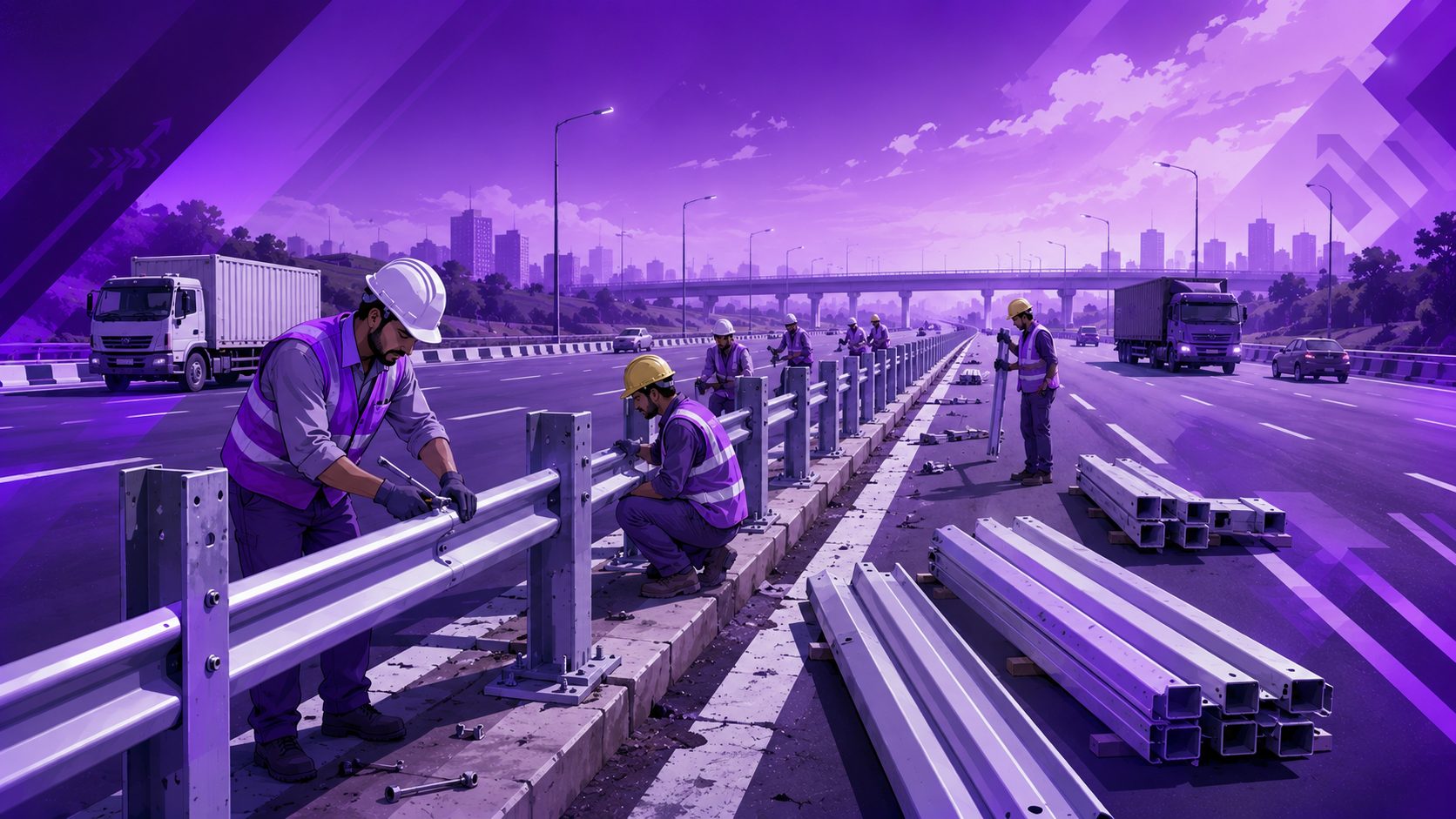
The long-term performance of a median barrier depends heavily on the quality of materials and construction practices used during manufacturing and installation. Contractors and procurement teams should verify that all components comply with project specifications before delivery and installation.
Steel requirements
Steel forms the primary structural element in most metal beam barrier systems. The material must meet the specified strength and quality requirements to ensure reliable performance under impact conditions.
Galvanisation standards
Since barriers remain exposed to weather throughout their service life, corrosion protection is essential. Most projects specify hot dip galvanised crash barriers to improve durability and reduce maintenance requirements. Proper galvanisation helps extend service life, particularly in coastal, industrial, and high-rainfall regions.
| Component | Function |
|---|---|
| Rail sections | Help contain and redirect vehicles |
| Steel posts | Provide structural support |
| Blockouts/spacers | Maintain proper rail positioning |
| Fasteners | Secure connections between components |
| End treatments | Improve safety at barrier ends |
Posts and rail sections
Posts provide the foundation for the system, while rail sections absorb and distribute impact forces. The dimensions, spacing, and configuration of these highway barrier components vary depending on project requirements and the selected barrier type.
Fasteners and accessories
Although often overlooked, fasteners play an important role in overall system performance.
- Bolts and nuts should comply with specified standards.
- Accessories must be compatible with the selected system.
- Damaged or corroded components should not be installed.
- Proper assembly helps maintain structural integrity.
When evaluating crash barrier procurement options, buyers should look beyond crash barrier price alone. Material quality, galvanisation standards, supplier credentials, and compliance documentation are equally important considerations when comparing crash barrier suppliers India.
Crash testing and performance requirements
Crash testing helps verify how a safety barrier performs during a collision. Instead of assessing performance only on paper, testing provides measurable data on vehicle containment, occupant safety, and post-impact behaviour. Many highway projects prefer crash-tested median barriers because they offer independently verified performance under controlled conditions.
Containment levels
Containment level refers to a barrier’s ability to prevent vehicles from breaching the system during an impact. The required level typically depends on factors such as traffic composition, operating speeds, and the presence of heavy vehicles. Locations with higher risk exposure may require a higher containment level crash barrier.
Working width
Working width measures the amount of lateral space a barrier occupies during a collision. This parameter becomes particularly important where median space is limited, as it helps engineers determine whether a specific system can be safely accommodated within the available corridor width.
Impact severity
Impact severity evaluates the forces transferred to vehicle occupants during a crash. Lower severity levels generally indicate a safer interaction between the vehicle and the barrier, making this an important consideration when comparing different systems.
Vehicle redirection capability
A key objective of any safety barrier is to redirect an errant vehicle back towards its original path while maintaining stability. Effective redirection helps prevent secondary collisions and reduces the likelihood of vehicles entering opposing traffic lanes.
| Performance parameter | Purpose |
|---|---|
| Containment level | Assesses vehicle retention capability |
| Working width | Measures barrier deflection during impact |
| Impact severity | Evaluates potential occupant risk |
| Vehicle redirection | Assesses post-impact vehicle behaviour |
Many EN 1317 barriers and MASH tested barriers are evaluated against these performance criteria, providing project teams with a consistent basis for comparing systems and meeting highway safety performance standards.

NHAI installation guidelines for median barriers
Proper installation is essential for achieving the intended performance of a safety barrier. Even a compliant system may not perform as expected if installation deviates from approved drawings or project specifications. While requirements vary by project, the median barrier installation process generally follows the steps below.
Step 1: Site preparation
The installation area is surveyed and marked before work begins. Project teams verify alignment, levels, median dimensions, and utility clearances to ensure the system can be installed according to approved plans.
Step 2: Post installation
Steel posts are installed at the specified spacing and alignment. Accurate positioning is important because post placement influences the overall stability and performance of the system.
Step 3: Rail mounting
Barrier rails are connected to the installed posts using approved fasteners and accessories. The rail alignment is checked to ensure continuity along the entire installation length.
Step 4: End treatments and transitions
Special attention is given to barrier terminals, transitions, bridge approaches, and other connection points. These areas require proper detailing to maintain consistent safety performance throughout the system.
Step 5: Quality control checks
Before handover, the completed installation undergoes inspection to verify compliance with project requirements.
| Inspection item | Purpose |
|---|---|
| Alignment and levels | Verify correct positioning |
| Post spacing | Confirm compliance with drawings |
| Fastener installation | Ensure secure connections |
| Galvanised surfaces | Check coating condition |
| Overall workmanship | Verify installation quality |
Following a structured barrier erection procedure helps improve consistency, supports quality compliance, and reduces the likelihood of corrective work during project inspections.
Inspection, maintenance, and compliance considerations
Proper inspection and maintenance help ensure that safety barriers continue to perform as intended throughout their service life. Regular monitoring also helps identify compliance issues before they result in costly repairs, failed inspections, or project delays. For contractors and concessionaires, maintaining accurate records is just as important as maintaining the physical system.
| Area | What to check | Common compliance issues |
|---|---|---|
| Routine inspections | Alignment, visible damage, loose components, corrosion. | Missed inspection schedules. |
| Post-crash assessment | Damaged rails, posts, connections, end treatments. | Delayed repairs after impact. |
| Maintenance activities | Replacement of damaged components and worn hardware. | Use of non-approved replacement parts. |
| Installation quality | Post spacing, rail alignment, fastening details. | Incorrect installation or deviations from approved drawings. |
| Material compliance | Steel quality, component specifications, supplier documentation. | Non-certified materials. |
| Galvanisation quality | Coating condition and corrosion protection. | Poor galvanisation or coating damage. |
| Performance compliance | Verification of approved system type. | Missing crash test documentation. |
| Documentation & records | Inspection reports, test certificates, quality records. | Incomplete compliance records. |
| Project audits | Review against contract and safety. requirements | Failure to meet NHAI compliance. requirements |
Regular highway safety inspections, timely barrier damage assessment, and documented maintenance activities support long-term performance and simplify road safety audits. A structured crash barrier inspection checklist can also help improve crash barrier quality control and support highway construction quality checks throughout the project lifecycle.
Procurement checklist for EPC contractors and NHAI vendors
Successful crash barrier procurement involves more than comparing prices. Before placing an order, contractors and procurement teams should verify that the proposed system complies with project specifications and crash barrier tender requirements.
- Review approved drawings and project specifications
- Confirm the selected system meets technical approval requirements
- Verify crash test reports and performance documentation
- Check material test certificates for key components
- Review galvanisation and coating records
- Confirm dimensions, thickness, and component specifications.
- Verify availability of inspection and quality control documents
- Assess manufacturing capacity and delivery timelines
- Evaluate previous project experience and references
- Confirm compliance with project-specific requirements
- Review warranty and after-sales support provisions
- Ensure all documentation required for highway material procurement is available
Vendor qualification checks
When evaluating crash barrier vendors, consider product quality, documentation, manufacturing capability, delivery performance, and technical support. Working with experienced suppliers can help simplify approvals, reduce procurement risks, and support timely project execution.
Conclusion
As India’s highway network continues to expand, safety infrastructure is evolving to meet higher performance and durability expectations. Project owners are increasingly focusing on advanced crash barrier systems that offer improved containment, longer service life, and lower maintenance requirements. The growing development of expressways and access-controlled corridors is also driving demand for high containment barriers in critical locations.
At the same time, smart highway infrastructure initiatives are encouraging greater use of data-driven safety planning and asset management. These developments are expected to support wider adoption of road safety innovations in India and contribute to safer, more resilient transport corridors.
Looking to procure steel?
Tata nexarc helps manufacturers, builders and MSMEs source certified steel products, compare prices, and choose the right grade as per IS codes—with complete traceability and procurement confidence.
FAQs
What are NHAI rules for median barriers?
Which median barrier is used on highways?
What is the difference between W-beam and thrie beam barriers?
Are crash-tested barriers mandatory for NHAI projects?
Which standards govern crash barriers in India?
What is a containment level in crash barriers?
Why is galvanisation important for crash barriers?
Where are thrie beam barriers typically used?
How often should crash barriers be inspected?
What documents should be checked before procuring crash barriers?
A product manager with a writer's heart, Anirban leverages his 6 years of experience to empower MSMEs in the business and technology sectors. His time at Tata nexarc honed his skills in crafting informative content tailored to MSME needs. Whether wielding words for business or developing innovative products for both Tata Nexarc and MSMEs, his passion for clear communication and a deep understanding of their challenges shine through.