Check Price Now
Table of Contents
- What is a W-Beam Crash Barrier?
- Types of W-Beam Crash Barriers
- W-Beam Crash Barrier Specifications & Dimensions
- W-Beam Crash Barrier Weight Chart
- IRC Standards & Government Specifications
- Coating & Galvanisation in W-Beam Crash Barriers
- W-Beam Crash Barrier Installation Process
- W-Beam Crash Barrier Price in India
- Leading W-Beam Crash Barrier Manufacturers in India
- Conclusion
- FAQs
W-beam crash barriers are among the most widely used road safety systems on Indian highways, bridges, expressways, and industrial corridors. These barriers help reduce accident impact and improve vehicle containment on high-speed roads. Government highway projects, infrastructure contractors, and industrial developers widely use W-beam crash barriers across India due to their strength, durability, and IRC compliance.
This guide covers W-beam crash barrier types, specifications, dimensions, weight charts, installation methods, coating standards, pricing, and manufacturers in India.
What is a W-beam crash barrier?
A W-beam crash barrier is a semi-rigid roadside safety system designed to reduce the severity of vehicle accidents on highways and high-speed roads. It uses a corrugated steel profile shaped like the letter “W” to absorb impact energy and redirect vehicles back onto the road. Due to its balance of strength, flexibility, and cost efficiency, the W-beam crash barrier remains one of the most widely used highway safety barriers in India.
Unlike rigid concrete barriers, a W-beam guardrail can flex during impact. This controlled movement helps reduce damage to both the vehicle and passengers. The system usually includes steel beams, posts, spacers, bolts, and reflectors installed at fixed intervals.
Purpose of W-beam barriers
W-beam crash barriers mainly improve roadside safety on accident-prone stretches. They help:
- Prevent vehicles from leaving the carriageway.
- Reduce vehicle crossover accidents on medians.
- Protect bridges, curves, slopes, and embankments.
- Improve safety in high-speed traffic zones.
- Support IRC and MoRTH highway safety requirements.
These steel crash barrier systems are widely used in national highway and expressway projects where vehicle containment is critical.
How the barrier absorbs impact

When a vehicle hits the beam crash barrier system, the steel beam deforms and spreads the impact force across multiple posts. This process absorbs kinetic energy and slows the vehicle gradually instead of causing a sudden stop.
| Component | Function |
|---|---|
| W-beam rail | Absorbs and distributes impact |
| Steel posts | Provide structural support |
| Spacer/blockout | Maintains rail distance from posts |
| Reflectors | Improve night visibility |
Common applications in India
W-beam crash barriers are commonly installed across:
- National highways and expressways
- Bridge approaches and flyovers
- Median dividers
- Sharp curves and hill roads
- Industrial roads and logistics parks
- Urban infrastructure corridors
Their durability, lower maintenance needs, and proven crash performance make them a preferred roadside safety system for Indian infrastructure projects.
Types of W-beam crash barriers
Different types of W-beam crash barriers are used across Indian highways, bridges, industrial corridors, and infrastructure projects based on traffic volume and safety requirements. Selecting the right barrier type improves vehicle containment, impact absorption, and long-term durability. The most commonly used metal beam crash barrier types are explained below.
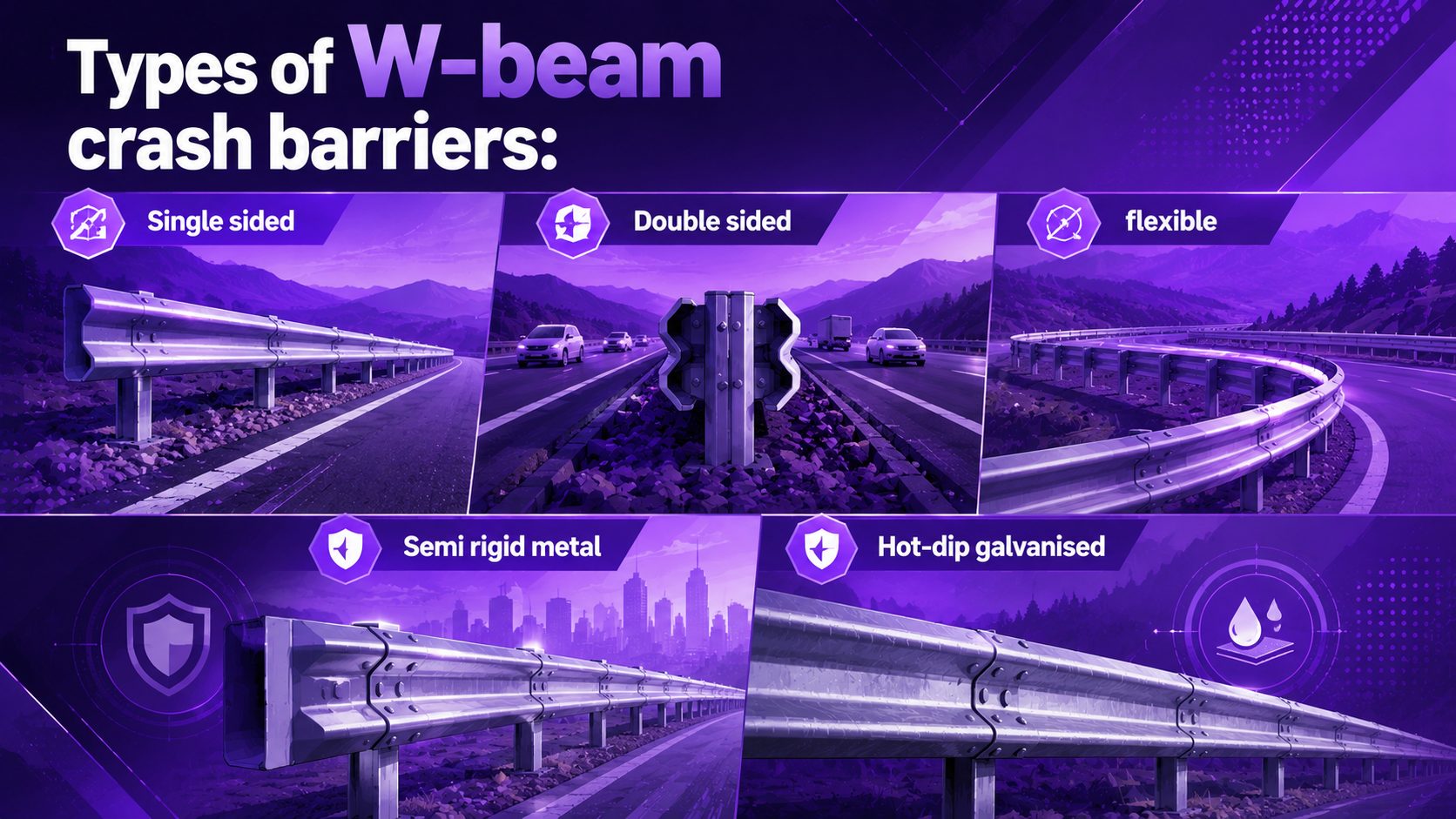
Single-sided W-beam crash barrier
A single side crash barrier features the W-beam rail on one side of the post. Contractors mainly install this type along road edges, embankments, flyovers, and bridge approaches. It helps prevent vehicles from moving off the roadway and reduces accident severity on high-speed corridors.
Double-sided W-beam crash barrier
A double wave crash barrier includes W-beam rails on both sides of the post. It is commonly used on highway medians and central dividers where traffic moves in opposite directions. This configuration helps reduce vehicle crossover accidents and improves safety on busy expressways.
Flexible crash barrier systems
Flexible W-beam crash barrier systems are designed to absorb higher impact energy during collisions. The barrier flexes during impact and gradually redirects the vehicle back onto the road. These systems are useful on accident-prone stretches and high-speed highway sections.
Semi-rigid metal beam crash barriers
Semi-rigid barriers are the most widely used IRC-compliant highway safety barriers in India. They offer a balance between flexibility and structural strength. Many national highway and infrastructure projects prefer this beam crash barrier system because it provides reliable performance with lower maintenance requirements.
Hot-dip galvanised W-beam barriers
Hot-dip galvanised W-beam barriers include a protective zinc coating that improves corrosion resistance. These galvanised W-beam barrier systems are suitable for coastal regions, industrial zones, and areas exposed to heavy rainfall or moisture. The coating also increases service life and reduces maintenance costs over time.
W-beam crash barrier specifications & dimensions
W-beam crash barrier specifications directly affect highway safety, vehicle containment, and long-term durability. In India, most highway and infrastructure projects follow IRC:119-2015 and MoRTH guidelines for barrier design, material quality, and installation requirements. Standardised W-beam dimensions also help maintain uniform safety performance across highways, bridges, medians, and industrial corridors.
Standard W-beam dimensions
Most Indian highway projects use standard W-beam crash barrier dimensions for easier installation and IRC compliance.
| Specification | Common India Standard (2026) |
|---|---|
| W-beam profile width | 312 mm |
| Corrugation depth | 83 mm |
| Beam thickness | 2.8 mm to 3 mm |
| Standard beam length | 3.81 metres |
| Post spacing | 2 metres centre-to-centre |
| Barrier height above road level | Approx. 850 mm |
| Post size | 75 mm × 150 mm |
| Post thickness | 5 mm |
These crash barrier dimensions may vary slightly depending on project requirements, road geometry, and containment level specifications.
Material grade & steel specifications
Manufacturers generally use high tensile galvanised steel for W-beam crash barriers to improve impact resistance and structural strength. Many IRC-compliant systems use steel grades such as Fe360, Fe410, or Fe510 based on project specifications. Hot-dip galvanisation also improves corrosion resistance and service life in outdoor environments.
Common components
A complete W-beam crash barrier system includes several connected components that improve stability and impact absorption.
| Component | Purpose |
|---|---|
| W-beam rail | Absorbs and redirects impact |
| Steel post | Supports the barrier structure |
| Spacer/blockout | Maintains rail positioning |
| Nut bolts | Secure beam connections |
| Reflectors | Improve night visibility |
W-beam crash barrier weight chart
W-beam crash barrier weight depends on several factors, including beam thickness, steel grade, galvanised coating, and overall system design. Weight calculations are important for highway contractors, infrastructure consultants, and procurement teams because they affect transportation, installation, structural load, and project cost. In India, most IRC-compliant W-beam crash barrier systems use standard beam dimensions with varying thickness levels based on containment and project requirements.
What is the standard weight of a W-beam crash barrier?
The standard W-beam crash barrier weight in India generally ranges between 18 kg and 24 kg per metre for the beam section alone, depending on thickness and galvanised coating. The total installed system weight increases after adding posts, spacers, fasteners, and reflectors.
Standard weight per metre
Most highway projects use standardised beam profiles to maintain uniform crash performance and easier installation.
| Beam thickness | Beam size | Approx. weight per metre | Galvanised coating weight | Approx. total installed system weight* |
|---|---|---|---|---|
| 2.67 mm | 312 mm × 83 mm | 18–19 kg/m | Included | 30–35 kg/m |
| 2.8 mm | 312 mm × 83 mm | 19–21 kg/m | Included | 32–37 kg/m |
| 3 mm | 312 mm × 83 mm | 22–24 kg/m | Included | 35–40 kg/m |
*Includes beams, posts, spacers, and standard accessories.
Beam thickness vs weight
Higher crash barrier thickness increases the overall metal beam barrier weight and improves impact resistance. Thicker W-beam crash barriers are commonly used on expressways, bridge approaches, and accident-prone stretches where higher vehicle containment is required.
Weight of posts & accessories
The total crash barrier weight per metre also depends on supporting components used during installation.
| Component | Approximate weight |
|---|---|
| Steel post | 16–20 kg |
| Spacer/blockout | 3–5 kg |
| Nut bolts & hardware | 1–2 kg |
| Reflectors | Minimal |
Galvanised crash barrier weight may vary slightly based on zinc coating thickness and manufacturer specifications.
IRC standards & government specifications for W-beam crash barriers
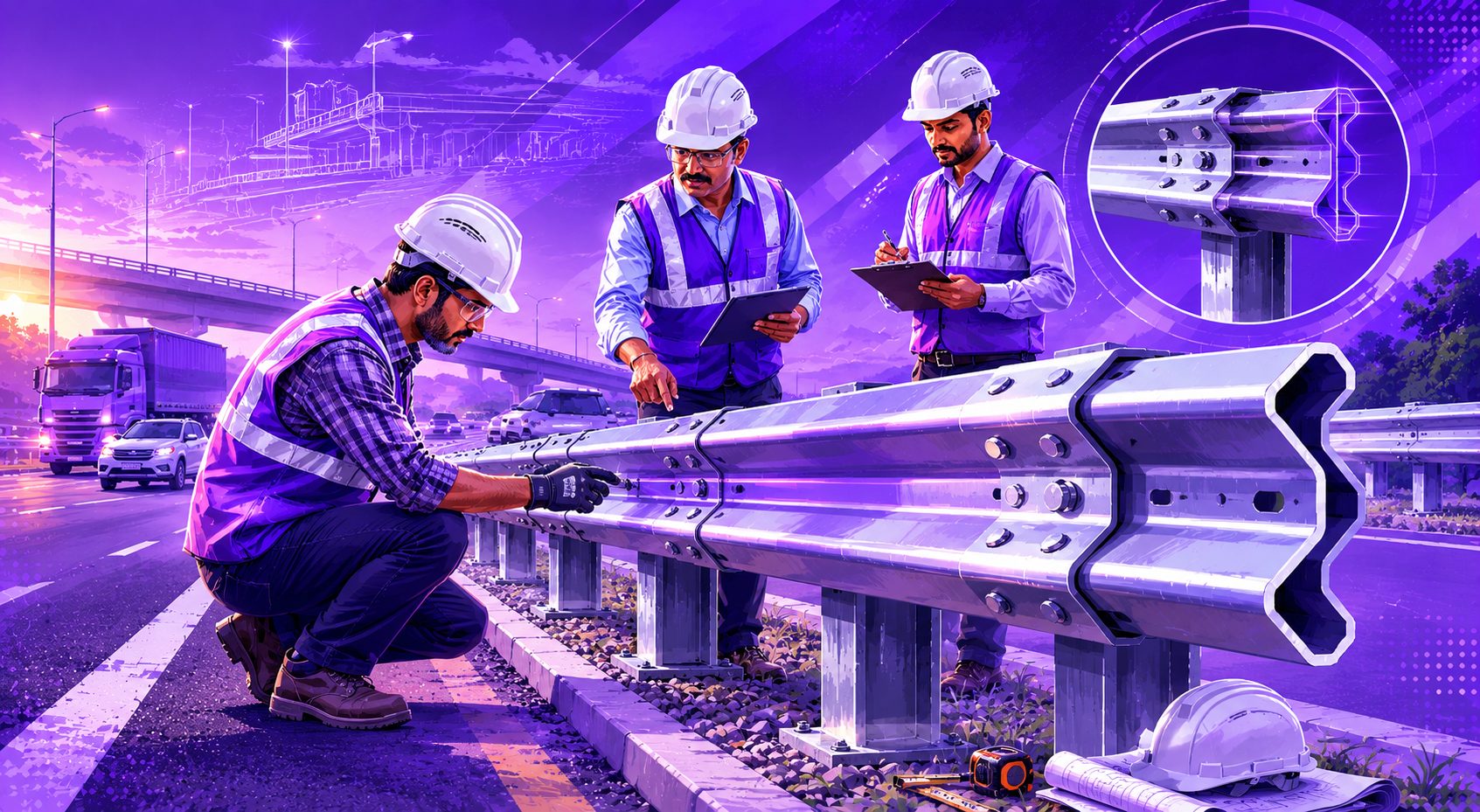
W-beam crash barriers used in Indian highway and infrastructure projects must follow specific government safety and quality standards. These guidelines help ensure proper vehicle containment, impact performance, durability, and installation quality across highways, bridges, expressways, and industrial corridors. Most NHAI and EPC projects require barriers that comply with IRC crash barrier standards and MoRTH specifications.
IRC:119 guidelines
IRC:119-2015 is the primary guideline for metal beam crash barrier IRC compliance in India. It covers barrier design, placement, installation height, post spacing, containment levels, and safety performance requirements. The guideline also defines where W-beam crash barriers should be installed based on road geometry, traffic conditions, and accident risk zones.
MoRTH specifications
MoRTH crash barrier specifications provide technical requirements for materials, galvanisation, fabrication quality, and installation practices. These specifications are commonly used in national highway tenders and government infrastructure contracts. Contractors must ensure that W-beam crash barriers meet approved dimensional and performance standards before installation.
Crash test requirements
Indian highway safety standards require W-beam crash barriers to undergo crash testing under approved containment categories. These tests evaluate vehicle redirection, structural stability, passenger safety, and impact absorption performance. Crash-tested systems are widely preferred for expressways, bridges, and high-speed highway projects.
Galvanisation & coating standards
Most IRC standards for W-beam crash barriers require hot-dip galvanised steel for corrosion resistance and longer service life. Zinc coating thickness plays an important role in protecting barriers from moisture, pollution, and weather exposure, especially in coastal and industrial regions.
Highway project compliance requirements
NHAI projects, expressway developments, and infrastructure tenders usually require complete compliance with IRC and MoRTH guidelines. Buyers and consultants often verify:
- Crash test certification
- Steel grade quality
- Galvanisation standards
- Dimensional accuracy
- Installation compliance
Following these requirements helps improve long-term highway safety performance and project approval readiness.
Coating & galvanisation in W-beam crash barriers
Coating and galvanisation play a major role in the durability and long-term performance of W-beam crash barriers. Since these barriers remain exposed to rain, pollution, moisture, heat, and changing weather conditions, proper surface protection helps prevent corrosion and structural damage. Most Indian highway and infrastructure projects prefer galvanised crash barrier systems because they offer better service life and lower maintenance requirements.
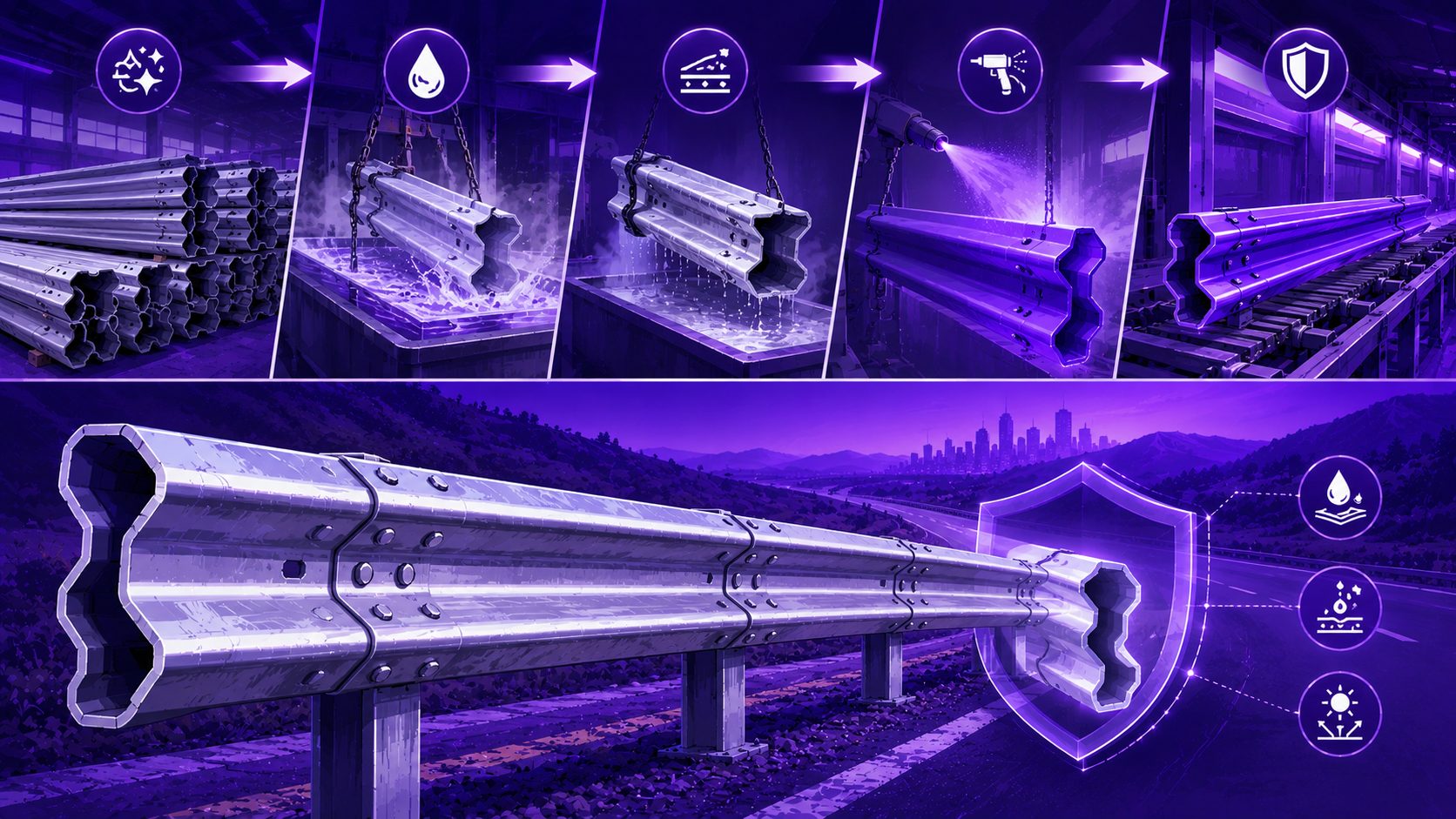
Hot-dip galvanised coating
Hot dip galvanizsed W-beam barriers use a protective zinc layer applied through a high-temperature galvanizing process. This coating forms a protective shield over the steel surface and improves resistance against rust and environmental exposure.
Key advantages include:
- Better corrosion resistance
- Longer outdoor durability
- Reduced maintenance frequency
- Improved highway safety performance
- Suitable for long-term infrastructure projects
Zinc coating thickness
Zinc coating on crash barriers directly affects corrosion protection and product lifespan. Higher coating thickness generally provides better resistance in harsh outdoor conditions. Most IRC and MoRTH-compliant projects specify minimum galvanisation requirements for highway installations.
Common project considerations include:
- Environmental exposure level
- Coastal or industrial application
- Expected service life
- Maintenance planning
Powder coating vs Galvanisation
Both coating methods improve surface protection, but galvanisation remains more widely used in highway projects.
| Coating type | Primary benefit |
|---|---|
| Hot-dip galvanisation | Strong corrosion protection |
| Powder coating | Improved surface finish |
| Duplex coating system | Combined durability and appearance |
Many infrastructure projects use galvanisation because it provides better long-term lifecycle performance.
Coastal & industrial environment protection
W-beam crash barriers installed near coastal regions, ports, industrial zones, and chemical exposure areas face a higher corrosion risk. Corrosion resistant crash barrier systems help maintain structural integrity in these demanding conditions.
Benefits for infrastructure projects include:
- Lower replacement costs
- Reduced maintenance downtime
- Improved lifecycle savings
- Better long-term asset protection
Proper highway barrier coating also supports faster project approvals in government and expressway tenders.
W-beam crash barrier installation process
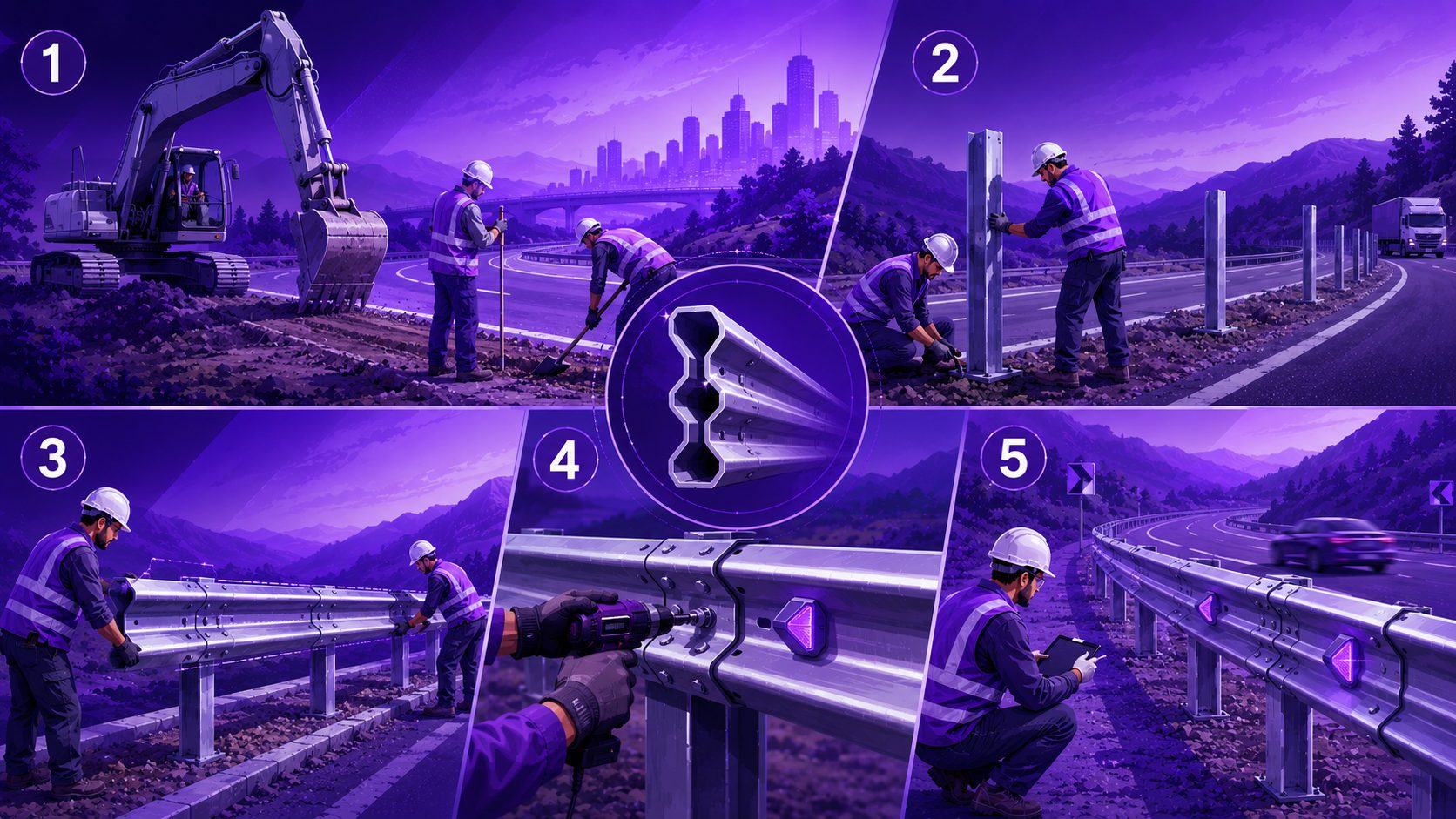
W-beam crash barrier installation requires proper alignment, accurate spacing, and compliance with IRC and MoRTH guidelines. A systematic installation process improves highway safety performance, vehicle containment, and long-term durability. Most EPC contractors and infrastructure developers follow a standard installation workflow during highway and expressway projects.
Step 1: Site preparation
Contractors first inspect the roadway, shoulder condition, and alignment area before starting installation. The site must be cleared of debris, uneven surfaces, and underground obstructions. Marking barrier lines and post locations in advance helps maintain uniform spacing during highway guardrail installation.
Step 2: Post installation
Steel posts are installed at specified intervals based on approved project drawings and IRC standards. Contractors usually use hydraulic equipment or mechanical methods to fix posts securely into the ground. Proper post depth and alignment are important for impact resistance and structural stability.
Step 3: Beam mounting & alignment
The W-beam rail sections are mounted onto the posts using spacers and connection hardware. Installation teams carefully align the beams to maintain continuous impact protection across the roadway. Correct beam height and overlap direction are important in the W-beam barrier installation process.
Step 4: Fasteners & reflectors
Workers tighten all nuts, bolts, and fastening components after beam alignment is completed. Reflectors are then added to improve night visibility and driver guidance on highways, curves, and bridge approaches.
Step 5: Safety inspection & testing
The final inspection checks barrier height, post spacing, fastening quality, and overall installation accuracy. Many highway projects also verify compliance with crash barrier fixing method standards, tender specifications, and safety requirements before project approval.
| Installation stage | Main objective |
|---|---|
| Site preparation | Alignment and layout planning |
| Post installation | Structural support |
| Beam mounting | Vehicle impact protection |
| Fasteners & reflectors | Visibility and stability |
| Final inspection | Compliance verification |
W-beam crash barrier price in India
W-beam crash barrier price in India depends on raw material costs, galvanisation quality, project scale, and transportation requirements. Most highway and infrastructure projects do not follow a fixed market rate because pricing changes based on steel prices, zinc coating thickness, containment requirements, and tender specifications. As of 2026, procurement teams and EPC contractors mainly compare suppliers based on compliance, durability, manufacturing capability, and long-term lifecycle value rather than only upfront pricing.
Factors affecting price
Several commercial and technical factors influence crash barrier price per metre in India:
- Steel grade and market price fluctuations
- Zinc coating thickness and galvanisation quality
- W-beam thickness and material weight
- Project quantity and order volume
- Transportation distance and logistics costs
- IRC and MoRTH compliance requirements
- Installation scope and site conditions
Price per metre trends
Galvanised crash barrier price India generally increases with higher coating thickness, heavier beam sections, and stricter project specifications. Expressway and NHAI projects often require higher-performance systems with additional testing and compliance documentation.
| Factor | Impact on W-beam crash barrier price |
|---|---|
| Higher steel thickness | Increases material cost |
| Heavy zinc coating | Improves durability but raises pricing |
| Bulk infrastructure orders | Reduces per metre cost |
| Remote project location | Increases logistics expenses |
| IRC/MoRTH compliance | Adds testing and certification costs |
Bulk procurement considerations
Large infrastructure and highway projects usually negotiate pricing based on supply capacity, delivery schedules, and galvanisation standards. Buyers also evaluate manufacturing consistency, stock availability, and after-sales support before finalising suppliers.
Tender & infrastructure supply pricing
Government tenders, NHAI projects, and expressway developments often prioritise technically compliant suppliers over low-cost quotations. Many metal beam barrier manufacturers India compete based on testing capability, galvanisation quality, and project execution experience.
Leading W-beam crash barrier manufacturers in India
India has a large and growing market for W-beam crash barrier manufacturers due to increasing highway expansion, expressway development, and industrial infrastructure projects. Buyers usually compare manufacturers based on compliance capability, production scale, galvanisation quality, and supply reliability rather than only pricing. Choosing the right supplier is important for long-term highway safety performance and tender approval requirements.
What to check before choosing a manufacturer
Infrastructure developers and EPC contractors should evaluate several factors before selecting crash barrier suppliers India.
| Evaluation factor | Why it matters |
|---|---|
| IRC & MoRTH compliance | Required for highway project approval |
| Manufacturing capacity | Supports bulk infrastructure orders |
| Galvanisation capability | Improves corrosion resistance |
| Crash testing standards | Ensures highway safety performance |
| Supply capability | Helps maintain project timelines |
| Quality control systems | Improves product consistency |
Many highway safety barrier manufacturers also provide customised fabrication, coating options, and project-based support for government and industrial contracts.
Conclusion
W-beam crash barriers are an important part of modern highway safety infrastructure in India. IRC compliant crash barriers with proper coating, reliable installation, and quality manufacturing help improve long-term durability and roadside safety performance. As infrastructure projects continue to expand, demand for durable and compliant W-beam crash barriers India will keep growing.
Looking to procure steel?
Tata nexarc helps manufacturers, builders and MSMEs source certified steel products, compare prices, and choose the right grade as per IS codes—with complete traceability and procurement confidence.
FAQs
What is a W-beam crash barrier used for?
What material is used in W-beam crash barriers?
What is the standard thickness of a W-beam crash barrier?
Are W-beam crash barriers IRC compliant?
Where are W-beam crash barriers commonly installed?
Why is galvanisation important in W-beam crash barriers?
What affects W-beam crash barrier price in India?
How long do W-beam crash barriers last?
What is the standard post spacing in W-beam crash barriers?
Who uses W-beam crash barriers in India?
A product manager with a writer's heart, Anirban leverages his 6 years of experience to empower MSMEs in the business and technology sectors. His time at Tata nexarc honed his skills in crafting informative content tailored to MSME needs. Whether wielding words for business or developing innovative products for both Tata Nexarc and MSMEs, his passion for clear communication and a deep understanding of their challenges shine through.