Check Price Now
Table of Contents
- What are Bitumen Modifiers and Additives?
- Difference Between Bitumen Modifiers and Bitumen Additives
- Types of Bitumen Modifiers and Additives Used in Road Construction
- How Bitumen Modifiers Improve Pavement Performance
- How to Select the Right Bitumen Modifier for Your Project
- Common Challenges and Best Practices
- Standards and Specifications for Bitumen Modifiers
- Conclusion
- FAQs
Bitumen modifiers and additives are materials that improve the performance of conventional bitumen for demanding road construction applications. Today, bitumen modifiers are widely used in highways, airport runways, industrial roads, and urban pavements to enhance pavement durability, withstand heavier traffic loads, and improve resistance to changing weather conditions.
Different modifiers and additives are designed to achieve specific performance goals, from increasing flexibility and rutting resistance to improving moisture resistance and workability. Choosing the right solution depends on the project’s traffic conditions, climate, pavement design, and performance requirements.
This guide explains the types of bitumen modifiers and additives, their benefits, applications across infrastructure projects, and the key factors to consider when selecting the right option for long-lasting road performance.
What are bitumen modifiers and additives?
Bitumen modifiers and additives are materials used to improve the performance of conventional bitumen and asphalt mixes for specific construction requirements. They help roads withstand heavier traffic, changing weather, and longer service periods without compromising pavement quality.
Bitumen modifiers: Materials added to bitumen to change and improve the properties of the binder itself, making it more suitable for demanding road and infrastructure applications.
Bitumen additives: Materials added during asphalt mix production to improve the performance, workability, durability, or construction efficiency of the overall mix.
Why conventional VG bitumen needs enhancement: Standard VG bitumen performs well in many applications, but roads exposed to heavy axle loads, extreme temperatures, frequent rainfall, or continuous traffic often require improved performance.
Increase durability: Helps pavements maintain structural integrity and reduces premature deterioration.
Improve flexibility: Allows pavements to better withstand repeated traffic loading and temperature-related movement.
Reduce rutting: Improves resistance to permanent surface deformation under heavy traffic.
Improve moisture resistance: Strengthens the bond between bitumen and aggregates, helping minimise moisture-related damage.
Improve temperature performance: Enables pavements to perform more reliably across high and low temperature conditions.
Binder properties vs mix behaviour: Modifiers primarily improve the characteristics of the bitumen binder, while additives are often used to enhance the performance, handling, or construction characteristics of the asphalt mix.
Industries using them: Highway construction, EPC infrastructure projects, airport development, state PWD works, municipal road projects, industrial infrastructure, ports, logistics parks, and other large-scale pavement construction projects.
Difference between bitumen modifiers and bitumen additives
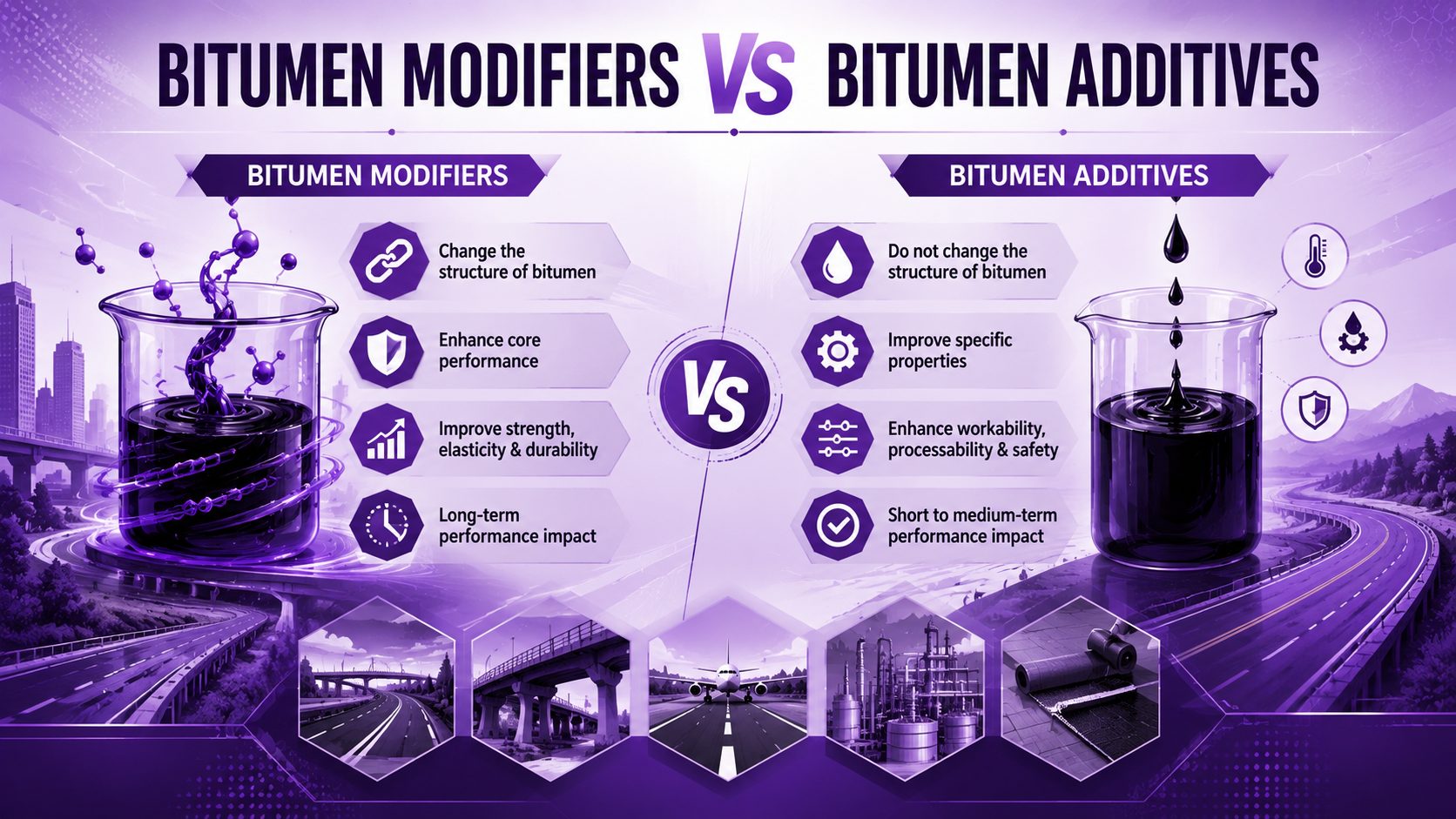
Although both improve pavement performance, they serve different purposes during road construction. Understanding the difference helps contractors, consultants, and procurement teams select the most suitable solution for project specifications.
| Parameter | Bitumen modifiers | Bitumen additives |
|---|---|---|
| Purpose | Improve the engineering properties of the bitumen binder for long-term pavement performance. | Improve the performance, workability, durability, or production efficiency of the asphalt mix. |
| How they work | Alter the physical and mechanical characteristics of the binder. | Enhance specific properties of the asphalt mix during production, laying, or in-service performance. |
| Stage of use | Blended with bitumen before or during binder preparation. | Added during asphalt mix production or at the mixing plant, depending on the application. |
| Primary focus | Strength, flexibility, elasticity, and resistance to deformation. | Workability, moisture resistance, adhesion, compaction, sustainability, or ease of construction. |
| Performance impact | Delivers significant improvements in pavement life under demanding traffic and climatic conditions. | Provides targeted improvements to solve specific construction or performance challenges. |
| Service life contribution | Helps extend pavement life by improving the binder’s long-term performance. | Supports pavement longevity by addressing issues such as moisture damage, poor compaction, or reduced workability. |
| Project suitability | Best suited for highways, expressways, airports, ports, and other heavy-duty infrastructure. | Suitable for a wide range of projects, including highways, municipal roads, industrial roads, overlays, and maintenance works. |
| Selection criteria | Chosen based on traffic loads, climate, pavement design, and expected service life. | Selected according to construction conditions, aggregate characteristics, project specifications, and operational requirements. |
| Cost implication | Generally involves a higher initial material cost but can reduce lifecycle maintenance costs. | Usually offers a cost-effective way to improve one or more specific aspects of asphalt mix performance. |
| Common examples | Polymer-based, rubber-based, and other binder modification systems. | Anti-stripping agents, warm mix additives, rejuvenators, fibres, hydrated lime, and adhesion promoters. |
| Typical applications | High-performance pavements designed for heavy traffic, high temperatures, or long design life. | Projects requiring improved workability, moisture resistance, compaction, sustainability, or construction efficiency. |
When are modifiers preferred and when are additives sufficient?
Bitumen modifiers are generally preferred when a project requires substantial improvements in long-term pavement performance, particularly on highways, airport runways, industrial roads, and other heavily trafficked infrastructure. Bitumen additives are often sufficient when the objective is to address specific construction or performance requirements, such as improving workability, moisture resistance, adhesion, or compaction, without significantly changing the binder’s overall characteristics.
Types of bitumen modifiers and additives used in road construction
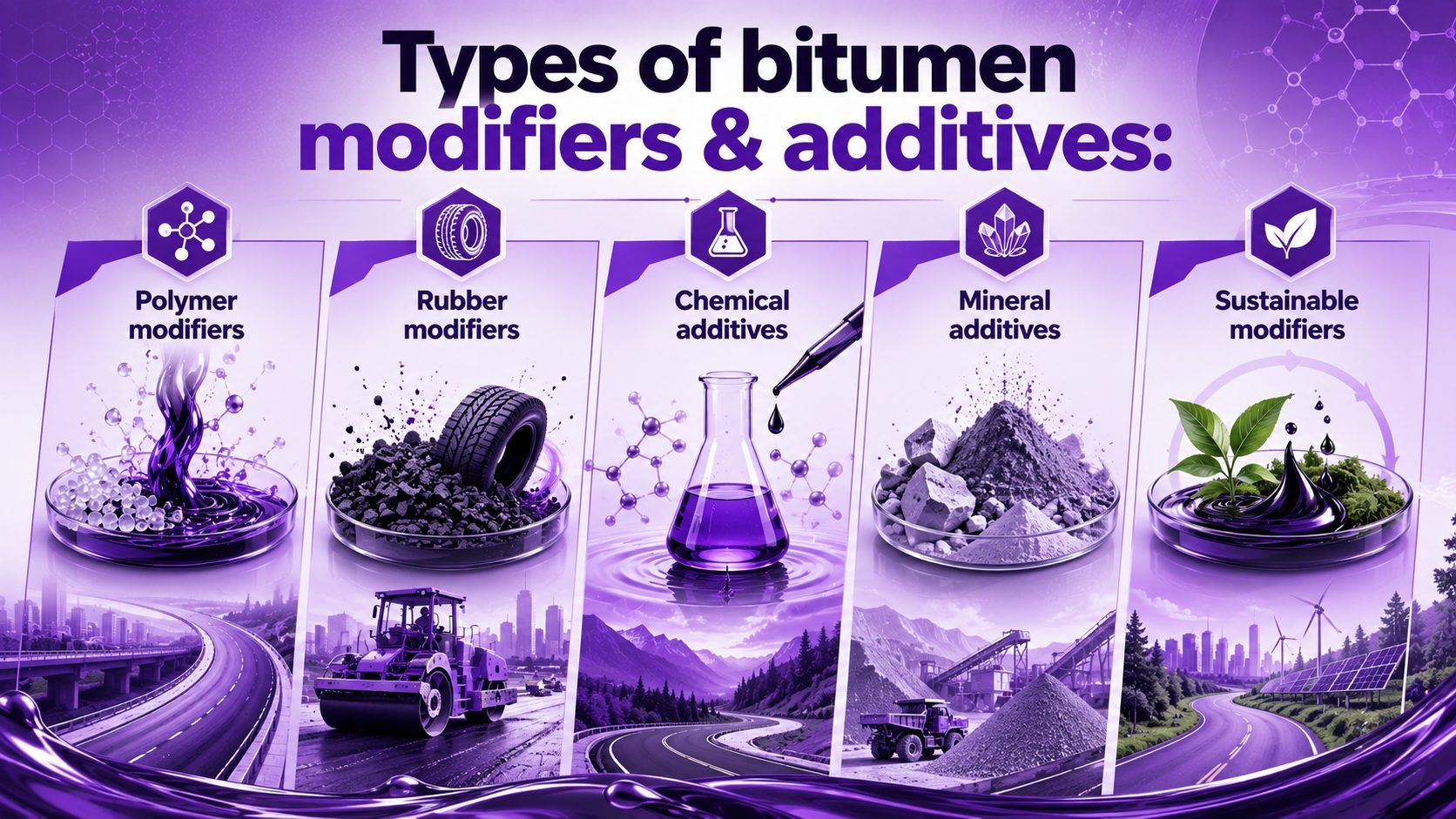
Modern road projects use different bitumen modifiers and additives based on pavement design, traffic conditions, climate, and project specifications. Some are blended with the bitumen binder, while others are introduced during asphalt mix production. Each serves a specific purpose, making it important to choose the right solution for the intended application.
Polymer modifiers
Polymer modifiers are among the most widely used bitumen modifiers for high-performance pavements. They enhance the binder’s characteristics to suit roads exposed to heavy traffic and demanding environmental conditions.
| Polymer modifier | What it is | Common applications |
|---|---|---|
| SBS (Styrene-Butadiene-Styrene) | A thermoplastic elastomer used in polymer-modified bitumen. | National highways, expressways, airport pavements, bridges |
| EVA (Ethylene Vinyl Acetate) | A thermoplastic polymer added to improve binder characteristics. | High-temperature regions, industrial roads, urban roads |
| Plastomers | Polymers that increase the stiffness of the bitumen binder. | Heavy-duty pavements, freight corridors, container terminals |
| Elastomers | Polymers that improve the binder’s elastic behaviour. | Roads exposed to repeated traffic loading and varying temperatures |
Typical applications include:
- National and state highways
- Airport runways and taxiways
- Industrial roads
- Toll plazas
- Ports and logistics parks
Rubber modifiers
Rubber modifiers use processed rubber materials to modify conventional bitumen. They are commonly associated with the reuse of end-of-life tyres in road construction.
Crumb rubber: Fine rubber particles produced from recycled tyres and blended with bitumen.
Waste tyre utilisation: Recovered rubber from discarded tyres incorporated into pavement construction.
Fatigue-resistant binders: Rubber-modified binders used on roads subjected to repeated traffic loading.
Typical applications include:
- Highways
- Urban arterial roads
- Industrial zones
- Bus corridors
Chemical additives
Chemical additives are incorporated into asphalt production to address specific construction or pavement requirements.
| Chemical additive | Primary use | Common applications |
|---|---|---|
| Anti-stripping agents | Improve aggregate-bitumen bonding in moisture-prone conditions. | High rainfall areas, bridges. |
| Adhesion promoters | Enhance compatibility between bitumen and aggregates. | Roads using difficult aggregate sources. |
| Warm mix additives | Enable asphalt production at lower temperatures. | Urban projects, long-distance asphalt transport. |
| Fluxing agents | Adjust binder consistency during production and laying. | Surface treatments and specialised paving works. |
| Rejuvenators | Restore aged reclaimed asphalt binder for reuse. | Rehabilitation and recycling projects. |
Mineral additives
Mineral additives are inorganic materials added to asphalt mixes to meet specific construction and specification requirements.
Hydrated lime: Widely used in highway and airport pavement mixes.
Mineral fillers: Fine materials incorporated into dense-graded asphalt mixtures.
Fibres: Used in specialised asphalt mixes for roads, intersections, and bridge decks.
Nano-materials: Emerging materials being explored for advanced pavement applications.
Emerging sustainable modifiers
Sustainability is becoming an important consideration in road construction, leading to the development of alternative modifier systems.
Bio-based modifiers: Produced from renewable resources for selected pavement applications.
Recycled materials: Include recycled polymers and reclaimed materials incorporated into asphalt production.
Circular economy solutions: Focus on increasing material reuse and reducing construction waste while supporting sustainable infrastructure projects.
The selection of bitumen modifiers and additives depends on project specifications, pavement design, available materials, environmental conditions, and the performance requirements defined by the client or relevant road authority.
How bitumen modifiers improve pavement performance
Bitumen modifiers improve the overall performance of pavements by helping them withstand traffic, environmental conditions, and long-term use. The exact level of improvement depends on the modifier used, pavement design, and project requirements.
Rutting resistance
Heavy traffic can create wheel-path depressions, especially on roads carrying commercial vehicles. Bitumen modifiers improve the binder’s ability to resist permanent deformation, making pavements more stable under repeated loading.
Crack resistance
Pavements expand and contract as temperatures change. Modified binders accommodate these movements more effectively, helping minimise surface cracking and preserving pavement integrity.
Improved fatigue life
Repeated vehicle loading gradually weakens pavement layers. Bitumen modifiers help the pavement tolerate continuous stress for longer, delaying fatigue-related deterioration.
Moisture damage resistance
Water can weaken the bond between bitumen and aggregates, leading to stripping and pavement failure. Modified binders provide better resistance to moisture, particularly in regions with heavy rainfall.
Oxidation resistance
Exposure to air and sunlight causes bitumen to age and harden over time. Bitumen modifiers slow this ageing process, helping the pavement maintain its performance for longer.
Better temperature stability
Road surfaces experience wide temperature variations throughout the year. Modified binders perform more consistently across both high and low temperatures, reducing temperature-related pavement distress.
Improved adhesion with aggregates
A stronger bond between bitumen and aggregates creates a more stable asphalt mix. This improves pavement integrity and helps maintain consistent surface performance under traffic.
Longer pavement life
By improving multiple performance characteristics, bitumen modifiers support longer-lasting pavements that can continue meeting design requirements over an extended service period.
Lower maintenance frequency
Better-performing pavements generally require fewer major repairs, helping road agencies and contractors reduce maintenance interventions and minimise traffic disruptions.
| Performance improvement | Practical benefit |
|---|---|
| Rutting resistance | Better resistance to wheel-path deformation under heavy traffic. |
| Crack resistance | Fewer surface cracks caused by traffic and temperature changes. |
| Improved fatigue life | Greater ability to withstand repeated vehicle loading. |
| Moisture damage resistance | Reduced risk of stripping and water-related pavement deterioration. |
| Oxidation resistance | Slower binder ageing and more consistent long-term performance. |
| Better temperature stability | Reliable performance across varying climatic conditions. |
| Improved adhesion with aggregates | Stronger asphalt mix with improved structural stability. |
| Longer pavement life | Extended service life before major rehabilitation is required. |
| Lower maintenance frequency | Reduced repair needs and fewer disruptions to road users. |
How to select the right bitumen modifier for your project
Choosing the right bitumen modifier starts with understanding the project’s technical and operational requirements. Rather than selecting a modifier based on a single property, contractors and consultants should consider traffic conditions, climate, pavement design, construction methods, and client specifications. The selection process should also fit seamlessly into the overall road construction workflow, from design and material approval to asphalt production and quality control.
| Project factor | What to consider |
|---|---|
| Traffic volume and axle loads | Expected traffic intensity and the proportion of heavy commercial vehicles. |
| Climate and weather | High temperatures, cold conditions, rainfall, and seasonal variations. |
| Pavement design life | Target service life specified for the project. |
| Road type | Highway, expressway, municipal road, industrial road, bridge deck, or airport pavement. |
| Aggregate characteristics | Compatibility between aggregates and the selected binder system. |
| Project specifications | Requirements defined by NHAI, MoRTH, state PWDs, airports, or other authorities. |
| Budget and lifecycle cost | Balance between initial material cost and long-term maintenance objectives. |
| Material availability | Reliable local supply and consistent product quality. |
Where modifiers fit in the construction process
Bitumen modifier selection is typically considered at different stages of a project:
Project planning: Identify traffic conditions, climate, and pavement performance requirements.
Pavement and mix design: Select a suitable binder system that meets the design criteria.
Material procurement: Source approved materials that comply with project specifications.
Asphalt production: Incorporate the selected modifier or additive using the specified production process.
Quality control: Verify compliance through laboratory and on-site testing before paving.
Selecting the appropriate bitumen modifier requires balancing technical requirements, project specifications, construction practices, and long-term maintenance objectives. A structured selection process helps contractors, consultants, and procurement teams choose a solution that aligns with both performance expectations and project goals.
Common challenges and best practices

Proper implementation is just as important as selecting the right bitumen modifier or additive. The following challenges can affect pavement quality if they are not managed during production and construction.
Incorrect dosage: Using more or less than the recommended quantity can affect the intended pavement performance.
Poor blending: Inadequate mixing may result in uneven distribution of the modifier or additive throughout the binder or asphalt mix.
Storage stability: Some modified binders require suitable storage conditions to maintain consistency before use.
Compatibility issues: The selected modifier or additive should be compatible with the bitumen binder and aggregates used in the project.
Quality control: Regular laboratory and plant checks help ensure materials comply with project specifications.
Temperature management: Maintaining the recommended production and paving temperatures supports proper mixing and laying.
Mixing sequence: Adding materials in the correct order helps achieve a uniform and consistent asphalt mix.
Supplier quality verification: Procure materials from reliable suppliers and verify product certifications and technical documentation.
Field testing: Conduct on-site testing to confirm the asphalt mix meets the required quality and performance standards.
Best practice: Follow project specifications, use approved materials, maintain strict quality control, and perform regular laboratory and field testing to achieve consistent, long-lasting pavement performance.
Standards and specifications for bitumen modifiers
Before procuring bitumen modifiers, verify that the product meets the technical requirements specified for your project. This helps avoid procurement delays, material rejection, and quality issues during construction.
Check IRC guidelines: Confirm the recommended binder requirements for the pavement design and traffic category.
Review MoRTH specifications: Ensure the selected modifier complies with the latest MoRTH requirements for road and bridge works.
Verify BIS (IS) compliance: Ask suppliers for test certificates demonstrating compliance with applicable Indian Standards.
Refer to ASTM or EN standards (if applicable): Follow international specifications only when required by the client or project.
Review tender specifications: Match the modifier’s technical properties with the requirements stated in the DPR, BOQ, or tender documents.
Request supplier documentation: Obtain product datasheets, test reports, and quality certifications before placing an order.
Procurement tip: Always shortlist suppliers whose products meet the project specifications and can provide consistent quality, technical support, and timely deliveries.
Conclusion
Bitumen modifiers and additives have become an integral part of modern road construction as infrastructure projects demand greater reliability, longer service life, and consistent quality. Choosing the right solution is not simply a material decision, but a project decision that should align with design requirements, applicable specifications, and construction practices. A well-informed selection process helps contractors, consultants, and procurement teams deliver pavements that meet both technical expectations and long-term project objectives.
Looking to procure steel?
Tata nexarc helps manufacturers, builders and MSMEs source certified steel products, compare prices, and choose the right grade as per IS codes—with complete traceability and procurement confidence.
FAQs
What are bitumen modifiers?
What are bitumen additives?
What is the difference between modifiers and additives?
Which polymer is commonly used in PMB?
Are crumb rubber modifiers suitable for highways?
What are anti-stripping additives?
Can additives improve moisture resistance?
How do warm mix additives benefit asphalt production?
Which modifier is best for heavy traffic roads?
Do bitumen modifiers increase pavement life?
A product manager with a writer's heart, Anirban leverages his 6 years of experience to empower MSMEs in the business and technology sectors. His time at Tata nexarc honed his skills in crafting informative content tailored to MSME needs. Whether wielding words for business or developing innovative products for both Tata Nexarc and MSMEs, his passion for clear communication and a deep understanding of their challenges shine through.