Check Price Now
Table of Contents
- Latest Bitumen Price in India (October 2026)
- What Factors Affect Bitumen Price in India?
- Bitumen Grades and Their Typical Price Differences
- Why Bitumen Prices Vary Across Indian States
- How Road Contractors Estimate Bitumen Procurement Costs
- How to Choose the Right Bitumen Supplier
- Tips to Reduce Bitumen Procurement Costs
- Conclusion
- FAQs
The bitumen price in India is one of the first factors that highway contractors, EPC companies, and procurement teams consider when planning a road construction project. However, the bitumen price alone does not determine the overall value of a purchase. Bitumen is one of the largest material costs in road construction, and prices can change with crude oil trends, refinery production, transportation costs, and the grade selected.
Buyers should also consider quality, supply reliability, and project specifications before placing an order. This guide explains the latest price ranges, the factors that influence costs, differences between bitumen grades, and practical procurement tips to help contractors and infrastructure developers make informed purchasing decisions.
Latest bitumen price in India (October 2026)
The bitumen price today in India depends on the grade, refinery, packaging type, order quantity, and delivery location. As of October 2026, the bitumen price per tonne for conventional paving grades generally ranges between ₹75,000 and ₹85,000 for bulk supplies across major Indian refineries, while packed material typically costs ₹82,000 to ₹97,000 per tonne. These indicative ranges reflect published early-October refinery-rate data and vary by depot.
Premium products such as Polymer Modified Bitumen (PMB) and Crumb Rubber Modified Bitumen (CRMB) are usually priced higher because of the additional modification process and enhanced performance characteristics. Oil marketing companies revise prices periodically, so the bitumen rate can change several times a month depending on crude oil movements, refinery pricing policies, and market demand.
| Bitumen Grade | Approximate price (₹/tonne)* | Common applications |
|---|---|---|
| VG 10 | ₹75,000–₹87,000 | Surface dressing, cold regions, spray applications. |
| VG 30 | ₹76,000–₹88,000 | National highways, state highways, flexible pavements. |
| VG 40 | ₹82,000–₹95,000 | Heavy traffic roads, industrial roads, expressways. |
| PMB | ₹95,000–₹1,10,000 | Bridges, expressways, airport pavements. |
| CRMB | ₹78,000–₹95,000 | High-rainfall areas, overlays, heavy-duty pavements. |
*Indicative market prices as of October 2026. Actual rates vary by refinery, supplier, location, packaging, and order quantity.
What factors affect bitumen price in India?

The bitumen cost depends on several market and project-related factors. Buyers need to evaluate these factors before finalising procurement because the lowest quoted price may not always result in the lowest overall project cost. Understanding the key drivers behind bitumen pricing helps contractors, EPC companies, and infrastructure developers plan purchases more effectively.
| Price Driver | Impact on bitumen price |
|---|---|
| Crude oil prices | Changes in global petroleum markets directly influence bitumen rates. |
| Bitumen grade | Modified grades generally cost more than conventional VG grades. |
| Order quantity | Bulk purchases usually offer better commercial rates. |
| Transportation | Freight charges increase with longer delivery distances. |
| Market demand | Construction activity affects regional availability and pricing. |
| Taxes and packaging | GST, drums, tankers, and storage options influence final cost. |
Crude oil prices
Bitumen is produced from crude oil, making global petroleum prices one of the biggest factors affecting its cost. Any increase or decrease in crude oil prices can influence refinery pricing and impact the final market rate in India.
Bitumen grade
The selected grade plays an important role in determining the purchase price. Conventional grades such as VG 10, VG 30, and VG 40 generally cost less than modified binders like PMB and CRMB, which require additional processing to improve performance.
Quantity ordered
The purchase volume directly affects the bulk bitumen price. Large infrastructure projects that order bitumen in bulk quantities often receive better commercial rates compared with smaller buyers purchasing limited quantities.
Transportation and delivery location
Freight charges from refinery locations to project sites affect the final landed cost. Projects located far from refineries or storage terminals usually experience higher transportation expenses.
Supply-demand conditions
Seasonal construction activity, government highway projects, and infrastructure development influence bitumen availability. Demand often increases during active construction periods, while monsoon conditions can affect roadwork schedules and regional consumption.
Taxes and packaging
GST, local charges, and packaging choices also impact the final price. Bulk tanker supply is generally preferred for large projects, while bitumen drums and bitutainers are used where storage facilities or handling requirements demand smaller quantities.
Bitumen grades and their typical price differences
Different bitumen grades have different prices because each grade offers varying performance characteristics, processing requirements, and availability. While conventional grades such as VG 10, VG 30, and VG 40 are widely used for road construction, modified binders such as PMB and CRMB involve additional treatment, which increases their cost. The VG 30 bitumen price, PMB price, and CRMB price depend on factors such as manufacturing process, raw material inputs, and project requirements.
| Bitumen grade | Relative cost | Why price differs |
|---|---|---|
| VG 10 | Low | Requires standard processing with fewer performance modifications. |
| VG 30 | Medium | Higher demand and balanced performance increase its market value. |
| VG 40 | Medium to High | Requires properties suitable for demanding applications. |
| PMB | High | Polymer modification increases processing and material costs. |
| CRMB | High | Rubber modification requires additional blending and quality control. |
VG 10 bitumen
VG 10 is a conventional paving grade with a lower price compared with higher-performance binders. Its cost remains competitive because it requires standard refinery processing without additional modification.
VG 30 bitumen
VG 30 is one of the most specified grades for highway projects. Its pricing reflects strong demand, wide availability, and suitability for different climates and traffic conditions.
VG 40 bitumen
VG 40 generally costs more than VG 30 because it is designed for projects that require improved resistance under heavier loads and higher stress conditions.
PMB and CRMB
PMB and CRMB have higher prices because manufacturers add polymers or crumb rubber to improve durability and performance. These modification processes require specialised equipment, controlled manufacturing, and additional quality checks. Storage and handling requirements can also influence their final cost.
Contractors should select a bitumen grade based on project specifications, traffic conditions, and climate requirements rather than choosing only the lowest-priced option. The right grade helps improve pavement performance and reduces long-term maintenance costs.
Why bitumen prices vary across Indian states
Distance from refinery: States located closer to major refineries generally receive bitumen at lower landed costs due to shorter transportation distances.
Freight logistics: Transport availability, fuel costs, and delivery routes influence regional price differences.
Local demand: High construction activity can increase demand and affect market rates.
Port accessibility: Coastal states with nearby ports often benefit from easier supply movement.
Infrastructure activity: States with major highway and infrastructure projects may see higher consumption levels.
Dealer network: Availability of suppliers and storage facilities affects local pricing and supply reliability.
| State/region | Key pricing influence |
|---|---|
| Maharashtra | Strong infrastructure demand and refinery connectivity |
| Gujarat | Advantage of coastal access and refinery proximity |
| Tamil Nadu | Port connectivity and industrial demand |
| Karnataka | Highway development and regional supply factors |
| Delhi NCR | High construction demand and logistics costs |
| Uttar Pradesh | Large road network and project-driven demand |
How road contractors estimate bitumen procurement costs
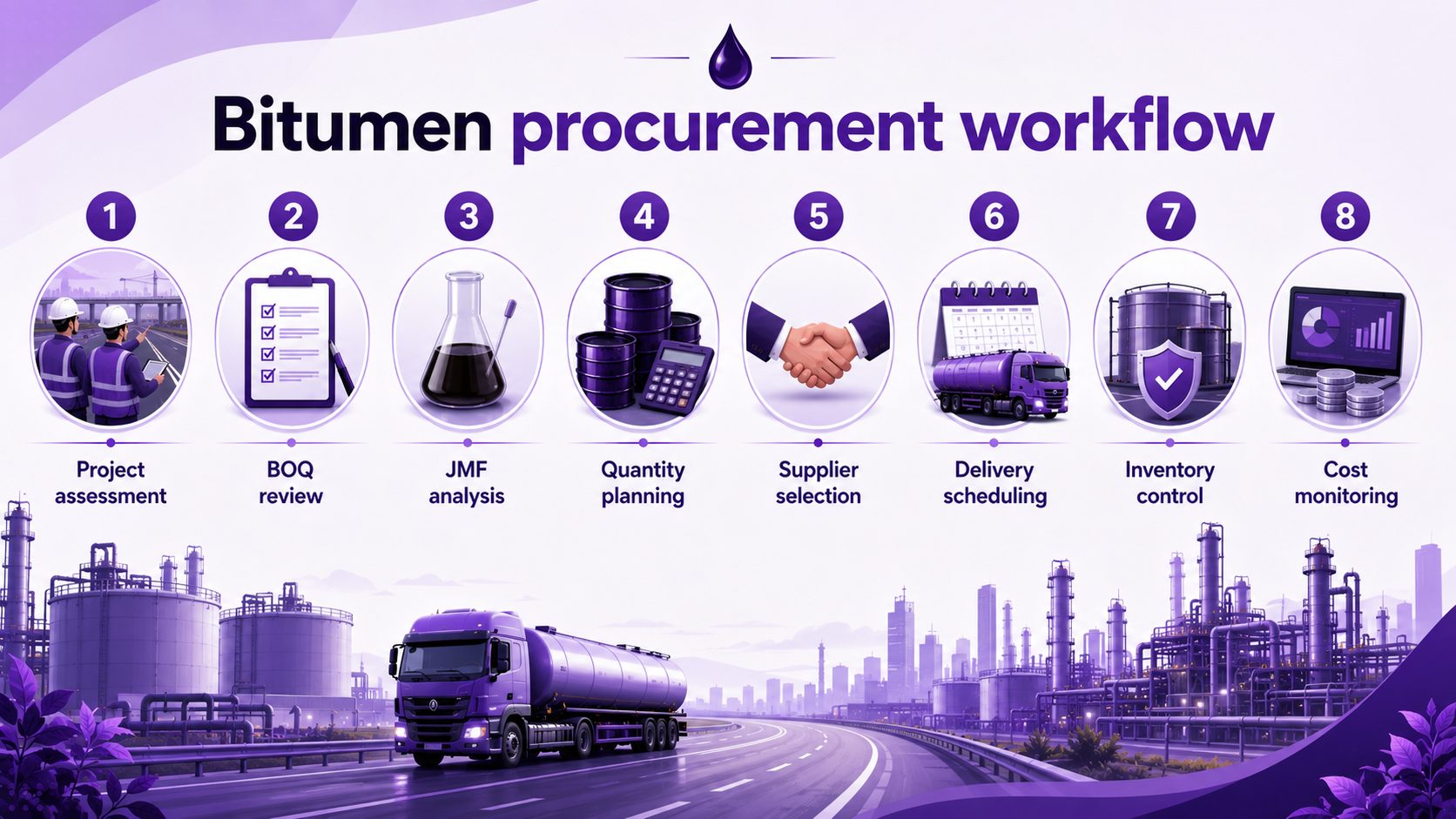
Accurate bitumen procurement planning helps road contractors control project budgets, maintain uninterrupted supply, and avoid unnecessary material costs. Procurement teams do not consider only the market rate. They also evaluate project requirements, tender conditions, delivery timelines, storage capacity, and contract terms to calculate the overall road construction material cost.
Project quantity estimation
Contractors begin by estimating the total bitumen requirement based on pavement thickness, road length, asphalt mix design, and project specifications. Accurate quantity planning helps avoid shortages during execution and prevents excess material purchase.
Tender BOQ requirements
The Bill of Quantities (BOQ) in the tender document defines the required material specifications, approved grades, and estimated quantities. Procurement teams use these details to align purchases with contract requirements and avoid compliance issues.
Job Mix Formula (JMF) planning
The approved Job Mix Formula (JMF) determines the optimum binder content required for the asphalt mix. Contractors use JMF data to estimate actual bitumen consumption and plan procurement accordingly.
Wastage allowance
Contractors include a reasonable allowance for handling losses, storage variations, and operational requirements. Proper planning reduces unexpected shortages while avoiding excessive inventory.
Delivery scheduling
Bitumen deliveries are planned according to asphalt plant operations, construction milestones, and site requirements. Timely deliveries help maintain workflow and prevent delays in paving activities.
Bulk procurement planning
Large infrastructure projects often prefer bulk bitumen purchases to improve commercial terms and ensure consistent supply. Procurement teams compare supplier rates, delivery capability, and storage requirements before finalising orders.
Inventory management
Contractors maintain adequate stock levels based on project progress and consumption rates. Effective inventory control reduces storage issues, material wastage, and working capital pressure.
Cash flow and price escalation planning
Long-term projects require careful financial planning because material prices can change during execution. Tender procurement teams review price escalation clauses and supplier agreements to manage future cost variations.
This structured approach helps contractors manage bitumen procurement efficiently while maintaining quality, cost control, and timely project completion.
How to choose the right bitumen supplier
BIS compliance: Verify that the supplier provides bitumen meeting required quality standards and project specifications.
Grade availability: Ensure the supplier can consistently provide required grades such as VG, PMB, and CRMB.
Supply reliability: Check the supplier’s ability to deliver material on schedule without affecting project progress.
Test certificates: Review quality test reports and material documentation before procurement.
Delivery capability: Evaluate transportation facilities, storage support, and coverage across project locations.
Bulk supply options: Prefer suppliers who can support large-volume requirements for highway and infrastructure projects.
Technical support: Choose suppliers who provide guidance on grade selection, handling, and storage requirements.
Project experience: Consider suppliers with experience in supplying bitumen for road, highway, and EPC projects.
After-sales support: Ensure the supplier responds quickly to quality concerns, delivery issues, and technical queries.
Tips to reduce bitumen procurement costs without compromising quality
Reducing procurement costs is about making smarter purchasing decisions rather than simply buying at the lowest price. Contractors can improve project profitability by planning purchases, managing inventory efficiently, and selecting reliable suppliers.
| Cost optimisation tip | How it helps |
|---|---|
| Plan purchases before peak season | Avoid seasonal price increases and secure better availability before demand rises. |
| Consolidate bulk orders | Increase negotiating power and reduce the per-tonne procurement and transportation cost. |
| Compare landed cost, not ex-refinery price | Consider freight, GST, packaging, unloading, and handling charges to identify the actual purchase cost. |
| Verify quality certificates | Ensure the supplied bitumen meets project specifications and reduce the risk of rejection or rework. |
| Minimise storage losses | Use proper storage practices to reduce material wastage, contamination, and unnecessary inventory losses. |
| Optimise delivery schedules | Align deliveries with construction progress to minimise storage time and prevent site delays. |
| Buy from approved suppliers | Work with reputable suppliers that offer consistent quality, dependable deliveries, and technical support. |
| Monitor market trends | Track refinery price revisions and market movements to plan purchases at favourable rates. |
| Align procurement with project timelines | Purchase materials according to execution schedules to improve cash flow and avoid excess inventory. |
| Review supplier quotations carefully | Compare payment terms, lead times, warranty, logistics support, and after-sales service instead of focusing only on price. |
Conclusion
Understanding the bitumen price in India requires more than checking the latest market rate. Successful procurement depends on matching the right material to the project’s technical requirements while ensuring reliable supply and commercial value.
Whether you are bidding for a government tender or managing a large infrastructure project, informed purchasing decisions can improve execution, minimise delays, and support long-term pavement performance. Regularly reviewing market updates and supplier offerings helps procurement teams stay competitive in a changing construction environment.
Looking to procure steel?
Tata nexarc helps manufacturers, builders and MSMEs source certified steel products, compare prices, and choose the right grade as per IS codes—with complete traceability and procurement confidence.
FAQs
What is the current bitumen price in India?
What is the price of VG 30 bitumen?
Why do bitumen prices change frequently?
Which bitumen grade is most commonly used for highways?
Does bulk purchase reduce bitumen cost?
How is bitumen transported to project sites?
What affects bitumen prices the most?
Which documents should buyers check before purchasing bitumen?
Is PMB more expensive than VG bitumen?
How can contractors reduce bitumen procurement costs?
A product manager with a writer's heart, Anirban leverages his 6 years of experience to empower MSMEs in the business and technology sectors. His time at Tata nexarc honed his skills in crafting informative content tailored to MSME needs. Whether wielding words for business or developing innovative products for both Tata Nexarc and MSMEs, his passion for clear communication and a deep understanding of their challenges shine through.