Check Price Now
Table of Contents
- What is Indian Oil Corporation Bitumen?
- Latest Indian Oil Corporation Bitumen Price in India
- Indian Oil Bitumen Grades and Their Typical Applications
- Factors Affecting Indian Oil Corporation Bitumen Prices
- How Highway Contractors and EPC Companies Procure Indian Oil Bitumen
- Tips to Reduce Bitumen Procurement Costs Without Compromising Quality
- Indian Oil Corporation Bitumen vs Other Major Bitumen Suppliers in India
- Conclusion
- FAQs
The Indian Oil Corporation bitumen price is one of the most searched topics among highway contractors, EPC companies, procurement teams and infrastructure developers planning road construction projects across India. As one of the country’s largest bitumen producers and suppliers, Indian Oil Corporation (IOCL) supplies a wide range of paving grades through its refinery and distribution network.
However, prices vary based on the bitumen grade, refinery location, order quantity, delivery destination, and prevailing market conditions. This guide covers the latest price trends, available grades, key factors affecting pricing, and practical procurement tips to help buyers make informed purchasing decisions.
What is Indian Oil Corporation bitumen?
Indian Oil Corporation’s role in road infrastructure: Indian Oil Corporation (IOCL) is one of India’s largest producers and suppliers of paving bitumen. It supplies bituminous binders to national highway projects, state road works, airport developments, urban infrastructure projects, and municipal road construction across the country through its extensive refinery and distribution network.
Types of bitumen supplied: IOCL manufactures a broad portfolio of road construction binders, including VG 10, VG 30 and VG 40 viscosity grade bitumen, Polymer Modified Bitumen (PMB), Crumb Rubber Modified Bitumen (CRMB) and bitumen emulsions for different pavement designs, traffic conditions and climatic requirements.
Industries served: IOCL supplies bitumen to highway contractors, EPC companies, NHAI contractors, State PWDs, municipal corporations, airport infrastructure developers, industrial infrastructure projects, asphalt mix plant operators, and authorised bitumen distributors serving public and private road construction projects.
Major applications: Indian Oil bitumen is used for flexible pavement construction, highway resurfacing, expressway development, airport runways, bridge approaches, urban road rehabilitation, rural road connectivity, pavement maintenance and preventive maintenance works using hot mix asphalt and bituminous surface treatments.
Why contractors choose IOCL: Many contractors and procurement teams prefer IOCL because of its nationwide supply network, consistent product quality, reliable availability for large infrastructure projects, compliance with applicable Indian standards, and dependable support for bulk procurement and government-funded road construction contracts.
Latest Indian Oil Corporation Bitumen price in India (September 2026)
The Indian Oil Corporation bitumen price changes periodically based on refinery revisions, crude oil trends, freight costs, product type, and regional demand. The table below shows indicative September 2026 prices for Indian Oil bitumen supplied in bulk and packed form. Actual quotations may vary by refinery, destination, order volume, and applicable taxes.
| Bitumen grade | Typical application | Indicative ex-refinery price (₹/MT) | Approx. price (₹/kg) |
|---|---|---|---|
| VG 10 | Cold regions, spray applications, low-traffic roads. | ₹67,700–₹77,400 | ₹67.70–₹77.40 |
| VG 30 | National highways, state highways, flexible pavements. | ₹69,500–₹80,200 | ₹69.50–₹80.20 |
| VG 40 | Heavy traffic corridors, intersections, industrial roads. | ₹74,500–₹86,900 | ₹74.50–₹86.90 |
| PMB | Expressways, flyovers, high-stress pavements. | ₹90,000–₹1,06,000 | ₹90–₹106 |
| CRMB | Heavy axle load roads, high-rainfall regions. | ₹72,000–₹73,000 | ₹72–₹73 |
| Bitumen emulsion | Surface dressing, tack coat, slurry seal, and maintenance works. | ₹52,000–₹72,000* | ₹52–₹72* |
*Indicative range varies by emulsion grade (RS, MS or SS) and bitumen content.
Ex-refinery price: This is the base price at the supplying Indian Oil refinery. It excludes freight, unloading, local transportation, GST, and other project-specific logistics costs.
Delivered price: This is the total landed cost at the project site or asphalt plant after adding transportation, handling, applicable taxes, and other delivery charges. It is the figure most contractors use for budgeting and tender estimation.
Buying note for contractors: Always request a project-specific quotation instead of relying on published rates. Even for the same grade, the final Indian Oil Corporation bitumen price can differ between refineries and destinations because freight, order quantity, packaging (bulk tanker or drums) and local logistics have a significant impact on the landed cost.
Indian Oil Bitumen grades and their typical applications
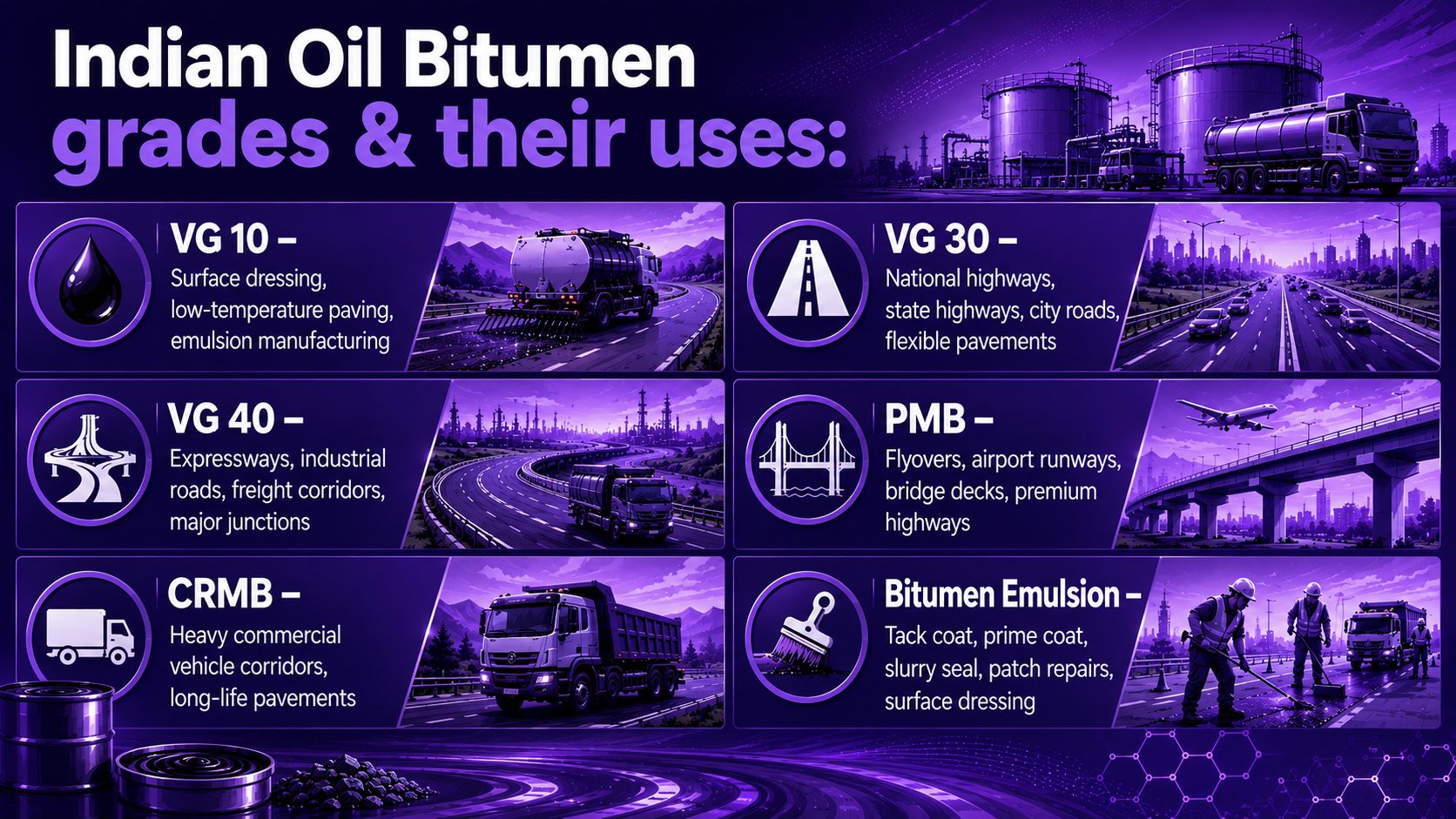
Indian Oil Corporation manufactures a wide range of bitumen grades to meet the requirements of different road construction and pavement maintenance projects. The right grade depends on traffic intensity, climatic conditions, pavement design, and the intended application. Its portfolio includes viscosity grade bitumen, modified bitumen and bitumen emulsions used across highways, expressways, airports, urban roads and maintenance works.
VG 10: A softer viscosity grade primarily used in colder regions and for spray applications. It is also widely used in the production of bitumen emulsions and modified bitumen.
VG 30: The most widely used grade for road construction in India. It is specified for national highways, state highways, urban roads, and flexible pavements because it delivers reliable performance under typical Indian traffic and weather conditions.
VG 40: A harder grade developed for roads carrying heavy traffic and high axle loads. It is commonly used on expressways, industrial roads, freight corridors, major intersections, and other locations exposed to severe loading.
Polymer Modified Bitumen (PMB): Manufactured by modifying bitumen with polymers to improve flexibility, durability and resistance to rutting. It is preferred for premium road infrastructure such as expressways, flyovers, bridge decks, and airport pavements.
Crumb Rubber Modified Bitumen (CRMB): Produced by blending processed crumb rubber with bitumen to enhance resistance to cracking, moisture damage, and repeated traffic loading. It is suitable for highways with a high proportion of heavy commercial vehicles.
Bitumen emulsion: A water-based bituminous binder that can be applied without heating. It is widely used for tack coats, prime coats, slurry seals, surface dressing, pothole repairs, and routine road maintenance.
| Bitumen grade | Key characteristics | Typical applications |
|---|---|---|
| VG 10 | Softer viscosity grade for lower temperatures | Surface dressing, spray applications, cold-region roads, emulsion manufacturing. |
| VG 30 | Standard paving grade for most road projects | National highways, state highways, city roads, flexible pavements. |
| VG 40 | Higher viscosity for heavy-duty pavements | Expressways, industrial roads, freight corridors, major junctions. |
| PMB | Enhanced flexibility and pavement durability | Expressways, flyovers, bridge decks, airport runways. |
| CRMB | Improved resistance to cracking and heavy traffic | High-volume highways, commercial vehicle corridors, long-life pavements. |
| Bitumen Emulsion | Cold-applied binder for maintenance works | Tack coat, prime coat, slurry seal, patch repairs, surface dressing. |
Factors affecting Indian Oil Corporation bitumen prices
The Indian Oil Corporation bitumen price is influenced by several market and operational factors. Understanding these variables helps contractors, procurement managers and tender teams estimate project costs more accurately.
Crude oil prices: Bitumen is a petroleum-based product, so changes in global crude oil prices directly affect production costs. A sustained rise or fall in crude prices is often reflected in bitumen quotations.
Refinery production: Scheduled refinery maintenance, production levels, and inventory availability can impact supply. Limited output may tighten availability and influence market prices.
Seasonal demand: Demand typically increases during the road construction season when weather conditions favour paving activities. Higher demand can lead to more frequent price revisions.
Government infrastructure spending: Large-scale investments in national highways, expressways, airports and state road projects increase bitumen consumption. Higher project activity often strengthens market demand.
Freight costs: Transportation is a major component of the final cost. Fuel prices, delivery distance, vehicle availability, and logistics charges all influence the landed price at the project site.
Supply chain conditions: Delays in transportation, storage constraints, or disruptions in the supply network can affect product availability and quotation timelines.
Bulk purchase quantity: Large-volume orders generally receive more competitive quotations than smaller purchases because logistics and handling costs are spread over higher quantities.
Packaging type: Bulk tanker supplies usually have a lower per-tonne cost than drum-packed bitumen due to reduced packaging and handling expenses.
Regional demand: Prices may vary across states depending on local construction activity, refinery proximity, and demand from public and private infrastructure projects.
Taxes and statutory charges: GST and any applicable local levies contribute to the final invoice value and should be considered when estimating project costs.
Market competition: Quotations also respond to prevailing market conditions, supplier availability, and competitive bidding across major infrastructure projects.
How highway contractors and EPC companies procure Indian Oil bitumen

Whether it is an NHAI highway, a State PWD road, or an airport project, contractors follow a structured procurement process to ensure timely material availability, compliance with project specifications, and uninterrupted paving operations.
Step 1: Assess project requirements
Procurement teams estimate the total bitumen requirement using the project scope, pavement design, construction schedule, and asphalt plant output. This forms the basis for procurement planning.
Step 2: Choose the supply source
Large infrastructure projects often source bitumen directly from Indian Oil’s designated refineries, while regional contractors and smaller projects commonly purchase through authorised distributors based on location and availability.
Step 3: Select the supply format
The supply format depends on project requirements and site infrastructure.
| Supply format | Typically used for |
|---|---|
| Bulk tanker | Large highway projects, EPC works and asphalt plants with storage tanks. |
| Drum-packed bitumen | Small projects, remote locations, and sites without bulk storage facilities. |
Step 4: Meet tender and contract requirements
Government and institutional projects require procurement to align with tender specifications, approved product requirements, delivery schedules, and contract documentation before material is dispatched.
Step 5: Plan deliveries
Instead of receiving the entire quantity at once, contractors schedule deliveries in phases to match paving progress, minimise storage requirements, and maintain continuous construction activities.
Step 6: Verify documents and quality
Before accepting a shipment, procurement and quality teams verify the delivery challan, tax invoice, batch details, and manufacturer’s quality certificate to confirm the material meets project requirements.
Indian Oil bitumen procurement workflow
| Stage | Objective |
|---|---|
| Requirement planning | Estimate project quantity and timelines |
| Source selection | Procure from IOCL refinery or authorised distributor |
| Supply format | Choose bulk tanker or drum supply |
| Contract compliance | Meet tender and project specifications |
| Delivery scheduling | Align dispatches with construction progress |
| Documentation | Verify invoices and quality certificates |
| Material acceptance | Approve the consignment before use |
Tips to reduce bitumen procurement costs without compromising quality
Plan procurement early: Finalise procurement schedules before peak construction season to improve supply availability and reduce the risk of project delays.
Consolidate orders: Combine requirements across multiple project packages or phases to simplify logistics and improve purchasing efficiency.
Compare freight costs: Evaluate transportation charges from different supply locations because freight can significantly influence the final landed cost.
Select the appropriate grade: Procure the grade specified in the pavement design instead of over-specifying materials that may increase project costs unnecessarily.
Verify supplier credentials: Purchase only from Indian Oil or its authorised distributors to ensure genuine products, proper documentation, and consistent supply.
Monitor market trends: Track refinery announcements, infrastructure activity and market movements to identify favourable procurement windows.
Avoid emergency purchases: Last-minute buying often limits supplier options and disrupts project planning, especially during periods of high demand.
Check refinery availability: Confirm product availability and expected dispatch schedules before finalising procurement plans to avoid unexpected supply gaps.
Optimise inventory: Maintain sufficient stock for uninterrupted paving while avoiding excessive storage that increases handling and inventory costs.
Consider long-term supply agreements: Framework agreements with reliable suppliers can improve supply planning, simplify repeat procurement, and support better project execution throughout the construction period.
Indian Oil Corporation bitumen vs other major bitumen suppliers in India
India’s bitumen market is served by several major oil companies, each offering products for road construction and infrastructure projects. While product quality generally complies with applicable Indian standards, procurement decisions often depend on supply reach, refinery locations, distributor network, project location, and delivery reliability rather than the supplier alone.
| Supplier | Product range | Distribution network | Availability | Common buyers | Procurement strengths |
|---|---|---|---|---|---|
| Indian Oil Corporation (IOCL) | VG 10, VG 30, VG 40, PMB, CRMB, bitumen emulsion. | Extensive refinery network with authorised distributors across India. | Excellent nationwide availability. | NHAI contractors, EPC companies, State PWDs, municipal agencies, airport contractors, asphalt plants. | Wide geographic coverage, reliable supply for large infrastructure projects, multiple refinery sourcing options, and strong distributor network. |
| Bharat Petroleum (BPCL) | VG grades, PMB, CRMB, bitumen emulsion. | Strong presence through refineries and regional distribution channels. | High, particularly in western, southern, and central India. | Highway contractors, EPC firms, road developers, government agencies. | Good regional coverage, dependable project supply, and broad portfolio of paving products. |
| Hindustan Petroleum (HPCL) | VG grades, PMB, CRMB, bitumen emulsion. | Refinery-supported supply with authorised dealer network. | High across major infrastructure markets. | State PWD contractors, municipal bodies, infrastructure developers, asphalt mix plants. | Reliable supply chain, established distribution network, and suitable for public infrastructure projects. |
| Nayara Energy | VG grades, modified bitumen, and selected speciality products. | Distribution supported by Vadinar Refinery and authorised channel partners. | Good, with stronger presence in western and northern India. | Bitumen distributors, road contractors, private infrastructure developers. | Competitive regional supply, efficient refinery operations, and growing market presence. |
When comparing suppliers, procurement teams should evaluate product availability, delivery timelines, refinery proximity, distributor support, documentation, quality assurance, and supply continuity alongside commercial terms. These factors often have a greater impact on project execution than selecting a particular supplier alone.
Conclusion
Indian Oil Corporation continues to play a significant role in supplying bitumen for India’s expanding road and infrastructure sector. However, successful procurement depends on more than comparing supplier quotations. Contractors, EPC companies and procurement teams should align purchasing decisions with project timelines, specification requirements, logistics planning, and long-term supply continuity.
Obtaining a fresh quotation before every order and evaluating the complete project requirement will help ensure smoother execution, minimise procurement risks, and support better cost control throughout the construction cycle.
Looking to procure steel?
Tata nexarc helps manufacturers, builders and MSMEs source certified steel products, compare prices, and choose the right grade as per IS codes—with complete traceability and procurement confidence.
FAQs
What is the latest Indian Oil Corporation bitumen price in India?
Does Indian Oil publish bitumen prices daily?
What affects Indian Oil bitumen prices?
Which Indian Oil bitumen grade is commonly used for highways?
Can contractors purchase directly from Indian Oil?
What is the difference between bulk and drum bitumen?
Does freight affect Indian Oil bitumen prices?
Is VG 30 the most commonly used Indian Oil bitumen grade?
How can buyers obtain the latest Indian Oil quotation?
Which industries purchase Indian Oil bitumen?
A product manager with a writer's heart, Anirban leverages his 6 years of experience to empower MSMEs in the business and technology sectors. His time at Tata nexarc honed his skills in crafting informative content tailored to MSME needs. Whether wielding words for business or developing innovative products for both Tata Nexarc and MSMEs, his passion for clear communication and a deep understanding of their challenges shine through.