Check Price Now
Table of Contents
- What is Bitumen Emulsion?
- Why is Bitumen Emulsion Used Instead of Hot Bitumen?
- How is Bitumen Emulsion Manufactured?
- Types of Bitumen Emulsion
- Grades of Bitumen Emulsion Used in India
- Applications of Bitumen Emulsion in Road Construction
- Advantages of Bitumen Emulsion
- How to Select the Right Bitumen Emulsion
- Conclusion
- FAQs
Road construction projects demand materials that are efficient, reliable, and cost-effective. So, what is bitumen emulsion? It is a mixture of bitumen, water, and an emulsifying agent that allows bitumen to be applied without heating it to high temperatures. Also known as cold bitumen, it has become a preferred choice for many road construction and highway construction projects because it is easier to handle and quicker to apply.
Today, contractors and infrastructure agencies across India increasingly use bitumen emulsion for both new roads and maintenance work because it offers several practical advantages.
Some of the key reasons behind its growing adoption include
- Faster application with reduced construction time.
- Lower fuel consumption compared to conventional hot bitumen.
- Improved worker safety due to lower application temperatures.
- Reduced emissions, supporting more sustainable construction practices.
- Better suitability for maintenance works, rural roads, and pavement preservation.
What is bitumen emulsion?
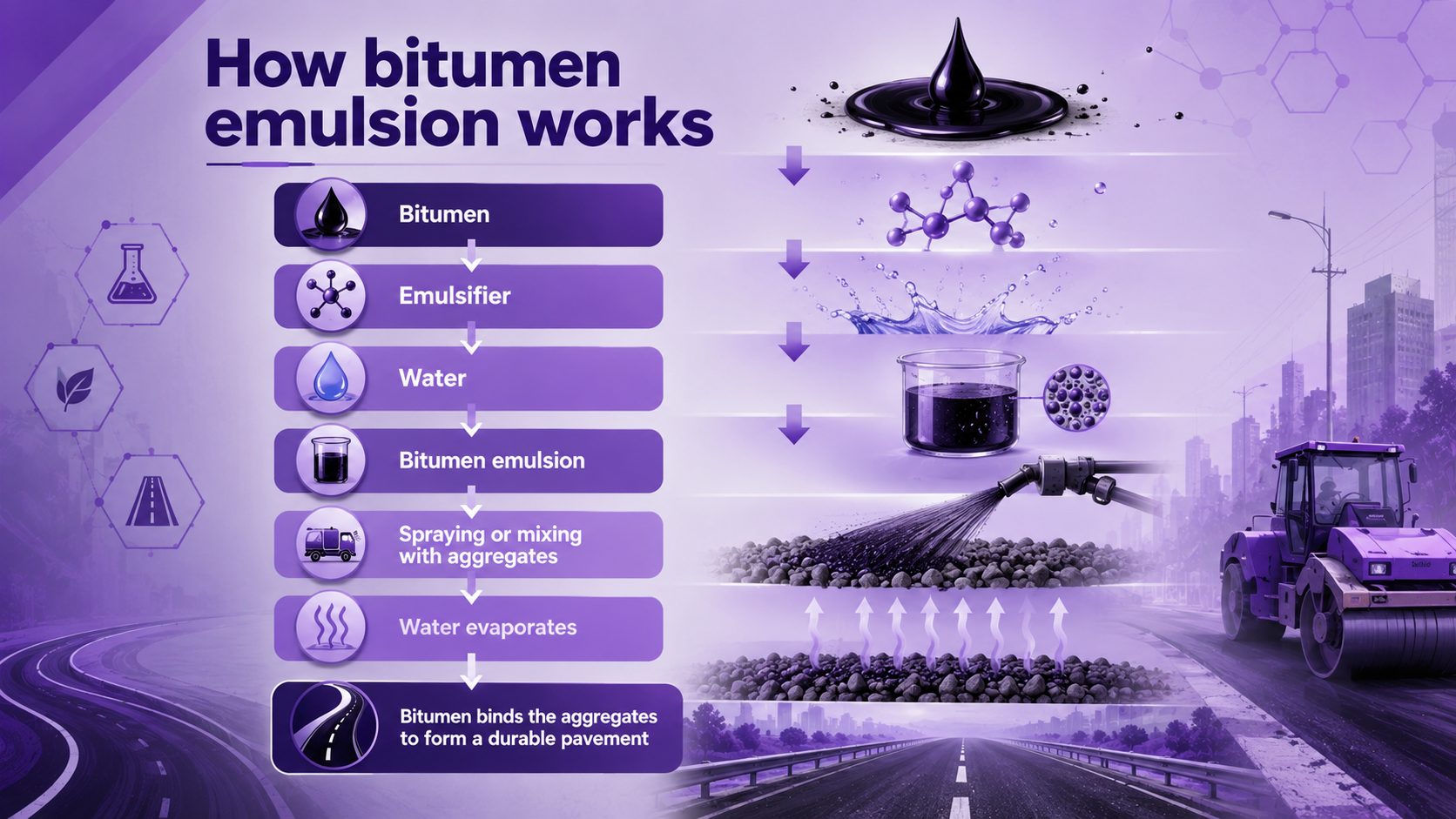
It is a mixture of bitumen, water, and an emulsifying agent that keeps tiny bitumen droplets evenly suspended in water. This stable mixture allows bitumen to be stored, transported, and applied at ambient temperatures without the need for continuous heating.
The composition is designed to make road construction safer and more efficient. The emulsifying agent prevents the bitumen droplets from separating during storage and application. As a result, contractors can spray or mix the material more easily than conventional hot bitumen, reducing fuel consumption and improving worksite safety.
The bitumen emulsion process begins when the emulsion is sprayed or mixed with aggregates. Once applied, the emulsion starts to break, meaning the emulsifier releases the bitumen from the water. The water then evaporates, leaving behind a strong bitumen film that coats and binds the aggregates together. This binder creates a durable surface capable of withstanding traffic and weather conditions.
Unlike hot bitumen, which must be heated to high temperatures before application, bitumen emulsion can be used with minimal heating. This makes it a practical and cost-effective choice for road maintenance, pavement preservation, and many highway construction projects.
Why is bitumen emulsion used instead of hot bitumen?
The shift from conventional hot bitumen to bitumen emulsion is driven by the need for faster, safer, and more sustainable road construction. Contractors, EPC companies, and government agencies are under increasing pressure to complete projects on time while reducing costs and meeting environmental goals. Bitumen emulsion helps achieve these objectives because it can be applied without heating to high temperatures.
Compared to hot bitumen, bitumen emulsion requires less fuel, fewer specialised heating systems, and lower energy consumption. This reduces operating costs and simplifies on-site operations. It also improves worker safety by lowering the risk of burns during handling and application. These advantages make it particularly suitable for road maintenance, rural roads, municipal works, and pavement preservation projects.
| Hot bitumen | Bitumen emulsion |
|---|---|
| Requires heating | Used at ambient temperature |
| Higher fuel cost | Lower fuel consumption |
| Higher emissions | Lower emissions |
| Greater burn risk | Safer handling |
| Longer preparation time | Faster application |
| Limited suitability for maintenance works | Well suited for maintenance and repair works |
When comparing hot bitumen vs bitumen emulsion, the latter offers clear operational and commercial advantages. Faster execution helps contractors meet tight project schedules, while reduced equipment and fuel requirements lower overall project costs. These benefits of bitumen emulsion also support more sustainable construction practices by reducing emissions and energy use, making it an increasingly preferred choice for modern infrastructure projects.
How is bitumen emulsion manufactured?

The bitumen emulsion manufacturing process combines bitumen, water, and specialised chemicals to produce a stable binder that can be applied without high-temperature heating. Manufacturers carefully control every stage to ensure consistent quality, storage stability, and field performance.
Raw materials
Bitumen: Bitumen acts as the primary binding material. It provides the adhesive properties needed to hold aggregates together and create a durable pavement.
Water: Water serves as the continuous phase that allows the bitumen to remain fluid. It enables the emulsion to be sprayed or mixed at ambient temperatures.
Emulsifier: The emulsifier is a chemical additive that keeps tiny bitumen droplets evenly dispersed in water. It prevents separation during storage and controls how quickly the emulsion breaks after application.
Additives: Manufacturers may add stabilisers or performance-enhancing additives to improve storage stability, adhesion, or setting characteristics for specific applications.
Manufacturing steps
Heating the bitumen: The bitumen is heated until it becomes fluid enough for processing.
Preparing the water phase: Water is mixed with the emulsifier and other additives in controlled proportions.
Colloid mill mixing: The heated bitumen and water phase pass through a colloid mill, which breaks the bitumen into microscopic droplets and distributes them evenly throughout the water. This step is critical to bitumen emulsion production because it determines particle size and overall stability.
Storage and quality testing: The finished emulsion is stored in dedicated tanks before dispatch. Manufacturers carry out quality tests to check particle size, storage stability, viscosity, and other performance parameters. In India, bitumen emulsions are produced and tested according to relevant BIS specifications, helping ensure consistent quality for road construction projects.
Types of bitumen emulsion
The types of bitumen emulsion are classified based on two factors: electrical charge and setting speed. Understanding these classifications helps contractors, consultants, and procurement teams select the right product for each road construction application.
Types of bitumen emulsion by electrical charge
Cationic bitumen emulsion
A cationic emulsion contains positively charged bitumen particles. It is the most widely used bitumen emulsion in India because it bonds well with the predominantly negatively charged mineral aggregates used in road construction. It also develops good adhesion, making it suitable for high-traffic roads and highways.
Common applications:
- Tack coat
- Slurry seal
- Surface dressing
- Micro surfacing
- Highway maintenance works
Anionic bitumen emulsion
An anionic emulsion contains negatively charged bitumen particles. It works best with positively charged aggregates and is used only in specific construction conditions. Compared to cationic emulsions, its use is more limited in India.
Common applications:
- Selected road construction projects
- Special aggregate conditions
- Certain industrial paving applications
Quick comparison
| Type | Particle charge | Best suited for |
|---|---|---|
| Cationic bitumen emulsion | Positive (+) | Most Indian aggregates, highways, maintenance works. |
| Anionic bitumen emulsion | Negative (−) | Positively charged aggregates and specialised projects. |
Types of bitumen emulsion by setting speed
The setting speed indicates how quickly the emulsion breaks and leaves the bitumen binder on the aggregate surface.
| Type | Setting speed | Common uses |
|---|---|---|
| Rapid Setting (RS) | Fast | Tack coat, surface dressing. |
| Medium Setting (MS) | Moderate | Premix works, patch repairs. |
| Slow Setting (SS) | Slow | Slurry seal, soil stabilisation, cold mix. |
Which setting speed should you choose?
Rapid Setting (RS): Ideal when quick bonding is required, especially for tack coats and surface dressing.
Medium Setting (MS): Suitable for premix applications where aggregates need more time to mix evenly with the binder.
Slow Setting (SS): Best for slurry seals, soil stabilisation, and cold mix applications because it provides a longer mixing and working time.
Choosing the correct RS, MS, SS bitumen emulsion depends on the construction method, aggregate type, weather conditions, and project specifications. Using the right emulsion helps improve pavement performance, construction efficiency, and long-term durability.
Grades of bitumen emulsion used in India
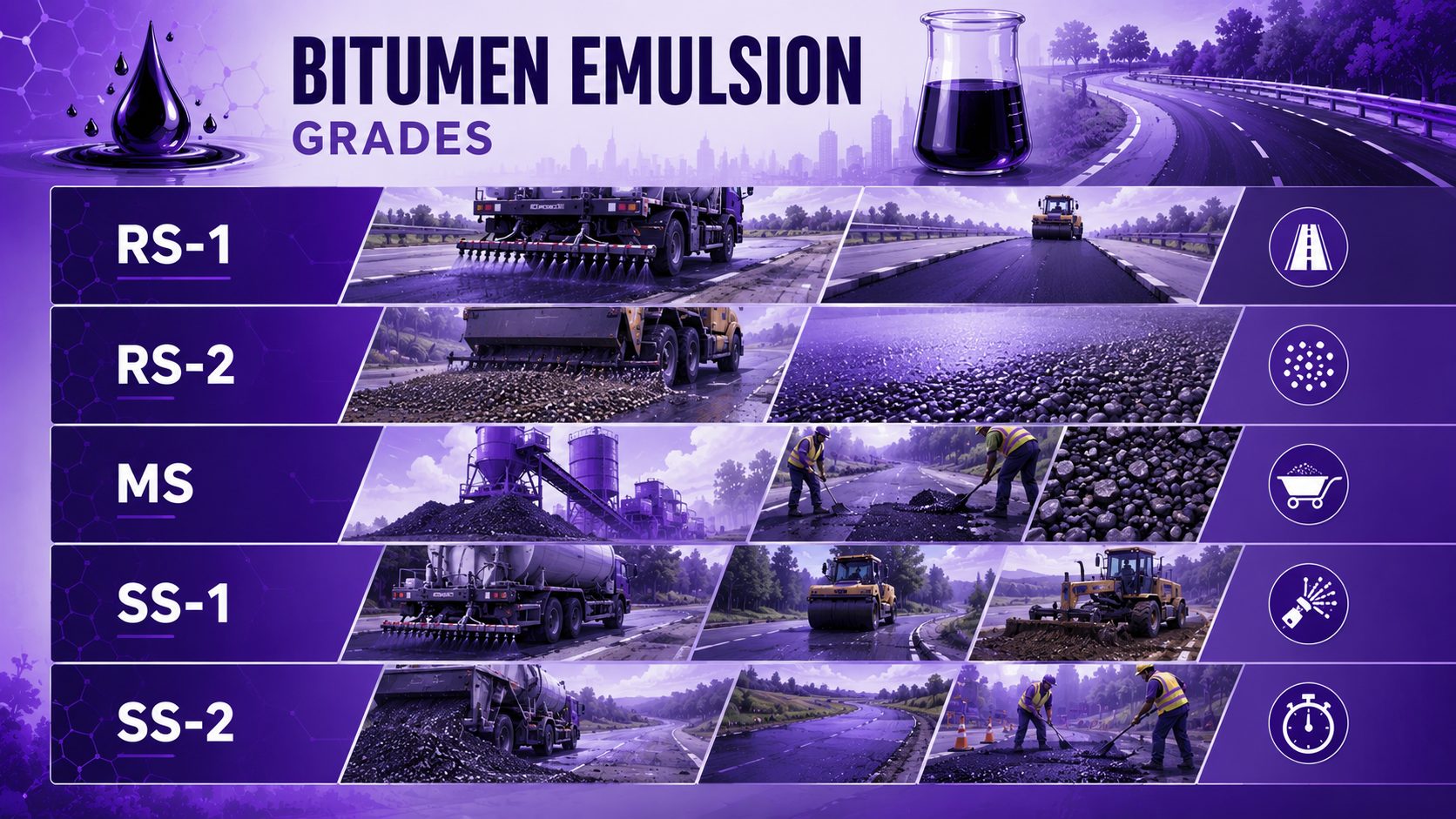
Different bitumen emulsion grades are designed for specific construction and maintenance applications. Each grade has a different setting speed, making it suitable for site conditions and construction methods. Selecting the right grade helps improve bonding, construction quality, and pavement life.
Common bitumen emulsion grades
| Grade | Typical applications |
|---|---|
| RS-1 | Tack coat before laying asphalt overlays. |
| RS-2 | Surface dressing, chip sealing, and spray applications. |
| MS (MS emulsion) | Premix works, patch repairs, and open-graded aggregates. |
| SS-1 | Slurry seal, fog seal, and soil stabilisation. |
| SS-2 | Cold mix, slurry seal, and maintenance works requiring longer mixing time. |
How contractors select the right grade
The choice of RS1, RS2, MS emulsion, or SS1 depends on the project’s technical and operational requirements rather than price alone. Contractors and procurement teams typically evaluate:
- Traffic volume and expected pavement load
- Weather and ambient temperature during construction
- Aggregate type and compatibility
- Construction method and application technique
- Project specifications and performance requirements
- Government tender and contract requirements
For example, RS-1 is commonly selected for tack coats because it sets quickly, while MS emulsion is preferred for premix applications that require more mixing time. Similarly, SS-1 and SS-2 are widely used for slurry seals, cold mix, and pavement maintenance.
In India, bitumen emulsion grades are manufactured and tested in accordance with relevant BIS specifications, ensuring consistent quality and performance for national highways, state roads, municipal infrastructure, and other road construction projects.
Applications of bitumen emulsion in road construction
The wide range of bitumen emulsion uses makes it an essential material for modern road construction and maintenance. It is used in new road projects as well as pavement preservation because it offers good adhesion, easy application, and lower energy consumption. From national highways to rural roads, bitumen emulsion for roads supports faster construction and longer pavement life.
| Application | Purpose | Typical use |
|---|---|---|
| Tack coat | Creates a strong bond between existing and new asphalt layers. | Highway overlays, resurfacing projects. |
| Prime coat | Seals and prepares granular base layers before asphalt paving. | New road construction. |
| Surface dressing | Protects the pavement surface and improves skid resistance. | State highways, rural roads, low to medium traffic roads. |
| Fog seal | Seals minor surface cracks and reduces oxidation. | Preventive maintenance on ageing pavements. |
| Slurry seal | Restores surface texture and extends pavement life. | Municipal roads, urban streets, residential roads. |
| Micro surfacing | Corrects minor rutting and improves riding quality. | Highways, expressways, heavy traffic corridors. |
| Cold mix roads | Enables road construction and repairs without hot mixing. | Remote locations, all-weather maintenance works. |
| Rural roads | Provides a cost-effective solution for low-volume traffic roads. | Village roads and rural connectivity projects. |
| Pothole repairs | Allows quick and durable patch repairs. | Emergency road maintenance and monsoon repairs. |
| Airport pavements | Maintains surface integrity with minimal operational disruption. | Runways, taxiways, airport service roads. |
| Bridge decks | Improves waterproofing and enhances layer bonding. | Bridges, flyovers, elevated corridors. |
| Road maintenance works | Preserves pavement condition and delays major rehabilitation. | Periodic maintenance across all road networks. |
Choosing the right bitumen emulsion helps improve construction efficiency, pavement performance, and long-term project value. To achieve these outcomes, contractors should match the emulsion type and grade to the application, site conditions, and project requirements. This approach helps deliver more consistent results and enhances pavement durability.
Advantages of bitumen emulsion

The advantages of bitumen emulsion go beyond easier application. Its ability to perform without extensive heating helps contractors complete projects more efficiently while improving safety and controlling costs. These practical and commercial benefits of bitumen emulsion make it a preferred choice for many road construction and maintenance projects.
Lower energy consumption: Requires little or no heating during application, reducing fuel usage, and operating costs.
Reduced carbon emissions: Lower fuel consumption results in fewer emissions, supporting more sustainable construction practices.
Faster construction: Quick application and shorter preparation time help accelerate project execution and minimise traffic disruption.
Better adhesion: Bonds effectively with aggregates, creating a strong and durable pavement layer.
Suitable for damp aggregates: Performs well even when aggregates contain some moisture, offering greater flexibility on site.
Lower labour costs: Simpler application methods reduce manual effort and improve workforce productivity.
Improved safety: Lower application temperatures reduce the risk of burns and create a safer working environment.
Less equipment: Eliminates the need for extensive heating systems, lowering equipment investment and maintenance requirements.
Better workability: Sprays and mixes easily, helping achieve uniform coverage and consistent pavement quality.
Lower maintenance costs: Improves pavement durability, reducing the frequency of repairs over its service life.
For procurement teams and contractors, these advantages translate into lower project costs, streamlined site operations, and better long-term value. Selecting the right bitumen emulsion for the application also helps meet project specifications while delivering consistent pavement performance.
How to select the right bitumen emulsion
Choosing bitumen emulsion involves more than selecting a grade. Contractors and procurement teams should evaluate project conditions, construction methods, and technical requirements before making a purchase.
| Factor | What to consider | Common mistake to avoid |
|---|---|---|
| Traffic volume | Select an emulsion suitable for the expected traffic load and road category. | Choosing a grade designed for lighter traffic conditions. |
| Climate | Consider temperature, humidity, and expected weather during construction. | Applying the emulsion during unsuitable weather conditions. |
| Pavement condition | Assess whether the pavement requires preventive maintenance, repair, or resurfacing. | Using the same emulsion for every maintenance activity. |
| Aggregate type | Ensure the emulsion is compatible with the aggregates used on site. | Ignoring aggregate compatibility, leading to poor adhesion. |
| Construction method | Match the emulsion to applications such as tack coat, slurry seal, or cold mix. | Selecting an unsuitable emulsion for the construction technique. |
| Project specifications | Follow tender documents, engineering drawings, and technical requirements. | Overlooking specification or contract requirements. |
| Curing time | Allow adequate breaking and curing before opening the road to traffic. | Opening the pavement before the emulsion has fully cured. |
| Contractor equipment | Confirm that available spraying or mixing equipment is suitable for the selected emulsion. | Using poorly calibrated or incompatible equipment. |
| Storage and handling | Store the emulsion according to the manufacturer’s recommendations and avoid unnecessary dilution. | Poor storage practices or excessive dilution that affect performance. |
| Surface preparation | Clean and prepare the pavement before application. | Applying the emulsion on dusty, wet, or contaminated surfaces. |
| Application rate | Apply the recommended spray rate for uniform coverage. | Using too much or too little emulsion, resulting in poor bonding. |
Conclusion
Bitumen emulsion has become a preferred binder because it supports the evolving needs of modern road infrastructure. It enables efficient project execution while aligning with the industry’s focus on resource efficiency and more sustainable construction practices. For procurement teams, it also offers greater flexibility by providing solutions for a wide range of construction and maintenance activities.
However, achieving the best results depends on selecting the right type and grade for the project. A well-informed choice helps deliver reliable pavement performance, reduces the need for premature repairs, and supports long-term asset value. For contractors, this means better project quality, faster execution, and lower lifecycle costs – key factors for delivering infrastructure projects on time and within budget.
Looking to procure steel?
Tata nexarc helps manufacturers, builders and MSMEs source certified steel products, compare prices, and choose the right grade as per IS codes—with complete traceability and procurement confidence.
FAQs
What is bitumen emulsion?
What is the difference between bitumen and bitumen emulsion?
Why is bitumen emulsion used for tack coat?
Which bitumen emulsion grade is most commonly used?
What are RS, MS and SS bitumen emulsions?
Is bitumen emulsion environmentally friendly?
Can bitumen emulsion be used during the monsoon?
What is the shelf life of bitumen emulsion?
Is bitumen emulsion used in NHAI projects?
How do contractors choose the right bitumen emulsion?
A product manager with a writer's heart, Anirban leverages his 6 years of experience to empower MSMEs in the business and technology sectors. His time at Tata nexarc honed his skills in crafting informative content tailored to MSME needs. Whether wielding words for business or developing innovative products for both Tata Nexarc and MSMEs, his passion for clear communication and a deep understanding of their challenges shine through.