Check Price Now
Table of Contents
- Why Accurate Bitumen Quantity Calculation Matters
- Information Required Before Calculating Bitumen Quantity
- Formula to Calculate Bitumen Quantity for Road Construction
- Step-by-Step Bitumen Quantity Calculation Example
- Typical Bitumen Consumption for Different Road Layers
- Factors That Affect Bitumen Quantity Requirements
- Common Mistakes When Estimating Bitumen Quantity
- Conclusion
- FAQs
Accurate estimation is essential for successful bitumen road construction projects. Whether you are building a national highway, an airport runway, or a municipal road, knowing how to calculate bitumen quantity for road construction helps you plan procurement with confidence. A reliable bitumen quantity calculation improves project costing, reduces material wastage, and prevents delays caused by shortages or excess inventory.
This is particularly important for EPC contractors, highway developers, and government agencies handling large infrastructure projects. It also strengthens BOQ preparation, DPR planning, and tender submissions by providing realistic material estimates.
When procurement teams and project engineers start with the right quantity, they can manage budgets more effectively, streamline material deliveries, and keep bitumen road construction activities on schedule from planning through execution.
Why accurate bitumen quantity calculation matters
Accurate bitumen quantity calculation plays a major role in the commercial success of any bitumen road construction project. It goes beyond estimating material. It helps contractors, engineers, and procurement teams make better decisions before work begins. A reliable estimate keeps projects organised, controls costs, and supports smooth execution from procurement to paving.
Procurement planning: Helps order the right bitumen requirement at the right time, reducing supply disruptions.
Budget estimation: Improves cost forecasting and prevents unexpected material expenses during execution.
Preventing wastage: Minimises over-ordering, excess storage, and unused inventory at the project site.
Tender quantity accuracy: Strengthens BOQs and tender submissions with realistic material estimates.
Asphalt plant scheduling: Ensures timely production and avoids delays caused by material shortages.
Material transportation: Supports efficient delivery planning and reduces unnecessary freight costs.
Project timelines: Keeps construction activities on schedule by maintaining a steady material supply.
Cost control: Improves financial management throughout the road construction project.
Incorrect estimates can create serious challenges on NHAI projects, State PWD roads, airport pavements, and municipal road works. Material shortages can delay paving, while excess procurement ties up working capital and increases storage costs. Accurate quantity estimation helps contractors deliver projects efficiently while improving procurement planning and overall project performance.
Information required before calculating bitumen quantity

Before you calculate bitumen quantity for road construction, gather all the project inputs. Even a small error in measurements or specifications can affect procurement, budgeting, and execution. Most of this information is available in the DPR, BOQ, approved drawings, and pavement design documents. For government projects, always verify the latest IRC and MoRTH specifications before estimating material quantities.
| Parameter | Why it matters | Typical source |
|---|---|---|
| Road length | Determines the total pavement area to be constructed. | Project drawings, BOQ, DPR. |
| Road width | Defines the surface area that will receive the bituminous layer. | Approved road layout drawings. |
| Layer thickness | Determines the volume of asphalt required for each pavement layer. | Pavement design, project specifications. |
| Pavement layer type | Different layers such as Prime Coat, Tack Coat, DBM and Bituminous Concrete require different material quantities. | Pavement design report. |
| Asphalt mix type | Different mixes contain varying aggregate sizes and binder requirements. | Approved Job Mix Formula (JMF). |
| Binder percentage | Indicates the percentage of bitumen used in the asphalt mix and directly affects the total bitumen requirement. | JMF, laboratory mix design. |
| Density of asphalt mix | Converts pavement volume into the total weight of the asphalt mix. | Mix design report, laboratory test results. |
| Project specifications | Define construction standards, material grades and quality requirements for the project. | Contract documents, BOQ, DPR. |
| IRC and MoRTH requirements | Ensure the estimation follows accepted Indian standards for bitumen road construction and government infrastructure projects. | Latest IRC and MoRTH specifications. |
Formula to calculate bitumen quantity for road construction
The standard method to calculate bitumen quantity for road construction uses three simple steps. First, calculate the volume of the pavement layer. Next, convert that volume into the total weight of the asphalt mix. Finally, apply the binder percentage from the approved Job Mix Formula (JMF) to determine the bitumen requirement. This approach is widely used for estimating material quantities during bitumen road construction projects. The final quantity should always be verified against the approved mix design and project specifications.
Standard formula
Step 1: Calculate road volume
Volume (m³) = Length (m) × Width (m) × Thickness (m)
↓
Step 2: Calculate asphalt mix weight
Mix Weight (tonnes) = Volume (m³) × Density (t/m³)
↓
Step 3: Calculate bitumen quantity
Bitumen Quantity (tonnes) = Mix Weight (tonnes) × Binder Percentage (%) ÷ 100
What each variable means
| Variable | Description |
|---|---|
| Length (m) | Total length of the road section to be paved. |
| Width (m) | Width of the pavement receiving the bituminous layer. |
| Thickness (m) | Compacted thickness of the pavement layer. Convert millimetres to metres before calculation. |
| Volume (m³) | Total volume of the pavement layer. |
| Density (t/m³) | Bulk density of the compacted asphalt mix used to convert volume into weight. |
| Mix Weight (tonnes) | Total weight of the asphalt mix required. |
| Binder Percentage (%) | Percentage of bitumen in the approved asphalt mix as specified in the JMF. |
| Bitumen Quantity (tonnes) | Estimated quantity of bitumen required for the pavement layer. |
Formula at a glance
Bitumen Quantity = (Length × Width × Thickness × Density) × Binder Percentage ÷ 100
| Asphalt Mix | Approximate density (t/m³) |
|---|---|
| Bituminous Concrete (BC) | 2.30–2.40 |
| Dense Bituminous Macadam (DBM) | 2.30–2.45 |
| Bituminous Macadam (BM) | 2.20–2.35 |
*These are typical industry ranges used for preliminary estimation. Actual density varies with aggregate type, mix design, air voids and compaction. Always use the density specified in the approved Job Mix Formula (JMF) for accurate bitumen road construction estimates.
Step-by-step bitumen quantity calculation example
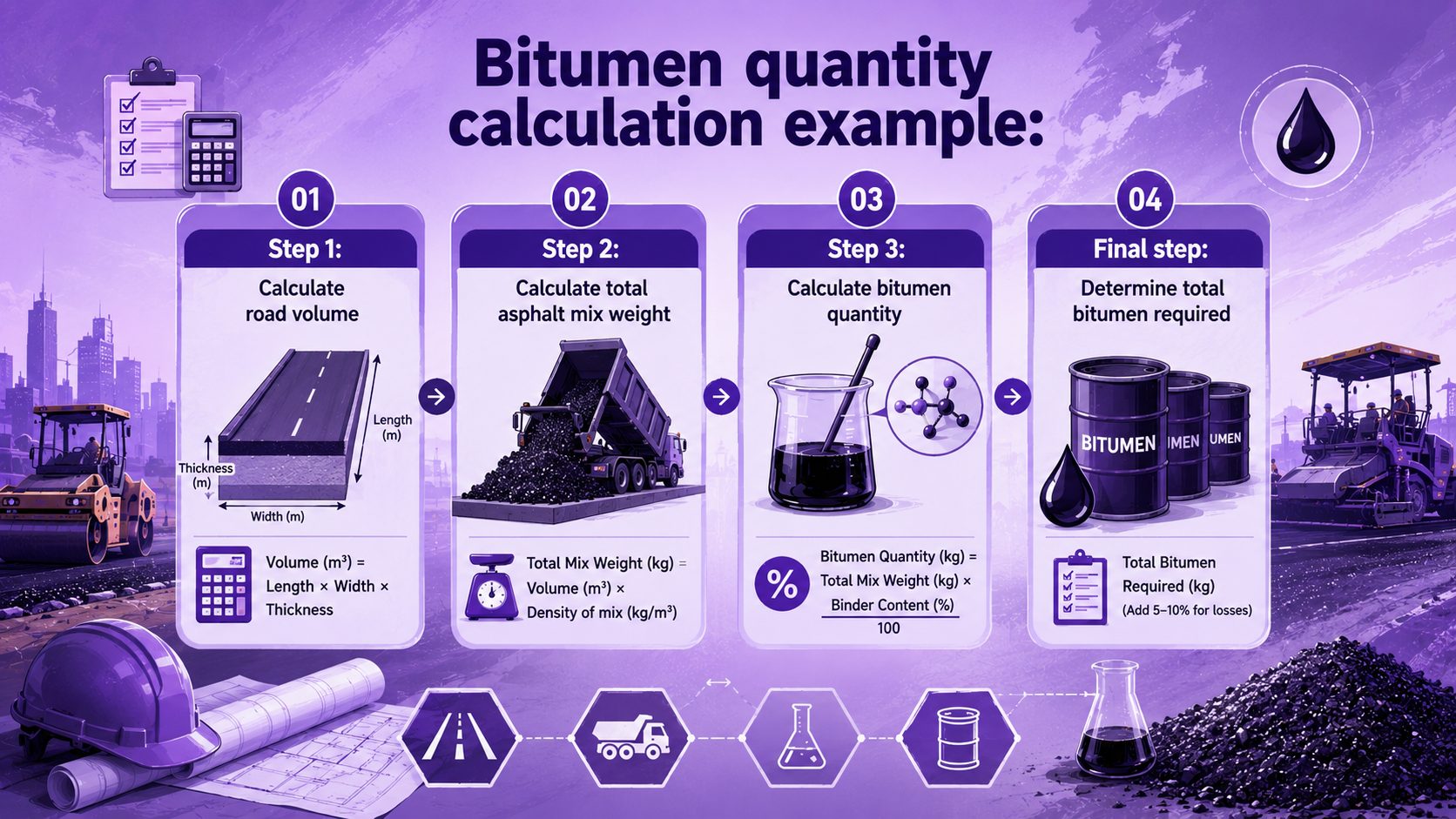
The following example shows how to calculate bitumen quantity for road construction using a simple estimation method. The values are for illustration only. Actual quantities depend on the approved Job Mix Formula (JMF) and project specifications.
Project details
| Parameter | Value |
|---|---|
| Road length | 1,000 m |
| Road width | 7.5 m |
| Bituminous Concrete (BC) thickness | 40 mm (0.04 m) |
| Asphalt mix density | 2.35 t/m³ |
| Binder content | 5.4% |
Step 1: Calculate road volume
Formula
Volume = Length × Width × Thickness
Calculation
= 1,000 × 7.5 × 0.04
= 300 m³
Step 2: Calculate total asphalt mix weight
Formula
Mix Weight = Volume × Density
Calculation
= 300 × 2.35
= 705 tonnes
Step 3: Calculate bitumen quantity
Formula
Bitumen Quantity = Mix Weight × Binder Percentage
Calculation
= 705 × 5.4%
= 705 × 0.054
= 38.07 tonnes
Final estimate
| Result | Quantity |
|---|---|
| Road volume | 300 m³ |
| Total asphalt mix required | 705 tonnes |
| Approximate bitumen required | 38.1 tonnes |
This example provides a reliable estimate for planning bitumen road construction and preparing procurement schedules. Before placing material orders, project engineers should compare the calculated quantity with the approved Job Mix Formula (JMF), BOQ, and MoRTH project specifications. They may also adjust the estimate to account for approved mix properties, construction tolerances and project-specific requirements. This final verification helps ensure accurate procurement and smoother project execution.
Typical bitumen consumption for different road layers
Bitumen consumption varies across pavement layers because each layer serves a different purpose. Some layers improve adhesion between surfaces, while others provide structural strength or a smooth riding surface. Understanding these differences helps contractors estimate material requirements more accurately during bitumen road construction and procurement planning.
| Road layer | Typical binder content/ Application rate | Common bitumen grade (India) |
|---|---|---|
| Prime coat | 0.7–1.0 kg/m² (spray application) | SS-1 Bitumen Emulsion / VG 10* |
| Tack coat | 0.20–0.30 kg/m² (spray application) | RS-1 Bitumen Emulsion / VG 10* |
| Bituminous Macadam (BM) | 3.0–3.5% by weight of mix | VG 30 |
| Dense Bituminous Macadam (DBM) | 4.0–4.5% by weight of mix | VG 30 |
| Bituminous Concrete (BC) | 5.0–6.0% by weight of mix | VG 30 (VG 40 for heavy traffic where specified) |
*Bitumen emulsions are commonly preferred for prime and tack coats in modern Indian road projects.
How bitumen consumption changes by layer
Base layers (BM): These layers provide structural support. They generally require a lower binder content because they contain coarser aggregates.
Binder course (DBM): This intermediate layer distributes traffic loads and creates a strong foundation for the surface layer. Binder content is usually higher than BM to improve durability.
Wearing course (BC): This is the top layer exposed to traffic and weather. It normally contains the highest binder content to provide better flexibility, durability, and resistance to water damage.
These values are widely used for preliminary estimation in Indian bitumen road construction projects. However, they should not replace project-specific requirements. The final bitumen requirement must always be based on the approved Job Mix Formula (JMF) and comply with the latest MoRTH specifications and contract documents.
Factors that affect bitumen quantity requirements

Several engineering and site conditions influence the final bitumen requirement for a project. Even when road dimensions remain the same, these factors can change the amount of binder specified in the approved mix design. Understanding them helps contractors make better procurement decisions and improves the performance of bitumen road construction projects.
Aggregate gradation: Well-graded aggregates generally require less binder than gap-graded or open-graded mixes.
Air voids: The target air void content affects the amount of bitumen needed to achieve the required pavement performance.
Mix design: The approved Job Mix Formula (JMF) determines the optimum binder content for each asphalt mix.
Traffic loading: Roads carrying heavy commercial vehicles often require mixes with higher performance and suitable binder content.
Climate: High temperatures, heavy rainfall, and cold regions influence the selection and quantity of bitumen.
Pavement thickness: Thicker bituminous layers require more asphalt mix and, therefore, a higher quantity of bitumen.
Surface condition: Existing pavement condition affects the quantity required for applications such as prime and tack coats.
Modified bitumen: PMB or CRMB may be specified instead of conventional VG bitumen for improved performance under demanding conditions.
Compaction: Proper compaction ensures the pavement achieves the intended density and performs as designed without unnecessary material use.
Considering these factors during planning helps engineers optimise material consumption while meeting performance, durability, and project specifications.
Common mistakes when estimating bitumen quantity
Small estimation errors can lead to procurement issues, project delays, and unnecessary costs. Before ordering materials for bitumen road construction, review the checklist below to improve quantity accuracy and streamline procurement.
| Common mistake | Impact on the project | Best practice |
|---|---|---|
| Ignoring material wastage | May result in bitumen shortages during paving. | Include a reasonable contingency as per project requirements and site conditions. |
| Using the wrong asphalt mix density | Produces incorrect asphalt weight and bitumen requirement. | Use the density specified in the approved Job Mix Formula (JMF). |
| Using average binder content | Can overestimate or underestimate the bitumen quantity. | Always use the binder percentage approved for the specific mix. |
| Using incorrect layer thickness | Leads to inaccurate volume and material calculations. | Verify the compacted thickness from approved drawings and BOQ. |
| Forgetting prime coat or tack coat | Results in incomplete procurement and additional material orders later. | Estimate each pavement layer separately, including surface treatments. |
| Not checking the approved JMF | Material estimates may not match project specifications. | Base all calculations on the latest approved Job Mix Formula. |
| Ignoring IRC and MoRTH specifications | May create compliance issues during execution. | Confirm that calculations follow the latest project specifications and standards. |
| Not verifying BOQ quantities | Differences between estimates and tender quantities can affect procurement. | Cross-check calculations with the BOQ and DPR before placing orders. |
| Poor coordination with the asphalt plant | Can disrupt production and paving schedules. | Confirm mix availability and production capacity before procurement. |
| Ignoring delivery schedules | Delayed deliveries may interrupt construction activities. | Plan procurement according to the project timeline and paving sequence. |
| Buying without supplier verification | Inconsistent material quality can affect pavement performance. | Source bitumen from reliable suppliers with consistent supply capability. |
| Skipping batch-wise quality checks | Defective material may reach the project site. | Verify quality certificates and test reports for every supplied batch before acceptance. |
Conclusion
Knowing how to calculate bitumen quantity for road construction helps contractors make informed decisions before work begins. A structured estimation process improves material planning, supports accurate procurement, and reduces the risk of costly delays. While standard formulas provide a reliable starting point, the final quantity should always be confirmed using the approved Job Mix Formula (JMF), project BOQ, and applicable MoRTH specifications.
Taking this practical approach enables EPC contractors, highway developers and procurement teams to execute bitumen road construction projects more efficiently while maintaining quality, cost control, and delivery timelines.
Looking to procure steel?
Tata nexarc helps manufacturers, builders and MSMEs source certified steel products, compare prices, and choose the right grade as per IS codes—with complete traceability and procurement confidence.
FAQs
How do you calculate bitumen quantity for road construction?
What is the standard formula for bitumen quantity calculation?
How much bitumen is required for a 1 km road?
What is the density of bitumen used in calculations?
Does bitumen quantity vary with road thickness?
What binder percentage is used in asphalt mix?
Why is the Job Mix Formula (JMF) important for estimating bitumen?
How do prime coat and tack coat affect total bitumen requirement?
Which bitumen grade is commonly used for highway construction in India?
What are the most common errors in bitumen quantity estimation?
A product manager with a writer's heart, Anirban leverages his 6 years of experience to empower MSMEs in the business and technology sectors. His time at Tata nexarc honed his skills in crafting informative content tailored to MSME needs. Whether wielding words for business or developing innovative products for both Tata Nexarc and MSMEs, his passion for clear communication and a deep understanding of their challenges shine through.