Check Price Now
Table of Contents
Cutback bitumen is a specialised road construction binder used when heating conventional bitumen is impractical, costly, or unsuitable for site conditions. It is produced by blending bitumen with volatile petroleum solvents, making it easier to apply and work with at lower temperatures. Contractors commonly use it for maintenance works, surface treatments, and cold mix applications where quick handling is important.
Although bitumen emulsions have become more common, cutback bitumen remains a practical choice for specific projects because of its ease of application and reliable performance in suitable conditions.
What is cutback bitumen?
Cutback bitumen is a type of road construction binder made by blending paving-grade bitumen with volatile petroleum solvents. These solvents temporarily reduce the binder’s viscosity, allowing it to flow more easily without requiring high heating temperatures. This makes handling, spraying, and mixing simpler, particularly on projects where heating equipment is unavailable or impractical.
After the material is applied, the petroleum solvent gradually evaporates into the atmosphere. As the solvent leaves the mix, the binder regains its original properties and forms a durable, water-resistant layer that bonds with the aggregate. In simple terms, the binder is fluid during application but returns to a stronger, more stable state after curing.
Cutback bitumen was developed to overcome the challenges of applying conventional hot bitumen in colder weather, remote locations, and maintenance projects where heating facilities may not be readily available. Today, it continues to support a range of pavement construction activities despite the increasing use of bitumen emulsions.
Where is cutback bitumen commonly used?
It is widely used by:
- Road construction companies
- Highway and EPC contractors
- Municipal road authorities
- Airport infrastructure contractors
- State PWD departments
- Industrial and mining projects
- Rural road development agencies
It is particularly useful for maintenance works, low-volume roads, remote construction sites, and projects where transporting or operating hot bitumen equipment is difficult.
| Common Term | Meaning |
|---|---|
| Cutback asphalt | Alternative name commonly used in international markets |
| Liquid bitumen | Refers to bitumen with reduced viscosity for easier application |
| Solvent-cut bitumen | Highlights that petroleum solvents are used to thin the bitumen |

How cutback bitumen works
The performance of cutback bitumen depends on a simple principle. Manufacturers blend paving-grade bitumen with volatile petroleum solvents to temporarily reduce its viscosity. The thinner consistency allows the binder to flow easily, making spraying, coating, and mixing with aggregates much easier than conventional hot bitumen. This reduces the need for excessive heating during application and improves workability on site.
Once the material is applied, the solvent begins to evaporate. As it evaporates, the bitumen gradually returns to its original consistency. The cured binder firmly adheres to the aggregate, creating a durable and water-resistant layer that helps protect the pavement from moisture infiltration and everyday traffic loads. The curing speed depends on the type of solvent used, which is why different grades of cutback bitumen are selected for different construction requirements.
How cutback bitumen works: Step by step
- Paving-grade bitumen is blended with volatile petroleum solvents.
- The mixture is applied without excessive heating.
- The solvent gradually evaporates after application.
- The bitumen regains its original consistency and hardens.
- A strong bond develops between the binder and the aggregates, forming a waterproof pavement layer.
Types of cutback bitumen
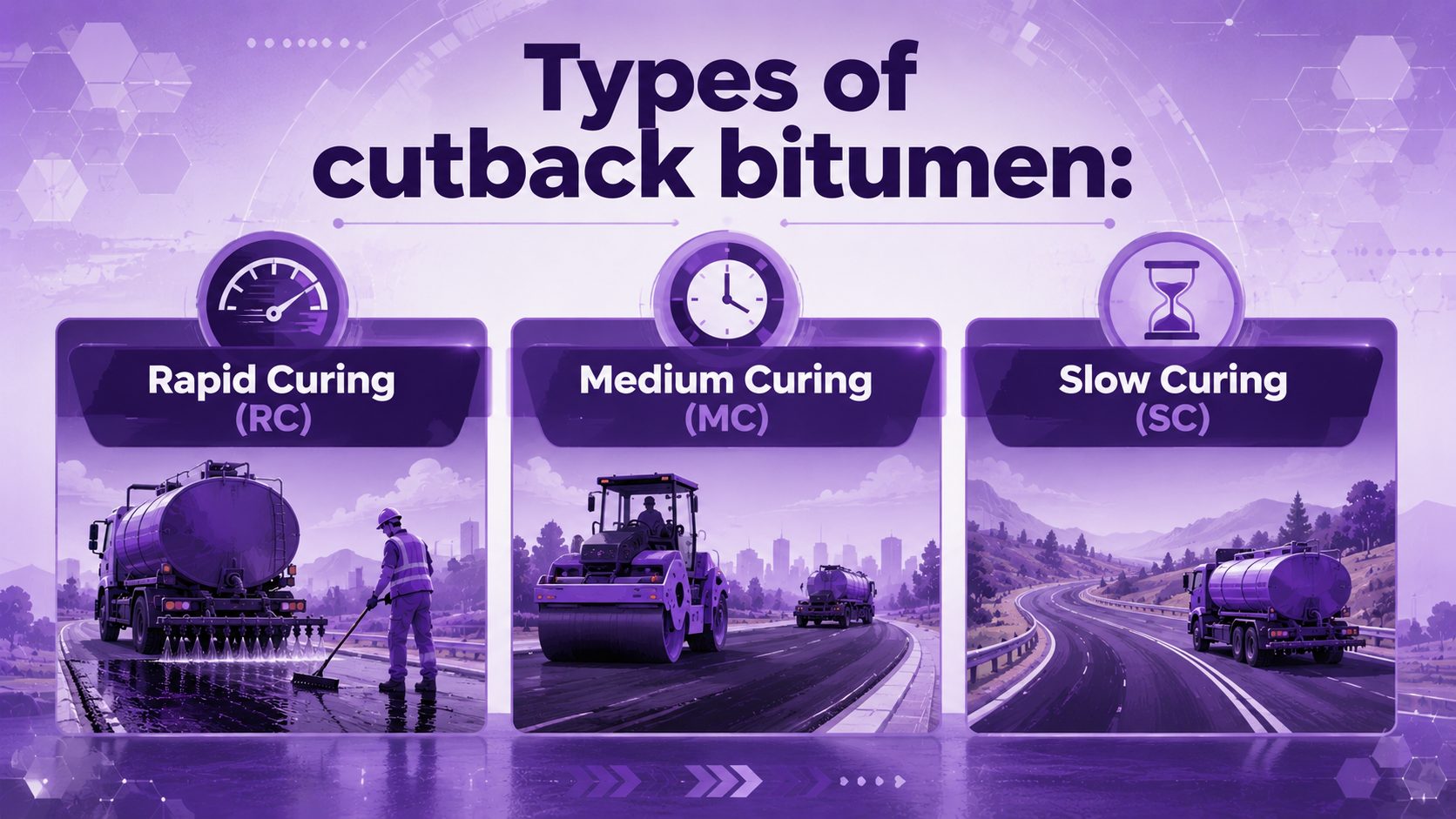
Cutback bitumen is classified according to how quickly the petroleum solvent evaporates after application. The curing speed directly affects when the pavement can be opened to traffic and the type of work the binder is best suited for. Selecting the right grade helps contractors achieve better application quality and project efficiency.
Rapid Curing (RC)
Rapid Curing (RC) cutback bitumen contains highly volatile petroleum solvents that evaporate quickly after application. This fast curing action makes it suitable for projects that require short construction windows and minimal traffic disruption. It is commonly used for surface dressing, spray applications, and patch repairs where quick setting is important.
Medium Curing (MC)
Medium Curing (MC) cutback bitumen uses solvents with a moderate evaporation rate, providing more time for the binder to mix and coat aggregates evenly. It is widely used in premix works, cold mix production, and routine road maintenance. The balanced curing rate makes it suitable for applications that require good workability before the binder sets.
Slow Curing (SC)
Slow Curing (SC) cutback bitumen contains the least volatile solvents and therefore cures more slowly than RC and MC grades. The extended curing time allows the binder to penetrate porous surfaces effectively before hardening. It is commonly used for prime coats, penetration applications, and low-traffic roads where deeper penetration into the base layer is required.
| Type | Solvent | Curing speed | Typical uses |
|---|---|---|---|
| Rapid Curing (RC) | Highly volatile | Fast | Surface dressing, spray applications, patch repairs. |
| Medium Curing (MC) | Moderate volatility | Medium | Cold mix production, premix works, road maintenance. |
| Slow Curing (SC) | Less volatile | Slow | Prime coats, penetration applications, low-traffic roads. |
Common applications of cutback bitumen
Cutback bitumen is mainly used in road maintenance and specialised pavement construction where easy application is important. The exact application depends on the project requirements, pavement condition, and construction method.
Prime coats
Cutback bitumen is widely used as a prime coat on prepared granular base layers. It penetrates the surface and creates a bond between the base course and the first asphalt layer.
Tack coats
In some projects, cutback bitumen is used as a tack coat to improve adhesion between existing and new bituminous layers. However, bitumen emulsions are more commonly preferred for this application today.
Surface dressing
It is used in surface dressing to bind aggregates to the road surface, helping restore skid resistance and extend pavement life on low- and medium-volume roads.
Cold mix production
Cutback bitumen serves as a binder in cold mix asphalt, allowing aggregates to be mixed without high-temperature heating. This method is commonly used for maintenance and small-scale paving works.
Road patching and shoulder repairs
Maintenance teams use cutback bitumen for pothole repairs, edge repairs, and shoulder restoration to keep roads safe and serviceable until permanent repairs are carried out.
Rural and remote road construction
Projects in rural areas and remote locations often use cutback bitumen where access to hot-mix plants or heating equipment is limited.
Airport and emergency maintenance
Airport operators and road authorities use cutback bitumen for localised maintenance, temporary road restoration, and emergency repairs that require quick site mobilisation. It is also suitable for maintenance works during colder weather when conventional hot bitumen is more difficult to handle.
Industries using cutback bitumen
- Highway construction
- Municipal infrastructure
- Mining roads
- Industrial roads
- Airport infrastructure
- Defence infrastructure
- Rural development projects
Advantages and limitations of cutback bitumen
The suitability of cutback bitumen depends on the project environment, construction method, and regulatory requirements. The table below summarises its key advantages and limitations.
| Aspect | Advantages | Limitations |
|---|---|---|
| Application | Easy to apply without extensive heating equipment. Suitable for spraying and mixing on site. | Requires careful handling because it contains flammable petroleum solvents. |
| Heating requirement | Requires significantly less heating than conventional paving bitumen, reducing on-site heating requirements. | Solvent content increases manufacturing and handling costs compared to standard paving bitumen. |
| Aggregate bonding | Penetrates and coats aggregates effectively, especially in prime coat and cold mix applications. | Some grades require longer curing times before the pavement reaches full performance. |
| Weather conditions | Can be applied more easily during cooler weather than hot bitumen. | Low temperatures may still slow solvent evaporation and extend curing time. |
| Construction speed | Supports quicker maintenance and repair activities with minimal site preparation. | Traffic may need to be restricted until the solvent has completely evaporated. |
| Workability | Lower viscosity improves spraying, coating, and handling during construction. | Improper storage can affect product quality and increase safety risks. |
| Project location | Well suited for remote sites where hot-mix plants or heating facilities are unavailable. | Transport and storage require additional precautions because of the solvent content. |
| Maintenance works | Commonly used for patch repairs, prime coats, shoulder repairs, and temporary road restoration. | Its use is gradually declining as alternative binders become more widely available. |
| Environmental impact | — | Releases volatile organic compounds (VOCs) during curing, leading to stricter environmental regulations in many regions. |
Today, many highway agencies and infrastructure authorities prefer bitumen emulsions wherever project conditions allow. Emulsions contain water instead of petroleum solvents, produce lower VOC emissions, and offer a safer and more environmentally responsible alternative for many modern road construction and maintenance applications.
Cutback bitumen vs concrete
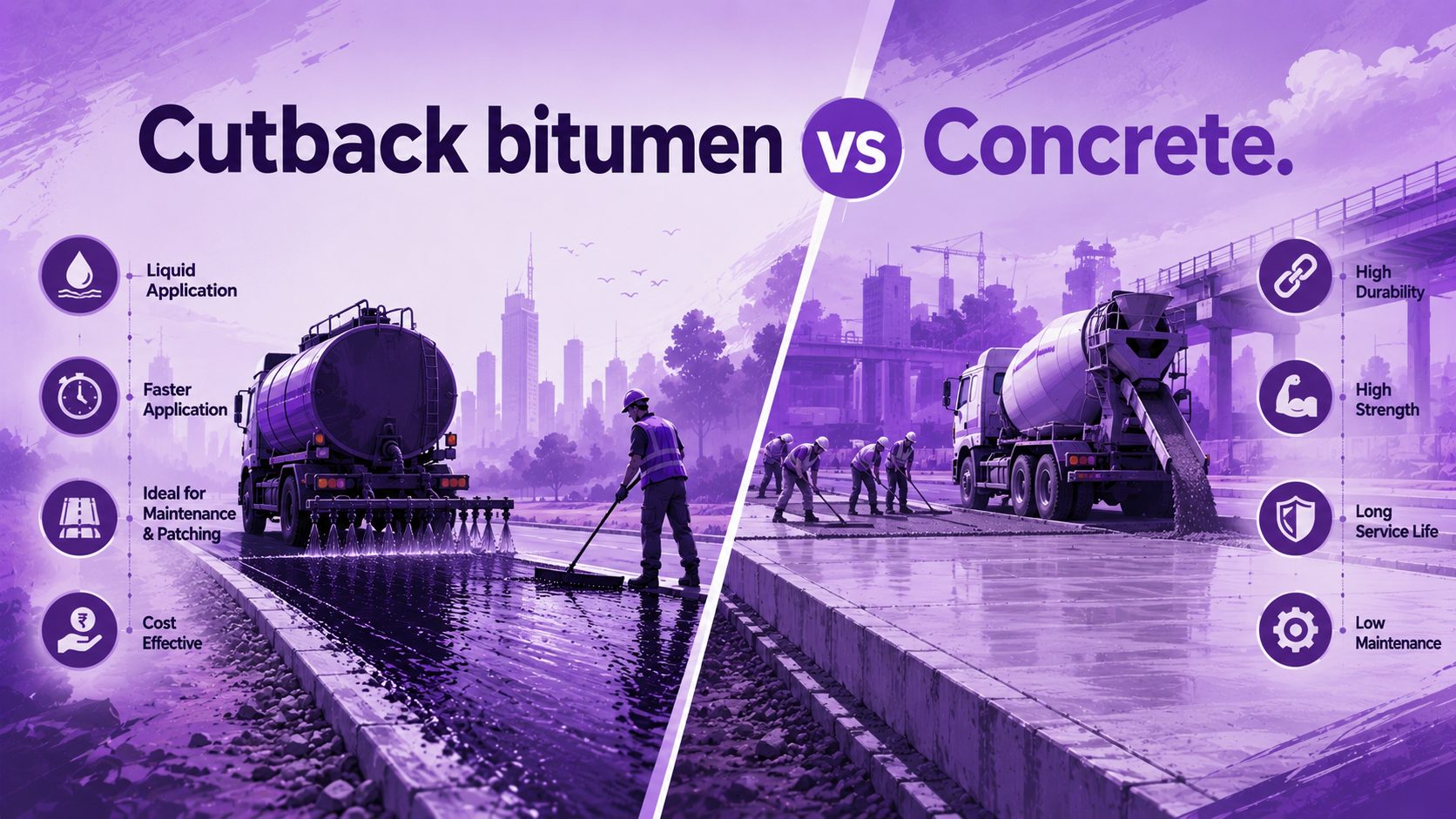
Road authorities, EPC contractors, and project consultants often compare bituminous pavements and concrete pavements during the planning stage. The choice depends on project objectives, traffic conditions, budget, maintenance expectations, and lifecycle requirements rather than one material being universally better. Understanding the differences helps procurement teams and engineers select the most suitable pavement solution for each project.
| Parameter | Cutback bitumen pavement | Concrete pavement |
|---|---|---|
| Construction speed | Faster | Slower |
| Initial cost | Lower | Higher |
| Flexibility | High | Low |
| Maintenance | Easier | More difficult |
| Repair time | Short | Longer |
| Heavy traffic life | Moderate | High |
| Noise | Lower | Higher |
| Weather adaptability | Good | Good (design dependent) |
| Recycling | Easier | More complex |
Factors to consider when choosing between cutback bitumen and concrete
Project budget: Bituminous pavements usually have lower initial costs, while concrete pavements require a higher upfront investment.
Lifecycle cost: Compare long-term maintenance, rehabilitation, and expected service life instead of initial cost alone.
Construction timeline: Flexible pavements can generally be completed and opened to traffic faster than concrete pavements.
Traffic loading: Roads with continuous heavy axle loads may benefit from concrete pavements, while flexible pavements suit a wide range of highway and urban applications.
Climate conditions: Local weather influences pavement performance and should be considered during material selection.
Maintenance strategy: Flexible pavements allow quicker and less disruptive repairs, whereas concrete pavements typically require less frequent but more extensive maintenance.
Urban vs highway applications: Material selection depends on traffic volume, road function, and expected operational requirements.
Project specifications: Always choose the pavement type that aligns with engineering design, tender requirements, and long-term performance objectives.
Factors to consider before choosing cutback bitumen
Selecting cutback bitumen should be based on project requirements, engineering specifications, and procurement considerations rather than convenience alone. The following factors help determine whether it is the right binder for a road construction or maintenance project.
| Factor | What to consider |
|---|---|
| Project location | Assess whether the site has access to hot-mix plants, heating equipment, and material supply. |
| Ambient temperature | Consider local weather conditions, as temperature influences application and curing. |
| Environmental regulations | Verify whether local regulations permit the use of solvent-based binders due to VOC emissions. |
| Availability of bitumen emulsions | Compare cutback bitumen with emulsions to determine the most suitable and compliant option. |
| Required curing time | Choose a grade that aligns with the project’s construction and commissioning schedule. |
| Traffic opening schedule | Ensure the pavement can be opened within the required timeframe after curing. |
| Aggregate characteristics | Evaluate aggregate type, cleanliness, and compatibility with the selected binder. |
| Equipment availability | Confirm that the required spraying, mixing, and application equipment is available on site. |
| Project specifications | Follow the technical requirements specified in the DPR, contract documents, and pavement design. |
| Government standards | Ensure compliance with applicable standards and guidelines issued by relevant authorities. |
| Tender requirements | Select materials that meet client specifications and tender eligibility criteria. |
| Project budget | Compare material, transportation, application, and lifecycle costs before procurement. |
| Contractor capability | Consider the contractor’s experience, available resources, and ability to apply the material correctly. |
A thorough technical and commercial evaluation will help contractors, consultants, and procurement teams select the most appropriate binder while meeting project specifications, compliance requirements, and long-term performance objectives.
Conclusion
Cutback bitumen continues to play an important role in road construction and maintenance, where low-temperature application and practical site execution are priorities. Choosing between Rapid Curing, Medium Curing, and Slow Curing grades depends on the project’s construction method and operational requirements. When comparing flexible and rigid pavements, no single material suits every project.
Contractors and engineers should evaluate technical specifications, environmental compliance, construction schedules, and expected lifecycle performance to select the most appropriate pavement solution instead of focusing on initial cost alone.
Looking to procure steel?
Tata nexarc helps manufacturers, builders and MSMEs source certified steel products, compare prices, and choose the right grade as per IS codes—with complete traceability and procurement confidence.
FAQs
What is cutback bitumen?
Why is solvent added to bitumen?
What are the three types of cutback bitumen?
Is cutback bitumen still used today?
What is the difference between cutback bitumen and bitumen emulsion?
Can cutback bitumen be used in rainy conditions?
Is cutback bitumen suitable for highways?
What is the curing time for cutback bitumen?
Which industries commonly use cutback bitumen?
How do I choose the right cutback bitumen grade?
A product manager with a writer's heart, Anirban leverages his 6 years of experience to empower MSMEs in the business and technology sectors. His time at Tata nexarc honed his skills in crafting informative content tailored to MSME needs. Whether wielding words for business or developing innovative products for both Tata Nexarc and MSMEs, his passion for clear communication and a deep understanding of their challenges shine through.