Check Price Now
Table of Contents
- What are MoRTH Specifications for Crash Barriers?
- Key Codes and Standards
- Types of Crash Barriers Covered Under MoRTH Specifications
- Material Specifications for Steel Crash Barriers
- Requirements for Crash Barrier Design and Dimensions
- Installation Guidelines as per MoRTH Specifications
- Crash Barrier Testing and Performance Requirements
- Quality Inspection and Compliance Checklist for Project Teams
- Tender, Procurement, and Vendor Selection Considerations
- Common Reasons Crash Barriers Fail MoRTH Compliance
- Conclusion
- FAQs
India continues to invest heavily in highways, expressways, bridges, and other road infrastructure projects. As traffic volumes increase, road safety has become a major priority for government agencies, contractors, and infrastructure developers. Crash barriers play a critical role in reducing accident severity by preventing vehicles from leaving the roadway or crossing into opposing traffic lanes. Understanding MoRTH specifications for crash barriers is essential for EPC contractors, highway consultants, NHAI vendors, procurement teams, and manufacturers involved in road projects.
These specifications define the requirements for design, materials, testing, installation, and quality control. Compliance with MoRTH requirements also affects project approvals, quality inspections, contractor performance, and eligibility for government tenders. Following the prescribed standards helps deliver safer, more durable, and compliant highway infrastructure.
What are MoRTH specifications for crash barriers?
The Ministry of Road Transport and Highways (MoRTH) establishes the standards and technical requirements used in road and highway construction projects across India. These standards help create consistency in the design, installation, testing, and maintenance of critical road safety infrastructure, including crash barriers.
MoRTH specifications for crash barriers are designed to improve vehicle containment and reduce the severity of road accidents. They ensure that barriers can perform effectively under impact conditions while maintaining durability in different operating environments. By following these road infrastructure standards, project stakeholders can improve safety outcomes and meet regulatory requirements.
Why MoRTH compliance matters
Crash barrier compliance is a key requirement in many government-funded and private infrastructure projects. EPC contractors, consultants, and suppliers must ensure that materials, installation practices, and testing records align with MoRTH standards.
Compliance is important because it can influence:
| Area | Why it matters |
|---|---|
| Tender approvals | Helps meet project qualification requirements |
| NHAI projects | Supports adherence to project specifications |
| Contractor accountability | Reduces quality and compliance risks |
| Quality inspections | Simplifies audits and site verification |
| Asset performance | Improves durability and service life |
Failure to meet highway safety regulations can result in project delays, corrective work, financial penalties, or rejection during inspections.

Projects where MoRTH specifications apply
MoRTH requirements apply to a wide range of road and transportation infrastructure projects. These specifications are commonly used for national highways, expressways, bridges, flyovers, urban road corridors, and access-controlled roads. They are also important in hill roads, sharp curves, embankments, and median protection zones where the risk of vehicle run-off or cross-median accidents is higher.
For project owners, contractors, and procurement teams, understanding where and how these standards apply is essential for delivering safe, compliant, and long-lasting road infrastructure.
Key codes and standards referenced in MoRTH specifications
MoRTH specifications for crash barriers do not operate in isolation. They work alongside several national and international standards that guide the design, testing, installation, and maintenance of highway safety systems. Understanding these standards helps contractors, consultants, manufacturers, and procurement teams select compliant crash barrier systems for infrastructure projects.
IRC standards used alongside MoRTH
The Indian Roads Congress (IRC) publishes technical guidelines that support the implementation of highway safety standards in India. While MoRTH specifications define construction and execution requirements, IRC documents provide guidance on barrier selection, placement, design considerations, and safety performance.
Some IRC crash barrier guidelines are commonly referenced during the planning and design stages of highway projects. These guidelines help engineers determine where barriers should be installed and what level of protection is required based on road geometry, traffic volume, and site conditions.
International standards considered
Modern crash barrier systems are often evaluated using internationally recognised testing standards. These include:
- EN 1317 for crash testing and performance classification
- MASH (Manual for Assessing Safety Hardware) for evaluating roadside safety hardware performance
- AASHTO guidelines for highway safety design considerations where applicable
- Relevant Indian Standards (IS) for material quality and manufacturing requirements
These standards help verify that crash barriers can safely contain or redirect vehicles during impact.
How standards work together
Each standard serves a specific purpose within the project lifecycle:
| Standard | Purpose |
|---|---|
| MoRTH specifications | Construction requirements |
| IRC guidelines | Design and application |
| EN 1317 | Crash testing |
| MASH | Performance evaluation |
| IS standards | Material quality |
Together, these standards create a framework for:
- Designing suitable crash barrier systems
- Testing safety performance under impact conditions
- Ensuring proper installation practices
- Maintaining long-term functionality and durability
Following the relevant highway safety standards India uses today helps project teams improve compliance, enhance road safety, and meet client and regulatory expectations.
Types of crash barriers covered under MoRTH specifications
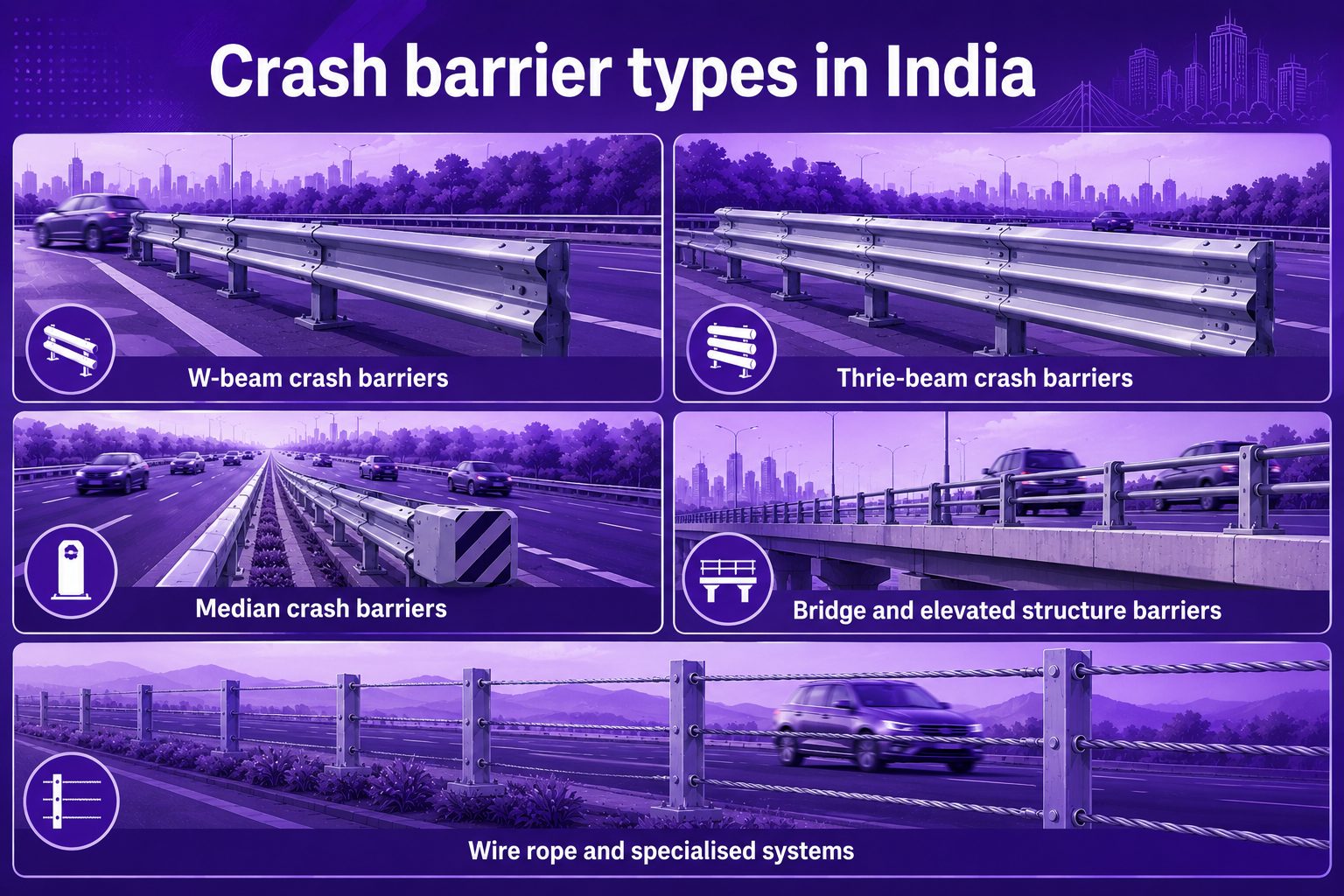
MoRTH specifications cover several types of crash barrier systems used across highways, expressways, bridges, and other road infrastructure projects. The choice of barriers depends on factors such as traffic speed, road geometry, accident risk, and site conditions.
W-beam crash barriers
The W-beam crash barrier is the most widely used roadside safety system on Indian highways. Its corrugated steel profile helps absorb impact energy and redirect vehicles back towards the roadway. W-beam barriers are commonly installed along embankments, road edges, curves, and other locations where vehicle run-off accidents may occur.
Thrie-beam crash barriers
A thrie beam crash barrier features a stronger three-wave profile that offers higher containment capability than a standard W-beam system. These barriers are often used in locations exposed to greater impact forces, including bridges, high-speed corridors, and sections with a higher proportion of heavy commercial vehicles.
Median crash barriers
Median barriers are installed between opposing traffic lanes to prevent vehicles from crossing into oncoming traffic. They play a critical role in reducing the severity of head-on collisions on divided highways and expressways. Median protection is particularly important on high-speed road networks with heavy traffic volumes.
Bridge and elevated structure barriers
Bridge crash barriers are designed for bridges, flyovers, elevated roads, and viaducts where vehicles require additional protection from falling off the structure. These systems must meet specific strength and safety requirements because of the higher consequences associated with bridge-related accidents.
Wire rope and specialised systems
Wire rope barriers and other specialised crash barrier systems are used in selected applications where flexibility, terrain conditions, or project requirements make conventional steel barriers less suitable. Although their use is more limited, they can provide effective protection in medians, hill roads, and other strategic locations when specified by the project’s design.
Material specifications for steel crash barriers
Material quality directly affects the strength, durability, and performance of a crash barrier system. MoRTH specifications require manufacturers and suppliers to use approved materials that can withstand impact loads, environmental exposure, and long-term highway operating conditions. For EPC contractors, procurement teams, and quality inspectors, verifying material compliance is an essential part of crash barrier procurement and project execution.
Key material requirements under MoRTH specifications
| Component/requirement | Specification focus | Why it matters |
|---|---|---|
| Beam rails | Manufactured from approved structural steel with specified mechanical properties. | Ensures impact resistance and vehicle containment performance. |
| Posts | Structural steel posts with prescribed dimensions, thickness, and strength requirements. | Provides support and stability to the barrier system. |
| Spacers and blockouts | Manufactured to approved dimensions and material standards. | Maintains correct offset between the rail and post. |
| Bolts, nuts, and washers | Corrosion-resistant fasteners meeting specified quality requirements. | Ensures secure assembly and long-term reliability. |
| Reflective elements | Approved road safety reflectors installed at specified intervals. | Improves night-time visibility and driver guidance. |
| Crash barrier steel grade | Must comply with applicable structural steel requirements and project specifications. | Delivers consistent strength and performance. |
| Galvanisation | Hot-dip galvanisation with specified zinc coating thickness. | Protects against corrosion and extends service life. |
| Zinc coating quality | Uniform coating free from defects, peeling, or exposed steel surfaces. | Maintains durability in harsh weather conditions. |
| Mill Test Certificates (MTCs) | Required for steel supplied to the project | Verifies material composition and mechanical properties. |
| Inspection documentation | Manufacturing and quality inspection records. | Supports project audits and compliance verification. |
| Third-party verification | Independent testing and inspection where specified. | Provides additional assurance of product quality. |
| Material traceability | Identification and documentation of supplied components. | Simplifies quality control and future inspections. |
When evaluating steel crash barrier specifications, procurement teams should review not only the barrier components but also the supporting quality documents. Proper material certification, galvanisation records, and inspection reports help demonstrate compliance with crash barrier material requirements and reduce the risk of quality issues during project execution.
MoRTH requirements for crash barrier design and dimensions
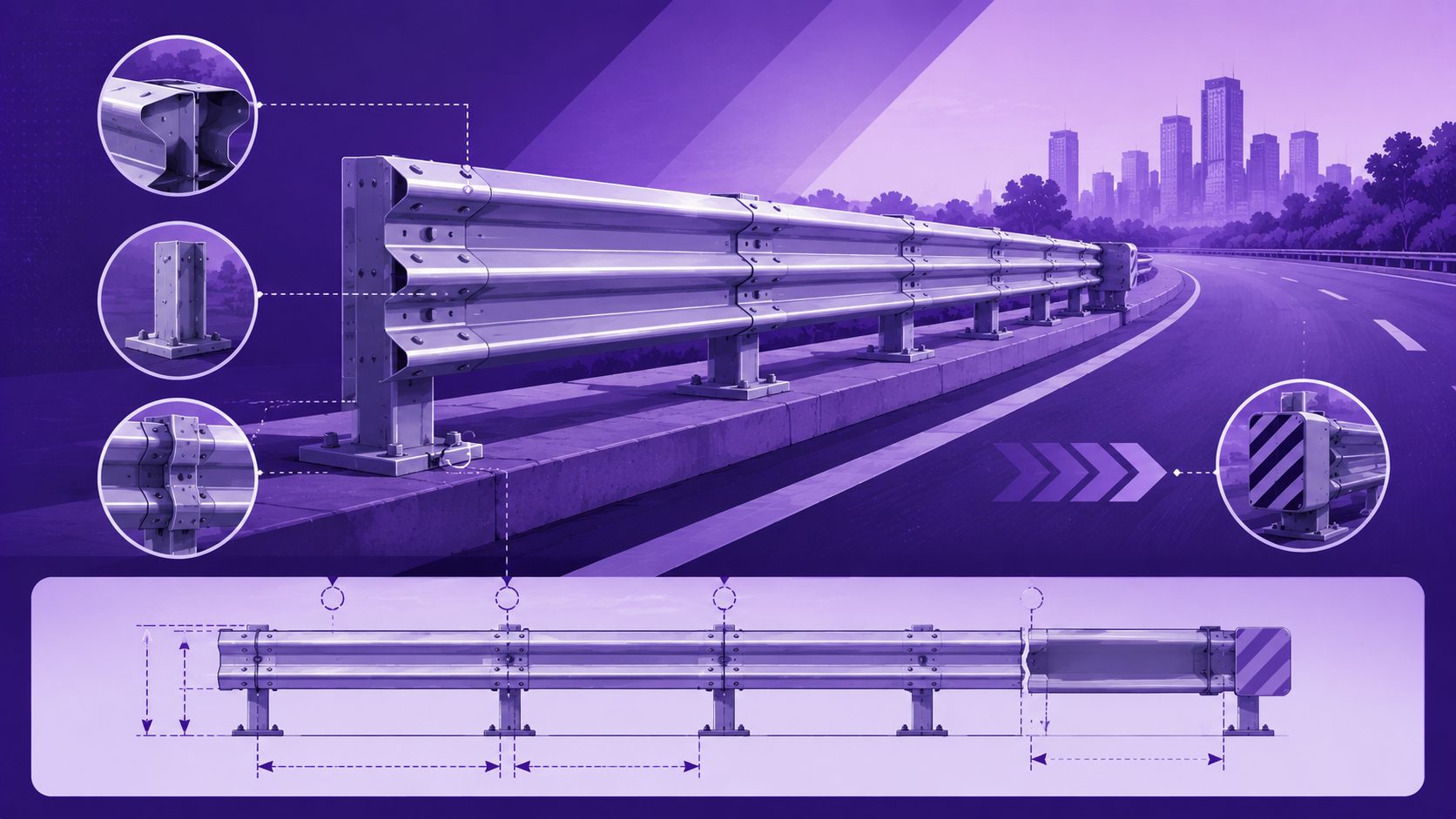
Proper design and installation are just as important as material quality when it comes to crash barrier performance. MoRTH specifications define key requirements for barrier geometry, component placement, and system continuity to ensure that barriers can safely contain and redirect vehicles during an impact.
Barrier height requirements
Barrier height is a critical factor in vehicle containment. If a crash barrier is installed too low or too high, its ability to redirect a vehicle safely may be reduced. MoRTH specifications prescribe installation requirements that help maintain consistent performance across different road and traffic conditions.
Why correct barrier height matters:
- Improves vehicle redirection capability
- Reduces the risk of vehicle override or underride
- Supports compliance during quality inspections
- Maintains tested system performance
Post spacing requirements
Post spacing influences the strength and flexibility of the crash barrier system. The spacing between posts must follow approved design requirements to ensure that impact loads are distributed effectively throughout the barrier.
| Design element | Purpose |
|---|---|
| Post spacing | Supports barrier strength and stability |
| Post alignment | Maintains uniform crash barrier layout |
| Foundation condition | Helps ensure proper load transfer |
| Consistent installation | Supports predictable barrier performance |
Incorrect post spacing can affect containment capability and may result in non-compliance during project inspections.
Beam overlap and connection details
Beam sections must be connected correctly to maintain structural continuity. The overlap direction is particularly important because it should follow the direction of traffic flow. Proper connections help prevent exposed edges and improve the barrier’s ability to guide vehicles safely during an impact.
Key considerations include:
- Correct beam overlap orientation
- Secure fastening of joints
- Proper alignment between rail sections
- Continuous barrier protection along the roadway
End treatment requirements
Crash barriers should not terminate abruptly. MoRTH specifications require suitable end treatment systems that reduce the risk of severe injuries when a vehicle strikes the end of a barrier.
Effective end treatments help:
- Absorb or dissipate impact energy
- Reduce vehicle snagging risks
- Improve roadside safety
- Enhance overall system performance
Installation guidelines as per MoRTH specifications
Even a high-quality crash barrier system can fail to perform as intended if it is installed incorrectly. MoRTH installation guidelines focus on proper site preparation, accurate assembly, correct component placement, and quality checks throughout the installation process. Contractors, site engineers, and quality teams should verify each stage before proceeding to the next.
Key installation requirements under MoRTH specifications
| Installation stage | Requirement | Purpose |
|---|---|---|
| Site survey | Verify approved drawings, road geometry, and barrier location. | Ensures installation matches project design. |
| Alignment verification | Mark barrier alignment before installation begins. | Maintains a consistent crash barrier layout. |
| Ground condition assessment | Check soil stability, embankment condition, and obstructions. | Supports safe and secure post installation. |
| Utility identification | Confirm underground utilities and services. | Prevents damage during installation. |
| Post positioning | Install posts at specified locations and spacing. | Maintains structural performance. |
| Post verticality checks | Ensure posts remain vertical and correctly aligned. | Improves system stability and appearance |
| Foundation considerations | Verify installation suitability based on site conditions. | Supports load transfer during impact. |
| Rail mounting | Fix beam rails according to approved specifications. | Creates a continuous protection system. |
| Beam overlap direction | Ensure overlaps face away from approaching traffic. | Reduces snagging risks during vehicle impact. |
| Bolt tightening | Tighten bolts and fasteners to specified requirements. | Prevents loose connections and movement. |
| Spacer installation | Install spacers and block outs correctly. | Maintains the required offset between rail and post. |
| Reflector installation | Fix reflective elements at prescribed intervals. | Improves night-time visibility. |
| Alignment inspection | Check overall barrier straightness and continuity. | Ensures effective vehicle redirection. |
| Tolerance verification | Confirm compliance with approved installation tolerances. | Supports quality and compliance requirements. |
| Final quality inspection | Verify all components before project handover. | Identifies defects before commissioning. |
Common installation mistakes to avoid
| Common issue | Potential impact |
|---|---|
| Incorrect post spacing | Reduced containment performance |
| Poor post alignment | Uneven barrier behaviour during impact |
| Improper handling of galvanised components | Damage to protective coating and increased corrosion risk |
| Incorrect beam overlap direction | Higher risk of vehicle snagging |
| Loose bolts and fasteners | Reduced structural integrity |
| Missing reflectors | Lower visibility in low-light conditions |
| Misaligned end terminals | Reduced safety performance |
| Failure to perform final inspections | Increased risk of non-compliance |
Following these crash barrier installation standards helps improve road safety, reduce rework, and support compliance with project specifications and quality inspection requirements.
Crash barrier testing and performance requirements

Crash barriers must demonstrate their ability to perform under impact conditions before they are approved for use on highway projects. Testing helps verify that the system can safely contain, redirect, or slow down vehicles while reducing the risk of severe injuries. For contractors, consultants, and procurement teams, reviewing testing records is an important part of supplier evaluation and compliance verification.
Why crash testing is required
Performance verification: Confirms that the barrier performs as intended under controlled impact conditions.
Safety validation: Demonstrates the barrier’s ability to protect road users during collisions.
Regulatory compliance: Supports adherence to project specifications and highway safety requirements.
Procurement assurance: Provides confidence that the system has undergone recognised testing procedures.
Key performance parameters
| Parameter | Description |
|---|---|
| Vehicle containment | Ability of the barrier to prevent a vehicle from breaching the system |
| Occupant risk | Assessment of potential injury levels to vehicle occupants |
| Dynamic deflection | Maximum lateral movement of the barrier during impact |
| Working width | Total space required for the barrier to perform safely during a collision |
| Vehicle redirection | Ability to guide the vehicle back towards the roadway |
| Structural integrity | Ability of the system to remain functional after impact |
Approved testing standards
EN 1317: Widely used standard for evaluating crash barrier performance and containment levels.
MASH: Used in selected projects where specific performance evaluation requirements apply.
Project-specific requirements: Additional testing criteria may be specified by project authorities or consultants.
Documentation required during procurement
Crash test reports: Evidence of successful performance testing.
Compliance certificates: Confirmation that the system meets specified requirements.
Approval records: Documentation demonstrating acceptance by relevant authorities or project stakeholders.
Material and quality certificates: Supporting records for manufacturing and component verification.
Reviewing these documents helps procurement teams assess crash barrier performance criteria and ensure compliance with recognised crash barrier testing standards before project execution begins.
Quality inspection and compliance checklist for project teams
Quality inspections help ensure that installed crash barriers meet project requirements and perform as intended. For PMC teams, consultants, and quality engineers, a structured inspection process can help identify compliance issues before project handover.
Pre-installation inspection
Before installation, verify that supplied components match approved specifications and project requirements. Inspect materials for visible damage, coating defects, or manufacturing inconsistencies that could affect performance.
During installation inspection
Monitor installation activities to ensure the barrier system follows approved drawings and site requirements. Attention should be given to installation accuracy, component placement, and workmanship quality.
Post-installation audit
Conduct a final site inspection after installation is complete. The audit should confirm that the barrier system provides continuous protection and that all safety components are installed correctly.
Documentation checklist
Maintaining complete records is an important part of any MoRTH compliance checklist.
| Inspection item | Verify |
|---|---|
| Material certificates | ✓ |
| Galvanisation quality | ✓ |
| Post spacing | ✓ |
| Barrier height | ✓ |
| End treatments | ✓ |
| Test certificates | ✓ |
A well-documented crash barrier inspection checklist supports quality control, simplifies audits, and helps project teams demonstrate compliance during inspections and project acceptance.
Tender, procurement, and vendor selection considerations

Selecting the right supplier is critical for ensuring crash barrier compliance, project quality, and long-term performance. Procurement teams should evaluate suppliers beyond pricing and verify their ability to meet project specifications and delivery requirements.
Evaluating crash barrier suppliers
Technical capability: Ability to manufacture barriers that meet project specifications.
Testing credentials: Availability of recognised crash test reports and performance records.
Production capacity: Capability to meet project timelines and volume requirements.
Quality systems: Established quality control and inspection processes.
Project experience: Track record in highway, expressway, and infrastructure projects.
Documents procurement teams should request
Test certificates: Evidence of successful performance testing.
Galvanisation reports: Verification of coating quality and corrosion protection.
Manufacturing quality records: Documentation of production and inspection processes.
Material certificates: Confirmation of steel quality and compliance.
Inspection reports: Records supporting product quality assurance.
Verifying compliance before award
Specification review: Confirm alignment with tender and project requirements.
Document verification: Validate submitted certificates and test records.
Factory assessment: Review manufacturing and quality control capabilities where required.
Sample inspection: Examine supplied components before final approval.
Common procurement risks
Non-compliant products: Materials or systems that fail to meet project specifications.
Inadequate testing: Missing or incomplete crash performance documentation.
Poor coating quality: Insufficient corrosion protection leading to reduced service life.
Incomplete documentation: Delays in approvals, inspections, or project acceptance.
Following a structured crash barrier procurement guide helps contractors and buyers identify reliable crash barrier suppliers India offers and reduce risks associated with non-compliant or poorly documented products.
Common reasons crash barriers fail MoRTH compliance
Even well-designed crash barrier systems can fail compliance checks if material, installation, or documentation requirements are not met. Identifying these issues early can help contractors avoid project delays, corrective work, and inspection failures.
Incorrect material thickness: Use of components that do not meet specified dimensions or strength requirements.
Poor galvanisation: Inadequate zinc coating or damaged protective layers that increase corrosion risk.
Improper installation: Failure to follow approved drawings, alignment requirements, or installation procedures.
Missing test reports: Absence of valid crash test documentation to demonstrate performance compliance.
Non-approved end terminals: Installation of end treatment systems that do not meet project requirements.
Inadequate quality documentation: Missing material certificates, inspection records, or compliance documents.
Component substitutions: Use of unapproved materials or alternative components without proper approval.
Poor workmanship: Installation defects that affect barrier performance and long-term durability.
Regular inspections, document verification, and supplier due diligence can help project teams identify compliance gaps before they become costly project risks.
Conclusion
Understanding MoRTH specifications is essential for every stakeholder involved in highway infrastructure projects, from planning and procurement to execution and final inspections. Compliant crash barrier systems support road safety objectives while helping projects meet approval and audit requirements. Contractors, consultants, manufacturers, and procurement teams should maintain a strong focus on compliance throughout the project lifecycle. Adhering to MoRTH and IRC requirements helps deliver safer, more durable, and audit-ready highway infrastructure that meets both performance and regulatory expectations.
Looking to procure steel?
Tata nexarc helps manufacturers, builders and MSMEs source certified steel products, compare prices, and choose the right grade as per IS codes—with complete traceability and procurement confidence.
FAQs
What are MoRTH specifications for crash barriers?
Why are MoRTH specifications important for highway projects?
Are MoRTH-compliant crash barriers mandatory for NHAI projects?
What is the most commonly used crash barrier type in India?
What is the difference between W-beam and thrie-beam crash barriers?
Why is galvanisation important for crash barriers?
What documents should buyers request from crash barrier suppliers?
Which testing standards are commonly used for crash barriers?
What are the common reasons for crash barrier non-compliance?
Who should verify crash barrier compliance on a project?
A product manager with a writer's heart, Anirban leverages his 6 years of experience to empower MSMEs in the business and technology sectors. His time at Tata nexarc honed his skills in crafting informative content tailored to MSME needs. Whether wielding words for business or developing innovative products for both Tata Nexarc and MSMEs, his passion for clear communication and a deep understanding of their challenges shine through.