Check Price Now
Table of Contents
- What are Bridge Crash Barriers?
- Why Bridge Crash Barriers are Essential
- Types of Bridge Crash Barriers Used in Infrastructure Projects
- Key Components of a Bridge Crash Barrier System
- Design Requirements
- Standards and Specifications
- Factors to Consider When Selecting Bridge Crash Barriers
- Installation Best Practices
- Maintenance and Inspection
- Conclusion
- FAQs
Bridge safety remains a critical priority as India expands its network of highways, expressways and flyovers. Bridge crash barriers help contain vehicles during collisions and reduce the risk of severe accidents on elevated structures. Their adoption continues to grow across infrastructure projects driven by stricter safety requirements and higher traffic volumes.
For EPC contractors, project engineers and infrastructure developers, choosing the right barrier system is essential. Understanding the available barrier types, applicable standards and key selection factors can support safer, more compliant and durable infrastructure projects.
What are bridge crash barriers?
Bridge crash barriers are specialised safety systems installed along the edges of bridges, flyovers and elevated road structures. They help prevent vehicles from leaving the carriageway during a collision and play a key role in improving road safety. These bridge safety barriers are designed to withstand vehicle impacts and redirect vehicles back onto the road, reducing the risk of serious accidents.
Definition and purpose
Bridge crash barriers are a type of vehicle restraint system used to contain and guide vehicles during an impact. Their primary purpose is to minimise the consequences of collisions on bridges, where the risk of vehicles falling from elevated structures is significantly higher. They form an essential part of modern bridge protection systems and highway safety infrastructure.
How they differ from roadside barriers
While roadside barriers and bridge crash barriers serve a similar safety function, bridges present unique challenges. Bridges offer limited recovery space for drivers who lose control of their vehicles. As a result, bridge barriers often require higher containment capabilities and stronger structural integration. They must also account for the design and load-bearing characteristics of the bridge itself.
Primary functions
The main function of bridge crash barriers is to prevent vehicles from overturning or leaving the bridge during an accident. They also help protect motorists, passengers, and other road users by reducing collision severity. In addition, these systems protect bridge structures from impact damage, helping infrastructure owners reduce repair costs and maintain long-term asset performance.
Why bridge crash barriers are essential for highway safety
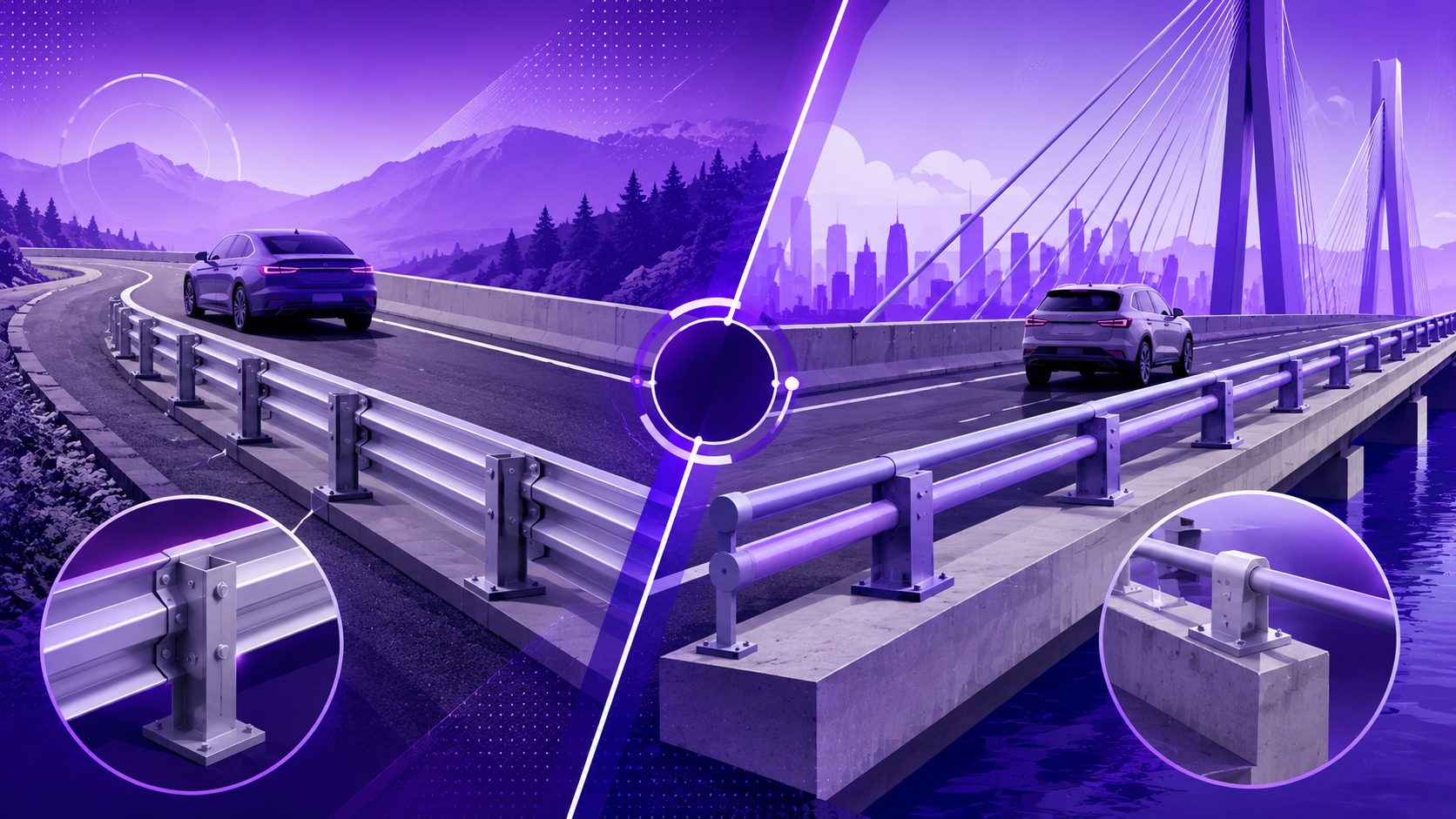
Bridge crash barriers play a vital role in maintaining highway bridge safety. Unlike standard road sections, bridges leave little room for driver error. A vehicle that loses control on an elevated structure faces a much higher risk of severe consequences. This makes bridge safety infrastructure a critical component of modern highway projects.
Unique risks associated with bridges
Several factors increase the safety challenges on bridges:
- Elevated structures with limited recovery space
- Sharp curves and bridge approaches that require careful vehicle control
- Heavy commercial vehicle movement on highways and freight corridors
- High-speed traffic that increases impact forces during collisions
These conditions make effective bridge accident prevention measures essential for protecting road users and infrastructure assets.
Safety benefits of bridge crash barriers
Bridge crash barriers provide multiple safety and operational benefits:
- Contain vehicles within the carriageway during collisions.
- Reduce the likelihood of fatalities and serious injuries.
- Protect bridge decks, parapets and supporting structures from damage.
- Improve overall traffic safety and operational reliability.
| Benefit | Impact on highway projects |
|---|---|
| Vehicle containment | Prevents vehicles from leaving the bridge |
| Reduced accident severity | Improves occupant safety during collisions |
| Infrastructure protection | Minimises damage to bridge structures |
| Better traffic safety | Supports safer movement of vehicles |
Growing importance in India’s infrastructure sector
India’s ongoing investment in highways, expressways and urban flyovers has increased the demand for reliable bridge safety infrastructure. Government agencies and project authorities now place greater emphasis on road safety measures throughout the project lifecycle. As traffic volumes continue to rise, bridge crash barriers have become an important requirement for delivering safer and more resilient transportation networks.
Types of bridge crash barriers used in infrastructure projects
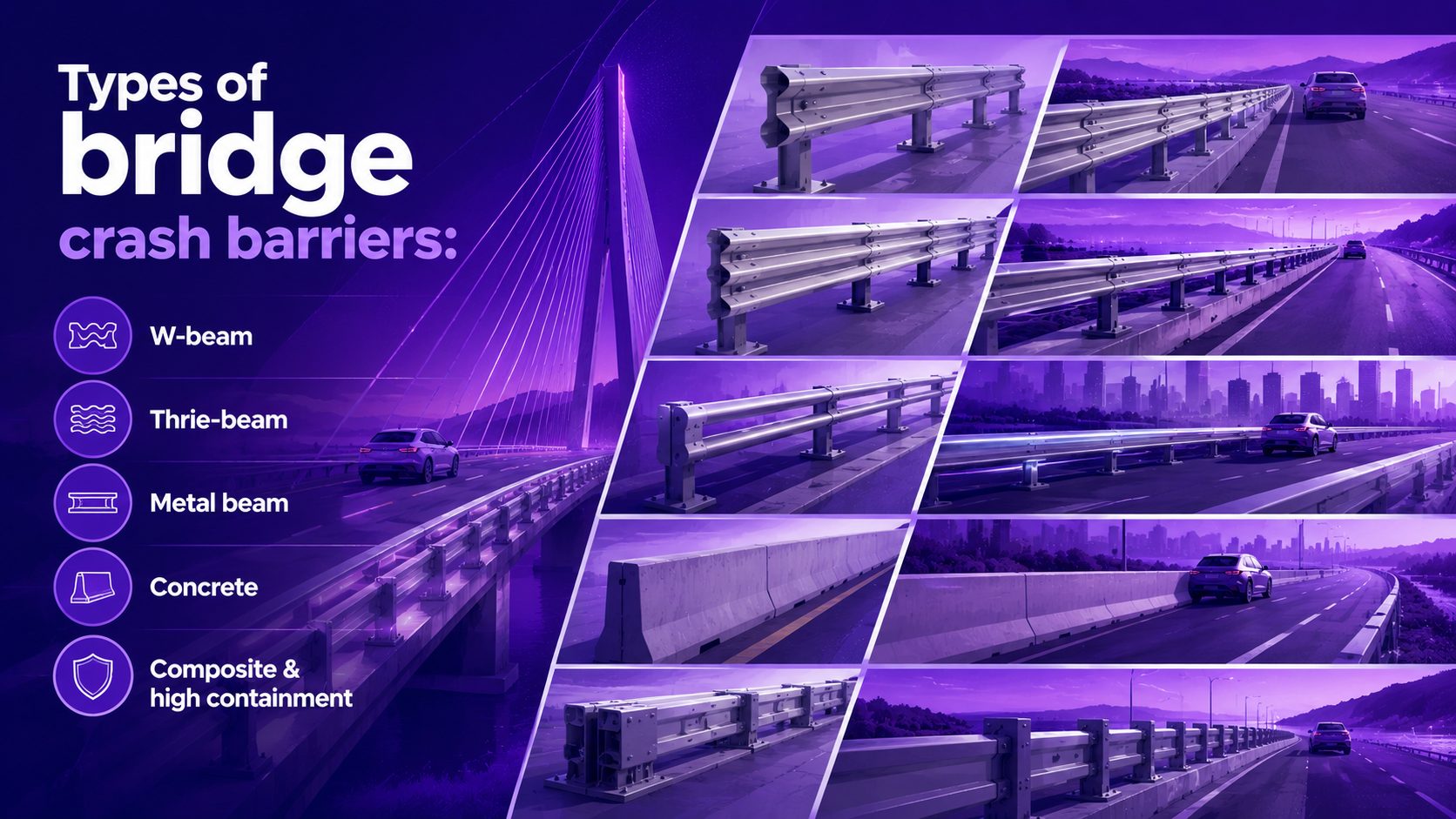
Infrastructure projects use different barrier systems depending on traffic volume, vehicle mix, bridge geometry, and safety requirements. Selecting the right solution helps improve vehicle containment, minimise accident severity, and ensure compliance with project specifications. The following are some of the most used systems on bridges, flyovers, and elevated road corridors.
W-beam bridge crash barriers
W-beam barriers feature a corrugated steel rail mounted on posts. During a collision, the system absorbs and distributes impact energy, helping redirect vehicles back towards the carriageway. These barriers are widely used on highways, bridge approaches and flyovers due to their versatility and cost-effectiveness.
Key advantages include:
- Proven safety performance
- Economical for large-scale projects
- Ease of installation and replacement
- Suitable for various traffic conditions
Thrie-beam bridge crash barriers
Thrie-beam barriers use a three-wave steel profile that offers greater rigidity than standard W-beam systems. The additional strength improves containment performance, particularly for heavier vehicles. They are commonly installed on high-speed corridors, major bridge structures and locations with significant truck movement.
Metal Beam Crash Barriers (MBCB)
Metal beam crash barriers are among the most widely specified roadside safety systems in highway projects. They are designed to safely redirect errant vehicles while reducing the severity of collisions.
Performance benefits include:
- Effective vehicle guidance during impact
- Lower risk of severe accidents
- Tested performance under controlled conditions
- Compatibility with highway safety requirements
Concrete bridge parapet barriers
Concrete parapet barriers are fixed safety structures commonly used on urban flyovers, elevated corridors, and major bridges. Their robust design provides a high level of protection while requiring relatively little maintenance.
These systems are often preferred where durability, longevity, and resistance to environmental conditions are key priorities.
Composite and high-containment barrier systems
Certain locations require higher levels of protection than standard systems can provide. In such cases, project teams may opt for composite barriers that combine steel and concrete elements.
These systems are typically used in:
- Major river crossings
- High-speed expressways
- Heavy freight corridors
- High-risk bridge sections
- Critical infrastructure projects
Their enhanced containment capability makes them suitable for locations where traffic volumes, vehicle weights, or safety risks are particularly high.
Key components of a bridge crash barrier system
A bridge barrier functions as a complete system rather than a collection of individual parts. Each component plays a specific role in absorbing impact forces, guiding vehicles, and maintaining structural stability. Understanding these crash barrier components helps project teams evaluate performance, durability, and maintenance requirements more effectively.
| Component | Function | Contribution to safety performance |
|---|---|---|
| Guardrail beam | The primary steel or concrete element that comes into contact with the vehicle during an impact. | Absorbs and distributes impact energy while helping redirect vehicles back towards the roadway. |
| Posts and support structures | Vertical members that support the barrier and transfer loads to the structure. | Provide stability and help the system withstand collision forces. |
| Spacer blocks | Components placed between the rail and posts. | Reduce wheel snagging and improve vehicle redirection during impact. |
| Fasteners and anchor assemblies | Bolts, nuts and anchoring elements that secure the system. | Ensure the barrier remains firmly connected and performs as intended under impact conditions. |
| End treatments and transition sections | Special sections installed at the beginning, end or connection points of a barrier. | Minimise impact severity and ensure smooth transitions between different safety systems. |
| Reflective road safety elements | Reflectors and visibility markers attached to the barrier. | Improve visibility during night-time driving and adverse weather conditions, supporting safer vehicle movement. |
Together, these highway safety hardware elements form an integrated safety system. Proper design, installation and maintenance of bridge guardrail systems ensure that each component works effectively to improve containment performance and reduce accident severity.
Design requirements for bridge crash barriers in India

Effective bridge crash barrier design requires more than selecting a barrier type. Engineers must consider traffic conditions, vehicle characteristics, bridge layout and environmental factors to ensure the system performs as intended. These design requirements help improve safety, durability and long-term reliability.
Containment levels
Containment level refers to a barrier’s ability to safely restrain and redirect vehicles during a collision. The required level depends on the types of vehicles using the bridge, ranging from passenger cars to heavy commercial vehicles.
Project teams must also assess the potential severity of impacts. Bridges carrying high-speed or mixed traffic often require stronger bridge containment systems to manage higher collision forces.
Impact resistance requirements
A barrier must withstand vehicle impacts without failing or allowing vehicles to leave the structure. Its design should absorb and distribute impact energy while maintaining stability. Adequate impact resistance helps reduce accident severity and improves occupant safety.
Bridge geometry considerations
The physical characteristics of a bridge directly influence barrier selection and design.
Key factors include:
- Bridge width
- Horizontal and vertical curvature
- Road alignment
- Edge and parapet configuration
These elements affect vehicle movement and determine how the barrier will perform during an impact.
Traffic and load considerations
Traffic conditions play a major role in bridge safety engineering decisions. Designers typically evaluate:
- Daily traffic volume
- Percentage of heavy commercial vehicles
- Operating and design speeds
- Future traffic growth
Bridges carrying frequent truck traffic generally require higher-performance safety systems.
Durability and service life
Barriers must remain effective throughout their service life despite exposure to weather and traffic-related wear. Corrosion protection is particularly important in coastal areas, industrial regions and locations with heavy rainfall. Materials, protective coatings, and maintenance requirements should all be considered to ensure long-term performance and minimise lifecycle costs.
Standards and specifications governing bridge crash barriers in India
Compliance with recognised standards is essential for ensuring safety, performance, and project approval. Highway authorities, consultants and contractors rely on established guidelines to determine design requirements, material quality, installation practices, and performance criteria. Understanding the key bridge crash barrier standards in India helps project teams make informed procurement and engineering decisions.
| Standard/requirement | Purpose | Key considerations |
|---|---|---|
| IRC guidelines | Provide recommendations for the design and application of road restraint systems on highways, bridges and flyovers. | Cover safety requirements, barrier selection, containment needs and integration with bridge structures. |
| MoRTH specifications | Define technical requirements for materials, fabrication, galvanisation, installation and workmanship. | Ensure consistency, quality control and compliance across highway infrastructure projects. |
| NHAI project requirements | Establish project-specific criteria for national highways and expressways. | Tender documents may specify barrier type, performance level, material standards and testing requirements. |
| Crash testing and compliance Requirements | Verify that safety systems perform as intended under controlled impact conditions. | Preference is typically given to tested and approved systems that demonstrate reliable containment and redirection performance. |
| Quality assurance and inspection | Ensure barriers meet design specifications throughout procurement and installation. | Includes material certifications, inspection records, dimensional checks and site quality audits. |
For EPC contractors, consultants and procurement teams, adherence to IRC bridge crash barrier guidelines, MoRTH crash barrier specifications and NHAI bridge safety standards is often a contractual requirement. Compliance not only supports project approvals but also helps improve long-term safety performance and asset reliability. Proper documentation, inspection and quality control processes remain equally important to ensure the installed system performs as expected throughout its service life.
Factors to consider when selecting bridge crash barriers
Choosing the right barrier system requires careful evaluation of project requirements, traffic conditions and long-term performance expectations. A solution that works well for one bridge may not be suitable for another. Considering the following factors can help project teams make informed decisions.
Type of road project
The safety requirements of a bridge often depend on the type of project. Highways, expressways, urban flyovers and major bridge structures operate under different traffic conditions and risk levels. The selected system should align with the project’s design requirements and expected vehicle movement.
Traffic volume and vehicle mix
Traffic density and vehicle composition play a major role in barrier selection. Bridges carrying a large number of heavy commercial vehicles typically require stronger containment capabilities than those used primarily by passenger vehicles. Future traffic growth should also be taken into account.
Bridge configuration
The physical characteristics of a bridge influence how a safety system performs during a collision. Factors such as bridge length, width, curvature and alignment can affect vehicle behaviour and impact severity. The barrier design should complement these structural features.
Environmental conditions
Local environmental conditions can significantly affect durability. Coastal regions may expose barriers to corrosion from salt-laden air, while high-rainfall areas and industrial zones can accelerate wear and deterioration. Material selection and protective coatings should reflect site conditions.
Maintenance requirements
Regular inspection and maintenance are essential for maintaining safety performance. Systems that are easier to inspect, repair, and replace can help reduce downtime and maintenance costs over the long term.
Lifecycle cost considerations
Cost evaluation should go beyond the initial procurement price. Installation expenses, maintenance requirements, repair frequency and expected service life all influence overall project value. Taking a lifecycle approach to crash barrier procurement can help contractors and infrastructure developers achieve better long-term returns on investment.
Installation best practices for bridge crash barriers
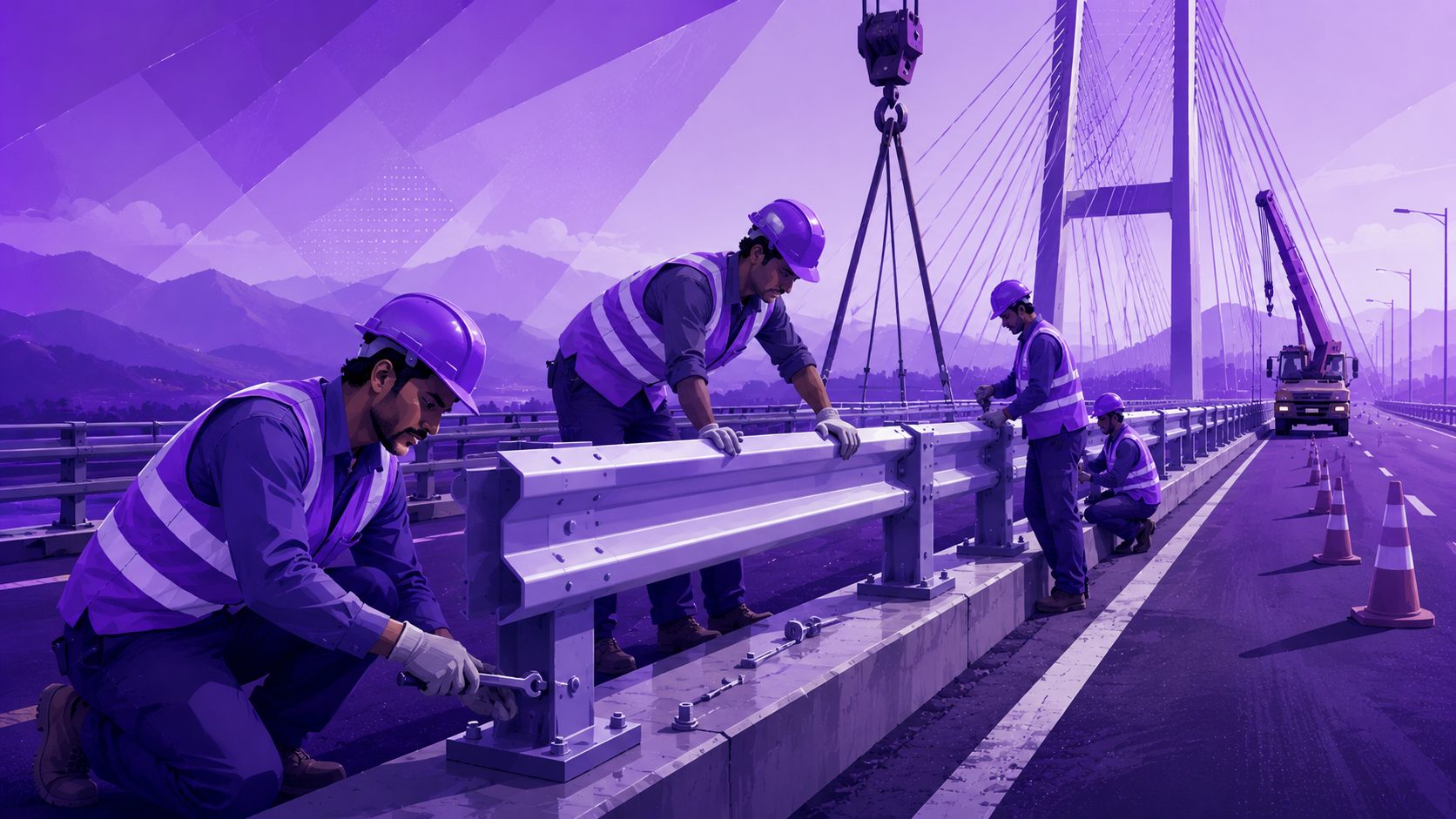
Proper bridge crash barrier installation is essential to ensure the system performs as intended during a collision. Even a well-designed barrier may not provide the required level of protection if installation standards are not followed.
Site preparation: Ensure the bridge structure and installation area are ready before work begins.
Alignment and positioning: Install the barrier according to approved drawings to maintain consistent performance throughout the structure.
Anchoring and fixing requirements: Use specified barrier anchoring systems and fastening methods to achieve the required structural stability.
Quality control during installation: Conduct regular checks on dimensions, materials, spacing and workmanship to verify compliance with project specifications.
Common installation mistakes to avoid: Improper anchoring, barrier misalignment, and incorrect post spacing can reduce safety performance and increase maintenance requirements.
Following established installation practices supports highway construction safety and helps maximise the effectiveness of the system.
Maintenance and inspection of bridge crash barriers
Regular maintenance and inspection help ensure that barriers continue to provide reliable protection throughout their service life. A proactive approach can also reduce repair costs and extend asset longevity.
Routine inspection requirements: Conduct periodic visual checks to identify signs of wear, impact damage or missing components.
Corrosion and damage assessment: Monitor steel components, coatings, and structural connections for corrosion, deformation, or deterioration.
Repair and replacement practices: Repair damaged sections promptly and replace components that no longer meet safety requirements.
Maintaining long-term performance: Implement scheduled bridge barrier maintenance and crash barrier inspection programmes as part of a broader highway asset management strategy to preserve safety and durability.
Conclusion
Innovation in road safety is shaping the next generation of bridge barrier systems. Manufacturers are increasingly focusing on lighter yet stronger materials, enhanced protective coatings and modular designs that improve project efficiency. Digital inspection tools and data-driven asset management practices are also gaining traction across infrastructure projects.
As bridge construction and upgrade activities continue across India, project stakeholders are placing greater emphasis on solutions that balance safety, durability and operational efficiency. Adopting modern technologies can help deliver more resilient infrastructure while supporting evolving performance and sustainability expectations.
Looking to procure steel?
Tata nexarc helps manufacturers, builders and MSMEs source certified steel products, compare prices, and choose the right grade as per IS codes—with complete traceability and procurement confidence.
FAQs
What is a bridge crash barrier?
Why are crash barriers important on bridges?
What types of bridge crash barriers are commonly used in India?
Which standards apply to bridge crash barriers in highway projects?
How do EPC contractors select the right bridge crash barrier?
What factors affect the lifespan of a bridge crash barrier?
Are bridge crash barriers mandatory in NHAI projects?
How often should bridge crash barriers be inspected?
Can damaged bridge crash barriers be repaired?
What is the difference between a bridge crash barrier and a roadside barrier?
A product manager with a writer's heart, Anirban leverages his 6 years of experience to empower MSMEs in the business and technology sectors. His time at Tata nexarc honed his skills in crafting informative content tailored to MSME needs. Whether wielding words for business or developing innovative products for both Tata Nexarc and MSMEs, his passion for clear communication and a deep understanding of their challenges shine through.