Check Price Now
usTable of Contents
- What are IRC Guidelines for Crash Barriers?
- Why Crash Barrier Compliance Matters in Highway Projects
- Types of Crash Barriers Covered Under IRC Standards
- Key IRC Design Requirements for Crash Barriers
- Material Specifications Under IRC Guidelines
- Crash Barrier Testing and Performance Criteria
- IRC Guidelines for Crash Barrier Installation
- Inspection, Maintenance, and Replacement Requirements
- Common Compliance Challenges Faced by Contractors
- How to Select IRC-Compliant Crash Barriers
- Key IRC Compliance Checklist
- Conclusion
- FAQs
Crash barriers play a vital role in improving highway safety and reducing the severity of road accidents. As India continues to expand its road network, compliance with safety standards has become increasingly important in NHAI and state highway projects. IRC guidelines for crash barriers help define requirements for design, material selection, testing, and installation.
Understanding these standards is essential for contractors, consultants, and infrastructure developers. This guide explains key IRC crash barrier specifications, compliance requirements, and best practices for modern highway projects in India.
What are IRC guidelines for crash barriers?
The Indian Roads Congress (IRC) develops standards and guidelines that help improve the safety, consistency and quality of road infrastructure across India. For crash barriers, these guidelines provide a framework for selecting, designing and implementing roadside safety systems on highways, expressways, bridges and other road networks. They help ensure that crash barriers meet recognised safety and performance requirements while supporting uniform practices across infrastructure projects.
Purpose of IRC guidelines for crash barriers
IRC standards for road safety barriers help project stakeholders make informed decisions throughout the project lifecycle. Their primary objectives include:
- Establishing consistent safety requirements for crash barrier systems.
- Guiding the selection of suitable barrier types for different road conditions.
- Promoting uniform construction and quality standards.
- Supporting safer and more reliable highway infrastructure.
- Providing a common reference point for designers, consultants and contractors.
Relationship between IRC, MoRTH, and NHAI
| Organisation | Role in crash barrier implementation |
|---|---|
| IRC | Develops technical guidelines and recommended practices for road safety barriers |
| MoRTH | Incorporates applicable requirements into road and bridge specifications |
| NHAI | Implements these requirements in national highway and expressway projects |
For EPC contractors, highway consultants and infrastructure developers, understanding how these organisations work together is important. Project specifications, tender requirements, and approval processes often draw from this framework.
Why compliance matters in public infrastructure projects
Compliance with IRC crash barrier specifications helps support successful project execution. It can also reduce challenges during reviews, inspections, and project handovers.
Key benefits include:
- Better alignment with project requirements.
- Improved consistency across construction activities.
- Easier coordination between consultants, contractors and authorities.
- Stronger quality assurance processes.
- Greater confidence during audits and compliance checks.
As road safety expectations continue to evolve, Indian Roads Congress crash barriers guidelines remain an important reference for organisations involved in highway design, construction, and procurement.

Why crash barrier compliance matters in highway projects
Enhancing road user safety
Crash barriers are designed to reduce the severity of accidents by helping redirect vehicles and prevent them from leaving the roadway. Compliance with established standards ensures that barrier systems perform as intended under impact conditions. This makes highway safety compliance a critical consideration for road authorities, contractors, and project engineers.
Meeting tender and contract requirements
Many national and state highway projects include specific safety provisions within their tender documents and technical specifications. Following NHAI crash barrier requirements helps contractors demonstrate compliance with project obligations and avoid issues during approvals, inspections, and project execution.
Supporting road safety audits
Road safety audits assess whether highway infrastructure meets accepted safety standards. Crash barriers often form an important part of these assessments, particularly in high-risk locations such as medians, embankments, bridges, and sharp curves. Compliance helps project teams address safety concerns before roads become operational.
Reducing long-term maintenance risks
Properly specified and compliant crash barrier systems generally deliver more reliable performance throughout their service life. Consistent design, material quality and installation practices can help minimise premature damage, reduce repair requirements, and support more efficient asset management. This aligns with broader road safety regulations in India and helps infrastructure owners manage maintenance costs more effectively.
Types of crash barriers covered under IRC standards
IRC guidelines recognise different crash barrier systems based on road geometry, traffic conditions, risk levels and site-specific safety requirements. Selecting the right barrier type is important for achieving the desired level of vehicle containment and roadside protection. The choice often depends on factors such as highway location, operating speeds, embankment conditions, and the presence of structures or fixed hazards.
| Crash barrier type | Description | Typical applications | Key advantages |
|---|---|---|---|
| W-beam crash barriers | A flexible steel barrier system featuring a W-shaped beam mounted on posts. It is one of the most widely used roadside safety systems on Indian highways. | National highways, state highways, embankments, roadside hazards, curves and bridge approaches. | Cost-effective, widely available, easier to install, absorbs impact energy effectively. |
| Thrie-beam crash barriers | Similar to a W-beam system but with an additional corrugation, creating a stronger profile and improved containment capability. | High-risk locations, expressways, elevated road sections, and areas requiring higher vehicle restraint. | Greater strength, improved containment performance, and enhanced protection in critical zones. |
| Median crash barriers | Barrier systems installed within the median to prevent vehicles from crossing into opposing traffic lanes. Can be steel or concrete depending on project requirements. | Divided highways, expressways, and high-speed corridors. | Reduces cross-median collisions and improves overall traffic safety. |
| Bridge crash barriers | Specialised barriers designed for bridges, flyovers, viaducts and elevated structures where vehicle containment is critical. | Bridges, flyovers, overpasses, ROBs, and elevated corridors. | Provides protection against vehicle departure from elevated structures and safeguards bridge users. |
| Concrete crash barriers | Rigid barriers constructed using reinforced or precast concrete. These barriers rely on mass and shape rather than flexibility to redirect vehicles. | Urban expressways, toll plazas, medians, tunnels, and locations with limited installation space. | High durability, low maintenance requirements, and strong resistance to repeated impacts. |
Among these systems, W-beam crash barrier specifications remain the most referenced in highway projects due to their versatility and widespread use. However, median safety barriers and bridge crash barriers are equally important in locations where the consequences of vehicle departure can be severe. Project designers typically evaluate site conditions, traffic volumes, and safety risks before selecting the most appropriate barrier system.
Key IRC design requirements for crash barriers
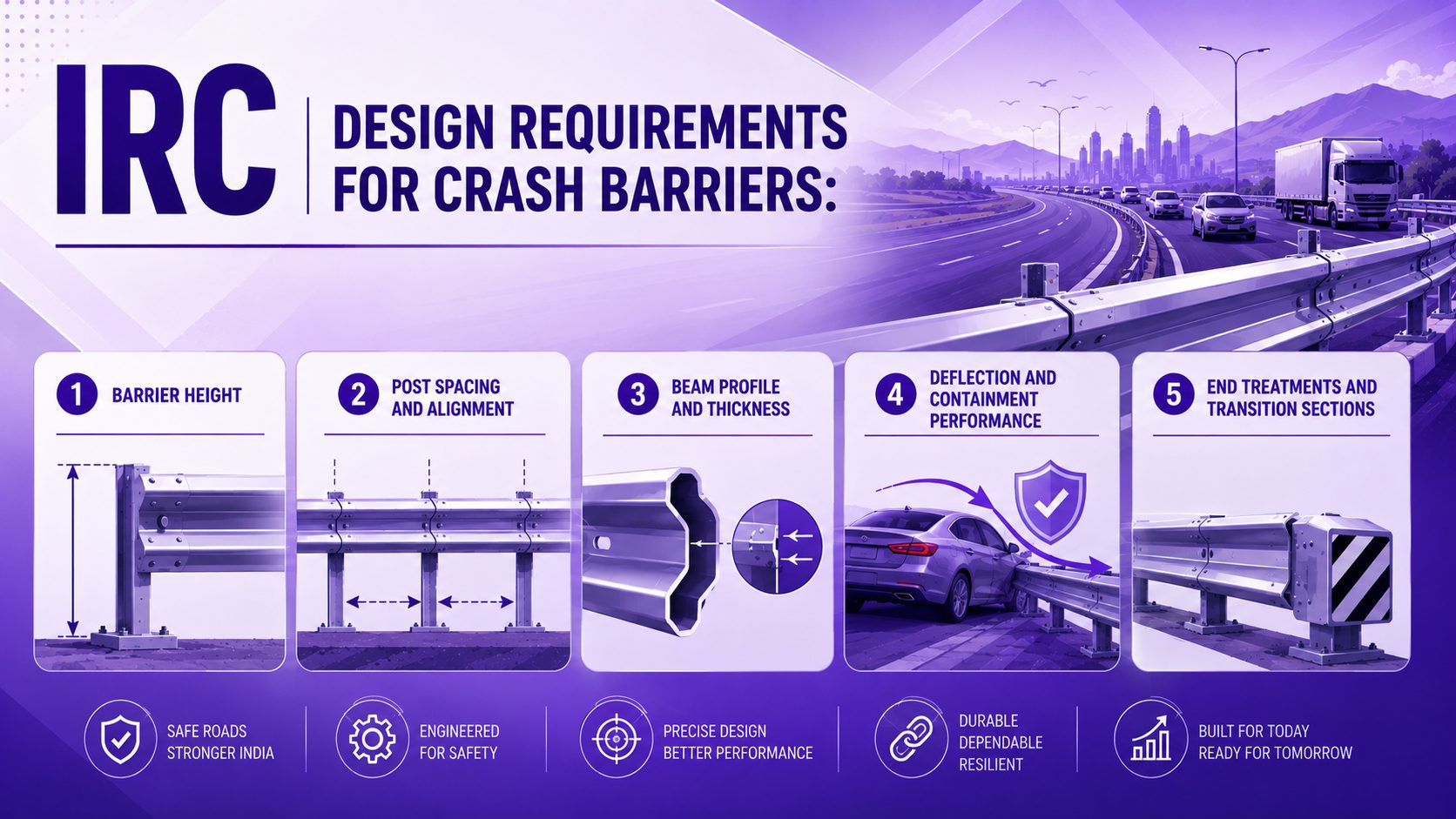
Effective crash barriers depend on more than material quality and installation. IRC crash barrier specifications also define several design requirements that influence how a barrier performs during a vehicle impact. These requirements help engineers develop safer and more reliable roadside protection systems.
Barrier height requirements
Barrier height plays an important role in vehicle containment and redirection. A barrier that is too low may allow a vehicle to override the system, while excessive height can affect impact performance. IRC guidelines specify suitable height requirements to help barriers interact effectively with different vehicle types commonly found on Indian roads.
Post spacing and alignment
Post spacing affects the overall strength and behaviour of a crash barrier system. Proper spacing helps distribute impact forces and supports consistent performance along the barrier length. Alignment is equally important, as sudden changes in direction or uneven installation can reduce the effectiveness of the system and create safety concerns.
Beam profile and thickness
The beam profile influences how the barrier absorbs and redirects impact energy. Common systems such as W-beam and thrie-beam barriers use specific profiles designed to achieve predictable performance. Beam thickness also contributes to structural strength and durability, making it an important consideration in highway guardrail design.
Deflection and containment performance
Crash barriers are expected to contain and redirect vehicles while limiting the risk of vehicle penetration. Different barrier systems offer varying levels of flexibility and deflection. Designers must consider available space, roadside conditions, and safety objectives when selecting a barrier that provides the required containment performance.
End treatments and transition sections
The beginning and end of a crash barrier require special attention. End treatments help reduce the severity of impacts involving barrier terminals, while transition sections provide a gradual connection between different barrier types or adjacent structures. These elements form an important part of crash barrier design standards and contribute to overall system safety.
Material specifications under IRC guidelines
Material quality has a direct impact on the strength, durability, and long-term performance of crash barrier systems. IRC guidelines establish requirements for highway barrier materials to help ensure consistent performance under demanding traffic and environmental conditions.
Steel grades and mechanical properties
Crash barriers typically use structural steel with specified strength and performance characteristics. The selected steel must provide adequate load-bearing capacity while maintaining the flexibility needed for energy absorption during vehicle impacts. Compliance with recognised steel crash barrier specifications helps support reliable performance throughout the barrier’s service life.
Galvanisation requirements
Galvanisation protects steel components from moisture and environmental exposure. IRC guidelines generally require hot-dip galvanisation for major crash barrier components to improve durability and reduce the risk of premature deterioration.
Corrosion resistance standards
Many highway projects are exposed to harsh weather, coastal environments and industrial pollution. Corrosion protection therefore remains a key consideration during material selection.
| Material requirement | Purpose |
|---|---|
| Galvanised steel components | Protect against rust and weather-related deterioration |
| Uniform coating quality | Improve long-term durability and performance |
| Corrosion-resistant hardware | Reduce maintenance and replacement requirements |
| Quality-controlled manufacturing | Ensure consistent protection across all components |
Fasteners, bolts, and accessories
Crash barrier performance depends on more than beams and posts. Bolts, nuts, spacers and other accessories must meet specified quality requirements to maintain structural integrity and ensure proper system performance.
Practical procurement checklist
Before procuring galvanised steel crash barriers, project teams should verify:
- Compliance with applicable IRC and project specifications.
- Steel grade and material certification.
- Galvanisation quality and coating consistency.
- Quality of bolts, nuts and connection components.
- Manufacturer quality assurance documentation.
- Availability of inspection and test records.
Careful material verification at the procurement stage can help avoid quality issues, project delays, and costly replacements later in the project lifecycle.
Crash barrier testing and performance criteria

Crash barriers must demonstrate their ability to perform under real-world impact conditions before they are used on highways and expressways. The vario testing requirements help verify whether a barrier system can safely contain and redirect vehicles while minimising risks to road users.
Vehicle impact testing requirements
Vehicle impact testing evaluates how a crash barrier behaves when struck by a moving vehicle under controlled conditions. These tests assess the barrier’s structural performance, vehicle stability, and overall effectiveness. Testing helps confirm that the system can perform as intended before it is deployed on road projects.
Containment levels
Containment level refers to a barrier’s ability to restrain and redirect vehicles of different sizes and weights. Higher containment levels are typically required in locations with greater safety risks, such as bridges, elevated structures, and high-speed corridors. The selected containment level should align with the specific requirements of the project.
Occupant risk assessment
A crash barrier should not only protect the roadway environment but also help reduce injury risks to vehicle occupants. Testing therefore evaluates factors that influence occupant safety during an impact event.
Key assessment areas include:
- Vehicle stability after impact
- Risk of rollover or penetration
- Occupant impact severity
- Controlled vehicle redirection
- Overall crash performance
Performance evaluation parameters
Testing agencies assess several performance criteria before approving a crash barrier system.
| Evaluation parameter | Purpose |
|---|---|
| Vehicle containment | Measures the ability to prevent vehicle departure |
| Structural integrity | Assesses barrier damage and overall stability |
| Vehicle trajectory | Evaluates how effectively the vehicle is redirected |
| Occupant safety indicators | Reviews potential injury risks during impact |
Importance of tested systems in government projects
Most government-funded highway projects place strong emphasis on proven performance. Using certified crash barriers in India can help contractors, consultants, and procurement teams demonstrate compliance with project specifications, support approval processes, and improve confidence in the long-term safety of the installed system.
IRC guidelines for crash barrier installation
Even a well-designed crash barrier may not perform as intended if installation quality is poor. IRC guidelines place significant emphasis on proper execution to ensure the barrier system delivers the expected level of safety and durability. Following recognised crash barrier installation standards helps contractors maintain consistency across highway projects and minimise quality-related issues during inspections.
| Installation stage | Key requirements | Why it matters |
|---|---|---|
| Site preparation requirements | Verify approved drawings, establish alignment, identify utilities and clear obstructions before installation begins. | Creates a suitable foundation for accurate installation and reduces execution errors. |
| Post installation procedures | Install posts at specified locations, depths and spacing while maintaining vertical alignment. | Supports structural stability and consistent barrier performance. |
| Beam installation and joint alignment | Fix beams securely to posts and maintain proper overlap and joint orientation throughout the barrier length. | Ensures continuity of the system and improves impact performance. |
| Connection components | Install bolts, nuts, spacers, and other accessories according to project specifications. | Maintains the integrity of the complete barrier system. |
| Terminal and transition installation | Properly install end treatments and transition sections where required. | Helps manage impact forces and ensures smooth transitions between systems. |
| Tolerances and quality control checks | Verify barrier height, alignment, post spacing, and component fitment during construction. | Identifies deviations before project completion and supports compliance requirements. |
Common installation errors
The following issues commonly result in corrective work, inspection observations or project delays:
- Incorrect post spacing
- Poor vertical or horizontal alignment
- Improper beam overlap direction
- Missing or incorrectly installed fasteners
- Uneven barrier height
- Inadequate foundation preparation
- Improper installation of terminals and transition sections
Consistent quality control during highway barrier installation helps reduce rework, improve project efficiency, and ensure the barrier system performs as intended throughout its service life.
Inspection, maintenance, and replacement requirements

Regular inspection and maintenance help ensure crash barriers continue to provide effective roadside protection throughout their service life. A structured approach to monitoring, repairs, and component replacement can help infrastructure owners maintain safety standards and reduce long-term asset deterioration.
Routine inspection practices
Routine inspections: Check barrier alignment, structural condition, missing components, and signs of visible damage.
Scheduled site reviews: Help identify issues before they affect barrier performance or road user safety.
Post-monsoon inspections: Detect damage caused by flooding, erosion, or changing ground conditions.
Assessing impact damage
Impact assessment: Evaluate whether a collision has affected the barrier’s strength, alignment, or functionality.
Component review: Inspect posts, beams, fasteners, and terminals for deformation or failure.
Safety evaluation: Determine whether immediate repairs are necessary to maintain protection levels.
Repair and replacement guidelines
Minor repairs: Address loose fasteners, isolated component damage, and small alignment issues.
Partial replacement: Replace damaged sections when repairs cannot restore original performance.
Full system replacement: Consider when extensive damage compromises the integrity of the barrier system.
Corrosion monitoring
Surface inspection: Look for rust, coating deterioration, and signs of environmental wear.
Galvanisation assessment: Verify that protective coatings remain intact and effective.
Preventive maintenance: Address corrosion early to extend service life and reduce replacement costs.
Consistent crash barrier maintenance and highway safety barrier inspection practices help preserve performance, support compliance requirements, and improve long-term infrastructure reliability.
Common compliance challenges faced by contractors
Maintaining compliance throughout a highway project requires careful coordination between procurement, quality control, and site execution teams. The following challenges commonly affect project approvals, inspections, and overall compliance outcomes.
Material non-conformity
Challenge: Materials supplied on-site do not fully match approved specifications or project requirements.
Solution: Verify material certificates, inspection records, and supplier documentation before procurement and installation.
Poor installation practices
Challenge: Incorrect post spacing, alignment issues, or improper assembly reduce installation quality.
Solution: Conduct regular site supervision, follow approved drawings, and perform stage-wise quality checks during installation.
Documentation gaps
Challenge: Missing certificates, inspection reports, or quality records create compliance concerns during reviews.
Solution: Maintain organised documentation and update quality records throughout the project lifecycle.
Use of untested systems
Challenge: Selecting barrier systems without recognised testing or performance validation may lead to approval challenges.
Solution: Procure IRC compliant crash barriers supported by relevant testing reports and technical documentation.
Inspection and audit issues
Challenge: Non-conformances identified during inspections can result in rework, delays, and additional costs.
Solution: Carry out internal quality audits and address issues before official inspections take place.
Weak supplier verification
Challenge: Inconsistent product quality from suppliers can create compliance risks later in the project.
Solution: Work with established manufacturers that follow recognised quality assurance and testing procedures.
Proactively addressing these challenges helps strengthen highway project quality control, streamline approvals and support smoother project execution.
How to select IRC-compliant crash barriers for infrastructure projects
Selecting the right crash barrier system involves more than comparing prices or product specifications. EPC contractors, consultants, and procurement teams should evaluate compliance, quality, and long-term performance before making a purchase decision. A structured assessment process can help reduce project risks and support smoother approvals.
| Consideration | What to verify |
|---|---|
| Verify IRC and MoRTH compliance | Confirm that the barrier system aligns with applicable project specifications and compliance requirements. |
| Review testing certifications | Check whether the system is supported by recognised testing reports and performance documentation. |
| Assess manufacturing capability | Evaluate the manufacturer’s production capacity, quality control processes and supply reliability. |
| Evaluate galvanisation quality | Verify coating quality and consistency to support durability and corrosion resistance. |
| Check project-specific suitability | Ensure the selected barrier type matches site conditions, traffic volumes and safety requirements. |
Procurement considerations for EPC contractors
For large highway projects, product availability can be just as important as technical compliance. Delays in crash barrier supply can affect construction schedules, inspection timelines, and project handovers. EPC contractors should therefore assess both product suitability and supplier capability before finalising procurement decisions.
| Procurement factor | Why it matters |
|---|---|
| Production capacity | Supports bulk project requirements without supply disruptions |
| Delivery capability | Helps maintain project schedules across multiple locations |
| Lead times | Reduces the risk of installation delays |
| Project experience | Indicates familiarity with highway and infrastructure requirements |
| After-sales support | Assists with technical queries and project coordination |
| Supply consistency | Helps maintain uniform quality across the project |
Key IRC compliance checklist for EPC contractors and consultants
A structured compliance review can help project teams identify gaps before inspections, audits, or project handovers. The following crash barrier compliance checklist can support smoother highway project compliance and help meet NHAI tender requirements.
Design approval: Confirm that barrier layouts, drawings, and specifications match approved project requirements.
Material verification: Check material certificates, steel specifications, and galvanisation records before installation.
Testing certificates: Verify that the selected barrier system is supported by relevant testing and performance documentation.
Installation checks: Review post spacing, barrier height, alignment, and component assembly during execution.
Inspection records: Maintain site inspection reports, quality checklists, and corrective action records.
Tender documentation: Ensure all compliance documents, certifications, and technical submissions are complete and up to date.
Supplier documentation: Collect manufacturer declarations, quality certificates, and product specifications.
Final compliance review: Conduct a pre-handover assessment to identify and address any outstanding issues.
Using a standardised compliance checklist can help contractors, consultants, and quality teams improve documentation accuracy, reduce approval delays, and maintain consistent project standards.
Conclusion
Crash barrier compliance is not a single-stage activity. It requires coordination across design, procurement, execution, and quality management throughout the project lifecycle. For highway contractors and consultants, early planning and consistent documentation can help minimise delays during reviews and project handovers.
As highway safety expectations continue to evolve, organisations that adopt a proactive approach to compliance and supplier selection will be better positioned to deliver safer, more efficient, and specification-compliant infrastructure projects.
Looking to procure steel?
Tata nexarc helps manufacturers, builders and MSMEs source certified steel products, compare prices, and choose the right grade as per IS codes—with complete traceability and procurement confidence.
FAQs
Which roads typically require crash barriers?
Are IRC guidelines applicable to state highway projects?
What is the main purpose of a roadside crash barrier?
Can different crash barrier systems be used on the same project?
Why is galvanisation important for crash barriers?
Who is responsible for crash barrier compliance on a project?
Do crash barriers require regular inspections after installation?
What documents should contractors maintain for compliance?
Can damaged crash barriers continue to provide protection?
Why is early compliance planning important?
A product manager with a writer's heart, Anirban leverages his 6 years of experience to empower MSMEs in the business and technology sectors. His time at Tata nexarc honed his skills in crafting informative content tailored to MSME needs. Whether wielding words for business or developing innovative products for both Tata Nexarc and MSMEs, his passion for clear communication and a deep understanding of their challenges shine through.