Check Price Now
Table of Contents
- Introduction
- What is 410 Stainless Steel?
- Chemical Composition of 410 SS
- Mechanical & Physical Properties of 410 SS
- Key Advantages & Limitations
- Applications of 410 SS in India
- 410 Stainless Steel vs Other Steel Grades
- 410 Stainless Steel Prices in India (October 2026)
- Factors Affecting 410 Stainless Steel Pricing
- Buying Guide for MSMEs & Procurement Teams
- Maintenance & Handling Tips
- Conclusion
- FAQs
Introduction: Why 410 stainless steel matters for Indian industry
In today’s cost-sensitive manufacturing environment, material choice is no longer just technical. It’s strategic. If you’re wondering what is 410 stainless steel, the answer lies in its balance of strength and price. Not all stainless steels are built for the same job, and 410 proves that well.
Across fabrication units, auto component manufacturing, and infrastructure projects, 410 SS uses in India are steadily rising. MSMEs, in particular, prefer it for parts that need durability without the premium cost of higher grades.
Why 410 stainless steel is gaining traction:
- Strong and wear-resistant for industrial use
- Offers moderate corrosion resistance for general environments
- More affordable than grades like 304 and 316
- Easily available across Indian steel markets
For buyers looking to control costs without compromising performance, 410 stands out as a budget-friendly stainless-steel grade that gets the job done.
What is 410 stainless steel?
Simple definition:
410 is a martensitic stainless steel, known for its strength and ability to be hardened through heat treatment.
At a glance:
It typically contains around 11.5–13.5% chromium, which gives it basic corrosion resistance, but not at the level of premium grades. Its martensitic structure makes it harder and stronger than many other stainless steels.
Key characteristics:
- Can be heat-treated to increase hardness and wear resistance
- Magnetic in nature (answering the common query: Is 410 stainless steel magnetic?)
- Offers moderate corrosion resistance
How it compares to other steel grades
Unlike austenitic grades such as 304, 410 is built for strength first. You get better hardness and durability, but lower corrosion resistance in return.
If you’re looking into 410 stainless steel composition or the martensitic stainless steel meaning, the key takeaway is simple: 410 is a performance-focused grade suited for demanding, wear-heavy applications where cost also matters.
Chemical composition of 410 stainless steel
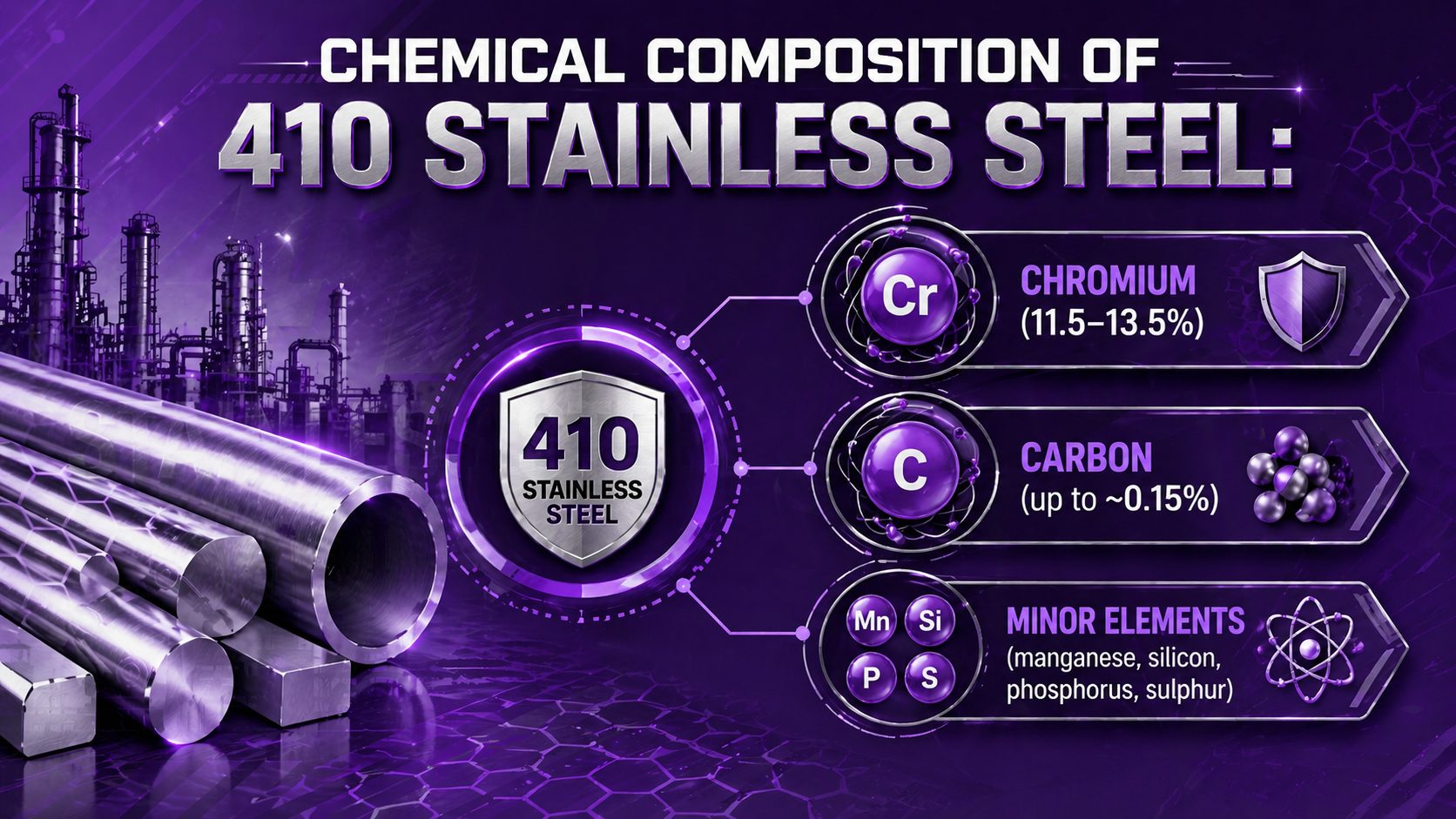
Understanding the SS 410 chemical composition helps explain why this grade behaves the way it does in real-world applications.
Chromium (11.5–13.5%)
This is the main element that gives stainless steel its corrosion resistance. However, the chromium content in 410 stainless steel is lower than grades like 304. That’s why it offers only moderate protection against rust, especially in harsh environments.
Carbon (up to ~0.15%)
Carbon plays a key role in strength. It allows 410 to be heat-treated and hardened. This is what makes it suitable for wear-resistant and load-bearing applications.
Minor elements (manganese, silicon, phosphorus, sulphur)
These are present in small amounts but still important. They improve manufacturability, strength, and overall stability during processing.
What this means for buyers
In simple terms, lower chromium means lower corrosion resistance, while carbon enables hardness. This balance is what makes 410 a practical choice for applications where strength matters more than exposure to moisture or chemicals.
Mechanical & physical properties of 410 stainless steel
When evaluating 410 stainless steel properties, buyers should focus on how the material performs in actual working conditions – not just lab values.
Tensile strength
410 offers solid tensile strength, making it suitable for components that handle load and stress. It performs well in shafts, fasteners, and structural parts where durability matters.
Hardness (after heat treatment)
One of its biggest advantages is the hardness of SS 410. It can be heat-treated to achieve high hardness levels, which improves lifespan in demanding applications.
Wear resistance
Thanks to its hardness, 410 handles friction and abrasion better than many standard stainless grades. This makes it ideal for tools, valves, and moving parts.
Temperature tolerance
It performs reliably in moderate high-temperature environments. However, it’s not designed for extreme heat or highly corrosive conditions.
Magnetic behaviour
410 is magnetic, which can be useful in certain industrial applications and sorting processes.
What this means for MSMEs
The key trade-off is clear: in the strength vs corrosion stainless steel debate, 410 leans towards strength. That’s why many MSMEs choose it for wear-heavy applications where performance and cost matter more than high corrosion resistance.
Key advantages & limitations of 410 SS
A clear view of the advantages of 410 stainless steel and its trade-offs helps buyers avoid over or under specifying the material.
| Advantages | What it means in practice |
| High strength & durability | Handles load, impact, and wear better than many standard stainless grades. |
| Heat treatable | Can be hardened to improve performance in demanding applications. |
| Cost-effective vs 304/316 | Lower upfront cost makes it suitable for budget-sensitive projects. |
| Good wear resistance | Performs well in moving parts, tools, and friction-heavy use cases. |
| Limitations | What it means in practice |
| Lower corrosion resistance | Not suitable for high-moisture or aggressive environments |
| Not ideal for marine/chemical use | Will corrode faster than 304/316 in such conditions |
| Requires maintenance | May need surface protection or regular upkeep to prevent rust |
Understanding these 410 stainless steel disadvantages is as important as knowing its strengths. If your application involves exposure to water, chemicals, or coastal conditions, this is a case when not to use 410 stainless steel. For dry, wear-heavy environments, it remains a practical and cost-efficient choice.
Applications of 410 stainless steel in India
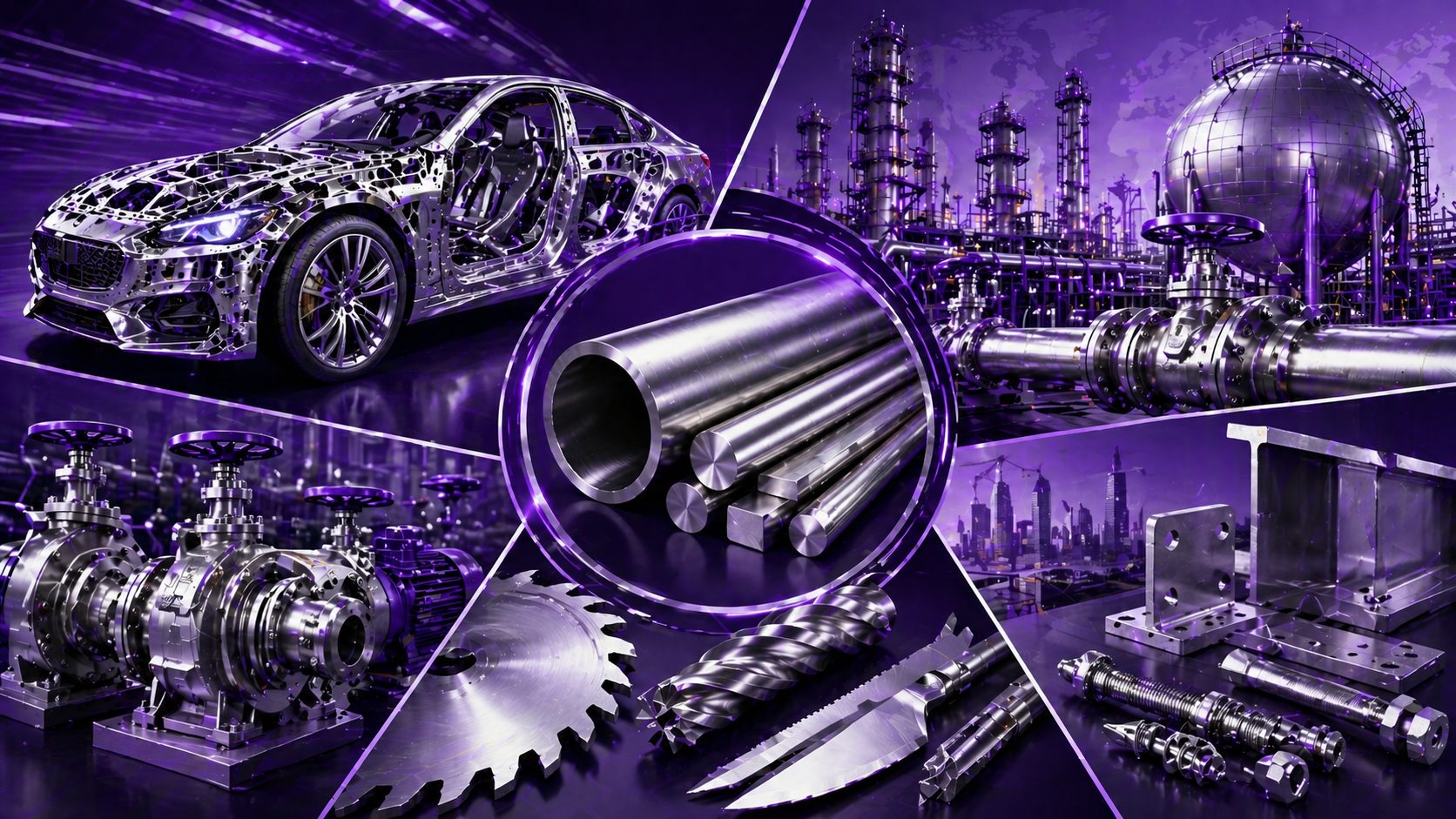
Understanding where is 410 stainless steel used helps buyers match the grade to the right application. In India, its demand is driven by cost-sensitive, performance-focused industries.
Automotive components
410 is widely used for shafts, fasteners, and engine-related parts. Its strength and wear resistance make it suitable for components that face constant stress and movement.
Oil & gas equipment
Used in select oil and gas components where high strength is required but exposure conditions are controlled. It works well in parts that are not constantly exposed to corrosive fluids.
Pumps & valves
A common choice for pump shafts, valve parts, and internal fittings. Its hardness improves service life in systems handling friction and pressure.
Industrial blades & tools
One of the most common 410 stainless steel uses. It is preferred for cutting tools, blades, and industrial equipment due to its ability to retain hardness after heat treatment.
Construction hardware
Used in nuts, bolts, and structural fittings where strength matters more than corrosion resistance. Ideal for indoor or low-exposure environments.
Indian MSME Ecosystem
Across fabrication clusters in India, especially among Tier 2 and Tier 3 suppliers, the industrial applications of SS 410 are growing. It offers a reliable balance of performance and cost, making it a go-to material for everyday industrial manufacturing.
410 stainless steel vs other steel grades (304, 316, mild steel)
Choosing the right material often comes down to balancing cost, strength, and corrosion resistance. Here’s a quick, practical comparison to help.
410 vs 304 stainless steel
304 stainless steel is known for excellent corrosion resistance, especially in wet or outdoor conditions. However, it comes at a higher cost. In contrast, 410 vs 304 stainless steel is a trade-off – 410 offers better strength and hardness, while 304 performs better against rust.
Choose 410 when: strength and cost matter more than corrosion resistance.
410 vs 316 stainless steel
316 stainless steel is designed for harsh environments, especially marine and chemical exposure. It has superior corrosion resistance but is significantly more expensive. In the 410 vs 316 stainless steel comparison, 410 is the economical option for less aggressive conditions.
Choose 410 when: the environment is controlled and budgets are tight.
410 SS vs mild steel
Mild steel is cheaper upfront but lacks corrosion resistance and durability. Over time, maintenance and replacement costs can add up. When comparing stainless steel vs mild steel price India, 410 offers a better long-term value in many industrial uses.
Choose 410 when: you need better lifespan and lower maintenance than mild steel.
Quick decision guide
Go for 410 → Wear resistance + budget control.
Go for 304/316 → High corrosion environments.
Go for mild steel → Ultra-low cost, non-critical use.
410 stainless steel prices in India (October 2026)

Understanding the 410 stainless steel price per kg in India is critical for procurement planning. Prices vary widely based on form, quantity, and market conditions.
| Product form | Typical price range (₹/kg) | Market insight |
|---|---|---|
| Sheets (CR/HR) | ₹190–₹370 | Lower end for bulk or stock lots; higher for branded, polished, or finished sheets. |
| Plates | ₹240–₹430 | Thickness, grade, and surface finish significantly influence pricing. |
| Round bars | ₹115–₹290 | Lower rates for basic grades; higher for precision-machined or premium grades. |
| Flats/sections | ₹175–₹330 | Commonly used in fabrication and engineering applications. |
| Industry benchmark (SS 316) | ~₹285–₹350 | Typical supplier reference range for standard SS 316 products. |
Broad benchmark:While many suppliers quote ₹285–₹350/kg as a general reference for SS 316 products, actual transaction prices depend on the grade (304/316/430), dimensions, thickness, surface finish, fabrication requirements, order quantity, and supplier. For SS 304, many products typically trade in the ₹190–₹280/kg range as of October 2026.
Regional price variation
Prices in hubs like Mumbai and Mandi Gobindgarh may differ slightly due to logistics, stock availability, and supplier networks. Coastal markets often reflect import-linked pricing, while inland markets depend more on domestic mills.
Factors affecting 410 stainless steel pricing
If you’re tracking what affects stainless steel prices, it’s important to understand that 410 pricing is not fixed. It moves with both global inputs and local demand conditions.
Raw material costs (chromium & scrap)
Chromium is the key alloying element, and its price directly impacts 410 rates. Stainless steel scrap prices also influence base costing, especially secondary producers.
Demand from auto & infrastructure
Strong demand from automotive, fabrication, and infrastructure sectors pushes prices up. When these sectors slow down, prices tend to soften – this is a key driver of steel price fluctuation in India.
Import & export trends
Imports from countries like China or Indonesia can stabilise or reduce domestic prices. Export demand, on the other hand, can tighten local supply.
Thickness & surface finish
Thicker materials and specialised finishes (polished, precision-cut) come at a premium due to additional processing.
Order quantity
Bulk orders typically secure better rates. Smaller or customised orders often include cutting, handling, and margin costs.
Bottom line:
410 pricing is dynamic. Smart buyers track input costs and demand cycles – not just supplier quotes.
Buying guide for MSMEs & procurement teams
Buying the right grade is as important as getting the right price. If you’re exploring how to buy stainless steel in India, a few practical checks can prevent costly mistakes.
Start with grade verification
Always confirm that the material is genuinely SS 410 – not a substitute.
- Ask for a Mill Test Certificate (MTC)
- Cross-check chemical composition and heat number
- Avoid suppliers who cannot provide documentation
Choose the right form for your use
| Application need | Recommended form |
| Fabrication, panels | Sheets/plates |
| Shafts, machining | Round bars |
| Structural parts | Flats/sections |
Selecting the correct form reduces machining time and wastage.
Supplier selection matters
When evaluating an SS 410 supplier India, look beyond price:
- Consistent quality and traceability
- Ready stock availability
- Ability to handle bulk and repeat orders
Avoid over-specification
One common mistake is choosing a higher grade than required. If your application does not require high corrosion resistance, 410 is often sufficient. This is one of the most overlooked stainless steel procurement tips – buy for the application, not assumptions.
Maintenance & handling tips
Proper care can significantly extend the life of 410. If you’re wondering how to maintain stainless steel 410, the focus should be on limiting exposure to moisture and contaminants.
Preventing corrosion: Keep surfaces clean and dry, especially after exposure to water or chemicals. This helps prevent rust in 410 stainless steel.
Surface protection: Use basic coatings, oiling, or passivation where needed, especially for parts stored or used in humid environments.
Storage practices: Store in dry, covered areas. Avoid direct contact with the ground or mixed metal stacking to reduce contamination risk.
A few simple steps can prevent unnecessary maintenance costs and improve service life.
Conclusion
So, is 410 stainless steel good? The answer depends on where and how you use it. It delivers strong performance at a lower cost, but only when matched to the right environment.
For many MSMEs, it strikes a practical balance between durability and budget. However, it is not a one-size-fits-all solution. The best stainless-steel grade for industrial use will always depend on exposure conditions, load requirements, and lifecycle costs. Choose based on application, not assumption, and 410 can be a smart, efficient choice.
Looking to procure steel?
Tata nexarc helps manufacturers, builders and MSMEs source certified steel products, compare prices, and choose the right grade as per IS codes—with complete traceability and procurement confidence.
FAQs
What is the lifespan of 410 stainless steel?
Is 410 stainless steel rust-proof?
Is 410 better than 304?
What is the price of 410 stainless steel in India?
Is 410 stainless steel magnetic?
Can 410 be used outdoors?
What thickness of 410 SS is ideal?
Is 410 suitable for food applications?
Does 410 require maintenance?
Where is 410 stainless steel commonly used?
A product manager with a writer's heart, Anirban leverages his 6 years of experience to empower MSMEs in the business and technology sectors. His time at Tata nexarc honed his skills in crafting informative content tailored to MSME needs. Whether wielding words for business or developing innovative products for both Tata Nexarc and MSMEs, his passion for clear communication and a deep understanding of their challenges shine through.