Check Price Now
Table of Contents
- What is IS 73:2013?
- Bitumen Grades Covered Under IS 73:2013
- Key Quality Requirements Under IS 73:2013
- IS 73:2013 Bitumen Tests Contractors Should Check
- IS 73:2013 vs Project and Tender Specifications
- How to Verify IS 73:2013 Compliance Before Buying Bitumen
- Common Mistakes When Using IS 73:2013 for Bitumen Procurement
- IS 73:2013 and Bitumen Quality Control at Asphalt Plants
- Conclusion
- FAQs
For road contractors, project engineers, and procurement teams, IS 73:2013 provides a benchmark for evaluating paving bitumen used in road construction. The standard defines viscosity grades and quality requirements that help buyers assess whether the material meets the required specification. Compliance matters for highway projects, asphalt production, and tender-based procurement, where material quality can directly affect project execution.
Contractors should not select bitumen based only on price or grade name. They should also verify test results, supplier documentation, and project-specific requirements before accepting the material.
What is IS 73:2013?
IS 73:2013 is the Indian Standard that specifies requirements for paving bitumen used in bituminous road construction. It provides a common specification framework for evaluating bitumen supplied for road works across India. This becomes important because material sourced from different refineries or suppliers may vary in its properties and handling characteristics.
Scope of the standard: It sets defined requirements that buyers, engineers, laboratories, and suppliers can use to assess paving bitumen.
Material acceptance: Contractors can compare supplied bitumen against the applicable specification before accepting it for use.
Laboratory testing: Testing laboratories can evaluate the material against defined requirements using relevant test methods.
Supplier evaluation: Buyers can use specification and test documentation to assess whether a supplier meets procurement requirements.
Tender compliance: EPC contractors and tender teams can align material requirements with the specifications stated in contract and project documents.
Quality control: Project teams can use a standardised reference point when monitoring bitumen quality during procurement and construction.
Why IS 73:2013 matters in bitumen procurement
For procurement teams: It provides a defined basis for comparing material offered by different suppliers.
For project engineers: It helps verify whether the supplied bitumen matches the specified material requirements.
For asphalt plant operators: It supports greater consistency in the bitumen entering asphalt production.
For tender teams: It helps align material specifications with project documents and procurement requirements.
Bitumen grades covered under IS 73:2013
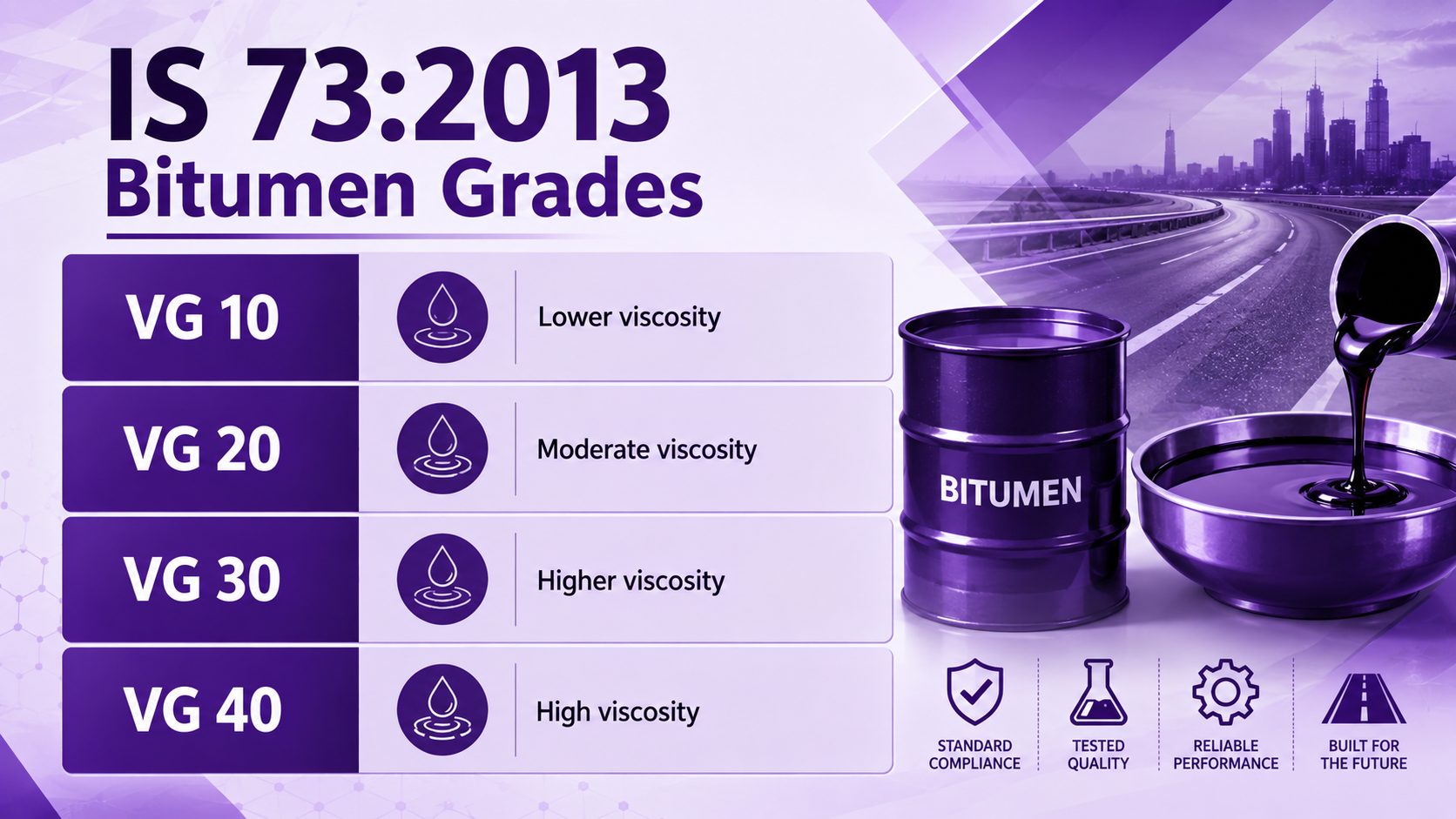
IS 73:2013 classifies paving bitumen using a viscosity grading system. Viscosity indicates how bitumen flows and resists deformation at specified temperatures. The standard covers four main viscosity grades: VG 10, VG 20, VG 30, and VG 40.
| Bitumen grade | General viscosity level | Typical application consideration |
| VG 10 | Lower | Suitable for applications requiring lower-viscosity bitumen, subject to climatic and project requirements. |
| VG 20 | Moderate | Used where intermediate viscosity characteristics are required. |
| VG 30 | Higher | Commonly specified for road and highway construction, depending on project requirements. |
| VG 40 | High | Considered for heavy-duty applications and locations where higher-temperature performance is required. |
VG 10: Offers lower viscosity compared with the other grades covered under the standard.
VG 20: Provides intermediate viscosity characteristics and may suit projects with specific pavement and climatic requirements.
VG 30: Is widely used in Indian road construction, but contractors should still confirm its suitability against the approved pavement and mix design.
VG 40: Has higher viscosity and may be specified for roads exposed to heavy traffic or demanding temperature conditions.
A higher VG number does not automatically mean better bitumen. The right grade depends on pavement design, traffic loading, climatic conditions, mix design, project specifications, and applicable road authority requirements. Contractors should therefore select VG 10, VG 20, VG 30, or VG 40 based on the technical requirements of the project rather than price, availability, or grade alone.
Key quality requirements under IS 73:2013
IS 73:2013 evaluates paving bitumen against defined physical and performance-related requirements. These properties help engineers, laboratories, and buyers assess whether the material meets the applicable specification. Contractors should review the complete set of relevant requirements rather than relying on a single property or the supplier’s declared grade.
Viscosity requirements
Viscosity forms the basis of the VG classification system. It affects how bitumen flows during pumping, mixing, handling, and asphalt production. Contractors should check the relevant test values and supporting documentation instead of accepting a grade based only on the supplier’s product label.
Penetration and other consistency indicators
Penetration and related consistency indicators help assess the physical characteristics of bitumen. These values provide additional information about the material and support a broader evaluation of its quality and suitability.
Softening point
The softening point indicates how bitumen responds as temperature rises. This becomes particularly relevant in road construction where pavements may face high surface temperatures. However, engineers should assess this property alongside other specified requirements rather than using it alone to select or approve a material.
Flash point and safety
Flash point is important for safe bitumen handling. Procurement and plant teams should consider it during storage, heating, asphalt production, and site operations, where excessive temperatures can create safety risks.
Solubility and material purity
Solubility-related requirements help assess the composition and quality of the bituminous binder. They can also support quality checks by indicating whether the material meets the specified requirements for paving bitumen.
IS 73:2013 bitumen tests contractors should check
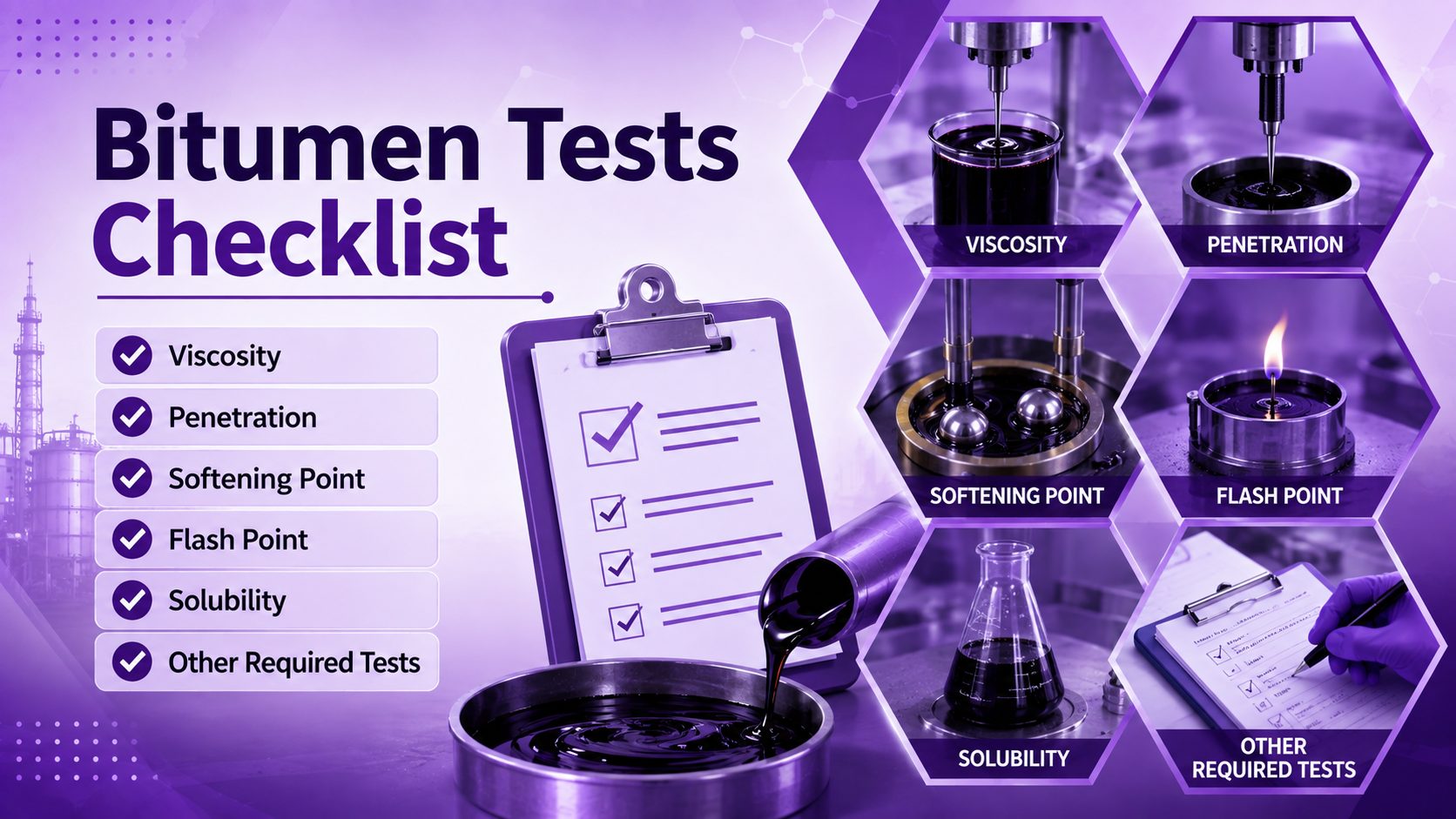
Testing plays a practical role in bitumen acceptance. Contractors and procurement teams should use test results to verify the supplied material before it enters storage or asphalt production. The following test areas help buyers assess whether the bitumen meets the specified requirements.
| Test area | What it helps check | Why it matters to buyers |
| Viscosity | Flow and consistency characteristics | Confirms suitability against the specified grade |
| Penetration | Consistency of bitumen | Supports quality evaluation |
| Softening point | Behaviour at elevated temperatures | Relevant to pavement performance |
| Flash point | Heating safety characteristics | Important for storage and asphalt production |
| Solubility | Material composition and purity | Helps identify deviations in quality |
| Other specified tests | Compliance with applicable requirements | Supports material acceptance |
Sampling and test certificates
Sampling matters: A test result only represents the sample tested. Contractors should follow appropriate sampling procedures to ensure the sample reflects the material supplied.
Batch or lot traceability: Where applicable, buyers should check whether the test certificate corresponds to the supplied batch or lot. This helps maintain traceability if quality issues arise during production or construction.
Product data sheets are not enough: A generic product data sheet may describe typical characteristics, but it does not always confirm the properties of the material delivered for a specific project.
Additional project requirements: Highway projects, tenders, consultants, or client specifications may require additional tests, inspections, or documentation. Procurement and quality teams should review these requirements before approving or accepting the bitumen.
IS 73:2013 vs project and tender specifications: Which requirement takes priority?
IS 73:2013 provides a specification framework for paving bitumen, but contractors must also meet the requirements set for the specific project. A material can comply with the relevant Indian Standard and still fall short of additional conditions stated in the contract or tender documents.
Project and road authority requirements
NHAI and highway projects: These may include material requirements linked to the applicable project specifications and construction documents.
MoRTH specifications: Contractors must check the relevant MoRTH provisions when they apply to the project.
State PWD requirements: State-level road projects may include additional specifications or approval procedures.
Contract and procurement requirements
Tender and contract conditions: These may define the required material, source approvals, documentation, or other procurement conditions.
Consultant-approved materials: Project consultants or engineers may specify additional approval requirements before material acceptance.
Approved makes or sources: Some projects may require contractors to procure bitumen from approved manufacturers or suppliers.
For tender teams, EPC procurement teams, project engineers, and quality managers, the key point is simple: buying “IS 73 compliant” bitumen does not automatically mean the material meets every project-specific requirement. Procurement decisions should therefore follow the complete hierarchy of applicable project, contract, and authority specifications.
How to verify IS 73:2013 compliance before buying bitumen
Before buying bitumen, procurement teams should verify more than the declared grade or quoted price. The following checks can help contractors, asphalt plant operators, and quality teams assess whether the supplied material meets the applicable requirements.
| Procurement check | What to verify | Why it matters |
| Specified VG grade | Confirm that the grade in the purchase order matches the project specification, approved mix design, and consultant requirements. | Helps avoid buying a grade that does not match the project requirement. |
| Test certificate | Check the grade identification, relevant test results, applicable specification reference, and batch or lot details where provided. | Provides documented evidence for material evaluation and acceptance. |
| Supplier and source details | Record the manufacturer, supplier, refinery or source details, as applicable. | Supports material traceability and supplier accountability. |
| Purchase order details | Ensure the grade, quantity, specification requirements, and any project-specific conditions are clearly stated. | Reduces confusion between the ordered and supplied material. |
| Storage conditions | Check whether the supplier and site teams can maintain suitable storage and handling conditions. | Even compliant bitumen can create operational issues if teams handle or store it poorly. |
| Transportation arrangements | Review tanker condition, material identification, delivery documentation, and handling procedures. | Helps reduce the risk of contamination, mix-ups, or traceability gaps during delivery. |
| Incoming material inspection | Carry out visual checks, document verification, sampling, or independent testing where required. | Allows teams to identify issues before the material enters production or construction. |
| Project-specific approvals | Check for consultant approval, approved source requirements, or other contract conditions. | Ensures the purchase meets requirements beyond the basic material specification. |
| Documentation records | Maintain purchase orders, test certificates, delivery records, inspection reports, and laboratory reports. | Creates an auditable quality trail for the project. |
For buyers searching for bitumen quality checks or preparing bitumen procurement specifications, this process can reduce the risk of accepting material that meets a general specification but does not meet the actual project requirement.
Common mistakes when using IS 73:2013 for bitumen procurement

Selecting a grade based only on previous projects: Road conditions, traffic loads, mix designs, and project specifications can differ from one project to another.
Assuming every VG grade suits every road project: Contractors should select the grade based on the technical and project requirements rather than general usage patterns.
Accepting material based only on supplier declarations: Supplier claims alone may not provide enough evidence for material acceptance, particularly on quality-sensitive projects.
Ignoring project-specific requirements: Compliance with a general bitumen specification may not cover additional conditions in contracts, tenders, or consultant requirements.
Comparing suppliers only on price per tonne: Freight, delivery reliability, material consistency, documentation, storage support, and quality control can also affect the actual procurement outcome.
Failing to maintain batch traceability: Missing batch or delivery records can make it harder to investigate quality issues or identify the source of a material-related problem later.
IS 73:2013 and bitumen quality control at asphalt plants
Bitumen quality control should continue after procurement. Asphalt plant teams need consistent controls across material receipt, storage, handling, and mix production.
| Quality control area | What plant teams should check | Why it matters |
| Incoming material verification | Delivery records, material identification, and required documentation. | Confirms that the received material matches the approved procurement requirements. |
| Storage tank management | Tank condition, material segregation, and storage practices. | Helps maintain material consistency and prevents unintended mixing. |
| Contamination control | Tanks, pipelines, pumps, and transfer systems. | Reduces the risk of contamination or material mix-ups. |
| Temperature monitoring | Heating and handling temperatures during storage and production. | Helps prevent operational issues caused by overheating or poor temperature control. |
| Mix production | Bitumen handling and dosing during asphalt production. | Supports consistent asphalt output and adherence to the approved mix design. |
| Laboratory checks | Required quality checks during production and material use. | Helps identify deviations before they affect larger production volumes. |
| Quality records | Inspection, production, and laboratory records. | Supports traceability and helps investigate quality issues. |
For asphalt plant operators and highway contractors, IS 73:2013 compliance should support an ongoing quality control process rather than a one-time material acceptance check.
Conclusion: Why IS 73:2013 matters for bitumen buyers and road contractors
IS 73:2013 helps create a common reference point for paving bitumen used in Indian road projects. However, successful material procurement depends on how well contractors apply the specification to actual project needs. Buyers should align their sourcing decisions with the required grade, project conditions, and contractual requirements. A structured supplier evaluation process can also help teams compare available sources beyond quoted prices. For large road and infrastructure projects, reliable documentation and supplier coordination can support smoother procurement and material planning.
Looking to procure steel?
Tata nexarc helps manufacturers, builders and MSMEs source certified steel products, compare prices, and choose the right grade as per IS codes—with complete traceability and procurement confidence.
FAQs
What is IS 73:2013 in bitumen?
Which bitumen grades are covered under IS 73:2013?
What does VG mean in bitumen?
Is VG 30 bitumen covered under IS 73:2013?
Which is better: VG 30 or VG 40 bitumen?
How can contractors check IS 73:2013 compliance?
Is an IS 73:2013-compliant bitumen suitable for every road project?
What documents should I check before buying paving bitumen?
Why is batch traceability important when buying bitumen?
Should buyers select bitumen based only on price per tonne?
A product manager with a writer's heart, Anirban leverages his 6 years of experience to empower MSMEs in the business and technology sectors. His time at Tata nexarc honed his skills in crafting informative content tailored to MSME needs. Whether wielding words for business or developing innovative products for both Tata Nexarc and MSMEs, his passion for clear communication and a deep understanding of their challenges shine through.