Check Price Now
Table of Contents
- What is a Wire Rope Crash Barrier?
- How Does a Wire Rope Crash Barrier Work?
- Components of a Wire Rope Crash Barrier System
- Types of Wire Rope Crash Barriers
- Standards and Testing Requirements in India
- Advantages for Highway Projects
- Wire Rope vs W-Beam Crash Barrier
- Where Should They Be Installed?
- Installation and Maintenance Best Practices
- Conclusion
- FAQs
India’s expanding highway network has increased the demand for reliable wire rope crash barrier systems that improve road safety and reduce accident risks. As expressways, national highways and high-speed corridors continue to develop; contractors are adopting advanced highway safety barrier solutions for better vehicle containment. A wire rope crash barrier is a flexible safety system that absorbs impact energy and helps redirect vehicles safely after collisions.
Unlike rigid barriers, these systems reduce the severity of crashes by allowing controlled movement during impact. For EPC contractors, NHAI vendors and infrastructure developers, selecting the right road safety infrastructure solution, such as a flexible crash barrier system, plays an important role in improving highway performance and safety.
What is a wire rope crash barrier?
A wire rope crash barrier is a flexible road safety system designed to prevent vehicles from leaving the roadway or crossing into opposite lanes during collisions. It uses multiple high-tensile steel cables fixed between supporting posts to absorb and redirect impact forces.
When a vehicle hits the barrier, the cables stretch and distribute the impact of energy across the system. This controlled movement helps manage vehicle direction and reduces the severity of crashes.
Unlike rigid barriers, a wire rope system allows controlled deflection during impact. This makes it an effective, flexible road safety barrier solution for high-speed highways, expressways, and road medians.
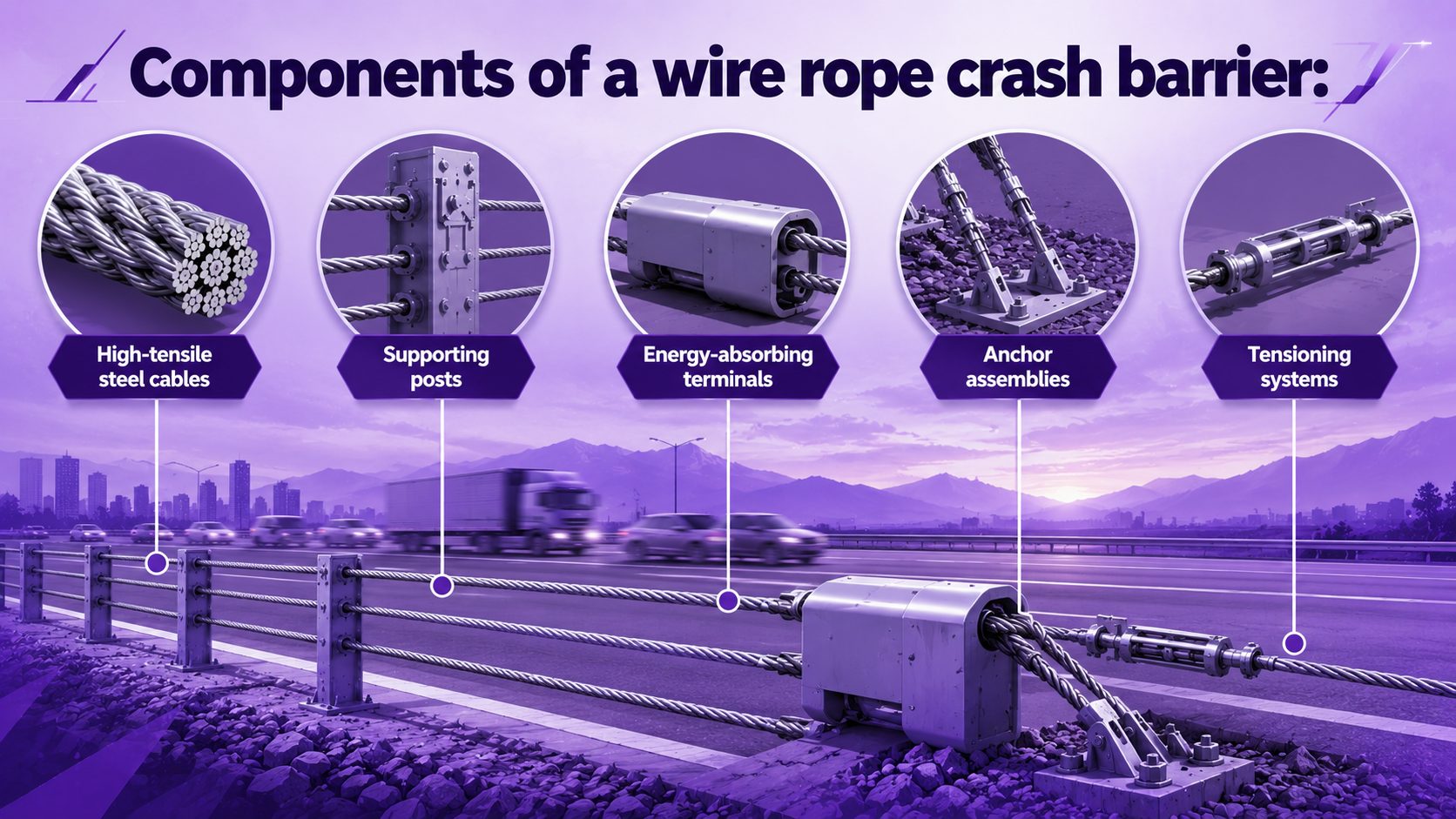
Key components of a cable crash barrier include
High-tensile steel cables: Absorb and transfer impact energy across the barrier length.
Supporting posts: Hold the cables in position and maintain system strength.
Energy-absorbing terminals: Help manage impact forces at barrier ends.
Anchor assemblies: Secure the system and maintain stability.
Tensioning systems: Maintain the required cable tension for effective performance.
Crash barriers work differently based on their design. Flexible barriers absorb impact through controlled movement; semi-rigid barriers deform partially to reduce collision forces, while rigid barriers provide vehicle containment through minimal movement.
| Barrier type | Working mechanism | Common application |
|---|---|---|
| Wire rope barrier | Cables absorb and redirect impact energy | High-speed highways, medians. |
| W-beam barrier | Steel beam deformation absorbs impact | Highways and roadsides. |
| Concrete barrier | Rigid structure contains vehicle movement | Bridges, medians. |
For EPC contractors, highway developers and road safety teams, selecting the right highway crash barrier system depends on factors such as road conditions, vehicle speed, safety requirements, and project specifications.
How does a wire rope crash barrier work?
A wire rope crash barrier works by absorbing and redirecting the force generated when a vehicle leaves its intended path. This flexible crash barrier system uses tensioned steel cables and supporting posts to control vehicle movement during a collision.
Vehicle impact
When a vehicle hits the cable system, the tensioned ropes absorb the initial impact force. The posts support the structure and allow the wire rope safety barrier to move in a controlled manner.
Energy absorption
The cables deflect during a collision and distribute the impact energy across the barrier length. This crash energy absorption process reduces the force transferred to the vehicle and improves occupant safety.
Vehicle redirection
After impact, the cable crash barrier helps guide the vehicle back towards the roadway. This reduces the risk of vehicles crossing medians or entering hazardous roadside areas.
Reduced collision severity
The flexible design reduces sudden stopping forces compared with rigid barriers. This controlled movement improves vehicle containment and helps lower collision severity.
As an advanced highway safety technology, cable-based barriers are increasingly used on expressways, highways and medians. Their ability to combine flexibility, containment, and impact absorption makes them an effective highway crash barrier system for modern road infrastructure projects.
Components of a wire rope crash barrier system
A wire rope crash barrier system consists of multiple components that work together to absorb impact, redirect vehicles, and maintain barrier strength. For EPC contractors and procurement teams, selecting quality wire rope barrier components is important to ensure safety, durability, and compliance with project requirements.
| Component | Description | Procurement considerations |
|---|---|---|
| Steel wire ropes | High-tensile steel cables form the main impact-absorbing element. Different rope configurations are used based on containment requirements and road conditions. | Check steel grade, tensile strength, corrosion resistance, and suitability for the project design. |
| Supporting posts | Steel posts hold the cables at fixed intervals and help maintain the barrier alignment during vehicle impact. | Evaluate post strength, spacing requirements, material quality, and durability. |
| Terminals and anchor systems | End terminals secure the cables and prevent loosening. Anchor assemblies maintain the required cable tension throughout the system. | Verify anchor strength, connection reliability and compatibility with the complete barrier system. |
| Spacers and accessories | Includes connection hardware, bolts, fasteners, and tensioning devices required for installation and maintenance. | Check component quality, dimensional accuracy, and manufacturer specifications. |
| Protective coating | Galvanisation protects steel components from corrosion and extends service life, especially in outdoor environments. | Assess galvanisation quality, coating thickness, and long-term resistance to weather conditions. |
When selecting crash barrier materials, contractors should consider material grade, manufacturer certifications, testing documentation and compatibility with project specifications. A high-quality galvanised steel crash barrier system provides better durability and performance across highways, expressways, and other infrastructure projects.
Types of wire rope crash barriers
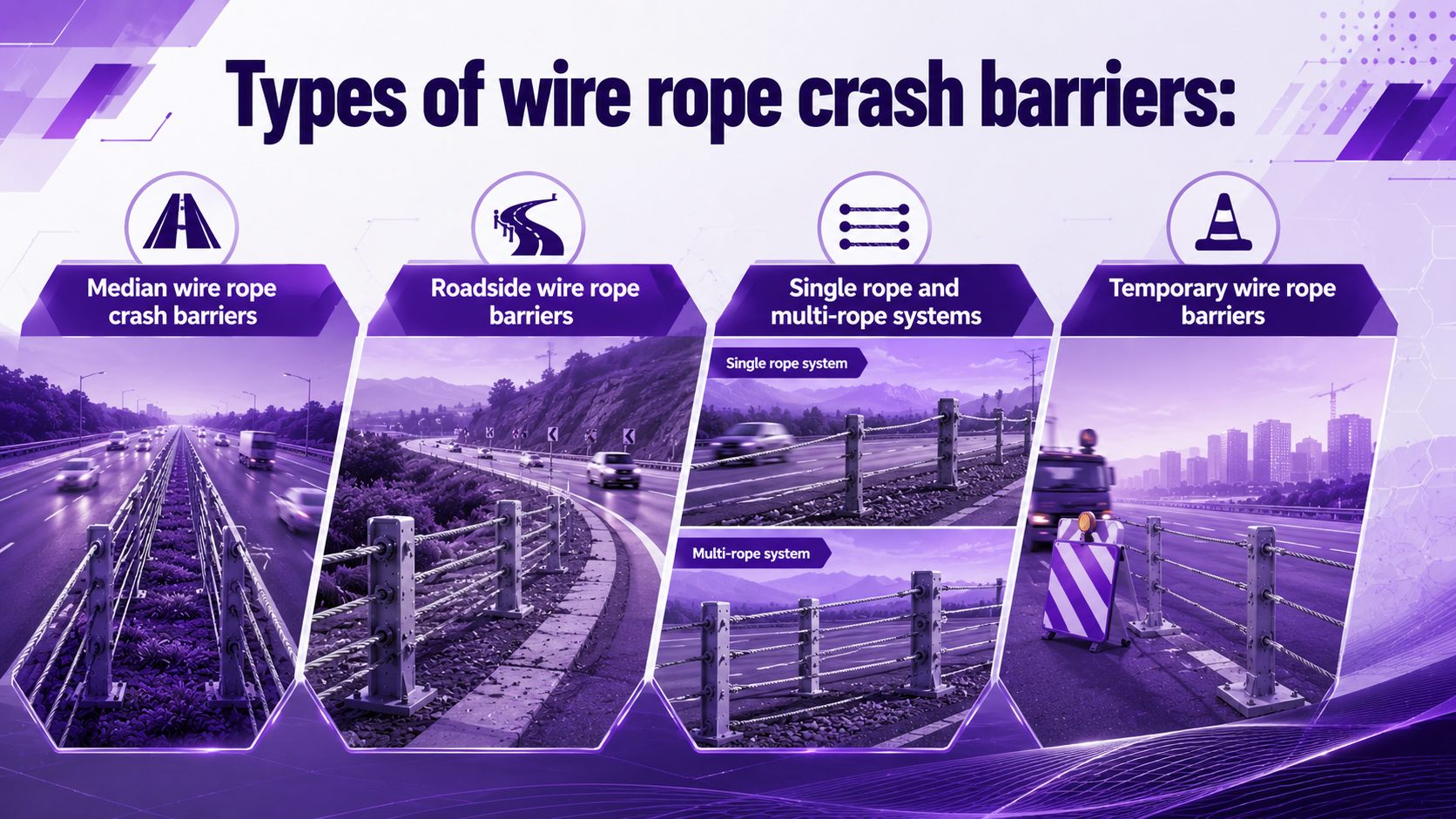
Wire rope crash barriers are available in different configurations based on road conditions, safety requirements, and vehicle containment needs. Contractors select the right system by considering factors such as road speed, location, traffic movement, and project specifications.
Median wire rope crash barriers
A median crash barrier is installed between two carriageways to prevent vehicles from crossing into opposite traffic lanes.
Common applications:
- Divided highways
- Expressways
- High-speed traffic corridors
Key benefits:
- Helps prevent crossover accidents between opposing lanes.
- Provides effective lane separation on high-speed roads.
- Offers flexible impact absorption during collisions.
These barriers are commonly used by highway developers where maintaining safe separation between fast-moving traffic lanes is critical.
Roadside wire rope barriers
A roadside wire rope barrier protects vehicles from leaving the carriageway and entering unsafe areas.
Common applications:
- Road edges
- Embankments
- Hazardous roadside locations
- Sharp curves and vulnerable sections
Key benefits:
- Reduces vehicle run-off-road accidents.
- Provides protection near steep slopes and roadside hazards.
- Improves safety on highways and rural roads.
This type of roadside safety barrier helps improve protection where vehicles face a higher risk of leaving the roadway.
Single rope and multi-rope systems
Wire rope systems can use different numbers of cables depending on the required containment level.
- Single rope systems are suitable for applications with lower containment requirements.
- Multi-rope systems provide higher restraint and improved vehicle control.
- The number of cables depends on project specifications, road conditions, and safety requirements.
Temporary wire rope barriers
Temporary systems provide short-term protection during road development and maintenance activities.
Common applications:
- Construction zones
- Highway expansion projects
- Temporary traffic diversions
Key benefits:
- Supports safer movement around active work areas.
- Provides quick installation and removal.
- Helps improve workers and road user safety.
A temporary highway barrier is especially useful for EPC contractors managing phased construction and highway upgrade projects.
Wire rope crash barrier standards and testing requirements in India
Meeting recognised safety standards is essential when selecting a road restraint system for highway projects. For EPC contractors, consultants and procurement teams, compliance helps ensure reliable performance, smoother approvals, and alignment with project specifications. Before procurement, always review the product’s testing reports, certifications, and applicable standards.
| Standard/guideline | What it covers | Why it matters |
|---|---|---|
| EN 1317 | An internationally recognised standard for testing road restraint systems under controlled crash conditions. | Defines key performance criteria such as containment level, impact severity, working width, and vehicle redirection. It is widely referenced for evaluating highway safety barriers. |
| MORTH Specifications | Technical specifications issued by the Ministry of Road Transport and Highways for road and highway projects in India. | Compliance is often required for National Highway and other government-funded infrastructure projects. |
| IRC guidelines | Recommendations published by the Indian Roads Congress for the design, selection and installation of roadside safety barriers. | Helps engineers choose the appropriate barrier system based on road geometry, traffic volume, and safety requirements. |
| Crash test certification | Independent testing that verifies how a barrier performs under defined impact conditions. | Confirms that the system has been evaluated for safety, reliability, and compliance before installation. |
Key crash testing parameters
Crash testing evaluates how a barrier performs under different collision scenarios. The following parameters are commonly assessed during testing.
| Parameter | Importance |
|---|---|
| Vehicle type | Assesses barrier performance with different vehicle categories and weights. |
| Impact speed | Measures performance at specified collision speeds. |
| Impact angle | Evaluates the barrier’s ability to redirect vehicles striking from different angles. |
| Containment level | Determines the barrier’s capability to safely restrain and redirect vehicles. |
| Working width | Indicates the space required behind the barrier during maximum deflection. |
| Dynamic deflection | Shows how far the barrier moves during impact and helps determine installation clearance. |
Advantages of wire rope crash barriers for highway projects
Wire rope barriers have become a preferred road safety solution for many highway projects because they combine flexibility with effective vehicle containment. Their ability to absorb impact energy makes them well suited for high-speed road networks and modern highway infrastructure.
Improved road safety: Helps reduce the severity of collisions by absorbing impact energy instead of resisting it completely.
Prevents cross-median crashes: Reduces the risk of vehicles crossing into opposing traffic, improving safety on divided highways.
Better energy absorption: The flexible cable system distributes impact forces across the barrier, helping control vehicle movement.
Lower installation requirements: Requires fewer steel components than some rigid barrier systems, which can simplify installation in suitable locations.
Suitable for high-speed roads: Ideal for applications such as – expressways, national highways, rural highways, and high-speed divided corridors.
Easier maintenance: Damaged cables or posts can often be repaired or replaced individually instead of replacing the entire system.
Long-term durability: Galvanised steel components offer good resistance to corrosion and weather exposure, helping extend service life.
Cost-effective over the project lifecycle: Lower repair requirements after minor impacts can help reduce long-term maintenance costs.
For EPC contractors and infrastructure developers, the benefits of wire rope crash barrier systems go beyond compliance. Their flexibility, ease of maintenance, and suitability for high-speed roads make them an effective choice for highway accident prevention systems and modern road safety infrastructure.
Wire rope vs W-beam crash barrier: Which one should you choose?
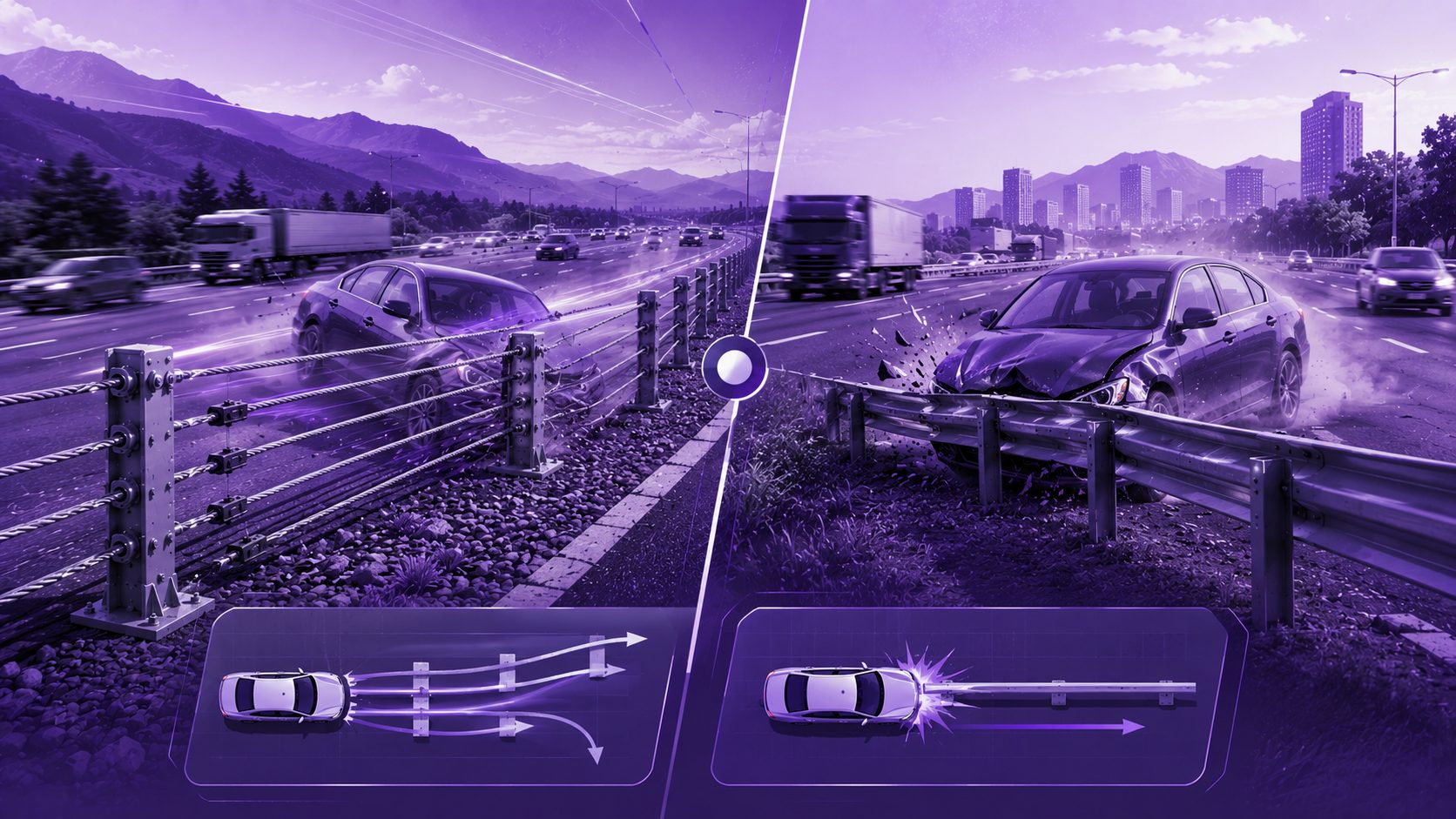
Both wire rope and W-beam barriers improve road safety, but they are designed for different applications. The right choice depends on your project’s safety objectives, site conditions, and technical specifications. This highway barrier comparison can help contractors and procurement teams make informed decisions.
| Feature | Wire rope barrier | W-beam barrier |
|---|---|---|
| Design | Flexible cable system | Semi-rigid steel beam |
| Energy absorption | High | Moderate |
| Installation | Faster in suitable locations | More conventional |
| Deflection | Higher | Lower |
| Typical application | High-speed roads, expressways and medians. | Highways, roadsides, bridges and general road networks. |
Which barrier is right for your project?
Road geometry: Curves, medians, embankments, and roadside hazards influence barrier choice.
Traffic speed: Flexible cable systems are commonly used in high-speed corridors where impact energy is higher.
Available roadside clearance: Wire rope barriers require more working width because they deflect during impact.
Project specifications: Always follow tender requirements, MORTH specifications, and applicable safety standards.
Maintenance requirements: Consider inspection frequency, repair procedures, and the availability of replacement components.
Budget: Compare the total project cost, including installation, maintenance, and lifecycle expenses.
There is no single solution for every highway project. In the wire rope barrier vs W-beam barrier debate, the best option depends on site conditions, safety requirements, and long-term operational needs. Using a structured crash barrier selection guide helps engineers and procurement teams choose the most suitable system for each application.
Where should wire rope barriers be installed?
Selecting the right location is just as important as selecting the right barrier system. Wire rope barriers perform best where there is enough space for controlled deflection during a vehicle impact. The table below highlights locations where these systems are commonly installed and why they are suitable.
| Location | Why it is suitable |
|---|---|
| Wide medians | Provides adequate working width for the cables to deflect while preventing crossover accidents. |
| Expressways and high-speed corridors | Flexible design absorbs impact energy effectively at higher vehicle speeds. |
| Divided highways | Improves lane separation and helps redirect errant vehicles back towards the carriageway. |
| Accident-prone stretches | Reduces the likelihood of severe head-on collisions in high-risk sections. |
| Long, straight highway sections | Offers consistent vehicle containment over extended distances. |
| Roads with adequate recovery zones | Allows the barrier to perform as intended without nearby obstacles restricting movement. |
Locations where they may not be the best choice
Wire rope barriers may be less suitable in certain situations, including:
Narrow bridges: Limited working width can restrict barrier deflection.
Urban roads: Space constraints often make rigid or semi-rigid barriers more practical.
Locations with fixed roadside structures: Poles, retaining walls or bridge piers close to the carriageway can limit safe barrier movement.
Projects requiring minimal deflection: Some sites may require barrier systems with lower working widths.
Before finalising a barrier type, engineers should assess road geometry, available clearance, traffic speed, safety objectives, and project specifications. Matching the barrier to the site conditions helps improve safety, simplifies compliance, and supports long-term performance.
Installation and maintenance best practices
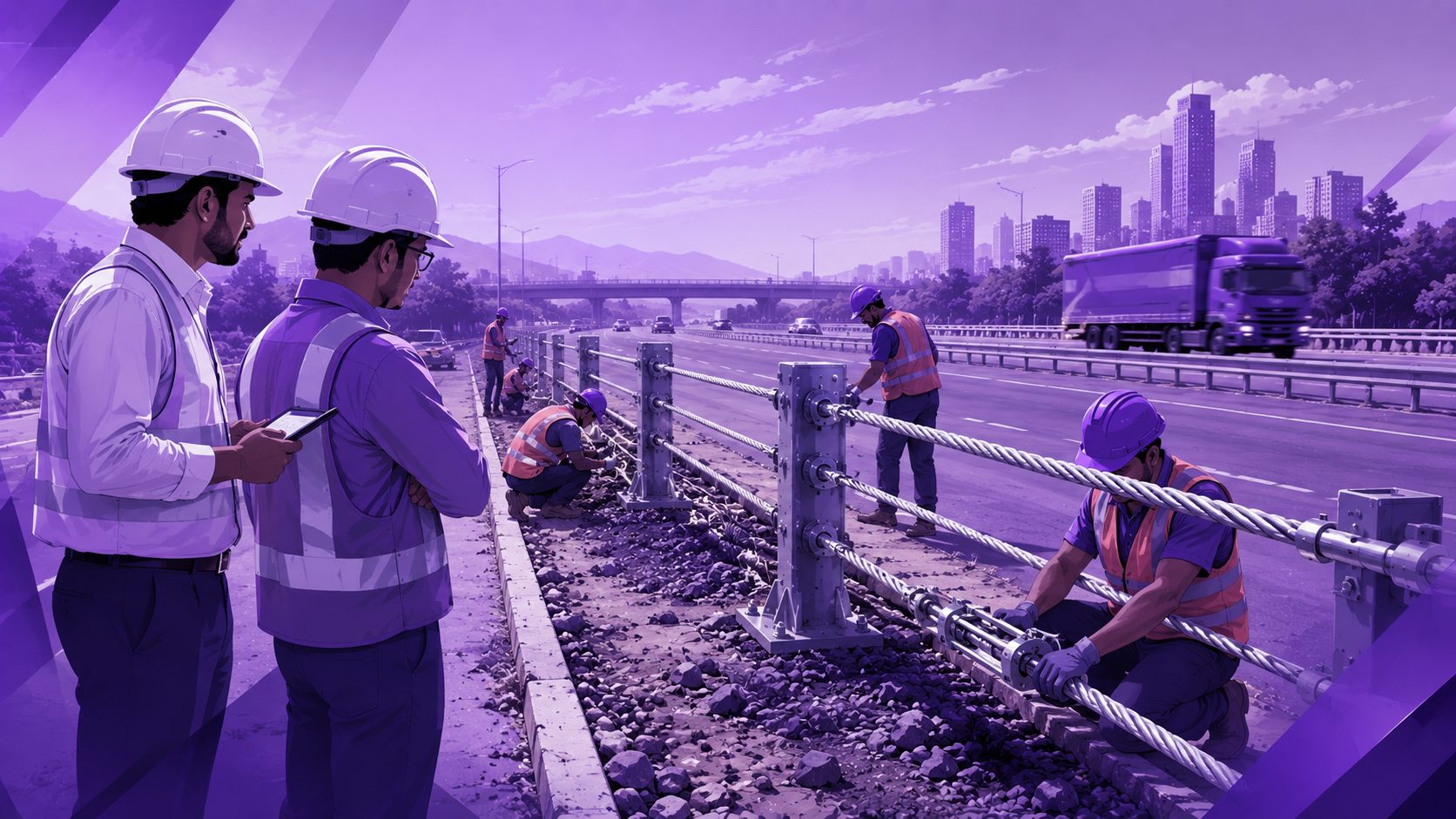
Proper wire rope barrier installation plays a major role in the long-term performance of the system. Following the recommended crash barrier installation process helps ensure the barrier performs as intended during a collision while reducing future maintenance requirements.
Site survey and marking: Identify the installation alignment, post locations, and any site-specific constraints before work begins.
Foundation preparation: Prepare the ground according to the project specifications to provide adequate support for the barrier system.
Installation of steel posts: Install the posts at the specified spacing and alignment. Incorrect post spacing can affect the barrier’s ability to absorb and redirect impact energy.
Cable fixing and tensioning: Attach the steel cables and apply the recommended tension. Proper cable tension is essential for consistent barrier performance.
Alignment and quality checks: Inspect the complete system to verify post alignment, cable height, tension, and component connections before opening the road to traffic.
Common installation and maintenance challenges: Watch for incorrect post spacing, improper cable tension, corrosion caused by environmental exposure, and damage after vehicle impacts. Delayed replacement of damaged components can also reduce system performance.
Best practices for long-term performance
- Inspect the barrier regularly for signs of damage or corrosion.
- Replace damaged cables, posts, and fittings promptly.
- Use certified replacement components that match the original system.
- Follow the manufacturer’s installation and maintenance recommendations.
- Schedule preventive maintenance to improve service life and reliability.
Proper installation and routine maintenance help ensure the barrier continues to provide effective vehicle containment, reliable impact performance, and long-term durability throughout its service life.
Conclusion
As India’s highway network continues to expand, selecting the right road restraint system is becoming increasingly important. Wire rope crash barriers offer a practical solution for improving safety on high-speed corridors while supporting modern infrastructure requirements. However, no single barrier is suitable for every project. Factors such as road geometry, traffic conditions, available working width, and project specifications should guide the final selection.
By choosing a system that matches site requirements and complies with recognised standards, project teams can enhance road safety, improve operational reliability, and support the long-term performance of highway infrastructure.
Looking to procure steel?
Tata nexarc helps manufacturers, builders and MSMEs source certified steel products, compare prices, and choose the right grade as per IS codes—with complete traceability and procurement confidence.
FAQs
What is a wire rope crash barrier?
Where are wire rope crash barriers commonly used?
What is the difference between a wire rope barrier and a W-beam barrier?
What are the main components of a wire rope crash barrier?
Which standards apply to wire rope crash barriers in India?
How does a wire rope crash barrier reduce accident severity?
Are wire rope crash barriers suitable for all roads?
How long do wire rope crash barriers last?
How often should wire rope crash barriers be inspected?
How do you choose the right wire rope crash barrier?
A product manager with a writer's heart, Anirban leverages his 6 years of experience to empower MSMEs in the business and technology sectors. His time at Tata nexarc honed his skills in crafting informative content tailored to MSME needs. Whether wielding words for business or developing innovative products for both Tata Nexarc and MSMEs, his passion for clear communication and a deep understanding of their challenges shine through.