Check Price Now
Table of Contents
- What is the Density of Bitumen?
- What is the Typical Density of Bitumen in kg/m³?
- Bitumen Density at Different Temperatures
- Bitumen Density vs Specific Gravity: What is the Difference?
- How to Calculate Bitumen Density
- How is Bitumen Density Tested?
- Factors That Affect Bitumen Density
- Why Bitumen Density Matters in Road Construction
- How to Use Bitumen Density for Procurement and Quantity Calculations
- Bitumen Density for VG Grades, PMB and CRMB
- Bitumen Density: Key Checks Before Accepting Bulk Supply
- Conclusion
- FAQs
Bitumen density refers to the mass of bitumen contained in a specific volume. It plays an important role in road construction, as engineers and contractors use it to estimate material requirements, convert bitumen volume into weight, and maintain control over asphalt mix production. The density of bitumen also helps procurement and site teams check whether delivered quantities align with project requirements.
Bitumen density in kg/m³ can vary depending on the bitumen grade, temperature, composition, and testing conditions. This makes it important to use the correct value when planning bitumen density for road construction, paving works, waterproofing applications, or bulk infrastructure procurement.
What is the density of bitumen?
The density of bitumen is the mass of bitumen contained within a specific volume. In simple terms, it shows how much a given volume of bitumen weighs. Engineers, asphalt plant operators, and procurement teams use this relationship to convert between volume and weight when estimating material requirements or checking bulk quantities.
The basic formula is
Density = Mass ÷ Volume
Density can be expressed in different units, including:
kg/m³ (kilograms per cubic metre): Common for engineering and bulk quantity calculations.
kg/litre: Useful when working with smaller volumes.
g/cm³ (grams per cubic centimetre): Commonly used in laboratory and technical data.
These units represent the same property but use different volume measurements. For example, 1,000 kg/m³ equals 1 kg/litre and 1 g/cm³.
A simple bitumen density calculation
If 1 cubic metre of bitumen weighs 1,020 kg:
Density = 1,020 kg ÷ 1 m³ = 1,020 kg/m³
The same value can help convert a known volume into weight:
Weight = Density × Volume
Engineers and procurement teams should also check the reference temperature when comparing density values. Bitumen changes in volume as its temperature changes, so a density value only makes sense when reported under the stated measurement conditions.
What is the typical density of bitumen in kg/m³?
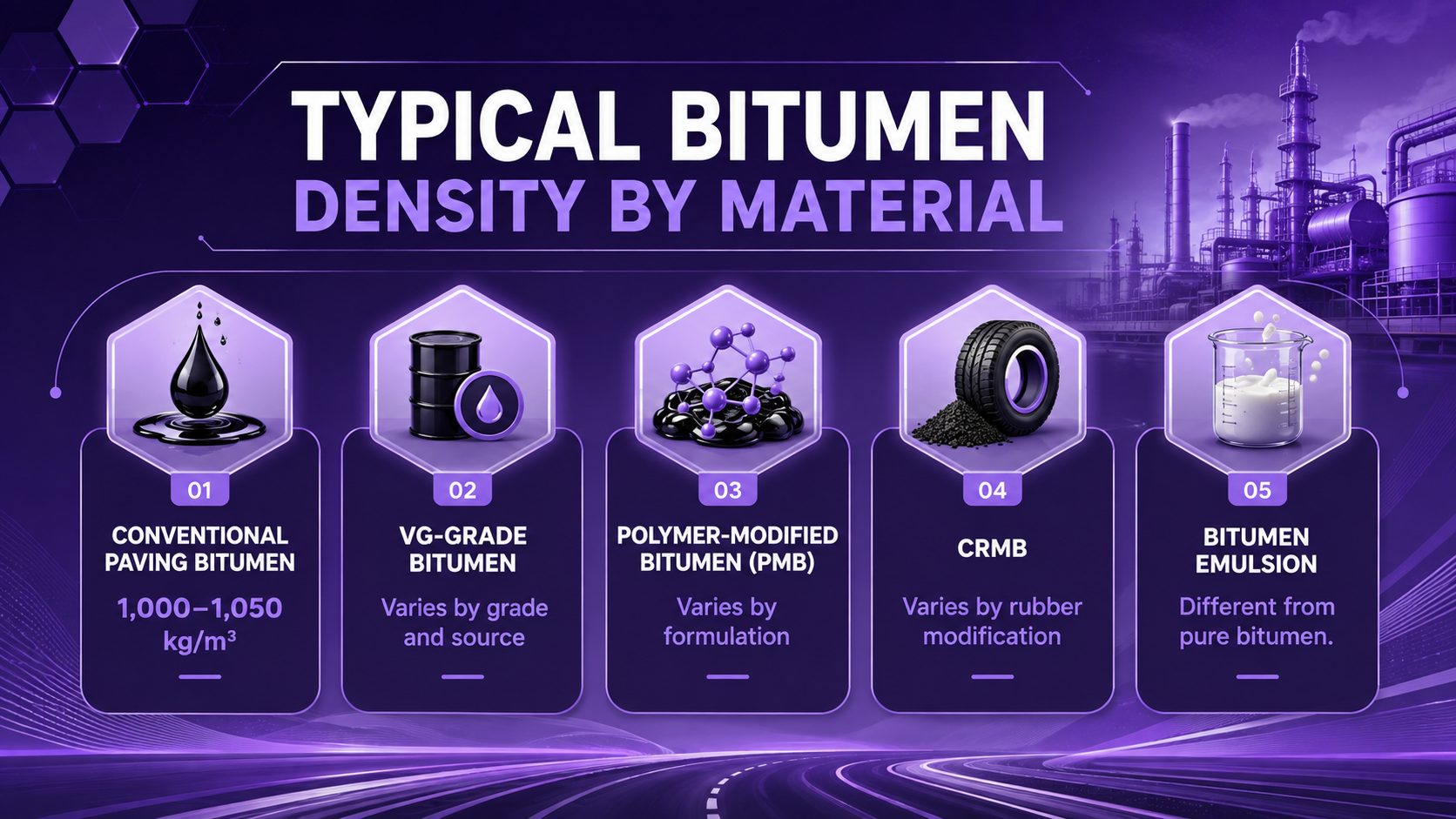
The typical bitumen density of conventional paving grades generally falls close to 1,000–1,050 kg/m³ at the specified reference temperature. However, this range should only serve as a general guide. The actual density of bitumen can vary depending on its grade, source, composition, and the temperature at which it is measured.
Different bituminous materials can also show different density values. Polymer or rubber modification, for example, can change the physical characteristics of the binder. Bitumen emulsion also has a different composition from pure paving bitumen, so its density should not be compared directly with conventional grades.
| Bitumen material | Typical density range* | Common use |
| Conventional paving bitumen | Generally close to 1,000–1,050 kg/m³ | Road construction and asphalt mixes |
| VG-grade bitumen | Varies by grade and source | Flexible pavement construction |
| Polymer-modified bitumen (PMB) | Varies depending on the modifiers used | High-performance roads |
| CRMB | Varies depending on rubber modification and formulation | Heavy-duty and high-traffic roads |
| Bitumen emulsion | Different from pure bitumen | Surface treatments and road maintenance |
*Actual values can vary based on formulation, temperature, source, and manufacturer specifications.
For contractors and procurement teams, using one standard bitumen density value for every product can lead to inaccurate quantity calculations. Always check the manufacturer’s certificate of analysis, approved technical data sheet, or relevant test report for the specific material supplied. The reported specific gravity of bitumen and reference temperature can also help engineers interpret and compare material properties correctly.
Bitumen density at different temperatures: Why temperature matters
Bitumen expands when heated
Bitumen expands as its temperature rises and contracts as it cools. This change affects the volume occupied by the material. As a result, the density of hot bitumen differs from its density at a lower temperature.
Density changes with temperature
Bitumen temperature and density are closely linked. When bitumen heats up, its volume increases while its mass remains the same. Its density therefore decreases. When the material cools and contracts, the density increases.
Compare density values at the same reference temperature
A bitumen density at temperature value cannot always be compared directly with a value measured under different temperature conditions. Engineers and quality teams should check the stated reference temperature before using density data for calculations or material comparisons.
Why this matters during project operations
Temperature-based density changes can affect several activities:
Bulk storage tanks: Tank volume can change as stored bitumen heats or cools.
Tanker loading: A tanker may carry a specific volume of heated bitumen, but its corresponding weight depends on the applicable density and measurement temperature.
Asphalt plants: Accurate density data supports better control over binder quantities during production.
Hot-mix production: Temperature variations can affect bitumen volume-to-weight conversion when operators calculate material consumption.
Quantity reconciliation: Site and procurement teams should use a consistent temperature basis when comparing delivery, storage, and consumption records.
Bitumen density vs specific gravity: What is the difference?
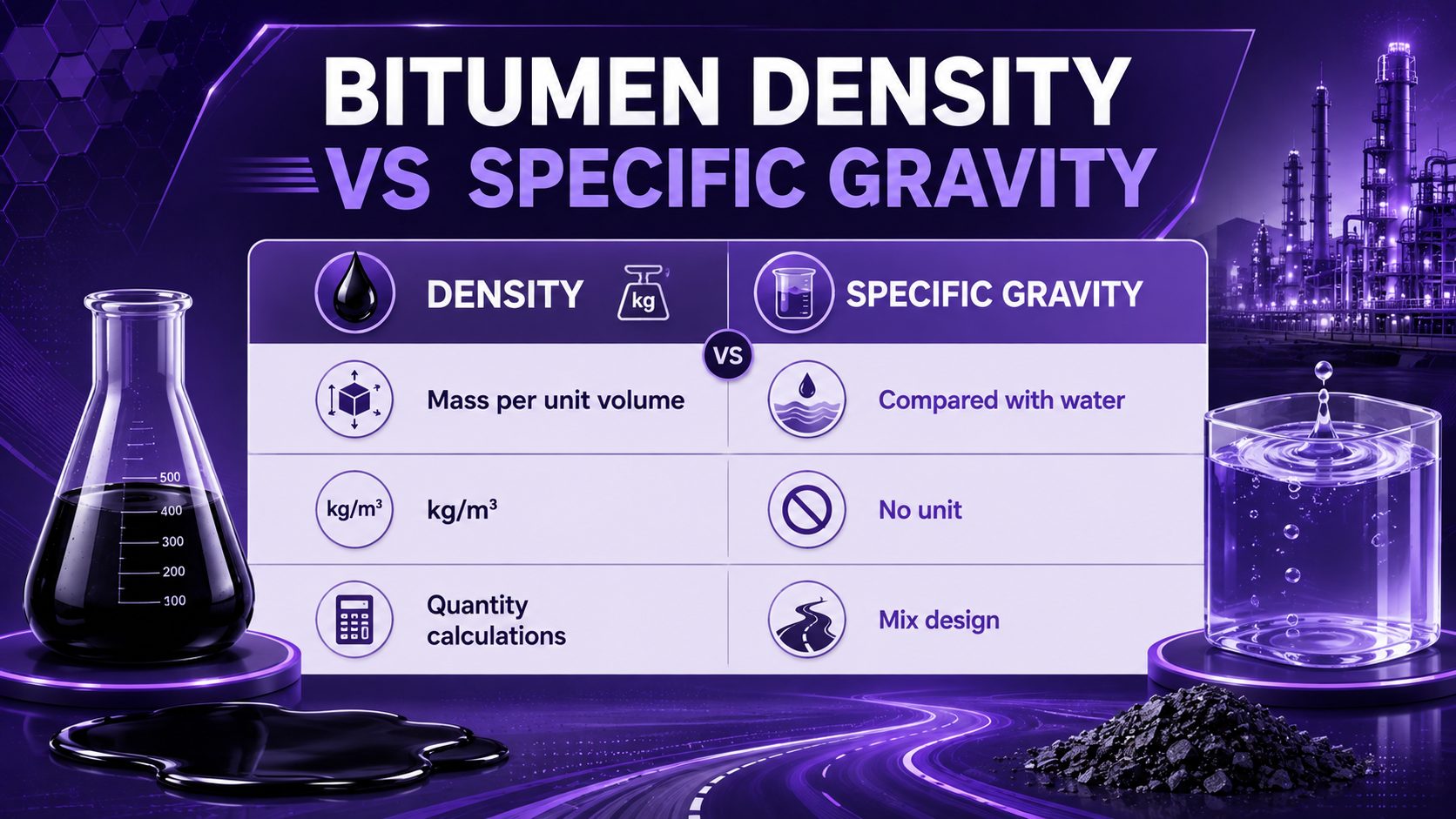
They are related, but measure different things. Engineers and contractors often use both values when checking material properties, calculating quantities, and preparing asphalt mixes.
Density measures mass per unit volume
Density shows the weight or mass of bitumen within a given volume. It is expressed in units such as kg/m³, kg/litre, or g/cm³. Project and procurement teams mainly use density for quantity, storage, and volume-to-weight calculations.
Specific gravity compares bitumen with water
The specific gravity of bitumen compares its density with the density of water under specified reference conditions. It is a ratio, so it has no unit. Testing laboratories and engineers often use this property when assessing bitumen and carrying out asphalt mix calculations.
Key difference at a glance
| Parameter | Density | Specific gravity |
| Meaning | Mass per unit volume | Relative density compared with water |
| Unit | kg/m³, kg/litre, g/cm³ | No unit |
| Use | Quantity and volume calculations | Material and mix design calculations |
When comparing bitumen density vs specific gravity, contractors should not treat the two values as interchangeable. The difference between density and specific gravity of bitumen becomes important when converting quantities or using laboratory data for mix design and quality control.
How to calculate bitumen density
Knowing how to calculate bitumen density helps contractors and project teams convert between weight and volume. This can support tanker quantity estimates, material receipt checks, and bitumen consumption planning at asphalt plants.
Bitumen density formula
Use the following formula:
Density = Mass ÷ Volume
Where:
- Mass is measured in kilograms (kg).
- Volume is measured in cubic metres (m³).
- Density is expressed in kg/m³.
For example, if a quantity of bitumen has a mass of 1,020 kg and occupies a volume of 1 m³:
Density = 1,020 kg ÷ 1 m³ = 1,020 kg/m³
Calculating weight from volume
Procurement and site teams can use density to estimate the weight of a known volume:
Weight = Density × Volume
This bitumen weight calculation can help when checking the approximate quantity carried in a tanker or stored in a bulk tank.
Calculating volume from weight
When the weight is known, use:
Volume = Weight ÷ Density
This helps teams convert bitumen volume to weight, or calculate the volume represented by a recorded weight. Always use the applicable density value and reference temperature for the specific material when carrying out quantity calculations.
How is bitumen density tested?
Bitumen density testing requires controlled conditions because temperature can affect the result. Quality-control teams should therefore follow the applicable test method and record the specified reference temperature when reporting the value. This helps engineers compare results on a consistent basis.
Representative sampling
The test starts with a representative bitumen sample. The sample should reflect the material supplied to the project, as an unsuitable or contaminated sample can affect the result.
Conditioning at the required temperature
Laboratory teams condition the sample at the temperature required by the applicable test method. This step helps ensure that the measurement uses the correct reference conditions.
Measurement using the applicable method
Laboratories use suitable equipment and recognised test methods to determine density or specific gravity. Calibrated equipment helps improve measurement accuracy and consistency.
Recording and reporting the results
The test report should clearly record the measured value, test conditions, and relevant reference temperature. Engineers can then use this information for quality checks and project calculations.
Highway contractors, consultants, PMC teams, and project authorities should rely on approved laboratory reports rather than estimating density from the bitumen’s appearance or viscosity. Visual checks cannot provide a reliable density value.
Factors that affect bitumen density
Does bitumen density vary? Yes. The density of a bitumen product can change based on its grade, composition, temperature, and modification. The table below explains the main factors affecting bitumen density.
| Factor | How it affects bitumen density | What project teams should know |
| Bitumen grade | Different grades can have different compositions and physical properties, which may result in different density values. | Do not assume that every VG grade has the same density. Check the product-specific technical data. |
| Temperature | Bitumen expands when heated and contracts as it cools, causing density to change. | Always consider the reference temperature when comparing density values. |
| Source and crude composition | The crude oil source and refining process influence the composition and properties of the final bitumen. | Products from different manufacturers or sources may not have identical density values. |
| Polymer modification | Added polymers can change the physical characteristics of the binder. | PMB density may differ from that of conventional paving bitumen. Check the approved product data. |
| Rubber modification | Crumb rubber changes the composition of the binder and can influence its density characteristics. | CRMB density should be checked against the relevant product specification or test report. |
| Ageing and oxidation | Storage, heating, and exposure over time can alter the physical properties of bitumen. | Long storage periods and repeated heating may require closer quality monitoring. |
| Blending and additives | Additives and blending components can affect the final composition of the binder. | Confirm the properties of modified or specially formulated products before project use. |
For VG bitumen density, PMB, CRMB, and other modified products, contractors should rely on the manufacturer’s technical documents and relevant test results rather than applying one standard density value across all materials.
Why bitumen density matters in road construction and asphalt production

Accurate material quantity estimation
Bitumen density helps contractors convert procurement volumes into weight. This supports more accurate material planning, especially when projects purchase and handle bitumen in bulk quantities.
Asphalt mix production
Asphalt plants need to control binder input carefully during production. The correct density value supports accurate binder dosing and helps operators track asphalt plant consumption against planned mix requirements.
Tanker receipt verification
During tanker unloading, site and procurement teams may compare supplied quantities with invoices, weighbridge records, and storage measurements. Using the applicable density and temperature basis supports better quantity verification and material reconciliation.
Storage tank management
Many projects monitor bulk bitumen through tank levels or recorded volumes. Density data helps teams interpret inventory records and maintain better control over available material.
Tender and cost estimation
Contractors preparing bids need reliable material estimates to control costs. A realistic density value can support quantity planning and improve project cost control, particularly for large road and highway packages.
Quality control and material consistency
An unexpected change in bitumen density does not automatically indicate a material defect. However, engineers should investigate significant variations by checking the product grade, specifications, test conditions, and reference temperature.
For bulk bitumen procurement, density therefore supports more than a simple technical calculation. It can strengthen material reconciliation, quantity control, production planning, and project-level decision-making across the road construction supply chain.
How to use bitumen density for procurement and quantity calculations
For bulk bitumen procurement, contractors and procurement teams can use the following process for bitumen quantity calculation:
Confirm the product: Check the bitumen grade, product specification, and approved material requirements.
Check the density basis: Refer to the manufacturer’s technical documentation or approved test report for the applicable density value and reference temperature.
Record the delivered volume: Obtain the volume from tanker records, delivery documents, or site measurements.
Convert volume into weight: Apply the relevant density value to estimate the corresponding weight. A bitumen volume-to-weight calculator can simplify this calculation.
Verify the delivered quantity: Compare the calculated result with the supplier’s invoice, weighbridge data, and delivery records during bitumen tanker quantity calculation.
Reconcile material records: Investigate significant differences before closing the receipt or inventory entry.
Document the calculation basis: Record the density value, reference temperature, volume, and calculation method for project and audit purposes.
Important: Do not use a generic density value for commercial quantity reconciliation when the project specification, supplier documentation, or approved test results provide a specific value for the material supplied.
Bitumen density for VG grades, PMB and CRMB: What contractors should check
The density of modified and conventional bitumen can differ based on grade, formulation, and product specifications. Instead of applying a standard value, contractors should verify the relevant technical and quality documents for the material supplied.
| Material | What to check | Why it matters |
| VG bitumen | Confirm the VG grade and applicable specification. Check the density or specific gravity stated in the approved technical data or test report. | VG bitumen density can vary based on the product and source, so project teams should use the approved material data. |
| PMB | Check the base bitumen, polymer modification, product specification, and reported physical properties. | Polymer modification can affect material characteristics, so PMB density should be assessed for the specific formulation. |
| CRMB | Verify the grade, crumb rubber modification, formulation, and relevant quality requirements. | CRMB density may depend on the material composition and modification process. |
| All bitumen types | Check the reference test temperature, batch or lot consistency, storage requirements, and handling instructions. | These factors help teams interpret technical data correctly and maintain material consistency during project use. |
For procurement and site acceptance, contractors should cross-check these details against the relevant bitumen specifications and approved test reports. Internal links to detailed guides on VG bitumen grades, PMB, CRMB, and bitumen testing can help users evaluate each material in greater detail.
Bitumen density: Key checks before accepting bulk supply

Before accepting a bulk bitumen delivery, procurement and project teams should complete these key checks:
Product grade: Confirm that the supplied bitumen matches the approved grade and project specification.
Density or specific gravity: Check the applicable value stated in the technical documentation or test report.
Reference temperature: Verify the temperature at which the reported value applies.
Test certificate: Review the supplier’s certificate or relevant quality documents before acceptance.
Delivery quantity: Match the supplied quantity with delivery records, invoices, weighbridge data, and project requirements.
Storage and handling: Check whether site storage and handling conditions meet the product requirements.
Significant deviations: Escalate unexpected differences in material properties or documentation for technical review.
These checks can help contractors maintain better control over bulk material acceptance and reduce avoidable discrepancies during project execution.
Conclusion
A small difference in the reported density can affect how teams interpret bulk bitumen volumes across procurement, storage, and asphalt production. For large highway and infrastructure projects, using an assumed value instead of the approved product data can create avoidable discrepancies in material records. Contractors should therefore treat density as a project-specific material parameter and verify it against the supplied grade, applicable specification, and test documentation before using it for operational calculations.
Looking to procure steel?
Tata nexarc helps manufacturers, builders and MSMEs source certified steel products, compare prices, and choose the right grade as per IS codes—with complete traceability and procurement confidence.
FAQs
What is the density of bitumen?
What is the bitumen density in kg/m³?
How do you calculate bitumen density?
How do you convert bitumen volume into weight?
Does bitumen density change with temperature?
What is the difference between bitumen density and specific gravity?
Does VG bitumen have a fixed density?
Is PMB density different from conventional bitumen density?
Why is bitumen density important in road construction?
Which bitumen density value should contractors use for quantity calculations?
A product manager with a writer's heart, Anirban leverages his 6 years of experience to empower MSMEs in the business and technology sectors. His time at Tata nexarc honed his skills in crafting informative content tailored to MSME needs. Whether wielding words for business or developing innovative products for both Tata Nexarc and MSMEs, his passion for clear communication and a deep understanding of their challenges shine through.