
 Check Price Now
Table of Contents
Builders and contractors typically have trouble deciding between TMT bars and TMX bars. The appropriate choice has a direct effect on the cost of construction, the safety of the structure, and how long it will last. A lot of people think that TMT and TMX bars are radically different, yet the only true difference is how well they work and how they are made. This guide makes it easy to understand by getting rid of the jargon and focusing on what counts on the site. You can then choose which one is preferable for your project.
What are TMT bars?
TMT bars are new-generation-high-strength steel with superior properties. These bars are known for their weldability, strength, ductility, and flexibility which has helped them to meet the highest quality standards. The abbreviation comes from its manufacturing process which is called Thermo-mechanical Treatment.
How TMT bars are manufactured
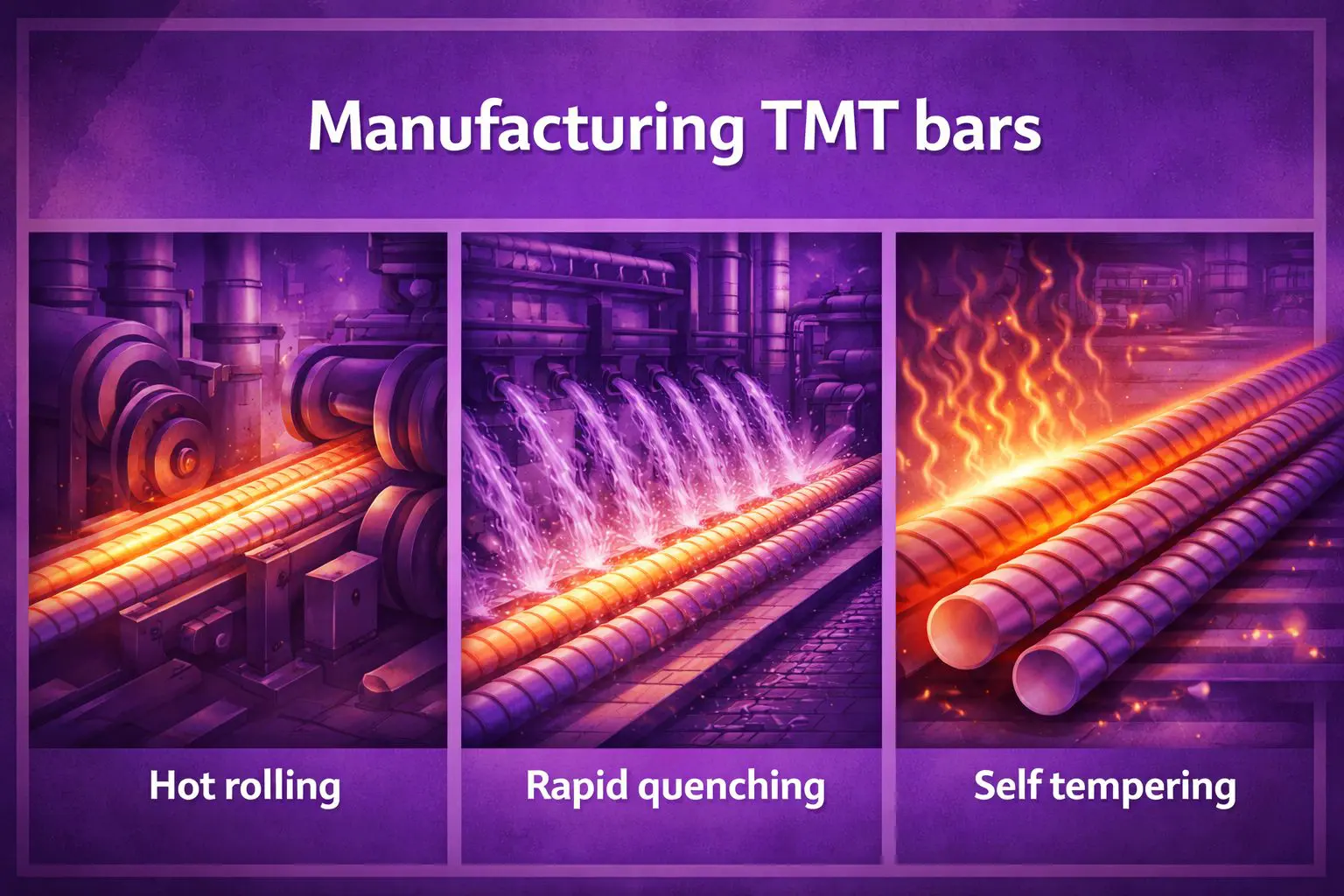
TMT bars are produced using a controlled thermo-mechanical process:
Hot rolling: Steel billets are heated and rolled into bars.
Rapid quenching: Water cooling hardens the outer layer.
Self-tempering: The inner core retains heat and tempers the surface.
This results in a strong outer surface and a ductile inner core, ideal for structural performance.
Key properties of TMT bars
| Property | What it means for construction |
| High ductility | Bends without cracking under load |
| Earthquake resistance | Absorbs seismic shocks effectively |
| Weldability | Easy to weld without weakening joints |
| Corrosion resistance | Longer life in humid/coastal conditions |
Why TMT bars are widely used in India
Builders prefer TMT bars because they are reliable and practical for local conditions:
- Perform well in earthquake-prone zones
- Available in standard grades like Fe 500, Fe 550, Fe 600
- Meet BIS quality standards
- Easy availability across cities and project scales
Where TMT bars are used
TMT bars fit a wide range of applications:
Residential construction: houses, apartments.
Infrastructure projects: bridges, highways, metros.
Commercial structures: malls, factories, warehouses.
Also read: Calculating unit weight of TMT bars – 8mm to 32mm
What are TMX bars?
TMX is an emerging technology in the steel manufacturing industry. A TMX bar also gets its name from the technology used for its production called Thermex technology. This technology is known for producing high quality TMT bars with high tensile strength.
How TMX bars are manufactured
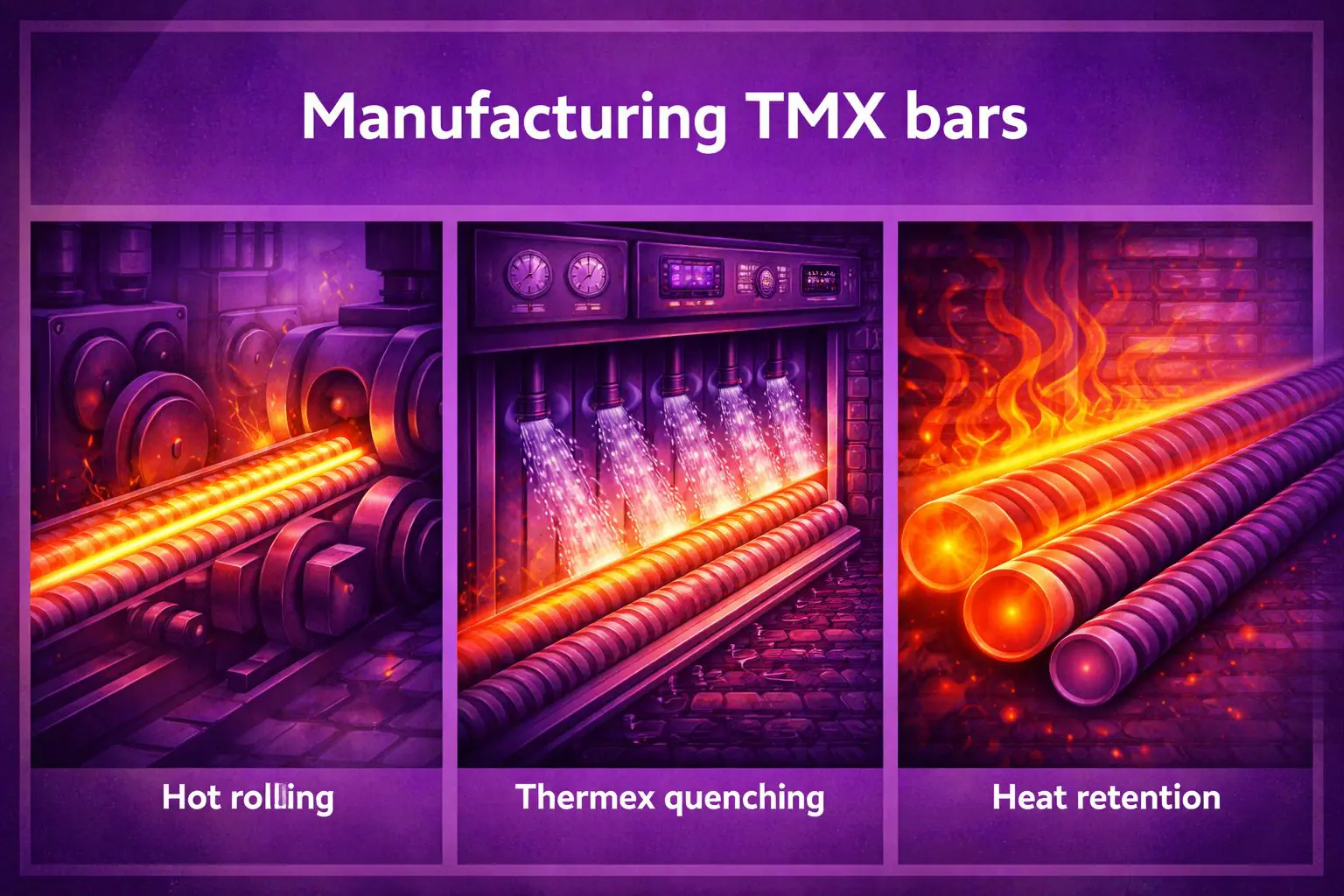
TMX bars follow an advanced version of the TMT process with better control:
Hot rolling: Steel is shaped into bars at high temperatures
Thermex quenching: Controlled water cooling creates a hardened outer layer
Heat retention: Inner core tempers the surface for strength and flexibility
This process improves consistency and enhances mechanical properties.
Key features of TMX bars
| Feature | What it means for construction |
| High tensile strength | Handles higher loads with less steel |
| Improved rib design | Better bonding with concrete |
| Heat/fire resistance | Maintains strength at high temperatures |
| Consistent quality | Uniform properties across batches |
Why TMX bars are gaining popularity
TMX bars are positioned as a process-optimised upgrade in steel manufacturing:
- Focus on material efficiency and cost savings
- Suitable for large-scale and high-load projects
- Increasing adoption by infrastructure and industrial sectors
- Seen as a next-step evolution of TMT technology
Where TMX bars are used
TMX bars are preferred where strength and efficiency matter most:
- High-rise buildings and commercial projects
- Industrial structures and heavy-load applications
- Bulk procurement projects with cost focus
Also read: Bright bar: Manufacturers, price per kg, MS bright bar, HSN codes
TMT bars vs TMX bars: Key differences
| Parameter | TMT bars | TMX bars |
| Manufacturing process | Thermo-mechanical treatment with quenching + self-tempering. | Thermex-controlled cooling (refined version of TMT process). |
| Rib pattern & bonding | Standard rib pattern for good bonding. | More uniform and defined ribs for stronger concrete grip. |
| Strength | High yield and tensile strength (Fe 500–Fe 600 grades). | Slightly higher strength due to better process control. |
| Ductility | Higher ductility, better for seismic zones | Slightly lower ductility compared to TMT |
| Weldability | Good weldability with low carbon content. | Comparable or slightly better weldability due to uniform composition. |
| Corrosion resistance | Strong resistance, especially in branded TMT bars. | Similar or slightly improved due to controlled cooling. |
| Cost (March 2026) | ₹55–₹65 per kg (brand, grade, and location dependent). | ₹52–₹62 per kg (generally 3–5% lower due to efficiency). |
Prices are indicative as of March 2026 and may vary based on location, brand, grade (Fe 500/550/600), and order quantity.
Quick takeaway
TMX bars are not a completely different category. They are a process refinement of TMT bars using Thermex technology, designed to improve strength and manufacturing efficiency.
In simple terms: both serve the same purpose, but TMX focuses more on process optimisation and cost efficiency, while TMT is the broader, widely recognised category.
Strength & performance comparison
Load-bearing capacity
Both TMT and TMX bars offer high load-bearing capacity, making them suitable for structural reinforcement. TMX bars often show a slight edge due to tighter process control, which improves consistency. However, for most residential and standard infrastructure projects, high-grade TMT bars (Fe 500/550) already meet required load standards.
Yield strength vs tensile strength
Yield strength defines when the bar starts to deform, while tensile strength is the maximum stress it can handle before failure. TMX bars may achieve marginally higher tensile strength. TMT bars, however, provide a more balanced yield-to-tensile ratio, which is critical for structural safety and controlled deformation.
Seismic performance (critical in India)
In earthquake-prone zones, ductility matters more than just strength. TMT bars perform better here because they can bend and absorb energy without sudden failure. TMX bars, while strong, may offer slightly lower ductility depending on the manufacturing quality.
Fire resistance comparison
Both TMT and TMX bars are designed to withstand high temperatures. TMX bars often claim better heat resistance due to uniform microstructure. In real-world scenarios, both perform well under fire exposure, provided they meet standard grades and certifications.
Longevity and durability
Durability depends on corrosion resistance and structural stability over time. Both types offer good corrosion resistance, especially low-carbon variants. Proper storage, handling, and concrete cover play a bigger role than the bar type itself.
Key insight: Strength alone isn’t enough
Higher strength does not always mean better performance. Structures need a balance of strength and ductility to handle real-world loads, shocks, and environmental stress without failure.
Cost and material efficiency
Price comparison (per kg)
As of March 2026, TMT bars typically range between ₹55–₹65 per kg, depending on brand, grade, and location. TMX bars are usually priced slightly lower at ₹52–₹62 per kg. The difference is not huge per kg, but it becomes significant in bulk procurement.
Manufacturing efficiency (steel savings)
TMX technology is designed for better material utilisation. Manufacturers often claim up to ~15–17% steel savings during production due to process efficiency and improved strength-to-weight ratio. This can translate into lower material consumption in large projects.
Lifecycle cost vs upfront cost
Lower upfront cost does not always mean better value. TMT bars, with higher ductility, can reduce repair and failure risks over time, especially in seismic zones. TMX bars may reduce initial material costs, but project conditions should guide the final choice.
Transportation and wastage
- TMX bars can reduce total tonnage due to higher strength, lowering transport costs.
- Better rib design may improve concrete bonding, reducing material wastage.
- TMT bars are easier to handle and bend on-site, which can reduce cutting losses.
Which one actually saves money in projects?
Cost savings depend on the project type. TMX bars may offer better savings in large, load-heavy projects, while TMT bars often deliver better long-term value in residential and safety-critical construction.
Applications: Where to use TMT vs TMX bars
Where TMT bars work best
TMT bars are a safe and versatile choice for most construction needs. Their ductility and flexibility make them reliable under dynamic loads and changing conditions.
Earthquake-prone areas: High ductility helps absorb seismic shocks without sudden failure.
Residential buildings: Ideal for homes and apartments where safety and longevity matter.
Projects needing flexibility: Suitable for structures with bends, curves, and on-site adjustments.
In general, TMT bars are preferred when structural safety and adaptability are top priorities.
Where TMX bars make more sense
TMX bars are better suited for projects that demand higher strength and material efficiency. Their consistent properties help in large-scale, load-heavy applications.
Heavy-load structures: Suitable for high-rise buildings, bridges, and industrial setups.
Industrial and commercial projects: Works well in factories, warehouses, and large complexes.
Cost-sensitive bulk procurement: Lower per kg cost and potential material savings benefit large orders.
TMX bars are often chosen when the focus is on strength optimisation and cost efficiency at scale.
Quick decision insights
There is no one-size-fits-all answer.
- Choose TMT bars for safety, flexibility, and residential use.
- Choose TMX bars for strength-driven, large-scale, and cost-focused projects.
Pros and cons of TMT vs TMX steel bars
| Category | TMT bars | TMX bars |
| Pros | • High ductility • Better seismic performance • Easier to bend and handle on-site • Reliable for residential use |
• Higher strength • Better rib design for stronger bonding • More cost-efficient in bulk • Consistent quality due to controlled process |
| Cons | • Slightly higher cost per kg • May use more steel in high-load designs |
• Lower ductility compared to TMT • Less suitable for high seismic zones • Requires careful grade selection |
Quick takeaways
- TMT bars offer better flexibility and safety, especially for homes and earthquake-prone areas.
- TMX bars focus on strength and cost efficiency, making them suitable for large-scale and load-heavy projects.
Which is better for your project?

Budget: Choose TMX if you want lower upfront cost on bulk orders; choose TMT if you prioritise long-term performance and reduced repair risk
Structure type: Choose TMT for homes, low-rise buildings, and general construction; choose TMX for high-rise, industrial, and infrastructure projects
Location (earthquake zones): Choose TMT for seismic areas, as higher ductility helps absorb shocks and prevent sudden failure
Load requirements: Choose TMX for heavy-load and high-stress structures; TMT is sufficient for standard residential and commercial loads
Project scale: Choose TMX for large-scale projects where even small cost savings per kg add up; TMT works well for small to mid-sized builds
On-site workability: Choose TMT if bending, cutting, and adjustments are frequent; TMX is better when design and execution are more standardised
Material optimisation: Choose TMX if reducing total steel consumption is a priority; choose TMT if design flexibility is more important
Quick takeaways
- Choose TMT if → you need safety, flexibility, seismic resistance, and ease of use on-site.
- Choose TMX if → you need higher strength, better cost efficiency, and optimisation in large-scale projects.
Conclusion
TMX bars build on the same foundation as TMT, using a more refined manufacturing approach. But there is no one-size-fits-all answer. The right choice depends on your project’s load, location, and budget priorities. Focus on what the structure demands rather than just specs. If you’re sourcing steel, compare verified suppliers and grades carefully to get consistent quality at the right price.
Also read: What key building raw materials are used in the construction industry?
Looking to procure steel?
Tata nexarc helps manufacturers, builders and MSMEs source certified steel products, compare prices, and choose the right grade as per IS codes—with complete traceability and procurement confidence.
FAQs
Is TMX better than TMT?
Are TMX bars stronger?
Which is cheaper?
Can TMX replace TMT?
Which is better for house construction?
Are TMX bars earthquake resistant?
What is the difference between Thermex and TMT?
Which lasts longer?
Priyanka is a seasoned content marketing professional with more than 6 years of experience crafting various forms of business and technology sector content. Her insightful writing tackles critical issues faced by small-scale manufacturing businesses. Priyanka's clear and concise communication empowers businesses to make informed decisions and thrive in today's dynamic business environment.



TMX sounds like a promising option, especially for its fire resistance. Any real-world examples of TMX bars performing better in fires compared to TMT bars? Would be helpful to see the benefits practically.
Actually there arent any real-world fire incidents specifically comparing TMX and TMT bars but i can tell you this.. their lower carbon content and unique heat treatment process are designed to make them more resilient to high temperatures. So in a fire, a structure built with TMX bars is likely to stand out for a longer duration compared to one built with TMT bars.
So this saves time as well
9756240496call me