Check Price Now

Table of Contents
Bridges, flyovers, high-rise apartments, industrial structures, and underground structures – do you know what’s common to all of them? They use TMT bars (Thermo-Mechanically Treated steel bars) for reinforcement. Widely used in Reinforced Cement Concrete (RCC) structures, high-quality TMT bars provide the strength, ductility, and durability needed for modern construction projects. But what exactly are TMT bars, and why are they preferred for concrete reinforcement?
TMT bars are widely used across the construction and infrastructure sectors because of their key properties:
-
High tensile strength: Withstand heavy structural loads.
-
Good ductility: Bend and deform without sudden failure, making them suitable for seismic-resistant construction.
-
Corrosion resistance: Specialised grades offer better protection in marine and coastal environments.
-
Heat resistance: Retain key mechanical properties under elevated temperatures, depending on the grade.
-
Cost-effectiveness: Offer a practical reinforcement solution for a wide range of construction projects.
With India’s expanding infrastructure, housing, and industrial construction sectors, demand for TMT steel bars remains significant. According to the Ministry of Steel, construction accounted for approximately 60.3 million tonnes of finished steel consumption in FY 2025–26. (Also read: Calculate unit weight of TMT bars)
This article covers the meaning of TMT bars, their manufacturing process, key features, advantages, and applications in construction. We will also discuss important factors to consider when buying TMT bars online for your business, including grades, quality standards, and procurement considerations.
Let’s get started!
What is a TMT bar?
The full form of TMT is Thermo-Mechanically Treated. TMT bars are high-strength reinforcement steel bars used in Reinforced Cement Concrete (RCC) construction. The TMT bar manufacturing process gives these bars their distinctive properties.
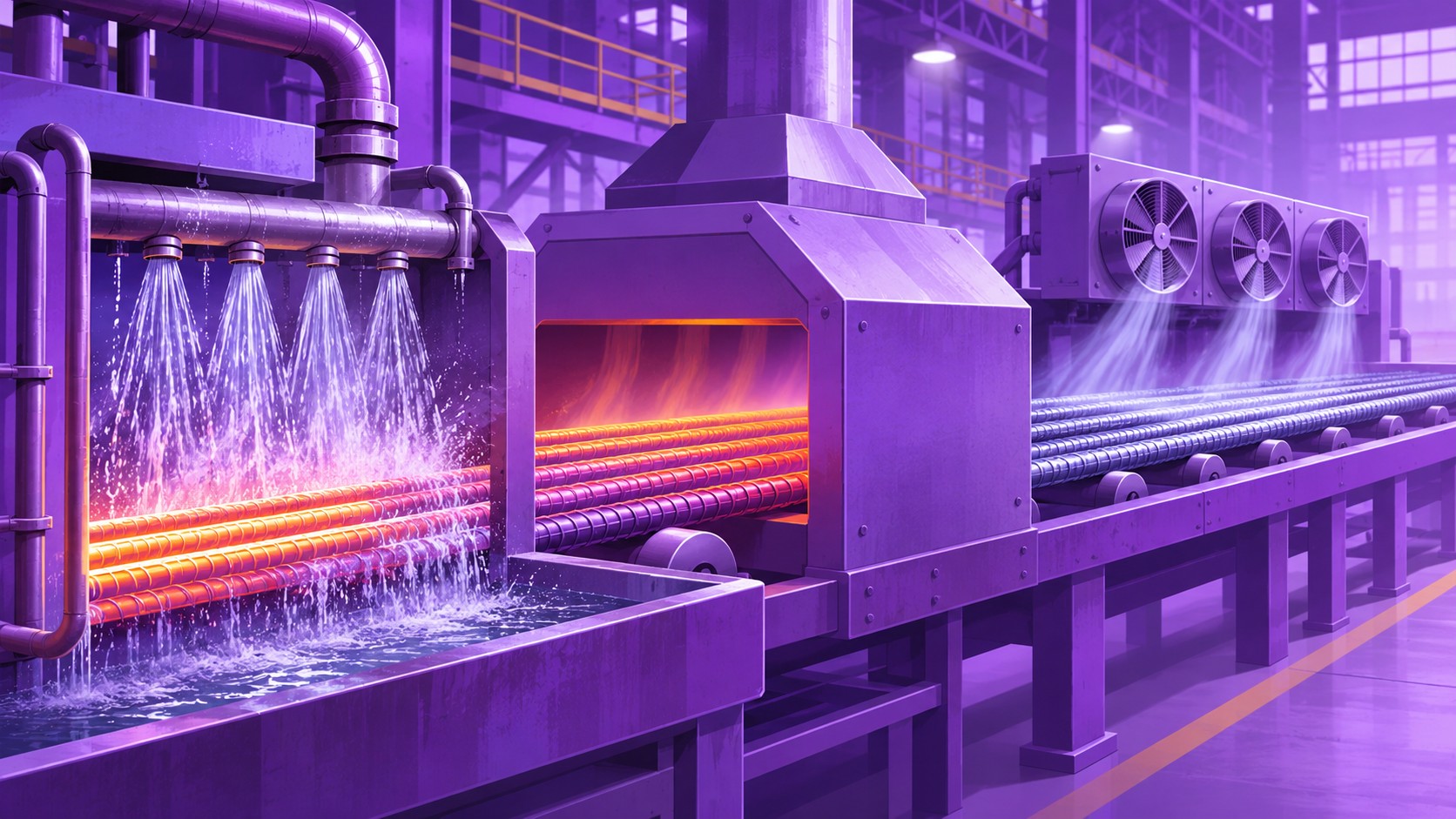
TMT bars have a hard outer surface and a relatively soft, ductile inner core. This combination is achieved through two key stages of the manufacturing process:
-
Quenching: Hot-rolled steel bars pass through a controlled water-cooling system, which rapidly cools the outer surface to form a hard martensitic layer.
-
Self-tempering and atmospheric cooling: Residual heat from the core tempers the outer layer, followed by controlled atmospheric cooling. This helps develop a strong exterior and a ductile inner core.
Together, these stages give TMT bars their characteristic combination of tensile strength, ductility, elongation, and weldability, making them suitable for a wide range of RCC applications.
Main features of TMT bars
TMT bars offer a combination of strength, ductility, and durability, making them suitable for different RCC construction applications. Let us look at their main features and why they matter when selecting reinforcement steel.
1. Fire resistance
TMT bars are used in buildings, dams, bridges, and flyovers, where exposure to high temperatures can affect structural safety. Their performance under fire depends on the steel grade, temperature, and duration of exposure. TMT bars can retain useful mechanical properties at elevated temperatures, but their strength and load-bearing capacity decrease as temperatures rise. Therefore, fire-resistant construction also requires adequate concrete cover and appropriate fire protection.
2. Earthquake resistance
TMT bars are widely used in earthquake-resistant RCC construction because of their high ductility and elongation properties. Grades such as Fe 415, Fe 500, and Fe 500D are used in structural applications, depending on the design requirements. Their ability to deform under stress without sudden failure helps RCC structures withstand seismic forces. However, earthquake resistance also depends on structural design, detailing, and compliance with applicable seismic codes.
3. Corrosion resistance
TMT bars can be used in coastal, marine, and other corrosive environments, provided the reinforcement grade and protection measures suit the exposure conditions. Standard TMT bars are not inherently corrosion-proof. Their corrosion resistance depends on factors such as steel composition, concrete cover, concrete quality, and environmental exposure. Special corrosion-resistant reinforcement may be considered for structures exposed to saline conditions.
4. Cost-effectiveness
TMT bars offer a cost-effective reinforcement solution for construction projects because of their high strength-to-weight ratio and durability. However, the overall cost depends on the steel grade, diameter (8 mm, 10 mm, 12 mm, 16 mm, 20 mm, 25 mm, etc.), market prices, and project requirements.
For example, Fe 500 TMT bars have a minimum yield strength of 500 MPa, compared with 415 MPa for Fe 415 bars. This is approximately 20.5% higher yield strength. Depending on structural design requirements, using a higher-grade bar may help optimise steel consumption. However, the actual quantity and cost savings must be established through structural calculations.
5. Flexibility and ductility
TMT bars offer good ductility, allowing them to bend and elongate without sudden failure. This property is particularly important in structures exposed to dynamic loads, vibrations, and seismic forces. Their ribbed outer surface also provides a strong mechanical bond with concrete, helping transfer loads effectively between the reinforcement and concrete.
Advantages of TMT bars in construction
TMT bars are widely used in construction because of their high strength, ductility, durability, and versatility. They can also help optimise material usage and project costs when the appropriate grade and diameter are selected.
The following table highlights the key advantages of TMT bars and how they benefit construction projects and steel procurement:
| Advantages of TMT bars | Benefits for construction projects |
|---|---|
| High strength-to-weight ratio | TMT bars offer high yield strength, helping structural engineers optimise reinforcement requirements without compromising structural safety. |
| Ease of handling, storage, and transportation | Standard TMT bars are available in different diameters and lengths, making them easier to handle, stack, transport, and distribute across construction sites. |
| Ductility and flexibility | Their ability to bend and elongate without sudden failure makes them suitable for structures exposed to dynamic loads and seismic forces. |
| Good weldability | TMT bars manufactured to meet the chemical composition and carbon-equivalent requirements of IS 1786 can be welded using suitable procedures. This supports fabrication and reinforcement assembly. |
| Durability | Their mechanical properties and compatibility with concrete help provide long-term structural performance when appropriate grades, concrete cover, and construction practices are followed. |
| Cost optimisation | Higher-strength grades may help reduce reinforcement requirements in suitably designed structures. Actual savings depend on structural calculations, steel prices, and fabrication costs. |
| Suitability for prefabrication | TMT bars can be cut, bent, and assembled into reinforcement cages and prefabricated components off-site, helping improve construction efficiency and reduce on-site labour. |
How much does a standard 12-metre TMT bar weigh?
The approximate unit weight of TMT bars varies by diameter. For procurement and material estimation, the commonly used formula is: Weight (kg/m) = D² ÷ 162
| TMT bar diameter | Approx. weight per 12 m bar |
|---|---|
| 8 mm | 4.74 kg |
| 10 mm | 7.41 kg |
| 12 mm | 10.67 kg |
| 16 mm | 18.96 kg |
| 20 mm | 29.63 kg |
| 25 mm | 46.30 kg |
Note: These are theoretical weights. Actual weights may vary within the tolerances specified under IS 1786.
For more details, read how TMT bars can reduce construction costs.
Things to keep in mind when buying TMT bars online

Buying TMT bars online can simplify steel procurement, but choosing the right product requires more than comparing prices. Buyers must check the steel grade, BIS certification, dimensions, weight, and supplier credentials before placing an order.
Here are some important factors to consider when purchasing TMT bars for your construction or infrastructure project.
1. Check the TMT bar grade
TMT bars are available in different grades, each offering specific yield strength and ductility characteristics. The right grade depends on the structural design, project requirements, and applicable standards.
| TMT bar grade | Minimum yield strength | Common procurement consideration |
|---|---|---|
| Fe 415 | 415 MPa | Applications where specified by the structural design |
| Fe 500 | 500 MPa | General RCC reinforcement applications |
| Fe 500D | 500 MPa | Applications requiring higher ductility |
| Fe 550 | 550 MPa | Structural applications requiring higher yield strength |
| Fe 550D | 550 MPa | Applications requiring higher strength and ductility |
| Fe 600 | 600 MPa | Specialised structural applications as specified by the design |
Procurement tip: Do not select a higher-grade TMT bar simply because it offers greater yield strength. Check the structural engineer’s specifications before finalising the grade.
2. Verify BIS certification and quality standards
Always check whether the TMT bars comply with IS 1786:2008, the Indian Standard covering high-strength deformed steel bars and wires for concrete reinforcement.
Before ordering, verify:
-
BIS Standard Mark: Check the ISI mark and applicable licence details.
-
BIS licence number: Verify the manufacturer’s licence through the official BIS portal.
-
Grade and specifications: Ensure the supplied grade matches the purchase order.
-
Test certificates: Request the Manufacturer’s Test Certificate (MTC) covering chemical composition and mechanical properties.
Why this matters: BIS certification helps buyers establish whether the product is covered by the relevant Indian Standard and a valid BIS licence.
3. Choose the right bar diameter and length
TMT bars are available in different diameters, commonly ranging from 8 mm to 32 mm. The required diameter depends on the structural drawings, reinforcement schedule, and load-bearing requirements of the project.
| TMT bar diameter | Common application areas |
|---|---|
| 8 mm | Stirrups and secondary reinforcement |
| 10 mm | Slabs and light reinforcement |
| 12 mm | Slabs, beams, and columns. |
| 16 mm | Beams and columns |
| 20 mm | Heavy-duty beams and columns |
| 25 mm | Heavy structural reinforcement |
| 32 mm | Large infrastructure and specialised structural projects |
Procurement tip: Confirm the diameter, specified length, and quantity against the project’s Bar Bending Schedule (BBS). Do not substitute one diameter for another without approval from the structural engineer.
4. Check the weight and dimensions
TMT bar weight is an important consideration when estimating material requirements, comparing supplier quotations, and calculating transportation costs.
Use the following formula to calculate the theoretical weight:
Weight (kg/m) = D² ÷ 162
Where D represents the nominal diameter of the TMT bar in millimetres.
| Parameter | What to verify |
|---|---|
| Nominal diameter | Check against the purchase order |
| Unit weight | Compare with theoretical weight |
| Bar length | Confirm standard or customised lengths |
| Weight tolerance | Check compliance with IS 1786 |
| Quantity | Verify the total weight supplied against the invoice |
Procurement tip: Do not rely solely on the number of bars supplied. Compare the actual consignment weight with the invoiced quantity and applicable BIS tolerances.
5. Compare TMT bar prices before ordering
TMT bar prices in India vary depending on the manufacturer, grade, diameter, location, and prevailing steel market conditions. Transportation costs, GST, and dealer margins can also affect the final purchase price.
Before placing an order, compare quotations from multiple suppliers.
| Price factor | What buyers should check |
|---|---|
| Base price | Price per kg or tonne |
| GST | Applicable GST charged on the invoice |
| Transportation | Freight and unloading charges |
| Grade | Price differences across Fe 500, Fe 500D, Fe 550, etc. |
| Brand | Manufacturer and product authenticity |
| Order quantity | Bulk order discounts, if available. |
| Delivery | Whether delivery is included in the quotation |
Procurement tip: Compare the final landed cost rather than just the quoted price per kg. A lower base price may not translate into lower procurement costs after freight and other charges.
6. Verify the manufacturer and supplier credentials
When buying TMT bars online, always verify the seller’s credentials and the manufacturer’s details. This is particularly important when purchasing in bulk for infrastructure, commercial, and industrial projects.
Check the following before placing an order:
-
Manufacturer details: Verify the manufacturing company and brand.
-
BIS licence: Check the validity and scope of the manufacturer’s BIS licence.
-
GSTIN: Verify the supplier’s GST registration.
-
Business credentials: Check the supplier’s business address, contact details, and transaction history.
-
Product traceability: Ensure the supplied bars can be traced to the manufacturer and relevant production batch.
You can use the official BIS Care app to verify licence details and the authenticity of the Standard Mark.
7. Ask for a manufacturer’s test certificate
A Manufacturer’s Test Certificate (MTC) helps buyers verify whether the supplied TMT bars meet the specified quality and mechanical requirements. For BIS-certified material, the consignment should be accompanied by a test certificate containing relevant details.
Check these details:
-
Manufacturer’s name and identification.
-
BIS Standard Mark and licence identification.
-
TMT bar grade and nominal diameter.
-
Cast or lot number.
-
Chemical composition and test results.
-
Mechanical properties, including yield stress, tensile strength, and elongation.
The BIS inspection and testing scheme for IS 1786 specifies the requirements for product marking and test certification.
8. Check delivery timelines and transportation arrangements
Timely delivery is important for construction projects because delays in reinforcement steel procurement can affect project schedules and labour deployment.
Before confirming your order, check:
-
Stock availability: Confirm whether the required grade and diameter are readily available.
-
Delivery timeline: Get a confirmed delivery date.
-
Transportation: Check freight charges and unloading arrangements.
-
Packaging and handling: Ensure bundles are properly secured for transportation.
-
Delivery documentation: Confirm that the invoice, delivery challan, and test certificate will accompany the consignment.
Procurement tip: For bulk orders, coordinate delivery schedules with site storage capacity and project requirements to avoid unnecessary inventory and handling costs.
9. Inspect the TMT bars upon delivery
Quality checks should not end when the purchase order is placed. Inspect the material when it reaches your construction site.
| Inspection parameter | What to look for |
|---|---|
| Surface condition | Check for cracks, visible defects, and excessive rust or pitting. |
| Bar markings | Verify the manufacturer’s identification, grade, and licence-related markings. |
| Diameter | Check against the specified nominal diameter |
| Length | Verify the supplied bar length |
| Weight | Compare actual and theoretical weight, accounting for applicable tolerances. |
| Documentation | Match the invoice and test certificate with the supplied batch |
Procurement tip: Segregate and report any damaged, incorrectly labelled, or non-conforming material before accepting the consignment.
For MSME steel buyers: A reliable TMT bar procurement process involves more than finding the lowest price. Verify product quality, manufacturer credentials, grade specifications, material weight, and delivery terms before making a purchase. These checks can help minimise procurement risks and ensure consistency across construction projects.
Conclusion
Choosing the right TMT bars is an important part of managing construction costs, material quality, and project efficiency. For MSME buyers, informed steel procurement decisions can help avoid material discrepancies, supplier-related risks, and unnecessary expenses. Understanding TMT bar grades, BIS standards, and market dynamics also makes it easier to evaluate suppliers and plan purchases. As India’s infrastructure and construction sectors evolve, staying updated on TMT steel specifications and procurement practices can give businesses a competitive edge.
Looking to procure steel?
Tata nexarc helps manufacturers, builders and MSMEs source certified steel products, compare prices, and choose the right grade as per IS codes—with complete traceability and procurement confidence.
FAQs
What is the full form of TMT bars?
What are TMT bars used for?
Which TMT bar grade is best for construction?
What is the difference between Fe 500 and Fe 500D TMT bars?
What is the standard length of a TMT bar?
How do you calculate TMT bar weight?
Which BIS standard applies to TMT bars in India?
Are TMT bars corrosion-resistant?
Are TMT bars suitable for earthquake-resistant construction?
What should you check before buying TMT bars online?
Sohini is a seasoned content writer with 12 years’ experience in developing marketing and business content across multiple formats. At Tata nexarc, she leverages her skills in crafting curated content on the Indian MSME sector, steel procurement, and logistics. In her personal time, she enjoys reading fiction and being up-to-date on trends in digital marketing and the Indian business ecosystem.