
 Check Price Now
Table of Contents
- Common MS Flat Sizes (India)
- MS Flat Weight Chart for 1m Bars (Length)
- MS Flat Weight Chart for 6m Bars (Length)
- How to Calculate MS Flat Weight
- Common Mistakes When Calculating MS Flat Weight
- MS Flat Price per kg in India (October 2026)
- MS Flat vs MS Angle vs MS Square: Key Differences
- Conclusion
- FAQs
Mild Steel or MS flats are low-carbon steel. They are not alloy steels but a type of standard steel with low carbon. This makes them easy to work with, especially in the building of light structural works. Having access to a MS flat weight chart pdf therefore will make it convenient for you to calculate MS flat weight and buy the right quantity for your projects.
MS flats are flat strips or bars made out of mild steel. They are characterised by its rectangular cross-section and widely used in fabrication and frameworks. The standard MS flats length starts from 20 metres and are 3 metres in thickness. They are also easy to weld and strong. MS flats are available in different sizes. Sizes can vary based on the manufacturer and the sizes offered by them. Listed below are some of the popular MS flat bar sizes and the MS flat weight chart for it.
MS flat weight formula (quick answer)
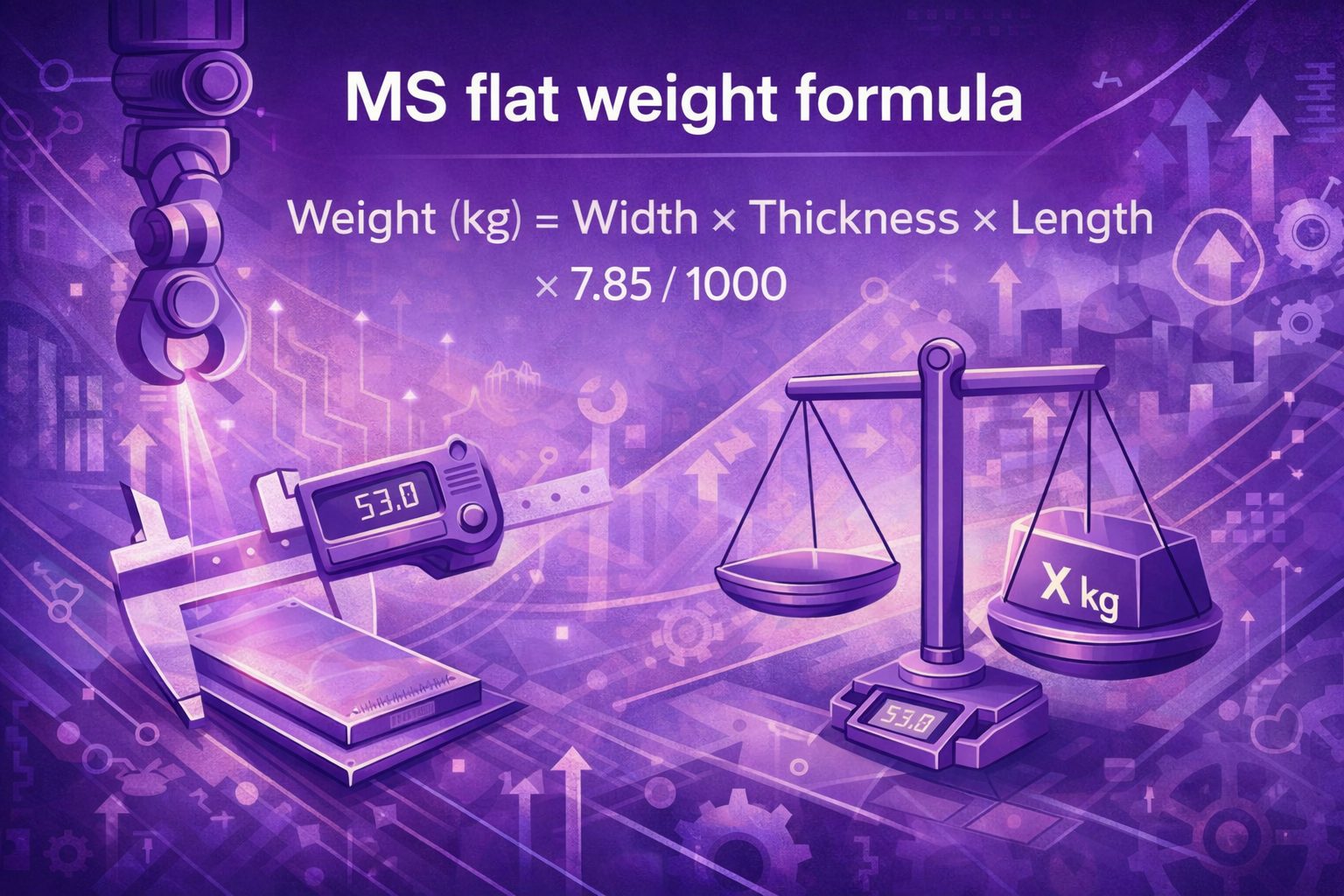
Weight (kg) = Width × Thickness × Length × 7.85/1000
This formula helps you quickly calculate the weight of MS flat bars using standard steel density.
Example: A 50mm × 5mm MS flat with 10m length weighs 19.63 kg.
Also read: Unit weight of TMT bars – Learn to calculate for 8mm to 32mm
Common MS flat sizes (India)
Width: 12 mm to 100 mm
Thickness: 3 mm to 25 mm
Length: 6 meters (standard), also available in 3m and custom lengths.
Popular MS flat size combinations
| Width (mm) | Thickness (mm) | Common use |
| 20 | 5 | Fabrication, grills. |
| 25 | 5 | Gates, frames. |
| 25 | 10 | Structural supports. |
| 32 | 6 | Industrial use. |
| 50 | 6 | Heavy fabrication. |
| 75 | 10 | Load-bearing structures. |
Things to know
- Most MS flats in India follow IS standards (IS 1730/IS 2062)
- Sizes may vary slightly based on rolling mills
- Heavier thickness flats are used for structural work
- Lighter flats are used in fabrication and general applications
Tip: Always confirm size, tolerance, and weight with your supplier before purchase.
MS flat weight chart for 1m bars (length)

MS flat weight chart for 1m bars (all values represent weight per metre, calculated using standard steel density of 7850 kg/m³).
Width = 12mm
| Thickness (mm) | Weight (kg/m) |
| 5 mm | 0.47 |
| 6 mm | 0.57 |
| 8 mm | 0.75 |
| 10 mm | 0.94 |
| 12 mm | 1.13 |
| 16 mm | 1.51 |
| 20 mm | 1.88 |
| 22 mm | 2.07 |
| 25 mm | 2.36 |
*Slight variation since digits are rounded off.
Width = 16mm
| Thickness (mm) | Weight (kg/m) |
| 5 mm | 0.63 |
| 6 mm | 0.75 |
| 8 mm | 1.00 |
| 10 mm | 1.26 |
| 12 mm | 1.51 |
| 16 mm | 2.01 |
| 20 mm | 2.51 |
| 22 mm | 2.76 |
| 25 mm | 3.14 |
*Slight variation since digits are rounded off.
Also read: 16mm steel bar weight
Width = 20mm
| Thickness (mm) | Weight (kg/m) |
| 5 mm | 0.79 |
| 6 mm | 0.94 |
| 8 mm | 1.26 |
| 10 mm | 1.57 |
| 12 mm | 1.88 |
| 16 mm | 2.51 |
| 20 mm | 3.14 |
| 22 mm | 3.45 |
| 25 mm | 3.93 |
*Slight variation since digits are rounded off.
Width = 25mm
| Thickness (mm) | Weight (kg/m) |
| 5 mm | 0.98 |
| 6 mm | 1.18 |
| 8 mm | 1.57 |
| 10 mm | 1.96 |
| 12 mm | 2.36 |
| 16 mm | 3.14 |
| 20 mm | 3.93 |
| 22 mm | 4.32 |
| 25 mm | 4.91 |
*Slight variation since digits are rounded off.
Width = 32mm
| Thickness (mm) | Weight (kg/m) |
| 5 mm | 1.26 |
| 6 mm | 1.51 |
| 8 mm | 2.01 |
| 10 mm | 2.51 |
| 12 mm | 3.01 |
| 16 mm | 4.02 |
| 20 mm | 5.02 |
| 22 mm | 5.52 |
| 25 mm | 6.28 |
*Slight variation since digits are rounded off.
MS flat weight chart for 6m bars (length)
All weights are calculated using the standard formula: Weight (kg/m) = Width × Thickness × 7.85/1000.
Width = 12mm
| Thickness (mm) | Weight (6m) |
| 5 mm | 2.83 |
| 6 mm | 3.40 |
| 8 mm | 4.53 |
| 10 mm | 5.66 |
| 12 mm | 6.79 |
| 16 mm | 9.06 |
| 20 mm | 11.28 |
| 22 mm | 12.45 |
| 25 mm | 14.15 |
*Slight variation since digits are rounded off.
Also read: 12mm steel bar weight
Width = 16mm
| Thickness (mm) | Weight (6m) |
| 5 mm | 3.78 |
| 6 mm | 4.52 |
| 8 mm | 6.03 |
| 10 mm | 7.54 |
| 12 mm | 9.06 |
| 16 mm | 12.06 |
| 20 mm | 15.08 |
| 22 mm | 16.56 |
| 25 mm | 18.84 |
*Slight variation since digits are rounded off.
Width = 20mm
| Thickness (mm) | Weight (6m) |
| 5 mm | 4.71 |
| 6 mm | 5.66 |
| 8 mm | 7.54 |
| 10 mm | 9.42 |
| 12 mm | 11.30 |
| 16 mm | 15.08 |
| 20 mm | 18.84 |
| 22 mm | 20.70 |
| 25 mm | 23.58 |
*Slight variation since digits are rounded off.
Width = 25mm
| Thickness (mm) | Weight (6m) |
| 5 mm | 5.89 |
| 6 mm | 7.07 |
| 8 mm | 9.42 |
| 10 mm | 11.78 |
| 12 mm | 14.15 |
| 16 mm | 18.84 |
| 20 mm | 23.58 |
| 22 mm | 25.92 |
| 25 mm | 29.45 |
*Slight variation since digits are rounded off.
Width = 32mm
| Thickness (mm) | Weight (6m) |
| 5 mm | 7.56 |
| 6 mm | 9.05 |
| 8 mm | 12.06 |
| 10 mm | 15.07 |
| 12 mm | 18.10 |
| 16 mm | 24.12 |
| 20 mm | 30.12 |
| 22 mm | 33.14 |
| 25 mm | 37.68 |
*Slight variation since digits are rounded off.
*For informational purposes only. Actual figures can change. Please check with your steel supplier for actual dimensions and weight chart. Slight variations since digits are rounded off.
As can be seen from the tables above, the weight of MS flats for various combinations of width and length change as per the length of the bars. As such, it’s important that when you measure mild steel bars you do so with precision to ensure cost-effectiveness and efficiency in your construction and manufacturing projects.
Also read: Unit weight of steel bars – Calculate weight with formula
How to calculate MS flat weight
Why do you need to use a MS flat weight calculator? The simple answer is that the weight of MS flat bar will directly impact its prices. As such, if you are calculating weight accurately, the cost will be as per the weight and dimensions of the flat bars. This naturally will help you to make informed business decisions and order for the right quantity of MS flats for your project.
MS flat bar weight calculator formula:
Here’s the simple formula you can use to calculate the weight of MS flat bars:
Weight (W) in kgs = {Width (mm) × Thickness (mm) × Length (m) × 7.85}/1000
Here: 7.85 is the density of mild steel (7850 kg/m³)
Example of MS flat weight calculation:
Width = 50mm
Thickness = 5mm
Length = 10m
Weight of MS flat in kgs = (50 × 5 × 10 × 7.85)/1000 = 19.63 kg
MS flat weight per meter = 1.96 kg/m
MS flat weight per meter
In the table below we calculate the weight of MS flats per metre:
| Width (mm) | Thickness (mm) | Weight (kg/m) |
| 20 | 5 | 0.79 |
| 25 | 5 | 0.98 |
| 25 | 8 | 1.57 |
| 30 | 12 | 2.83 |
| 32 | 6 | 1.51 |
| 38 | 10 | 2.98 |
Note: Calculations are based on standard steel density of 7850 kg/m³. Actual weight may vary slightly due to manufacturing tolerances.
MS flat weight calculator (quick & easy method)
You can quickly calculate MS flat weight by entering the width, thickness, and length into the standard formula. For faster estimation, simply multiply width and thickness (in mm), then multiply by length (in meters), and apply the steel density factor (7.85). This acts as a quick MS flat weight calculator and helps you instantly estimate material requirements without referring to charts.
Common mistakes when calculating MS flat weight
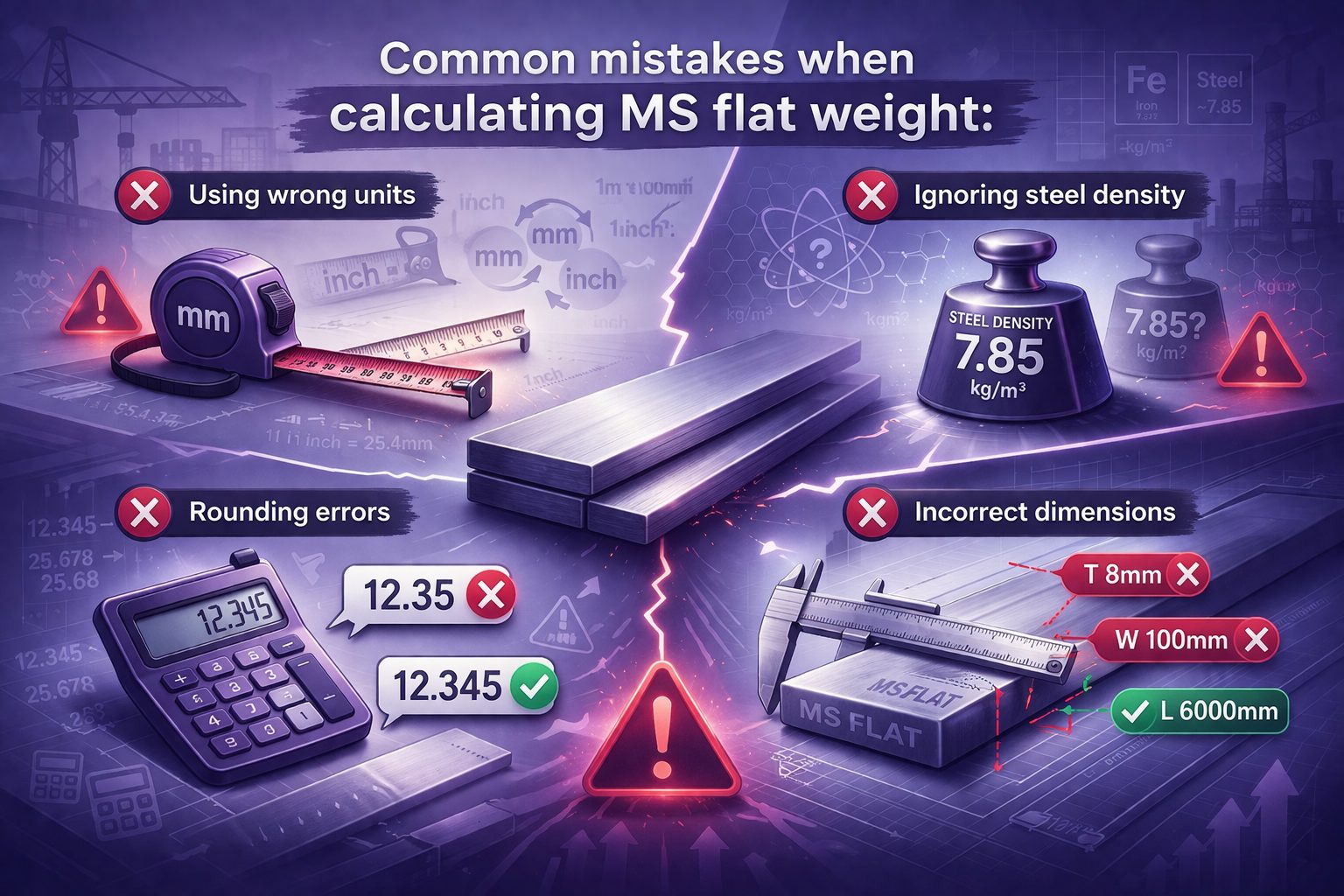
Using wrong units
One of the most common errors is mixing units like mm and meters. Width and thickness should be in millimetres, while length must be in meters. Using the wrong units can lead to major calculation errors.
Ignoring steel density
The standard density of mild steel (7.85 or 7850 kg/m³) is essential for accurate results. Skipping or changing this value will give incorrect weight estimates.
Rounding errors
Rounding numbers too early in the calculation can affect the final result. Always round off only at the final step and maintain consistency (usually 2 decimal places).
Incorrect dimensions
Using wrong width or thickness values can lead to inaccurate weight calculation. Always double-check dimensions before applying the formula.
Tip: Small mistakes in calculation can lead to incorrect cost estimation, especially in bulk orders.
MS flat price per kg in India (October 2026)
- Mild steel prices in India (October 2026) generally range between ₹56 and ₹82 per kg, depending on the product type, grade, and market conditions.
- MS flat bars typically range between ₹60 and ₹76 per kg, depending on size, thickness, brand, and location.
- Bulk orders (25+ tonnes) can reduce procurement costs by approximately ₹1–₹4 per kg, depending on the supplier and order volume.
- Prices vary by city due to logistics, demand, and supply conditions.
Mild steel flat bar prices in October 2026 have remained broadly stable, with modest fluctuations driven by iron ore, coking coal, and hot rolled coil prices, as well as demand from the construction, fabrication, and engineering sectors. Since MS flats are widely used in structural fabrication and industrial applications, their prices closely track broader steel market trends. For the most accurate pricing, buyers should obtain quotations from multiple suppliers, as rates can change with market conditions and order quantity.
Indicative MS flat price table (India – October 2026)
| Type/specification | Price range (₹/kg) |
|---|---|
| MS flat (standard) | ₹60–₹76 |
| Branded MS flat | ₹66–₹82 |
| Heavy thickness flats | ₹62–₹78 |
| Bulk purchase (25+ tonnes) | ₹58–₹74 |
Note: Prices are indicative for October 2026 and may vary depending on city, grade, dimensions, brand, order quantity, freight charges, and supplier margins. Bulk procurement and long-term supply contracts may offer additional discounts.
MS flat vs MS angle vs MS square: Key differences

MS flat
MS flats are rectangular steel bars with a flat surface. They are widely used in fabrication, grills, frames, and light structural work. MS flats are easy to cut, bend, and weld, making them ideal for general-purpose applications. Their weight is calculated based on width and thickness.
MS angle
MS angles have an “L” shape and are commonly used in structural and load-bearing applications. They provide better strength and support compared to flats. MS angles are widely used in construction, frames, racks, and supports where rigidity is important.
MS square
MS square bars have equal width and thickness on all sides. They are mainly used in machining, shafts, and industrial components. MS squares offer uniform strength and are suitable for precision work and heavy-duty applications.
Key differences (quick view)
Shape: Flat (rectangular) vs Angle (L-shape) vs Square (equal sides).
Strength: MS angle > MS square > MS flat.
Use: Fabrication vs structural support vs machining.
Weight calculation: Varies based on shape and dimensions.
Tip: Choose MS flat for flexibility, MS angle for strength, and MS square for precision applications.
Conclusion
Understanding MS flat weight is essential for accurate material planning and cost control in construction and fabrication projects. By using standard formulas, correct dimensions, and updated weight charts, you can avoid errors and improve efficiency. Whether you are sourcing materials or estimating project requirements, having precise weight data helps in better decision-making. Always verify specifications with your supplier and stay updated with current market trends to ensure optimal results and cost-effective procurement of MS flats.
Looking to procure steel?
Tata nexarc helps manufacturers, builders and MSMEs source certified steel products, compare prices, and choose the right grade as per IS codes—with complete traceability and procurement confidence.
FAQs
What is MS flat weight per meter?
How to calculate MS flat weight?
What is density of mild steel?
What is standard MS flat size?
How much does 50x5 MS flat weigh?
What is the formula for MS flat weight?
What is the weight of MS flat for 6 meters?
Why is MS flat weight important?
Does MS flat weight vary by manufacturer?
What factors affect MS flat weight calculation?
Sohini is a seasoned content writer with 12 years’ experience in developing marketing and business content across multiple formats. At Tata nexarc, she leverages her skills in crafting curated content on the Indian MSME sector, steel procurement, and logistics. In her personal time, she enjoys reading fiction and being up-to-date on trends in digital marketing and the Indian business ecosystem.




The MS flat weight chart is a great reference for common sizes, and the formula is easy to follow for calculating weight for any size MS flat. It’s going to help me to calculate the demand easily now. Thanks
Steel sections are manufactured with specific tolerances. This i can tell you as i have 20+ years experience in the field.
I’m working on a project that needs custom-sized MS flats. Is there a way to calculate the weight for non-standard sizes using the formula provided?