
 Check Price Now
Table of Contents
- Steel Bar Weight Chart
- Invoice Weight vs Received Weight: Why Differences Occur
- What the Unit Weight of Steel Bars Means
- How to Calculate the Unit Weight of Steel Bars
- Unit Weight of Steel Bars: Sample with Approximate Price (October 2026)
- Grades and Sizes of Steel Bars as per Indian Standard Codes
- Common Applications of Steel Bars
- Rolling and Mass Tolerance: Why Steel Bar Weight Can Differ
- Conclusion: Using Weight Data for Better Steel Procurement
- FAQs
Steel bars are a common element in construction and manufacturing projects. Strong and versatile, these bars come in various types such as TMT bars, Mild Steel bars, deformed bars, steel rebars, reinforced bars, each with its unique properties and applications.
Understanding the weight of steel bars, therefore, is crucial for project planning, budgeting, and procurement. Referring to a steel bar weight chart, therefore, can be an invaluable reference tool.
Further, for industry professionals, knowledge of steel bar weight in kg enables resource allocation and cost estimation. Here, let us take a look at how to calculate the unit weight of steel bars and what a steel bar weight chart looks like.
Disclaimer: The focus here is to understand the process of steel bar weight calculations and how to prepare a weight chart for reference. The dimensions used below are for reference only. Procurement teams should consult with their steel manufacturer for exact dimensions and sizes for the weight calculation.
Steel bar weight chart
The quickest way to plan steel procurement is to start with unit weight of a steel bar, then convert it into the weight of a 12 m bar and tonne requirements. Unit weight is simply kg per metre (kg/m). Once kg/m is known, estimation becomes straightforward, and delivery checks become easier.
Before learning how to calculate the unit weight of a steel bar, refer to the steel bar weight chart below. It provides the standard weights of TMT bars, MS bars, deformed bars, and other commonly used steel bars.
TMT bar weight chart
(Updated: October 2026 | All weights in kg, length = 12m)
| Diameter (mm) | Unit weight (kg/m) | Weight of one 12 m bar (kg) | Approx. bars per tonne* | Typical bundle size** | Approx. price per 12 m bar*** |
|---|---|---|---|---|---|
| 8 | 0.395 | 4.74 | 211 | Varies by manufacturer | ₹300–₹360 |
| 10 | 0.617 | 7.40 | 135 | Varies by manufacturer | ₹470–₹570 |
| 12 | 0.888 | 10.66 | 94 | Varies by manufacturer | ₹680–₹820 |
| 16 | 1.58 | 18.96 | 53 | Varies by manufacturer | ₹1,210–₹1,460 |
| 20 | 2.47 | 29.64 | 34 | Varies by manufacturer | ₹1,890–₹2,280 |
| 25 | 3.85 | 46.20 | 22 | Varies by manufacturer | ₹2,950–₹3,570 |
| 32 | 6.31 | 75.72 | 13 | Varies by manufacturer | ₹4,840–₹5,840 |
| 36 | 7.99 | 95.88 | 10 | Varies by manufacturer | ₹6,140–₹7,390 |
*For reference only. Please check with your steel seller for precise size, price, weight, and other details.
MS round bars weight chart
Weight chart with approximate price (October 2026)
| Size (mm) | Weight (kg/ft) | Weight (kg/m) | Approx. price per metre (₹)* |
|---|---|---|---|
| 8 | 0.120 | 0.395 | ₹24–₹32 |
| 10 | 0.188 | 0.617 | ₹37–₹51 |
| 12 | 0.271 | 0.888 | ₹53–₹73 |
| 14 | 0.369 | 1.210 | ₹73–₹99 |
| 16 | 0.482 | 1.580 | ₹95–₹130 |
| 20 | 0.753 | 2.469 | ₹148–₹203 |
*For reference only. Please check with your steel seller for precise size, price, weight, and other details.
Deformed reinforcing steel bar weight chart
Weight chart with approximate price (October 2026)
| Size (mm) | Weight (kg/ft) | Weight (kg/m) | Approx. price per metre (₹)* |
|---|---|---|---|
| 8 | 0.120 | 0.395 | ₹23–₹32 |
| 10 | 0.188 | 0.617 | ₹36–₹51 |
| 12 | 0.271 | 0.890 | ₹52–₹73 |
| 14 | 0.369 | 1.210 | ₹70–₹99 |
| 16 | 0.481 | 1.580 | ₹92–₹130 |
| 20 | 0.753 | 2.470 | ₹143–₹203 |
| 25 | 1.173 | 3.850 | ₹223–₹316 |
| 28 | 1.472 | 4.830 | ₹280–₹396 |
| 32 | 1.923 | 6.310 | ₹366–₹517 |
| 36 | 2.435 | 7.990 | ₹463–₹655 |
| 40 | 2.999 | 9.850 | ₹571–₹808 |
*For reference only. Please check with your steel seller for precise size, price, weight, and other details.
Hot-rolled steel bar weight chart
Weight chart with approximate price (October 2026)
Hot-rolled MS round bars are widely used in fabrication, machining, repair works, and industrial maintenance. The weight is standardised by diameter, so a clean chart helps MSMEs avoid billing surprises and check whether the received material matches the PO.
Common fabrication sizes
| Diameter (mm) | Unit weight (kg/m) | Approx. pieces in 1 tonne (6 m) | Approx. price (₹/m)* |
|---|---|---|---|
| 8 | 0.395 | 421.94 | ₹24–₹32 |
| 10 | 0.617 | 270.12 | ₹37–₹51 |
| 12 | 0.888 | 187.69 | ₹53–₹73 |
| 16 | 1.580 | 105.49 | ₹95–₹130 |
| 20 | 2.470 | 67.48 | ₹148–₹203 |
| 25 | 3.850 | 43.29 | ₹231–₹316 |
| 28 | 4.830 | 34.51 | ₹290–₹396 |
*For reference only. Please check with your steel seller for precise size, price, weight, and other details.
Heavy round bars used for shafts and industrial components
| Diameter (mm) | Unit weight (kg/m) | Approx. pieces in 1 tonne (6 m) | Approx. price (₹/m)* |
|---|---|---|---|
| 30 | 5.55 | 30.03 | ₹333–₹455 |
| 32 | 6.31 | 26.41 | ₹379–₹517 |
| 34 | 7.14† | 23.36 | ₹428–₹585 |
| 36 | 7.99† | 20.86 | ₹479–₹655 |
| 40 | 9.86 | 16.90 | ₹592–₹808 |
| 45 | 12.50 | 13.33 | ₹750–₹1,025 |
| 50 | 15.40 | 10.82 | ₹924–₹1,263 |
| 60 | 22.20 | 7.51 | ₹1,332–₹1,820 |
*For reference only. Please check with your steel seller for precise size, price, weight, and other details.
Often missed in MSME buying: Invoice weight vs received weight
A common issue is mismatch between what was estimated and what was billed. This happens when estimation is done using kg/m, but billing is done on actual weighbridge weight. A simple reconciliation discipline reduces disputes and prevents silent leakage.
PO vs delivery vs invoice reconciliation (Reference Table)
Assumption: Expected weight is calculated using the theoretical unit weight (D²/162) for a standard 12 m steel bar. Actual weight may vary within the permissible mass tolerance specified in IS 1786, depending on the diameter and manufacturing tolerances.
| Diameter (mm) | Ordered qty | Expected weight (kg) | Received pieces | Weighbridge weight (kg) | Variance (kg) | Remark |
|---|---|---|---|---|---|---|
| 8 | 200 pcs | 948.0 | 200 | 952.0 | +4.0 | Verify against applicable batch/individual-sample tolerance and PO specifications before closing the GRN. |
| 10 | 100 pcs | 740.4 | 98 | 726.0 | -14.4 vs ordered quantity | Short by 2 pcs; raise a shortage note and verify bundle tags and delivery documents. |
| 12 | 120 pcs | 1,278.7 | 120 | 1,272.0 | -6.7 | Check actual supplied length, weighbridge records and applicable mass tolerance. |
| 16 | 60 pcs | 1,137.6 | 60 | 1,145.0 | +7.4 | Reconcile against applicable tolerance and confirm that the MTC matches the supplied material. |
| 20 | 30 pcs | 889.2 | 30 | 884.0 | -5.2 | Record the variance and verify against applicable specifications and tolerance criteria. |
| 25 | 20 pcs | 924.0 | 20 | 918.0 | -6.0 | Verify the weighbridge slip, actual length and invoice quantity before closure. |
| 32 | 10 pcs | 757.2 | 9 | 684.0 | +2.5 vs 9 bars expected | 1 bar short. Reconcile the shortage separately and resolve through replacement or a credit note. |
| 36 | 5 pcs | 479.4 | 5 | 482.0 | +2.6 | Verify against applicable tolerance and supporting quality documents before closing the GRN. |
How to calculate the key fields (simple rule):
- Expected weight (kg) = Ordered pieces × theoretical weight of one 12 m bar for the selected diameter. Alternatively, if the order is placed in tonnes, Expected weight (kg) = Ordered quantity (MT) × 1,000.
- Weight variance (kg) = Weighbridge weight − Expected weight for the quantity actually received. If the number of received pieces is lower than the ordered quantity, first verify the shortage before assessing the weight variance.
Practical tip for MSMEs: Bundle packing may vary by supplier. Count the number of bars of each diameter during unloading, record the weighbridge slip number, verify the Material Test Certificate (MTC), and reconcile the Purchase Order (PO), delivery challan, weighbridge slip, and supplier invoice before approving the Goods Receipt Note (GRN) or processing payment.
What is the unit weight of steel bars?
What is the unit weight of a steel bar, and what does it mean?
Unit weight is the weight of a steel bar per metre (kg/m). It indicates how much one metre of a steel bar weighs and is one of the most important values used for material estimation, procurement, and project planning. For MSMEs, this single value bridges engineering requirements with procurement calculations.
Site teams usually work with the diameter and length of steel bars, such as 12 mm diameter bars with a standard length of 12 m, or the total running metres specified in a Bar Bending Schedule (BBS). Suppliers, on the other hand, typically quote prices in ₹ per kg or ₹ per tonne and bill based on the actual weighbridge weight. The unit weight of a steel bar connects these two measurements, helping buyers estimate the quantity of steel required, compare supplier quotations on a like-for-like basis, and verify whether delivered material matches the Purchase Order (PO).
Unit weight is often confused with density, but the two are different. Density is a material property and is generally taken as 7,850 kg/m³ for carbon steel in standard engineering calculations. Unit weight, however, is the weight per metre of a steel bar and is used for estimating material quantities, procurement, costing, and delivery verification. As the diameter of a steel bar increases, its unit weight also increases because a larger cross-sectional area contains more steel per metre.
Why unit weight calculation matters
For MSMEs evaluating vendors and managing multiple sites, unit weight helps in three practical ways:
- It improves cost estimation, because total weight drives the final bill.
- It supports logistics planning, because truckloads and unloading are managed in tonnes.
- It reduces billing disputes, because expected weight can be compared with the Purchase Order (PO), invoice, and weighbridge weight using a simple reconciliation sheet.
How to calculate the unit weight of steel bars?
Most steel bars used in construction are round, so the calculation is based on the steel bar’s circular cross-section. The logic is simple. Find the volume of steel in the bar, then multiply by steel density.
The core formula:
Weight = Volume × Density
- Density of steel (for standard calculations): 7,850 kg/m³
- Volume of a round bar: Cross-sectional area × Length
- Area of a circle: πr², where r = D/2
Now, putting it together for a round steel bar:
Weight = (π × D² / 4) × L × 7,850 × 10⁻⁶
Here, D is in mm, L is in metres, and the result comes in kg. The 10⁻⁶ factor converts mm² into m².
Steps to calculate the unit weight of steel bars
Let’s look at a simple example to understand how to find the weight of a steel bar.
Step 1: Know the dimensions
Steel TMT bars come in standard diameters like 8 mm, 10 mm, 12 mm, 16 mm, etc.
Here, the diameter is the end-to-end measurement of the circular face of the bar.
In this example, we’ll use:
- Length = 10 m
- Diameter = 12 mm
- Radius = 6 mm or 0.006 m (half the diameter)
Step 2: Calculate the cross-sectional area
Use the formula:
Area = πr²
= 3.1416 × (0.006)²
= 0.000113 m²
Step 3: Find the volume per meter
Volume = Area × Length
= 0.000113 × 10
= 0.00113 m³
Step 4: Calculate the total weight of the bar
Weight = Volume × Density
= 0.00113 × 7850
= 8.87 kg (approx.)
This method is reliable and helps explain the logic to finance and audit teams when questions come up later.
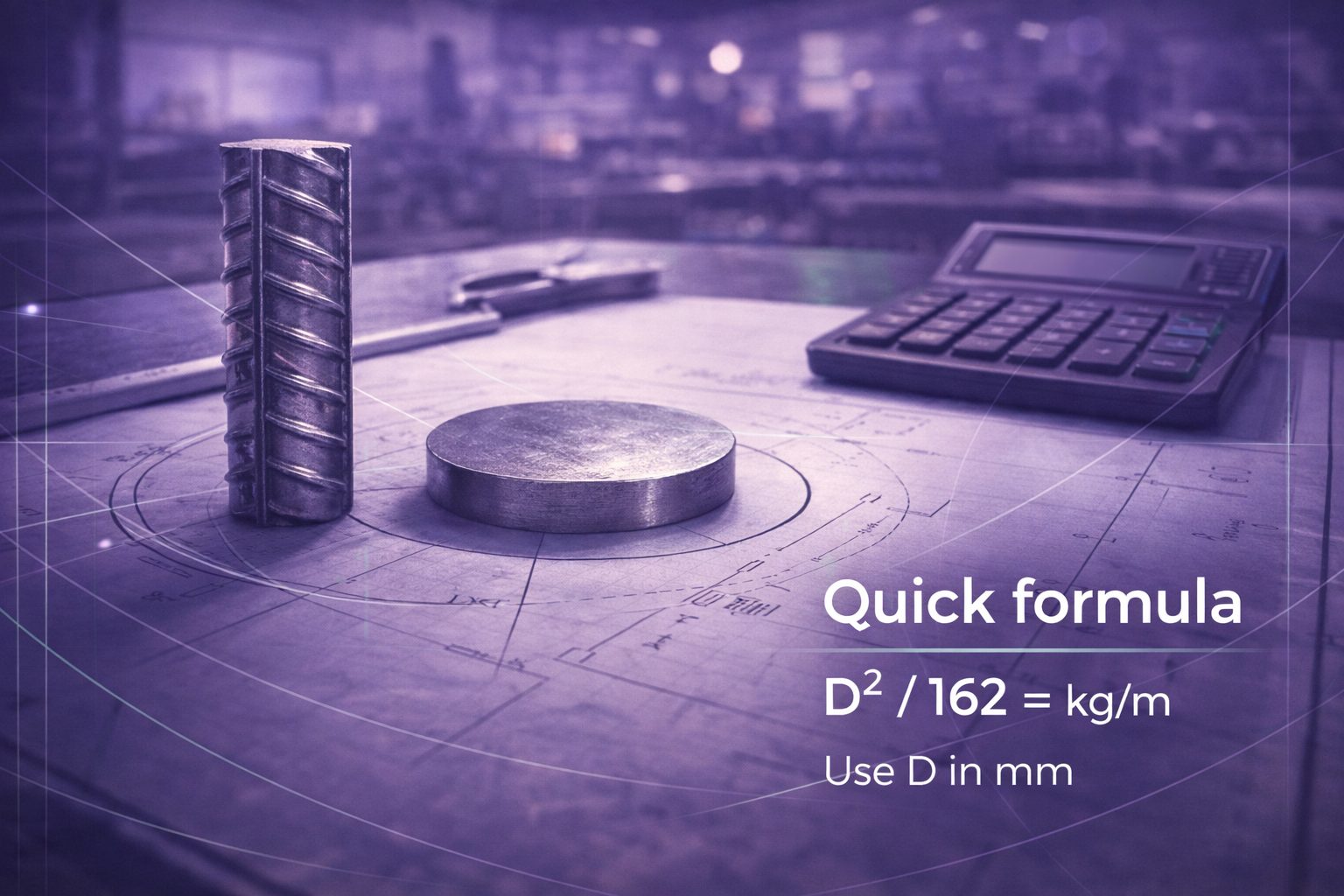
The shortcut used on site, D²/162 (kg/m)
For daily procurement work, most teams use a quick rule:
Unit weight (kg/m) = D²/162
D must be in mm.
For example, using a 12 mm diameter bar:
12²/162 = 144/162 = 0.889 kg/mFrom here, a standard 12 m bar therefore weighs:
0.889 × 12 = 10.67 kg
Procurement-friendly use cases
- Convert running metres to tonnes
Total weight (kg) = Total running metres × Unit weight (kg/m)
Total tonnes = Total weight ÷ 1000
This is useful when the BBS provides total length, but the vendor quotes in tonnes.
- Convert pieces to kilograms for invoice checks
Expected weight (kg) = Number of pieces × 12 m bar weight (kg)
This makes PO, GRN, and invoice reconciliation faster, especially when multiple diameters arrive in one truck.
Common mistakes that cause wrong estimates
- Using diameter in cm or inches without converting to mm before applying D²/162.
- Assuming every piece is exactly 12 m without checking the supplier’s dispatch practice.
- Mixing diameters in one line item, then comparing invoice weight to a single average number.
- Rounding too early, especially on large orders, where small rounding errors become large kg differences.
Unit weight of steel bars sample with approx. price (October 2026)
Based on the formula above, the following sample chart shows the theoretical unit weight of steel bars in common 12 m trade lengths. Unit weight is determined by the bar diameter. Actual supplied mass may vary within the applicable manufacturing tolerances under the relevant standard.
Price basis used (October 2026):
- Indicative steel prices vary by grade, brand, city, supplier, quantity, freight charges, taxes, and prevailing market conditions.
- Approximate price per bar = Bar weight (kg) × applicable steel rate (₹/kg).
- Fe 500 and Fe 500D are different grades, and their prices may vary by manufacturer and market. Neither grade should be assumed to have a fixed premium or discount over the other.
- The prices shown are indicative calculations, not fixed national market prices.
- Check the latest manufacturer or authorised dealer price list before procurement.
Indicative unit weight and approx price for 12mm steel bar (common trade length)
| Diameter (mm) | Radius (mm) | Unit wt. (kg/m) | Weight per 12 m bar (kg) | Approx. price (Fe 500D)* | Approx. price (Fe 500)* |
|---|---|---|---|---|---|
| 8 | 4.0 | 0.395 | 4.74 | ₹300–₹360 | ₹280–₹340 |
| 10 | 5.0 | 0.617 | 7.40 | ₹470–₹570 | ₹440–₹530 |
| 12 | 6.0 | 0.890 | 10.68 | ₹680–₹820 | ₹630–₹770 |
| 16 | 8.0 | 1.580 | 18.96 | ₹1,210–₹1,460 | ₹1,130–₹1,390 |
| 20 | 10.0 | 2.470 | 29.64 | ₹1,890–₹2,280 | ₹1,770–₹2,170 |
| 25 | 12.5 | 3.850 | 46.20 | ₹2,950–₹3,570 | ₹2,740–₹3,390 |
| 32 | 16.0 | 6.310 | 75.72 | ₹4,840–₹5,840 | ₹4,480–₹5,550 |
| 36 | 18.0 | 7.990 | 95.88 | ₹6,140–₹7,390 | ₹5,660–₹7,010 |
*For reference and information only. Not exact. Please check with your steel manufacturer for actual dimensions and weight. Final landed price changes by brand, grade, city, freight, and GST.
Indicative unit weight and approx. price for 8-metre bars as of October 2026 (often used in smaller jobs)
| Diameter (mm) | Radius (mm) | Unit wt. (kg/m) | Weight per 8 m bar (kg) | Approx. price (Fe 500D)* | Approx. price (Fe 500)* |
|---|---|---|---|---|---|
| 8 | 4.0 | 0.395 | 3.16 | ₹200–₹240 | ₹185–₹225 |
| 10 | 5.0 | 0.617 | 4.94 | ₹315–₹380 | ₹290–₹355 |
| 12 | 6.0 | 0.890 | 7.12 | ₹450–₹545 | ₹420–₹515 |
| 16 | 8.0 | 1.580 | 12.64 | ₹810–₹970 | ₹750–₹925 |
| 20 | 10.0 | 2.470 | 19.76 | ₹1,260–₹1,510 | ₹1,180–₹1,440 |
| 25 | 12.5 | 3.850 | 30.80 | ₹1,970–₹2,360 | ₹1,830–₹2,250 |
| 32 | 16.0 | 6.310 | 50.48 | ₹3,230–₹3,870 | ₹3,000–₹3,690 |
| 36 | 18.0 | 7.990 | 63.92 | ₹4,100–₹4,900 | ₹3,780–₹4,670 |
*For reference only. Always confirm the exact grade, mill, rolling tolerance, bundle count, and weighbridge weight with the supplier before closing the PO.

Grades and sizes of steel bars as per Indian Standard Code
Given below are the nominal size groups of steel bars and steel wires, and their grades according to the Bureau of Indian Standards (BIS) IS 1786.
Table 1: Grouping of steel bars based on nominal diameter (IS 1786:2008)
| Group | Size |
| Group I | 4 mm, 5 mm, 6 mm |
| Group II | 8 mm, 10 mm, 12 mm, 16 mm, 20 mm, 25 mm, 28 mm, 32 mm |
| Group III | 36 mm, 40 mm, 45 mm, and 50 mm |
Table 2: Grouping of steel bars based on strength grade (IS 1786:2008)
| Group | Strength grade |
| Group 1 | Fe 415, Fe 415D, Fe 415S |
| Group 2 | Fe 500, Fe 500D, Fe 500S |
| Group 3 | Fe 550, Fe 550D |
| Group 4 | Fe 600 |
| Group 5 | Fe 650 |
| Group 6 | Fe 700 |
*Source: Bureau of Indian Standards (BIS), IS 1786:2008 – High strength deformed steel bars and wires for concrete reinforcement (latest publicly available BIS implementation guide).
The weight of steel is generally measured in kilograms or tonnes. Construction projects usually source tonnes of steel bars as raw materials. Measuring the unit weight of steel bars is necessary to determine the load-bearing capacity of pillars, columns, etc.
Common applications of steel bars
Steel bars are used to reinforce concrete, so the right bar choice affects not only strength but also execution speed, inspection outcomes, and billing confidence. For MSMEs handling multiple sites, the practical goal is consistency. The same diameter mix, grade specification, and documentation discipline should repeat across orders, so site teams do not improvise on every delivery.
- Buildings (residential and commercial)
In buildings, steel bars are used in foundations, columns, beams, and slabs. Bars take tensile loads that concrete cannot handle well. Procurement teams usually deal with multiple diameters in the same project, so the key is to control the diameter mix and grade on the PO.
Often missed at site is the connection between reinforcement planning and wastage. Cutting and bending loss, lap lengths, and design changes can push consumption higher than the original estimate. A simple buffer policy and weekly reconciliation reduces last-minute emergency buying at higher rates.
- Bridges and flyovers
Bridges and flyovers face repeated traffic loads and exposure to weather. Procurement should focus on two things: the grade specified by the structural design, and traceability. Inspection teams typically ask for certificates, batch or heat identification, and consistent supply from approved sources.
The practical buying risk is mixing grades across lots. It can happen when a supplier substitutes material during shortages. Avoid this by keeping grade and certificate checks part of GRN closure, not an afterthought.
- Roads, pavements, and retaining structures
Steel bars are used in rigid pavements, drains, culverts, and retaining walls where reinforcement is part of the design. These jobs often run on tight timelines and multiple dispatches. For businesses, the real challenge becomes is delivery planning and preventing mismatch between ordered and received quantities.
Short supplies are usually spotted late when bar cutting begins. The best time to catch it is at unloading, by matching pieces and weighbridge weight against the PO.
- Dams and water-retaining structures
Water-retaining structures demand tight control on quality and execution, because cracking and leakage become expensive defects. Hence, procurement teams must stick strictly to the grade and documentation requirements mentioned in project specifications. Apart form it, storage and handling also matter. Even steel bars left exposed to heavy moisture or mud can create avoidable site-level quality concerns.
- Industrial buildings and power plants
Factories, heavy foundations, and equipment bases can involve higher reinforcement density and more complex bar schedules. Steel procurement planning must align with the pouring sequence, not only total tonnage. Smaller, timed dispatches often reduce congestion at site and lower the chance of wrong diameter being issued to the wrong zone.

Often missed in tender planning
Many government and large EPC jobs expect clean records, not only material. Keep a simple audit trail that links the PO to delivery challans, weighbridge slips, and test certificates. This reduces rework during client verification and helps avoid payment holds.
Practical procurement lens
| Application | What procurement should confirm | Common avoidable mistake |
| Buildings | Dia mix and grade on PO, planned dispatch schedule, basic reconciliation. | Emergency buying due to under-planned wastage and laps. |
| Bridges/flyovers | Strict grade matching, certificate and traceability discipline. | Mixing grades across dispatches, weak certificate checks. |
| Roads/retaining works | Delivery planning and site storage, diameter segregation. | Short supply detected late, after cutting starts. |
| Water structures | Spec compliance, controlled handling and storage. | Ignoring documentation, then failing inspections. |
| Industrial plants | Sequenced dispatches, correct diameter availability. | Wrong diameter issued on site due to poor segregation. |
Rolling and mass tolerance (why weight can differ)
Steel bars are manufactured with permissible variations in nominal mass per metre. That is why theoretical weight (D²/162) and weighbridge weight can differ slightly. For procurement teams, the right approach is to compare the measured weight against the permissible tolerance specified in IS 1786, rather than treating every small difference as a shortage.
Permissible tolerance on nominal mass (IS 1786:2008, Table 2)
(Use as a practical reference for receiving checks.)
| Nominal diameter | Typical tolerance band used for checks |
| Up to and including 10 mm | ±7% |
| Over 10 mm up to and including 16 mm | ±5% |
| Over 16 mm | ±3% |
Simple on-site verification checklist
- Count pieces by diameter and record bundle tags.
- Match Purchase Order (PO), delivery challan, weighbridge slip, and invoice.
- If variance looks high, sample-check 2 to 3 bars per diameter using weight per metre (cut a 1m sample if required).
- Do not mix diameters in one line item during reconciliation.
- Verify the Material Test Certificate (MTC) to ensure the supplied grade and diameter match the purchase order.
Conclusion
Steel bar weight is not only a calculation topic, it is a procurement control topic. Unit weight (kg/m) helps convert drawings and running metres into tonnes, and that directly impacts ordering, transport planning, and budgeting.
The most common issues on projects come from small gaps between estimation and execution. Bars get ordered by pieces, quoted per kilogram (₹/kg) or per tonne, billed by weighbridge weight, and received in mixed diameters. Without a simple reconciliation sheet, shortages or overbilling can slip through unnoticed.
A practical way to stay in control is consistent across projects. That is:
- Use the weight chart for quick planning, apply the D²/162 shortcut for rapid checks, and verify deliveries using a Purchase Order (PO) vs delivery vs invoice reconciliation table.
- Keep Material Test Certificate (MTC), grade, and documentation checks as part of the Goods Receipt Note (GRN) closure process, rather than leaving them for a later audit.
With these steps in mind, MSME teams can reduce last-minute buying, avoid disputes with suppliers, and maintain cleaner records for client verification and tender work.
Disclaimer: This article is for informational purposes only. The weight calculation methods explained are intended to help readers understand how steel bar weight is estimated using theoretical values. Dimensions and weights are for reference only. Actual dimensions, weight, and prices may vary depending on the manufacturer, grade, rolling tolerance, and applicable standards. Please consult your steel supplier for the latest specifications and product details.
Looking to procure steel?
Tata nexarc helps manufacturers, builders and MSMEs source certified steel products, compare prices, and choose the right grade as per IS codes—with complete traceability and procurement confidence.
FAQs
How heavy is a 12 mm TMT bar per meter?
How many 8 mm TMT bars make one ton?
What are the size groups of steel bars under IS 1786?
According to IS 1786, steel bars are grouped as:
- Group I: 4 mm, 5 mm and 6 mm
- Group II: 8 mm, 10 mm, 12 mm, 16 mm, 20 mm, 25 mm, 28 mm and 32 mm
- Group III: 36 mm, 40 mm, 45 mm and 50 mm
Which strength grades of TMT bars are available in India?
Is BIS certification compulsory for TMT bars in 2026?
Which TMT grade is best for residential buildings?
What density of steel should I use for weight calculations?
What is the meaning of the unit weight of TMT bar?
What is the formula for steel weight calculation?
| Steel type | Weight formula | Example dimensions | Approx. weight |
|---|---|---|---|
| TMT bars | π × r² × L × 7,850 | L = 12 m, r = 6 mm (0.006 m) | ≈ 10.67 kg |
| Steel beams | L × W × H × 7,850 | L = 6 m, W = 0.1 m, H = 0.2 m | 942 kg |
| Steel sheets | L × W × Thickness × 7,850 | L = 2 m, W = 1 m, T = 0.002 m | 31.4 kg |
| Steel pipes/tubes | π × (R² − r²) × L × 7,850 | L = 3 m, R = 0.05 m, r = 0.045 m | ≈ 20.3 kg |
What is the difference between Fe 500 and Fe 500D?
Sohini is a seasoned content writer with 12 years’ experience in developing marketing and business content across multiple formats. At Tata nexarc, she leverages her skills in crafting curated content on the Indian MSME sector, steel procurement, and logistics. In her personal time, she enjoys reading fiction and being up-to-date on trends in digital marketing and the Indian business ecosystem.




Having a weight chart available is helpful for estimating material needs and costs during project planning. The comparison of TMT, MS round, deformed reinforcing, and hot-rolled steel bars is really useful. Would like to know if there are standard length options available for each bar diameter.
aniketkumarak1272454@gmail.com
I’m building a small residential house. What type and size of steel bar would typically be recommended for the foundation and the walls?
Where you’re based? I have construction company from Rohtak. You can use TMT bars for foundation and steel as they are very strong. Generally, TMT bars with diameters of 10mm, 12mm, or 16mm are used for foundations. I can give you contact of structural engineer who can help you with this.
This chart is helpful. taken a print of this and kept on my desk under the glass 🙂
Calculating steel bar weight is now easy for me. Also creating an excel format for my team which can use it on day to day basis.
For anyone involved in construction or manufacturing, having a reference like this is crucial for accurate material planning and cost estimation. The detailed breakdown of different steel bar sizes and their corresponding weights helps streamline the procurement process, ensuring that there’s no overestimation or underestimation of the materials required.
Much appreciated for this weight chart and formula.
I stand with you bro
During procurement, this is very important for everyone. I have experienced that Weight Calculation of TMT bars and steel products set base for the negotiation on the price also. Higher quantity and higher weight will bring the per kg cost down.
Yes it sets a base for negotiation. But this weight chart will always help in pre-plan procurement and will give you a tentative idea of amount required for order placement.
Understanding the weight of steel bars is essential for effective project planning and budgeting in construction. Different types, like TMT and deformed bars, serve unique purposes, making a weight chart a vital tool for professionals. Knowing how to calculate unit weight aids in resource allocation and cost estimation, ensuring projects run smoothly and efficiently.
This is extremely useful. I have been trying to solve this for days until I stumbled on this page. Thank you so much.