

Table of Contents
Any discussion on GST compliance is incomplete without understanding the GST Network or Goods and Services Tax Network (GSTN) – the technology backbone powering the GST portal. From GST registrations and return filing to payments and reconciliation, GSTN supports critical tax operations for businesses across India. For MSMEs, it simplifies compliance processes and improves operational efficiency. As GST systems continue to evolve, understanding GSTN is essential for managing GST compliance smoothly and reducing compliance challenges.

What is GSTN?
GSTN full form and meaning
The full form of GSTN is Goods and Services Tax Network. It is a non-government, non-profit organisation that manages the entire technology and IT infrastructure behind the GST portal. GSTN acts as the digital backbone of GST compliance by enabling taxpayer registrations, GST return filing, payments, reconciliation, and other tax-related processes.
Why was GSTN introduced?
Before GST, businesses had to deal with multiple indirect tax systems managed separately by central and state authorities. This often led to complexity, duplication, and compliance challenges.
GSTN was introduced to create a unified technology infrastructure that standardises GST administration across states. It enables seamless data sharing, simplifies tax management, improves transparency, and supports smoother GST compliance for businesses, including MSMEs.
Role of GSTN: Acts as the technology backbone of the GST portal by enabling taxpayer registrations, GST return filing, and GST payments.
Purpose of GSTN: Simplifies tax management and makes GST information more accessible for businesses and government authorities.
Importance of GSTN: Enhances GST compliance through automation, real-time reporting, improved transparency, and stronger monitoring systems that help reduce tax evasion.
GSTN vs GST portal – Are they different?
Many taxpayers use GSTN and GST portal interchangeably. However, they are not the same.
GSTN (Goods and Services Tax Network) is the technology backbone that manages GST registration, return filing, payment processing, and compliance systems under GST in India.
The GST portal is the front-end platform taxpayers use to access GST services, while GSTN provides the technology infrastructure that powers these services.
| GSTN | GST portal |
| Technology backbone | User interface. |
| IT infrastructure | Taxpayer access platform. |
| Backend processing system | Front-end compliance system. |
| Manages GST data processing | Used for GST registrations, returns, and payments. |
| Supports GST compliance operations | Allows taxpayers to interact with GST services. |
In simple terms, GSTN works behind the scenes to ensure the GST portal functions smoothly and securely. Together, they simplify GST compliance and improve tax administration across India.
To know more about the Goods and Services Tax Network, visit the official website: //www.gstn.org.in/

What are the features of GST Network?
The GST Network is the technology backbone that manages and supports the GST portal. It is designed to simplify GST compliance through digital infrastructure, automation, and secure tax administration systems. From GST registration to return filing and reconciliation, GSTN helps businesses and tax authorities manage GST processes efficiently.
Unified GST ecosystem
GSTN brings multiple GST activities under a single digital system, helping businesses avoid fragmented tax processes.
Key functions supported through the GST ecosystem include:
- GST registration management
- GST return filing
- Payment tracking and processing
- Refund monitoring
- Compliance reporting
- Tax data management
Its unified structure ensures businesses across states can follow a standardised GST compliance process.
Real-time compliance automation
GSTN uses GST automation and digital systems to improve compliance accuracy and reduce manual effort.
Some important automation capabilities include:
Auto-populated forms: Reduces manual data entry using existing GST return information.
GST invoice matching: Matches invoices and supplier filings to support accurate Input Tax Credit (ITC) claims.
Compliance alerts: Identifies mismatches, anomalies, or missing information.
Validation systems: Helps verify data before submission to reduce filing errors.
GST reconciliation process support: Enables businesses to reconcile transactions efficiently.
For example, GSTR-2A and GSTR-2B auto-population features help businesses improve tax accuracy while reducing reconciliation challenges.
Data protection and system reliability
As a large GST digital infrastructure platform, GSTN processes massive volumes of taxpayer information daily. The system includes safeguards to ensure reliability and secure operations.
Its key capabilities include:
| Feature | Purpose |
| Encryption protocols | Protect taxpayer information |
| Secure data systems | Maintain confidentiality and integrity |
| Large transaction handling capability | Supports high transaction volumes efficiently |
| Robust IT infrastructure | Enables uninterrupted GST operations |
These capabilities strengthen GST compliance technology and improve system stability.
Automation features helping MSMEs
For MSMEs, GST automation reduces operational burden and improves efficiency.
For example, a small manufacturing business filing GSTR-1 can benefit from auto-populated information and ITC matching, reducing manual reconciliation effort and improving filing accuracy.
Top GSTN features include:
- Unified GST portal ecosystem
- Real-time processing systems
- GST invoice matching and ITC matching
- Auto-populated GST returns
- Secure payment integration
- GST reconciliation process support
- Technology-driven GST compliance systems
What is the role and importance of GSTN?
GSTN plays a critical role in managing GST compliance and strengthening tax administration in India. It provides a common digital infrastructure that supports GST registrations, return filing, payments, reconciliation, and compliance monitoring. By creating a unified system for taxpayers and tax authorities, GSTN helps improve efficiency, transparency, and standardisation across GST processes.
GSTN as India’s GST technology backbone
GSTN acts as the technology backbone that powers the GST ecosystem. It connects central and state tax systems through a common platform, enabling seamless coordination and administration.
Its role supports:
- Centre-state integration for GST operations
- Unified tax administration across India
- Standardised compliance processes
- Centralised management of GST activities
- Faster processing of registrations, returns, and payments
This common GST compliance technology infrastructure helps businesses operate within a more streamlined tax environment.
GSTN and GST compliance monitoring
One of the major advantages and importance of GSTN lies in its ability to strengthen compliance monitoring through technology and automation.
GSTN supports:
Mismatch identification: Detects differences between filed returns and reported transactions.
Risk analysis: Helps authorities identify unusual patterns and compliance risks.
Non-compliance detection: Flags discrepancies, delayed filings, and irregularities.
Audit support: Enables structured reporting and compliance verification.
For example, invoice-level validation and reconciliation systems help reduce filing errors and improve GST compliance accuracy.
GSTN’s role in reducing tax evasion
GST compliance technology in India increasingly relies on digital systems and automation to improve transparency.
GSTN contributes by enabling:
- Data analytics for transaction monitoring
- Transaction validation across GST records
- Cross-system verification of tax information
- Faster identification of discrepancies
- Improved compliance visibility
These capabilities strengthen GST administration and help reduce opportunities for tax leakage.
Why GSTN matters for MSMEs
For MSMEs, GSTN reduces compliance challenges and simplifies day-to-day tax management.
Its operational benefits include:
- Lower compliance burden
- Faster GST filing processes
- Reduced manual work
- Better Input Tax Credit visibility
- Improved GST reconciliation processes
For example, a small distributor filing GST returns can use auto-populated information and reconciliation systems to minimise manual effort and improve compliance accuracy.
By combining GST compliance automation with digital infrastructure, GSTN continues to play a vital role in improving tax administration and supporting businesses across India.
Also read: GSTN under PMLA Act – Addition of GSTN as the 26th entity in the Prevention of Money Laundering Act

What are the functions of GST Network?
GSTN supports the technology infrastructure that powers GST compliance in India. It enables businesses to complete registrations, file returns, make tax payments, track refunds, and manage compliance obligations through a single digital ecosystem. By automating critical processes, GSTN improves efficiency and reduces operational challenges for businesses.
GST registration management
GSTN functions as a GST registration platform that standardises the registration process across India. Businesses can submit registration applications digitally, complete verification procedures, and obtain GSTIN details through a unified system.
This standardised approach simplifies onboarding and ensures businesses can enter the GST ecosystem without dealing with fragmented state-level systems.
GST return filing ecosystem
GSTN supports the GST return filing system by providing the infrastructure required to file returns electronically. Businesses can file returns such as GSTR-1 and GSTR-3B while benefiting from automation features that improve filing accuracy.
Auto-population systems reduce manual effort by pulling relevant information from existing GST records. Validation checks also help identify errors before submission, making GST compliance smoother for businesses.
Payment and refund processing
GSTN strengthens the GST payment process by integrating payment infrastructure within the GST ecosystem. Businesses can complete tax payments digitally while monitoring payment records through a centralised system.
The platform also supports GST refund tracking by enabling businesses to monitor refund requests and application status. This improves visibility and reduces delays in refund-related processes.
ITC reconciliation capabilities
Input Tax Credit management is one of the most important operational functions supported through GSTN. The system enables GST reconciliation by matching transaction records and supplier information to improve ITC claim accuracy.
For example, a small distributor reviewing GSTR-2B information can identify mismatches early and reduce reconciliation effort. This improves compliance accuracy while lowering manual workload.
Compliance monitoring systems
GSTN strengthens GST compliance through automated monitoring and validation capabilities. The system helps identify discrepancies, supports reporting requirements, and improves overall compliance management.
Some important compliance capabilities include:
- Data validation systems
- Compliance alerts
- Reporting tools
- Mismatch identification support
These systems help businesses maintain stronger compliance practices while reducing operational inefficiencies.
Hidden GSTN functions businesses often overlook
Beyond registrations and return filing, GSTN also supports backend functions that improve GST compliance technology in India. Automated validation systems, GST reconciliation infrastructure, reporting mechanisms, and transaction monitoring capabilities work in the background to strengthen compliance processes and improve tax administration efficiency.
What is the structure of GSTN?
Understanding the GSTN structure helps businesses understand how the technology backbone behind GST compliance is managed and governed. GSTN operates through a structured framework designed to support large-scale tax administration, digital compliance management, and seamless coordination across India. As GST systems continue evolving, GSTN governance and ownership remain important for maintaining a reliable and scalable GST ecosystem.
GSTN governance model
GSTN is a government-owned, non-profit organisation responsible for managing the technology and IT infrastructure that powers the GST ecosystem. It supports GST registrations, return filing, tax payments, reconciliation, compliance monitoring, and other digital tax functions through a common platform.
Its governance structure helps ensure:
- Standardised GST administration
- Coordination between central and state tax systems
- Technology-driven GST compliance management
- Efficient handling of large transaction volumes
This framework strengthens GST compliance technology and improves operational efficiency for businesses and tax authorities.
Ownership structure
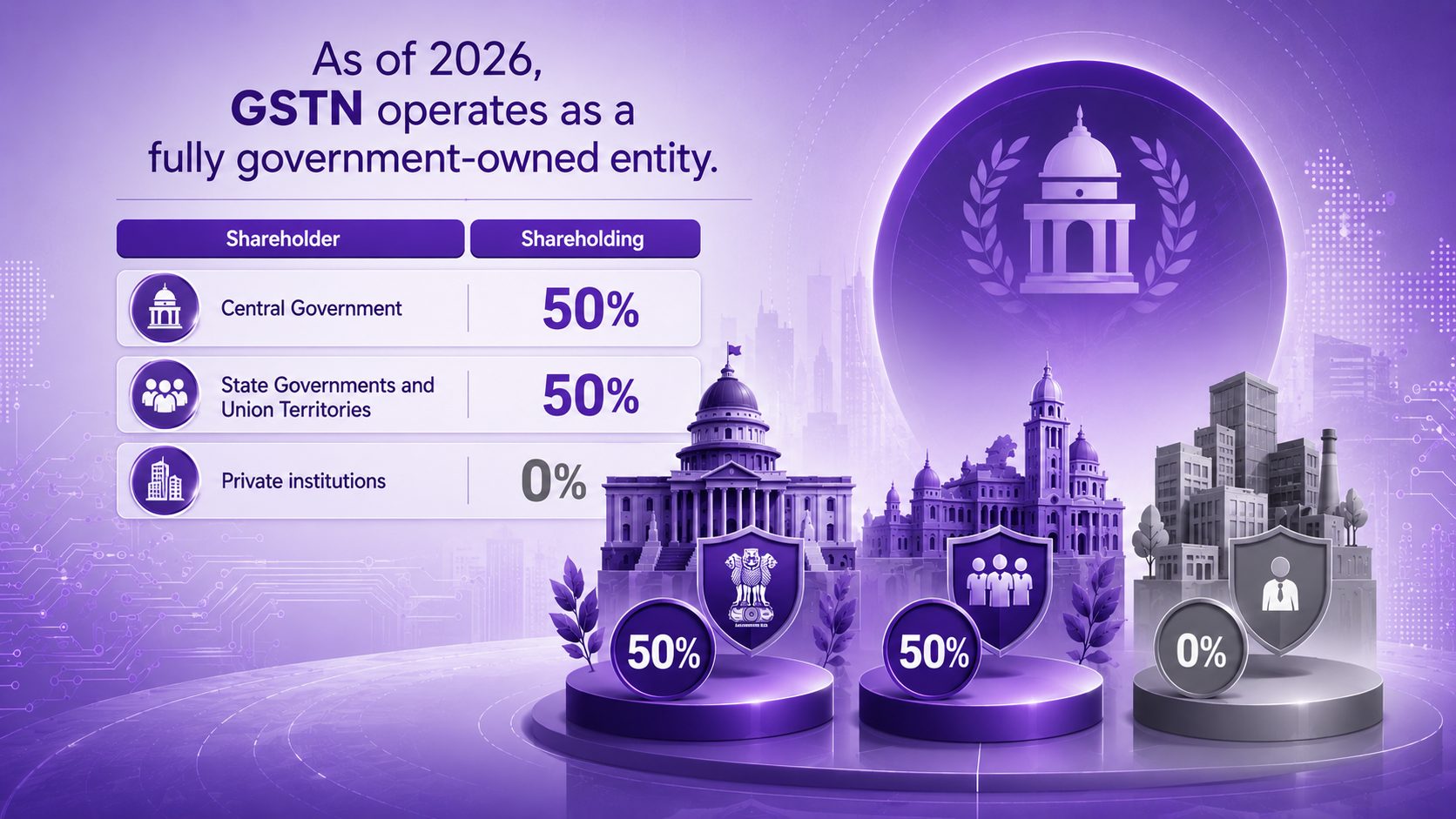
The GSTN ownership structure has evolved over time to align with the growing importance of GST compliance and digital tax administration. As of 2026, GSTN operates as a fully government-owned entity.
| Shareholder | Shareholding |
| Central Government | 50% |
| State Governments and Union Territories | 50% |
| Private institutions | 0% |
Authorised share capital: ₹10 crore
Public ownership model
GSTN initially followed a public-private participation model to leverage technology expertise and operational scalability during the early years of GST implementation. Over time, ownership transitioned fully to the government to strengthen governance and centralise management.
The present structure supports stronger standardisation, system reliability, and scalable GST infrastructure, enabling GSTN to efficiently manage India’s expanding digital tax ecosystem.
How GSTN supports GST compliance for MSMEs
Managing GST compliance can be challenging for MSMEs handling day-to-day business operations. GSTN simplifies MSME GST management by providing digital systems that support registrations, return filing, reconciliation, and compliance processes.
GSTN helps MSMEs by improving:
- GST return filing efficiency
- ITC accuracy through invoice matching
- Reduced compliance errors
- Faster GST reconciliation
- Lower operational burden
Businesses benefit in different ways. A retailer can improve ITC tracking, a manufacturer can reduce manual effort during return filing, and a distributor can identify mismatches early to strengthen compliance accuracy.
By reducing manual work and improving compliance efficiency, GSTN supports smoother GST compliance for MSMEs across industries.
GSTN and digital GST compliance in 2026
As GST systems continue evolving, GSTN remains central to strengthening GST compliance through technology-driven processes. Increasing automation, digital workflows, and data-based systems are helping businesses manage compliance more efficiently while reducing manual effort.
The growing digital GST ecosystem is also improving reconciliation capabilities, reporting accuracy, and compliance monitoring. Risk-based scrutiny systems and validation tools further strengthen compliance processes by helping identify discrepancies early.
Businesses should understand how GST technology trends continue shaping GST compliance practices and operational efficiency.
| Common GSTN issue | Possible solution |
| Login problems | Password reset or credential verification |
| Return mismatch | GST reconciliation and return review |
| ITC mismatch | Supplier verification and invoice matching |
| Auto-population errors | Data review before return filing |
| Compliance discrepancies | Validation checks and reconciliation processes |
As GST compliance 2026 continues becoming more technology-driven, businesses that adapt to digital compliance systems can improve efficiency and reduce compliance challenges.
Conclusion
GSTN has transformed GST administration by building a more connected and technology-driven compliance ecosystem. As the technology backbone behind GST operations, it improves transparency, streamlines tax processes, and supports smoother compliance management for businesses. For MSMEs especially, GSTN helps improve operational efficiency by reducing process complexity and enabling better compliance management. As India’s GST ecosystem continues evolving, understanding GSTN remains important for businesses aiming to manage compliance more effectively.
*This article is for information only. For more details, please visit the official GST website. You can also consult with a GST practitioner or CA or tax consultant for professional advice.
Empowering MSMEs to grow smarter
Tata nexarc delivers powerful solutions for MSMEs—discover tenders, logistics solutions, and streamline procurement. Everything your business needs, all in one place.
FAQs
Is GSTN government owned?
Is GSTN different from GST portal?
How does GSTN help businesses?
Can MSMEs use GSTN directly?
Why is GSTN important for ITC claims?
Does GSTN process GST refunds?
What is the full form of GSTN?
Does GSTN help reduce GST compliance errors?
How does GSTN support GST return filing?
Why is GSTN important for MSMEs?
Sohini is a seasoned content writer with 12 years’ experience in developing marketing and business content across multiple formats. At Tata nexarc, she leverages her skills in crafting curated content on the Indian MSME sector, steel procurement, and logistics. In her personal time, she enjoys reading fiction and being up-to-date on trends in digital marketing and the Indian business ecosystem.


The GSTN is responsible for ensuring all processes regarding GST are running smoothly and without any hiccups. Managing tax data of such a big population is no small task. By introducing latest technological updates, it also makes sure that all processes are up to date and seamless.