Check Price Now
Table of Contents
- What are reinforcement steel bars?
- Types of steel bar tests
- Core mechanical tests
- Core chemical tests
- Non-destructive and advanced tests
- Tests for rebars, TMT bars, and HYSD bars
- Laboratory vs. field testing
- Steel bar sampling procedure and frequency
- Importance of testing & role of Mill Test Certificates
- Common reasons for steel bar test failure
- Conclusion
- FAQs
In construction, every decision comes down to one question: will the material perform when it matters most? For reinforcement steel, the answer comes from a steel bar test. Steel bar testing verifies whether reinforcement bars meet strength, ductility, and chemical limits defined under IS 1786 before construction use.
Today, reinforcement steel bar testing and TMT bar testing are mandatory testing requirements in India. Authorities such as PWD, CPWD, PSU buyers, and large EPC contractors insist on test certificates to ensure rebar quality compliance. Steel that fails testing, or lacks valid reports can lead to site rejection, payment holds, or even tender disqualification. Testing is no longer optional. It is a basic entry requirement for compliant construction projects.
What are reinforcement steel bars?

Reinforcement steel bars, commonly known as rebars, are steel products used to increase the tensile strength of concrete. Concrete performs well under compression but is weak in tension. Steel bars used in RCC structures absorb tensile stresses and help the structure resist cracking and failure. In everyday usage across India, these bars are also called sariya (reinforcement steel bars).
Types of reinforcement steel bars
The two most common categories used in India are:
TMT bars (Thermo Mechanically Treated bars)
Known for high strength, better ductility, and superior weldability. These are widely used in modern construction.
HYSD bars (High Yield Strength Deformed bars)
An older category with good strength but generally lower ductility compared to TMT bars.
When comparing TMT bars vs. HYSD bars, TMT bars are preferred for earthquake-prone and high-rise structures due to their controlled chemical composition and ductile core.
Common steel bar grades (as per IS 1786)
Fe 415 – Used in low-rise residential construction.
Fe 500 – General-purpose structural applications.
Fe 500D – Higher ductility, suitable for seismic zones.
Fe 550D – Infrastructure and heavy-load structures.
Typical applications of reinforcement steel bars
- Residential buildings: Fe 415, Fe 500.
- Commercial structures: Fe 500, Fe 500D.
- Infrastructure projects (bridges, flyovers): Fe 500D, Fe 550D.
In seismic zones, standards mandate higher ductility grades such as Fe 500D or Fe 550D to absorb energy during earthquakes and reduce the risk of sudden structural failure.
Types of steel bar tests
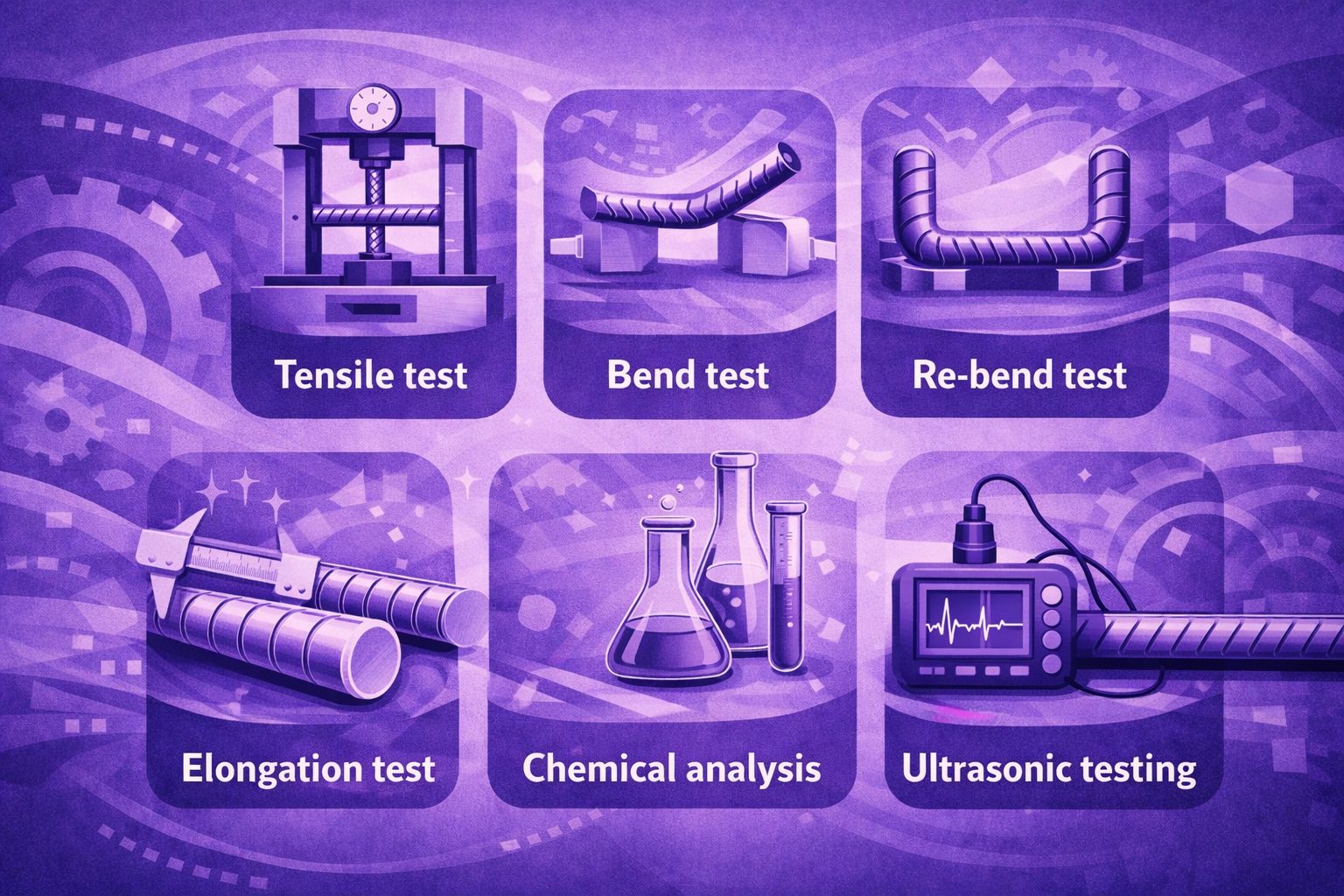
The types of steel bar tests are designed to confirm whether reinforcement steel can safely perform under load, deformation, and long-term exposure. In India, rebar testing methods and acceptance limits are defined under IS 1786:2016, which applies to TMT and hot-rolled deformed bars used in RCC work.
Tests are conducted batch-wise or heat-wise, depending on buyer and tender requirements. Each test has a clear purpose and a direct pass or fail outcome that determines material acceptance at site.
Mechanical and chemical tests for steel bars
| Test category | Test name | What it checks | Risk it prevents | Pass/fail impact |
| Mechanical | Tensile test | Yield strength, tensile strength, elongation. | Bar failure under load. | Fail leads to batch rejection. |
| Mechanical | Bend test | Ability to bend without cracking. | Brittle behaviour during fabrication. | Fail results in site rejection. |
| Mechanical | Re-bend test | Ductility after heating and bending | Poor performance in seismic loads. | Mandatory retesting or rejection. |
| Mechanical | Elongation test | Stretching capacity before fracture. | Sudden structural failure. | Disqualifies high-grade bars. |
| Chemical | Chemical analysis | Carbon, sulphur, phosphorus, manganese. | Poor weldability and corrosion risk. | Non-compliance with IS 1786. |
| Non-destructive* | Ultrasonic testing | Internal cracks or voids. | Hidden defects in bars | Used for critical projects. |
*Non-destructive tests are applied when specified by the buyer or tender conditions.
Core mechanical tests
Core mechanical tests form the backbone of reinforcement steel bar testing. These tests confirm whether steel can safely carry loads, deform without cracking, and perform under real site conditions. All results are evaluated against minimum values as per IS 1786.
Mechanical testing is usually carried out in a fixed sequence to avoid material distortion. Visual inspection is followed by tensile testing and then bend or re-bend tests. Only bars that pass each stage are approved for use.
Key mechanical tests for steel bars
| Test | Purpose | What it measures | Common failure reasons |
| Tensile strength test of steel bars | Checks load-bearing capacity | Yield strength, tensile strength, elongation. | Brittle fracture, low elongation. |
| Bend test for TMT bars | Confirms ductility during bending | Ability to bend without cracks. | Surface cracks at bend. |
| Re-bend test | Tests post-heating ductility | Strength after bending and heating. | Cracks after re-bending. |
| Elongation test steel | Measures stretch before fracture | Percentage elongation. | Sudden break without warning. |
Why these tests matter
- Tensile testing ensures the bar will not fail under design loads.
- Bend and re-bend tests simulate site fabrication and bar placement.
- Elongation testing is critical for structures exposed to dynamic or seismic loads.
Buyer-focused insight
While Fe 500 bars meet strength requirements, Fe 500D bars offer higher ductility. This allows them to absorb more energy during earthquakes, reducing the risk of sudden failure. As a result, many government and EPC buyers now specify Fe 500D over Fe 500 for structural and infrastructure projects.
Failure in any mechanical test can lead to batch rejection, re-testing costs, or site-level rejection, making compliance essential for suppliers and contractors alike.
Core chemical tests

Core chemical tests verify whether the chemical composition of TMT bars meets the limits defined under IS 1786. While mechanical tests show how steel behaves under load, chemical testing explains why it behaves that way. Even small variations in composition can affect strength, durability, and long-term performance.
Chemical testing is mandatory for every heat or batch submitted for approval and is evaluated against minimum values as per IS 1786.
Key chemical parameters tested
| Element/parameter | What it controls | Risk if limits are exceeded |
| Carbon content in steel bars | Strength and hardness | Reduced ductility, brittle failure. |
| Manganese | Strength and wear resistance | Cracking and inconsistent properties. |
| Sulphur | Hot shortness | Poor surface finish, cracking. |
| Phosphorus | Brittleness | Reduced toughness, weld failure. |
| Carbon equivalent (CE) | Overall weldability | Welding cracks and joint failure. |
Why chemical composition matters
- Weldability of reinforcement steel depends largely on carbon content and carbon equivalent. High CE values make steel difficult to weld and increase cracking risk.
- Chemical imbalance accelerates corrosion, especially in humid, coastal, or industrial environments.
- In marine, coastal, or infrastructure projects, buyers often specify stricter chemical limits than standard building work to improve service life.
Traceability and compliance
Chemical test reports must match the heat number stamped on the steel bars and the corresponding Mill Test Certificate (MTC). Any mismatch between chemical analysis, heat number, or documentation can result in batch rejection, even if mechanical results are acceptable.
Chemical testing is not just a formality. It protects weld quality, corrosion resistance, and long-term structural reliability.
Non-destructive and advanced tests
Non-destructive testing of rebars is used to detect hidden defects without damaging the steel bar. These tests are not required for every construction project, but they are commonly specified in government and infrastructure projects where safety margins are tighter and service life expectations are higher.
Unlike routine mechanical and chemical tests, advanced tests focus on internal quality and performance under extreme conditions.
Common non-destructive and advanced tests
| Test | What it checks | Typical application |
| Ultrasonic testing of steel bars (UT) | Internal cracks, voids, inclusions. | Bridges, metro rail projects. |
| Impact test for steel | Resistance to sudden shock loads. | Seismic and high-load structures. |
| Hardness test | Surface resistance to deformation. | Heavy-duty and wear-prone zones. |
| Fatigue test | Performance under cyclic loading. | Flyovers, long-span bridges. |
When are these tests required?
- Mandatory in many metro rail, bridge, defence, and PSU projects as part of tender conditions.
- Recommended when sourcing steel from new suppliers or smaller rolling mills.
- Optional for standard residential and low-rise commercial buildings unless specified by the buyer.
Cost versus risk
Advanced testing increases inspection cost, but it significantly reduces the risk of hidden defects, premature failure, and post-installation disputes. For large infrastructure works, the cost of testing is negligible compared to the financial and safety risks of material failure.
For suppliers, understanding when and why these tests are specified helps in accurate pricing, better compliance, and smoother approvals in high-value projects.
Tests for rebars, TMT bars and HYSD bars
Different types of reinforcement steel bars are subjected to different tests based on their manufacturing process and end use. Understanding the difference between TMT and HYSD bar testing helps buyers and suppliers ensure compliance with project specifications. The table below summarises the tests for reinforcement steel bars in an easy, infographic-ready format.
Applicability of tests by steel bar type
| Test type | Rebars (general) | TMT bars | HYSD bars |
| Tensile test | ✓ | ✓ | ✓ |
| Yield stress test | ✓ | ✓ | ✓ |
| Elongation test | ✓ | ✓ | ✓ |
| Bend test | ✓ | ✓ | ✓ |
| Chemical analysis | ✓ | ✓ | ✓ |
| Ultrasonic testing | ✓ | ✓ | ✓ |
| Fatigue test | Optional | Optional | Optional |
| Torsion test | Optional | ✓ | ✓ |
| Impact bending test | Optional | Optional | Optional |
| Corrosion test | Optional | Optional | Optional |
| Hardness test | Optional | Optional | Optional |
| Flexural/twist test | Optional | ✓ | ✓ |
✓ = Commonly required | Optional = As per buyer or tender requirement
How to test steel bars: Laboratory vs. field testing
Steel bar testing is carried out either through laboratory testing of steel bars or on-site rebar testing. Both approaches serve different purposes. Understanding when to use each helps avoid compliance gaps, re-testing, and site rejection.
Laboratory testing (third-party NABL-accredited lab)
| Aspect | Details |
| Testing environment | Controlled conditions with calibrated equipment. |
| Who conducts it | Trained technicians and metallurgical engineers. |
| Tests covered | Tensile, chemical analysis, elongation, bend, re-bend. |
| Sampling norms | Heat-wise or batch-wise samples as per IS 1786. |
| Accuracy level | High and legally defensible. |
| Compliance value | Mandatory for government, EPC, and PSU projects. |
Field testing (on-site)
| Aspect | Details |
| Testing environment | Construction site conditions. |
| Who conducts it | Site engineers or quality inspectors. |
| Tests covered | Bend and re-bend tests only. |
| Sampling norms | Limited, quick-check samples. |
| Accuracy level | Indicative, not conclusive. |
| Compliance value | Preliminary verification only. |
When each method is appropriate
Field test for TMT bars is sufficient for quick, on-site verification during receipt or before cutting and bending. Laboratory testing is mandatory when test certificates are required for billing, audits, or statutory compliance.
Risk of relying only on field tests
Field tests cannot detect chemical imbalance or internal defects. Depending only on on-site testing increases the risk of batch rejection, delayed payments, and non-compliance during third-party audits.
Field tests support quality checks. Lab tests from a NABL-accredited laboratory enable approval.
Steel bar sampling procedure and frequency

The steel bar sampling procedure plays a critical role in test accuracy and acceptance. Sampling is carried out either heat-wise or batch-wise, depending on buyer specifications and tender conditions. Incorrect sampling is a common reason for disputed results and re-testing.
Typically, laboratories require defined sample lengths taken from representative bars, while rebar testing frequency is decided by quantity and heat number. Sampling may be done by the supplier, under buyer supervision, or directly by the testing lab. Understanding how steel bars are tested and sampled correctly reduces rejection risk, avoids repeat testing, and ensures smoother approvals, especially for MSMEs.
Importance of steel bar testing and the role of Mill Test Certificates
The importance of steel bar testing lies in ensuring safety, compliance, and accountability across the construction supply chain. Testing confirms that reinforcement steel meets strength, ductility, and chemical limits, forming the foundation of quality control in reinforcement steel.
Why testing matters to each stakeholder
- Contractors rely on tested steel to avoid structural risk, rework, and liability during audits or inspections.
- Suppliers and MSMEs use test reports to demonstrate compliance, protect payments, and remain eligible for repeat orders.
- Buyers and developers depend on testing for regulatory approval, insurance acceptance, and long-term asset safety.
In most government, EPC, and PSU projects, steel bar testing is a contractual requirement. Test certificates are often a precondition for bill processing and payment release. Non-compliance can lead to material rejection, payment holds, or contract penalties.
Role of Mill Test Certificates (MTCs)

A mill test certificate for steel, commonly called an MTC for TMT bars, is the official quality document issued for each tested heat or batch. It typically includes:
- Steel grade and IS 1786 compliance
- Mechanical and chemical test results
- Heat number and batch identification
- Testing laboratory details and authorisation
Traceability and verification
Buyers verify steel bar test certificates by matching the heat number on the MTC with markings on the supplied bars. Common MSME errors include reused MTCs, mismatched heat numbers, or missing lab endorsements. Even tested steel can be rejected if documentation does not align. In today’s procurement environment, testing proves quality, but MTCs prove compliance.
Common reasons for steel bar test failure
Use this compliance checklist to identify the most frequent steel bar test failure reasons and avoid common TMT bar rejection causes during inspection and approval.
Mechanical failures
☐ Tensile strength below minimum values as per IS 1786
☐ Low elongation leading to brittle fracture
☐ Surface cracks during bend or re-bend tests
☐ Failure in twist or flexural tests for TMT bars
Impact: Batch rejection or mandatory re-testing
Chemical deviations
☐ Excess carbon content reducing ductility
☐ High carbon equivalent (CE) affecting weldability
☐ Sulphur or phosphorus beyond permissible limits
☐ Composition not aligned with project-specific requirements
Impact: Poor weld performance and long-term corrosion risk
Documentation mismatch
☐ Heat number on bars does not match MTC
☐ Reused or outdated mill test certificates
☐ Missing lab seal or authorisation details
☐ Incomplete test reports submitted for billing
Impact: Payment holds or tender non-compliance
Improper sampling
☐ Samples not taken heat-wise or batch-wise
☐ Incorrect sample length or quantity
☐ Sampling done without buyer or lab supervision
☐ Damaged samples affecting test accuracy
Impact: Disputed results and repeat testing costs
Conclusion
A steel bar test is no longer just a quality check; it is a compliance requirement in modern construction. With increasing audits and stricter buyer scrutiny, verified test reports and clear documentation have become essential for project approval and payment release. Digital traceability and tighter quality controls are further raising expectations across the supply chain. Suppliers who treat testing as a system, not a cost, reduce rejection risk and build long-term trust. In today’s market, testing is a business enabler that separates compliant suppliers from the rest.
Looking to procure steel?
Tata nexarc helps manufacturers, builders and MSMEs source certified steel products, compare prices, and choose the right grade as per IS codes—with complete traceability and procurement confidence.
FAQs
What is a steel bar test?
Why is reinforcement steel bar testing important?
Who mandates steel bar testing in India?
What are the common grades of steel bars?
What types of tests are done on steel bars?
What is a Mill Test Certificate (MTC)?
How are steel bars sampled?
Can field testing replace lab testing?
Why do steel bars fail testing?
How does testing affect payment and compliance?
A product manager with a writer's heart, Anirban leverages his 6 years of experience to empower MSMEs in the business and technology sectors. His time at Tata nexarc honed his skills in crafting informative content tailored to MSME needs. Whether wielding words for business or developing innovative products for both Tata Nexarc and MSMEs, his passion for clear communication and a deep understanding of their challenges shine through.