
 Check Price Now
Table of Contents
- Roofing steel sheet price range by type
- Roofing steel sheet prices by size, gauge, and brand
- Roofing steel sheet prices per kg vs. per sheet
- Roofing steel sheet price trends (2023-2026)
- Roofing sheet prices by city
- Types of roofing steel sheets
- How gauge, thickness, and coating affect price
- Local vs. branded roofing steel sheets
- Buy roofing steel sheets at the right price
- Conclusion
- FAQs
Roofing steel sheet prices in India can be difficult to interpret due to constant market movement and varying specifications. Rates are influenced by steel coil costs, zinc and aluminium prices, freight charges, GST, and brand premiums. Confusion often arises because roofing sheets are quoted per kg, not per sheet. This article breaks down roofing steel sheet price structures in a clear and practical way. It focuses on widely used 12, 14, and 20 ft sizes, along with gauges, coatings, and leading manufacturers. The price ranges mentioned are indicative of prevailing market levels and may vary based on location, order volume, and supplier terms.
Roofing steel sheet price range by type (per kg, Indian market)
Roofing steel sheet prices in India vary primarily by sheet type, coating technology, and structural profile. Each category serves a different use case, which directly affects its per kg price. The ranges below represent typical market levels and may change based on location, order size, and supplier margins.
Price range by roofing steel sheet type
| Roofing sheet type | Price range (₹/kg) |
| Galvanised steel sheets | ₹40 – ₹55 |
| Coated steel sheets (pre-painted/colourbond) | ₹50 – ₹70 |
| Aluzinc steel sheets | ₹45 – ₹65 |
| Corrugated steel sheets | ₹40 – ₹60 |
| Trapezoidal steel sheets | ₹55 – ₹70 |
Why prices differ by sheet type
- Galvanised roofing sheets are the most economical option. They offer basic corrosion resistance and are widely used for sheds, warehouses, and rural construction.
- Pre-painted or coated sheets command a premium due to added paint layers, better UV resistance, and improved aesthetics. Resin-based coatings also introduce higher cost volatility.
- Aluzinc sheets balance durability and pricing by combining aluminium and zinc coatings, making them suitable for longer service life.
- Corrugated sheets are affordable because of simple profiling and lower steel consumption.
- Trapezoidal sheets cost more structurally due to higher load-bearing capacity, better span coverage, and increased steel content per square metre.
Key pricing considerations
- Prices vary by city, freight distance, and order volume.
- Bulk purchases often attract lower per kg rates.
- Coating inputs such as zinc and aluminium tend to fluctuate more sharply than base steel, which impacts coated sheet pricing.
Roofing steel sheet prices by size, gauge, and brand (12, 14, 20 ft)

Roofing steel sheet prices increase as sheet length, thickness, and brand quality rise. In the Indian market, 12 ft, 14 ft, and 20 ft sheets are the most commonly traded sizes due to their suitability for residential, commercial, and industrial roofing. Prices are quoted per kg, but the final cost depends on handling and logistics.
Indicative pricing by size, gauge, and brand
| Size (ft) | Gauge (mm) | Sheet type | Local (₹/kg) | SAIL (₹/kg) | Tata/JSW (₹/kg) |
| 12 | 0.50 (28) | Galvanised | 44 – 54 | 52 – 62 | 57 – 64 |
| 12 | 0.55 (26) | Pre-painted/ Aluzinc | 54 – 64 | 62 – 72 | 67 – 74 |
| 14 | 0.50 (28) | Galvanised | 46 – 56 | 54 – 64 | 59 – 66 |
| 14 | 0.55 (26) | Pre-painted/ Aluzinc | 56 – 66 | 64 – 74 | 69 – 76 |
| 20 | 0.50 (28) | Galvanised | 48 – 58 | 56 – 66 | 61 – 68 |
| 20 | 0.55 (26) | Pre-painted/ Aluzinc | 58 – 68 | 66 – 76 | 71 – 78 |
Why sheet length affects pricing
- Longer sheets reduce overlap and installation wastage, which can lower material loss.
- Transport and handling costs rise with length, especially for 20 ft sheets.
- Longer sheets require careful loading, increasing freight risk and insurance costs.
Brand-wise price differences
- Local manufacturers offer competitive rates but show wider quality variation.
- SAIL sheets sit in the mid-range with consistent coating standards.
- Tata and JSW sheets usually carry a premium due to tighter tolerances, warranties, and nationwide availability.
Roofing steel sheet prices per kg vs. per sheet
Roofing steel sheets in India are quoted per kg, while buyers often plan budgets based on per sheet cost. This difference frequently leads to pricing confusion. Understanding how per kg rates translate into per sheet costs helps buyers compare offers correctly and avoid specification mismatches.
Why roofing steel sheets are priced per kg
- Steel is traded by weight, not by count.
- Sheet weight varies with thickness, coating gsm, and profile depth.
- Per kg pricing ensures fair comparison across sizes and brands.
- Digital weighbridge billing is increasingly used by organised suppliers.
How to calculate roofing sheet price per sheet
The per sheet cost is calculated by multiplying the sheet weight by the quoted per kg price.
Sample calculation (12 ft sheet)
| Specification | Value |
| Sheet length | 12 ft |
| Thickness | 0.55 mm (26 gauge) |
| Approx. weight | 32 – 34 kg |
| Price range | ₹55 – ₹65 per kg |
| Estimated cost per sheet | ₹1,760 – ₹2,210 |
Actual weight may vary slightly depending on coating thickness and manufacturing tolerance.

Common pricing mistakes to avoid
- Comparing per sheet prices without verifying actual weight.
- Ignoring coating gsm, which adds both weight and cost.
- Assuming identical weights for the same gauge across suppliers.
- Accepting bundled quotes without a weight break-up.
Key takeaway for buyers
- Compare roofing steel sheet prices on a per kg basis.
- Confirm weight per sheet and coating specifications.
- Use per sheet pricing only for budgeting, not supplier comparison.
Roofing steel sheet price trends (2023–2026)
| Year | Market trend | Key price drivers |
| 2023 | Volatile | Steel coil swings, freight cost spikes. |
| 2024 | Moderating | Improved supply, stable demand |
| 2025 | Firming | Higher zinc and aluminium costs. |
| 2026 | Range-bound | Coating costs, brand premiums, logistics. |
Note: Prices generally track steel coil and coating inputs, with coated and branded sheets showing sharper movement than basic galvanised sheets.
Roofing sheet prices by city (₹/kg, indicative)
| City | Galvanised sheets | Pre-painted/Aluzinc sheets | Trapezoidal sheets |
| Delhi | 52 – 62 | 62 – 72 | 65 – 75 |
| Mumbai | 54 – 64 | 64 – 74 | 67 – 77 |
| Chennai | 50 – 60 | 60 – 70 | 63 – 73 |
| Hyderabad | 51 – 61 | 61 – 71 | 64 – 74 |
| Bangalore | 53 – 63 | 63 – 73 | 66 – 76 |
Note: Prices are indicative, per kg, and vary with gauge, coating, supplier, and transport. Long sheets (14–20 ft) may carry additional freight costs.
Types of roofing steel sheets used in India
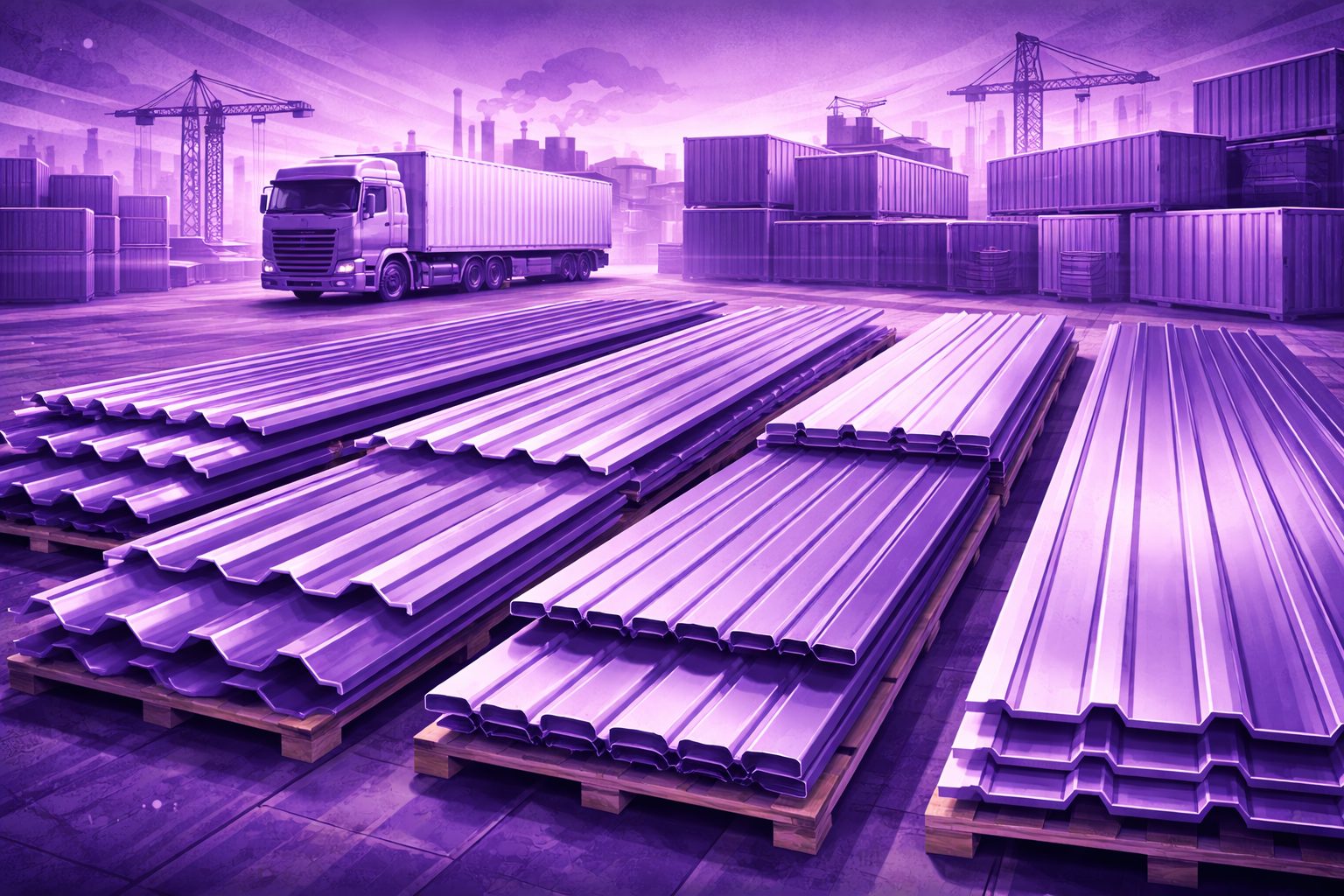
Roofing steel sheets are available in multiple profiles and coatings, each designed for specific structural, environmental, and aesthetic requirements. Understanding the types of roofing steel sheets helps buyers balance upfront cost with durability and long-term maintenance.
Economy roofing steel sheets
Economy-grade sheets focus on functionality and affordability. They are widely used in rural housing, sheds, and small commercial structures where cost control is a priority.
Galvanised steel sheets
These sheets feature a zinc coating that provides basic corrosion resistance. They are commonly used for warehouses, farm structures, and temporary roofing. Maintenance costs are moderate, especially in non-coastal regions.
Corrugated steel sheets
Corrugated sheets use a wave-like profile to improve stiffness with lower steel usage. They are cost-effective and easy to install, making them suitable for both industrial sheds and residential extensions.
Mid-range and premium roofing steel sheets
Premium sheets offer better durability, appearance, and lower maintenance over time. They are preferred for permanent structures and exposed environments.
Pre-painted steel sheets (including colourbond-type sheets)
These sheets include a paint layer over a metallic coating, improving weather resistance and visual appeal. They are commonly used in residential and commercial buildings where appearance matters. Maintenance costs are lower due to enhanced coating protection.
Aluzinc steel sheets
Aluzinc sheets combine aluminium and zinc coatings for improved corrosion resistance. They perform well in coastal and industrial environments and offer longer service life compared to basic galvanised sheets.
High-performance roofing profiles
Trapezoidal steel sheets
These sheets provide higher load-bearing capacity and are suited for industrial roofs and large spans. Maintenance costs are lower over the lifespan due to better structural stability.
Tile-profile steel sheets
Tile-profile sheets mimic traditional tiles while offering steel’s durability. Demand is increasing in tier-2 residential markets where aesthetics and longevity are equally important.
Standing seam steel sheets
Standing seam systems provide superior waterproofing and are increasingly used in warehouses and logistics parks due to low maintenance and long-term reliability.
How gauge, thickness, and coating affect roofing sheet price

The price of a roofing steel sheet is directly linked to its gauge, thickness, and coating quality. These three factors determine strength, corrosion resistance, and service life. Understanding how they work together helps buyers choose the right specification without overspending.
Gauge and thickness: How they are connected
Gauge is an indirect way of expressing sheet thickness. A lower gauge number means a thicker sheet. For example, a 24-gauge sheet is thicker and stronger than a 28-gauge sheet. Thickness is measured in millimetres and represents the actual steel content.
Thicker sheets cost more because they use more steel and offer higher load-bearing capacity. They are less prone to denting, bending, and vibration. Thinner sheets are cheaper but may require closer purlin spacing and more frequent maintenance.
Coating and gsm: Why it matters
Coating protects steel from rust. It is measured in grams per square metre (gsm), which indicates the amount of protective metal applied.
- Lower gsm coatings wear out faster and expose steel to corrosion.
- Higher gsm coatings provide longer protection and reduce repainting needs.
For example, a galvanised sheet with low coating thickness may start rusting within a few monsoons in humid regions. In contrast, Aluzinc sheets with AZ150 or higher offer better resistance, especially in aggressive environments.
Coastal vs. inland usage guidance
- Coastal and industrial areas: Higher coating grades such as AZ150 or above are recommended due to salt and pollution exposure.
- Inland and dry regions: Standard galvanised coatings may be sufficient if thickness is adequate.
Why specifications affect price
- Higher thickness and gsm increase material cost per kg.
- Better coatings reduce long-term maintenance and replacement costs.
- Under-gsm sheets are increasingly rejected in large projects and tenders.
Local vs. branded roofing steel sheets – Price vs. long-term cost
Choosing between local and branded roofing steel sheets is not only a price decision. It also affects maintenance, lifespan, and replacement costs. The table below compares both options using decision-focused criteria, helping buyers assess total cost of ownership rather than upfront price alone.
Local vs. branded roofing steel sheets
| Decision factor | Branded manufacturers (Tata, JSW, SAIL) | Local manufacturers |
| Average price per kg | Higher upfront cost due to quality control and brand premium. | Lower initial price, budget-friendly. |
| Thickness consistency | Tight tolerances and consistent gauge. | Thickness variation may occur. |
| Coating quality (gsm) | Certified coating levels with documentation. | Coating gsm may vary or be unverified. |
| Rust and corrosion risk | Lower risk with proper installation. | Higher risk if coating is under-gsm. |
| Repainting requirement | Usually after longer intervals. | Often required earlier, especially outdoors. |
| Replacement cycle | Longer service life reduces replacement frequency. | Shorter lifespan may increase replacement cost. |
| Warranty coverage | Product warranties available, enforcement improving. | Limited or no formal warranty. |
| After-sales support | Structured support and complaint redressal. | Support depends on individual supplier. |
| Suitability | Industrial, commercial, and long-term projects. | Rural, temporary, and budget-led projects. |
How to decide based on project needs
Branded sheets suit projects where durability, warranty, and compliance are critical. They often justify their higher price through lower maintenance and longer service life. Local sheets work well for cost-sensitive projects, especially in rural infrastructure and short-term applications, where replacement is acceptable.
Key cost insight:
- Lower upfront pricing does not always mean lower total cost.
- Repainting, rust repair, and early replacement can narrow the initial price gap.
How to procure roofing steel sheets at the right price

Procuring roofing steel sheets at the right price requires planning, market awareness, and clear specifications. Following a structured approach helps control costs while ensuring quality.
Define requirements: Measure roof area accurately. Finalise sheet type, gauge, coating gsm, profile, and length based on structural and environmental needs.
Track steel price cycles: Roofing sheet prices move with hot-rolled coil and zinc rates. Buying during stable or downward price phases can reduce overall cost.
Compare suppliers: Evaluate branded producers, regional manufacturers, and online B2B platforms to assess availability and pricing transparency.
Request detailed quotations: Ask for per kg rates, coating gsm, delivery charges, and loading terms. Avoid lump-sum quotes without specification details.
Negotiate on volume: Bulk buyers can negotiate better per kg rates, flexible delivery schedules, or reduced freight charges.
Check quote validity: Quotation validity periods are becoming shorter due to market volatility. Always confirm the rate lock period before placing orders.
Inspect delivery: Verify thickness, coating, and quantity at the site before accepting material.
Online B2B platforms are increasingly influencing price discovery, but buyers should still validate specifications and supplier credibility. This approach supports smarter decisions when you buy roofing steel sheets in India and compare roofing sheet suppliers effectively.
Common pricing mistakes to avoid
Small specification errors can lead to higher long-term costs, even if the initial price appears attractive.
Ignoring coating gsm: Lower gsm coatings reduce price but increase rust risk and repainting frequency.
Mixing gauges unknowingly: Similar-looking sheets may have different thicknesses, affecting strength and lifespan.
Falling for “cheap per sheet” offers: Lower per sheet pricing often hides reduced weight or thinner steel.
Not checking weight per sheet: Variations impact true per kg cost and material performance.
Overlooking quote validity: Delayed orders can face price revisions if the market moves.
Avoiding these mistakes improves cost control, builds supplier trust, and reduces maintenance and replacement risks over the roofing lifecycle.
Conclusion
Choosing the right roofing steel sheet goes beyond comparing per kg prices. Gauge, coating quality, and manufacturer standards directly affect durability and long-term cost. Comparing specifications across brands helps avoid premature rusting, frequent repairs, and unnecessary replacement expenses.
Looking to procure steel?
Tata nexarc helps manufacturers, builders and MSMEs source certified steel products, compare prices, and choose the right grade as per IS codes—with complete traceability and procurement confidence.
FAQs
How does the price of galvanised steel sheets compare to pre-painted sheets in India?
What factors influence the price fluctuations of roofing steel sheets in the Indian market?
Which type of roofing steel sheet is best for coastal areas in India?
What is the significance of the gauge and thickness of roofing steel sheets?
How can I ensure the quality of the coating on roofing steel sheets?
What are the differences between local and branded roofing steel sheet manufacturers in terms of quality?
What are the essential steps for procuring roofing steel sheets in India?
Are there any considerations to make concerning the transportation costs of Roofing steel sheets?
How do I calculate how many roofing steel sheets I will need for my project?
A product manager with a writer's heart, Anirban leverages his 6 years of experience to empower MSMEs in the business and technology sectors. His time at Tata nexarc honed his skills in crafting informative content tailored to MSME needs. Whether wielding words for business or developing innovative products for both Tata Nexarc and MSMEs, his passion for clear communication and a deep understanding of their challenges shine through.





What would be the roofing sheet price in Uttrakhand? I am looking to make a steel structure for my electrical plant.