Check Price Now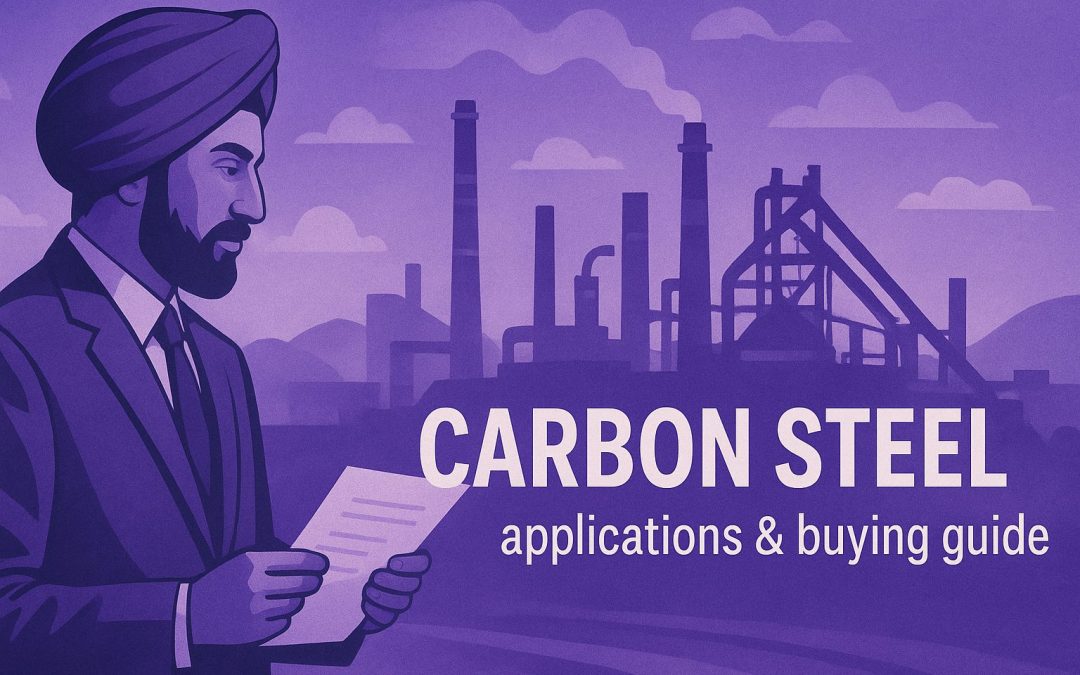
Table of Contents
Carbon steel is one of the most widely used materials in India’s industrial economy. It is strong, affordable, and available in many grades and forms. This makes it a reliable choice for construction, manufacturing, automotive production, machinery, and everyday fabrication.
As India builds more roads, bridges, factories, and urban infrastructure, the demand for carbon steel continues to rise. It remains the backbone of many sectors because it offers good performance at a reasonable cost.
This guide helps steel buyers and producers understand how carbon steel is used, which grades suit different applications, and how to source it responsibly. It explains the key factors to check before buying, the standards that matter, and the pricing trends that shape India’s market.
Brief overview of carbon steel
Carbon steel is a type of steel where carbon is the main alloying element. It is simple, strong, and widely used across Indian industries. Its properties depend mainly on how much carbon it contains.
Definition and classification
Carbon steel in India is usually grouped into three categories:
- Low-carbon steel (mild steel): Up to 0.25% carbon. Soft, ductile, and easy to weld.
- Medium-carbon steel: 0.25%–0.60% carbon. Stronger and suitable for machinery and automotive use.
- High-carbon steel: 0.60%–1.0% carbon. Hard, wear-resistant, and ideal for tools and high-strength parts.
How carbon content affects mechanical properties
Higher carbon levels:
- Increase hardness and tensile strength
- Reduce ductility and weldability
- Improve wear resistance
Lower carbon levels:
- Improve formability
- Allow easier welding
- Reduce hardness
This is why choosing the correct carbon percentage is crucial for performance and safety.
India’s production capacity and key suppliers
India is one of the world’s largest producers of carbon steel. The market includes:
- Integrated steel plants: Tata Steel, JSW Steel, SAIL
- Major private producers: AM/NS India, Jindal Steel & Power
- Secondary mills: Hundreds of Induction Furnace (IF) and Electric Arc Furnace (EAF) units
- Service centres and distributors: Offer cut-to-length, slitting, and ready-to-use material
This mix ensures steady availability across coils, sheets, plates, bars, and structural steel.
Carbon steel vs. alloy steel vs. stainless steel
| Type | Key composition | Main advantages | Typical use cases |
| Carbon steel | Mainly iron and carbon. | Affordable, strong, easy to weld and process. | Construction, fabrication, general manufacturing. |
| Alloy steel | Iron with added elements such as chromium, nickel, or molybdenum. | Higher strength, better heat resistance, improved mechanical performance. | Specialised machinery, automotive parts, engineering components. |
| Stainless steel | Iron with at least 10.5% chromium. | High corrosion resistance, clean appearance, long life. | Food processing, chemical plants, appliances, environments with moisture or chemicals. |
Types of carbon steel commonly used in India
India uses three main types of carbon steel, each suited to different levels of strength, hardness, and fabrication needs. Choosing the right type is essential for balancing performance, safety, and cost.
Low-carbon steel (mild steel)
Low-carbon steel contains up to 0.25% carbon. It is soft, ductile, and easy to weld or bend. It offers reliable strength at a low cost, which makes it the most commonly used carbon steel in India.
Characteristics: Good formability, smooth welding behaviour, and low hardness.
Strengths: Affordable, widely available, and suitable for large-scale fabrication.
Use cases: Construction beams and sections, general fabrication, automotive body panels, pipes, tanks, and appliances.
Medium-carbon steel
Medium-carbon steel contains 0.25%–0.60% carbon. It offers a balance of strength and ductility. It responds well to heat treatment, which can further increase hardness and wear resistance.
Characteristics: Higher strength and hardness than mild steel; moderate weldability.
Strengths: Can be hardened and tempered for better performance.
Use cases: Gears, shafts, axles, machinery parts, automotive components, and industrial tools.
High-carbon steel
High-carbon steel contains 0.60%–1.0% carbon. It is very hard and wear-resistant but less ductile. It is used when components must withstand heavy stress, impact, or repetitive wear.
Characteristics: High hardness, high strength, and low weldability.
Strengths: Performs well in demanding, high-friction environments.
Use cases: Cutting tools, springs, blades, dies, industrial machinery parts, and applications requiring long-term durability.
IS standards and grades (BIS/IS codes)
| IS standard | What it covers | Typical uses in India |
| IS 2062 | Hot-rolled medium and high tensile structural steel. | Structural sections, plates, beams, bridges, buildings. |
| IS 1570 | Classification of carbon and alloy steels into various grades. | General engineering applications, machinery components. |
| IS 2830 | Carbon steel billets, blooms, and slabs for re-rolling. | Raw material for rolling mills and secondary producers. |
| IS 1786 | High-strength deformed steel bars for concrete reinforcement (TMT bars). | Construction, reinforced concrete, infrastructure projects. |
Applications of carbon steel in India
Carbon steel plays a central role across India’s industrial sectors. Its strength, affordability, and range of grades make it suitable for everything from large infrastructure projects to precision automotive parts and daily-use consumer goods.
Construction and infrastructure
Carbon steel is the backbone of India’s construction sector. It is widely used in buildings, bridges, railways, metro networks, and industrial structures. Plates, beams, angles, and channels made from carbon steel provide the strength needed for safe and durable frameworks. Large infrastructure projects such as highways, ports, and airports depend on consistent supply and reliable performance from structural-grade steels.
Automotive and transport manufacturing
The automotive industry relies heavily on medium- and high-carbon steels. These grades offer the strength and wear resistance needed for chassis components, body structures, suspension parts, and fasteners. OEMs choose carbon steel because it can be shaped precisely and heat-treated for better performance. As India’s automotive and commercial vehicle production expands, carbon steel remains essential for cost-efficiency and safety.
Oil & gas, refineries & petrochemicals
Carbon steel is widely used for pipelines, tanks, and pressure systems in India’s energy sector. Its ability to handle high pressure and temperature makes it well suited for upstream, midstream, and downstream operations. As India builds more refineries, LNG terminals, and petrochemical plants, the demand for reliable carbon steel grades continues to grow.
Machinery & industrial equipment
Medium- and high-carbon steels are key materials for machinery manufacturing. They are used to make gears, shafts, tools, and components that must handle heavy loads and continuous wear. Heat-treated carbon steels offer higher strength, longer service life, and better resistance to friction, making them essential for India’s expanding engineering and capital goods industry.
Consumer goods & fabrication
Carbon steel is used across appliances, furniture, kitchenware, and general hardware. It is easy to cut, bend, and weld, which is why MSME fabrication units rely on it for everyday production. Its low cost and wide availability help small manufacturers deliver durable products without increasing expenses.
Power sector
India’s power sector uses carbon steel for transmission towers, boiler components, and structural assemblies in thermal, hydro, and renewable energy plants. Carbon steel’s strength and resistance to high temperatures make it suitable for demanding environments such as boilers and turbine housings.
MSME and local manufacturing clusters
Carbon steel supports thousands of MSMEs across industrial clusters in Maharashtra, Gujarat, Tamil Nadu, and Jharkhand. Small and medium manufacturers use carbon steel for fabrication, machining, and equipment building. Its consistent availability, flexible supply sizes, and low cost make it the preferred material for local industries producing machinery parts, construction fittings, and consumer products.
Factors to evaluate when purchasing carbon steel
Before placing an order, buyers should assess several technical and commercial factors. These checks help ensure material performance, reduce fabrication issues, and avoid delays or rework.
Mechanical properties
Evaluate the material’s strength and performance under load.
- Yield strength – Determines how much stress the steel can handle before it starts to deform.
- Tensile strength – Indicates the maximum load the steel can withstand.
- Elongation – Shows how ductile the material is and how easily it can bend or form.
- Impact toughness – Extremely important for bridges, railways, and infrastructure exposed to vibration or shock.
Chemical composition
Check the chemical limits to ensure the steel behaves as expected during processing.
- Carbon content – Higher carbon increases hardness but reduces weldability.
- Manganese – Improves strength and hardenability.
- Sulphur and phosphorus – Must be kept low to avoid brittleness and cracking.
- Effect on processing – The chemistry affects weldability, machinability, and surface finish.
Dimensions and tolerances
Accurate dimensions reduce waste and fabrication errors.
- Thickness tolerance – Variations can affect weight, strength, and fit-up.
- Width and length tolerance – Important for plate and coil processing.
- Shape and straightness – Poor tolerances increase cutting time and raise production costs.
Surface condition and coatings
Surface finish affects corrosion resistance, aesthetics, and downstream processing.
- Hot-rolled (HR) – Rougher surface; ideal for structural applications.
- Cold-rolled (CR) – Better finish and tighter tolerances; used for appliances and automotive parts.
- Galvanised – Zinc-coated for corrosion resistance.
- Painted or pre-coated – For appliances and roofing.
- Pickled & oiled (P&O) – Scale removed; smoother surface for further processing.
Heat treatment requirements
Check whether the application demands specific heat treatments.
- Annealing – Improves formability.
- Quenching and tempering – Increases strength and wear resistance.
- Normalising – Enhances toughness and uniformity.
Quality certifications
Certifications help ensure traceability and compliance with Indian and global standards.
- BIS marking – Confirms compliance with Indian standards.
- Mill Test Certificate (MTC) – Shows chemistry, mechanical properties, and heat number.
- Third-party inspection – Agencies like Lloyd’s, BVQI, and TUV can verify quality for critical projects.
How to buy carbon steel in India: A step-by-step guide
| Step | What to check | Details |
| Define application requirements | End-use and performance needs | Identify whether the steel is for structural work, automotive parts, machinery, or fabrication. Check if it is load-bearing or non-load-bearing to determine minimum strength. |
| Select correct grade & standard | Match IS code with application | Choose grades such as E250, E350, or IS 1570 series based on strength, ductility, and service conditions. Ensure compliance with BIS standards. |
| Choose the right product form | Form that suits fabrication needs | Select from plates, coils, sheets, bars, angles, channels, or pipes depending on cutting, welding, and forming requirements. |
| Choose supplier category | Type of seller and scale | Options include integrated steel plants (Tata Steel, JSW Steel, SAIL), secondary producers, stockists/distributors, and fabricators for customised parts. |
| Evaluate supplier credibility | Reliability and consistency | Check past performance, customer reviews, quality certifications, and production capabilities before placing an order. |
| Request & analyse technical documentation | Verify chemical and mechanical properties | Review Mill Test Certificates (MTCs), heat numbers, and, if required, ultrasonic or radiography test reports for critical components. |
| Conduct rice comparison & negotiation | Compare commercial terms | Evaluate spot vs contract pricing, freight charges, GST implications, and minimum order quantities. Negotiate for better rates on bulk orders. |
| Inspection & testing before acceptance | Ensure delivered material meets specifications | Conduct dimensional checks, chemical analysis, and mechanical testing such as UTS, YS, hardness, or bend tests. |
| Delivery, logistics & storage | Safe handling and protection | Plan for lead times, especially during high demand. Ensure proper protection against corrosion during monsoon transport. Store steel on dry platforms with adequate ventilation. |
Common steel procurement mistakes to avoid
Choosing the wrong steel grade: Leads to performance issues, rework, or safety risks.
Ignoring tolerances: Poor dimensional accuracy increases fabrication time and cost.
Overlooking traceability & MTCs: Missing heat numbers or incomplete MTCs weaken quality assurance.
Relying solely on price: Cheaper supply can mean inconsistent quality, defects, or higher long-term costs.
Not considering lead times: Delays disrupt project schedules, especially during peak demand seasons.
Buying from non-BIS-certified sources: Raises compliance risks and may lead to project rejections or safety failures.
What elements influence pricing?
Carbon steel prices in India change frequently because they depend on raw materials, market demand, government policies, and global trends. Understanding these price drivers helps buyers plan purchases, negotiate better, and avoid unexpected cost increases.
- Iron ore and coking coal fluctuations: These are the primary raw materials. Any rise in international coal prices or domestic iron ore premiums directly increases steel costs.
- Domestic demand cycles: Construction, automotive, and infrastructure demand can cause sudden price swings. When these sectors surge, steel prices rise.
- Export policies: If export demand strengthens or export duties change, domestic supply tightens, pushing prices up.
- Government tariffs, duties, and BIS compliance rules: Import duties, anti-dumping measures, and BIS certification requirements affect both supply and pricing, especially for imported or secondary-grade material.
Integrated vs. secondary market pricing
Integrated steel plants and secondary producers follow different pricing patterns.
Integrated producers such as Tata Steel, JSW Steel, and SAIL usually offer more stable prices because they control their iron ore and coal sources. Their products come with consistent quality and certification, which is preferred for large projects.
Secondary mills rely heavily on scrap and imported raw materials, so their prices move more quickly. They often offer lower prices, but quality can vary widely. Buyers must check MTCs and tolerances carefully when sourcing from secondary units.
Seasonal trends
India’s steel demand follows clear seasonal patterns. During Q4, construction activity increases as companies rush to complete yearly targets. This leads to a rise in steel consumption and firmer prices. The monsoon months see construction slow down across most of India. This reduces demand, and prices often dip or stabilise. Buyers who plan strategically can take advantage of these predictable trends.
Conclusion
Carbon steel continues to underpin India’s industrial and infrastructure expansion, making informed material choices more important than ever. Selecting the right grade, standard, and supplier ensures stronger performance and long-term value.
A structured, data-driven procurement approach further helps buyers avoid costly mistakes and delays. For steel producers, consistently aligning quality, documentation, and service with evolving buyer expectations is essential to remain competitive.
Looking to procure steel?
Tata nexarc helps manufacturers, builders and MSMEs source certified steel products, compare prices, and choose the right grade as per IS codes—with complete traceability and procurement confidence.
FAQs
What is carbon steel?
What are the common types of carbon steel?
Where is carbon steel mostly used in India?
How do I choose the right grade?
What technical factors should buyers check?
What are the main elements that influence steel pricing?
Why is traceability important in steel purchasing?
Should buyers rely on secondary mills?
How can buyers reduce procurement mistakes?
Is carbon steel sustainable?
Priyanka is a seasoned content marketing professional with more than 6 years of experience crafting various forms of business and technology sector content. Her insightful writing tackles critical issues faced by small-scale manufacturing businesses. Priyanka's clear and concise communication empowers businesses to make informed decisions and thrive in today's dynamic business environment.