Check Price Now
Table of Contents
- What is HTS Wire?
- What is REBCO Wire?
- REBCO Wire vs Other HTS Wire: Key Differences
- Key REBCO and HTS Wire Specifications to Check
- REBCO Wire Price and HTS Wire Cost
- REBCO and HTS Wire Standards
- Applications of REBCO and HTS Wires
- REBCO Wire Suppliers and HTS Wire Manufacturers
- How to Choose the Right HTS or REBCO Wire
- REBCO and HTS Wire Market in India: Opportunities and Challenges
- Conclusion
- FAQs
The REBCO wire vs HTS wire comparison can be confusing because the two terms are not direct alternatives. HTS wire is a broad term for high-temperature superconducting wires. REBCO wire is one specific type of HTS wire.
So, the better comparison is between REBCO and other types of HTS conductors. Each type can suit different applications and operating conditions. This article explains their key differences, important specifications, and common uses. It also covers price factors, standards, suppliers, and sourcing points to help engineers, researchers, and technical buyers make a more informed choice.
What is HTS wire?
HTS wire: HTS stands for high-temperature superconducting wire. It is a broad term for conductors that can carry electricity with very low resistance under specific operating conditions.
HTS conductor families: HTS wires include different superconductor technologies. The two main families relevant to commercial and research applications include REBCO and BSCCO.
REBCO wire: REBCO is a type of HTS conductor. It is widely used in applications that need strong performance in high magnetic fields.
BSCCO wire: BSCCO is another HTS conductor technology used in superconducting applications.
Conductor selection: The right HTS wire depends on where and how it will operate. Temperature, magnetic field, current requirements, and the final application can all influence the choice.
What is REBCO wire?
REBCO meaning: REBCO stands for rare-earth barium copper oxide. It is a superconducting material used to make high-temperature superconducting wires.
2G HTS conductor: REBCO is commonly known as a second-generation, or 2G, HTS conductor. BSCCO conductors are generally classified as first-generation, or 1G, HTS wires.
Coated conductor structure: REBCO wire is usually made as a thin coated conductor. It contains several layers that work together to support superconducting performance.
Substrate and buffer layers: The substrate provides mechanical support, while buffer layers help create the right structure for the superconducting material.
Superconducting and stabilising layers: The REBCO layer carries the superconducting current. Additional stabilising layers can help improve the wire’s electrical and thermal stability.
High-field applications: REBCO wire attracts attention because it can perform well in high magnetic fields. This makes it suitable for applications such as high-field magnets, fusion systems, and advanced research equipment.
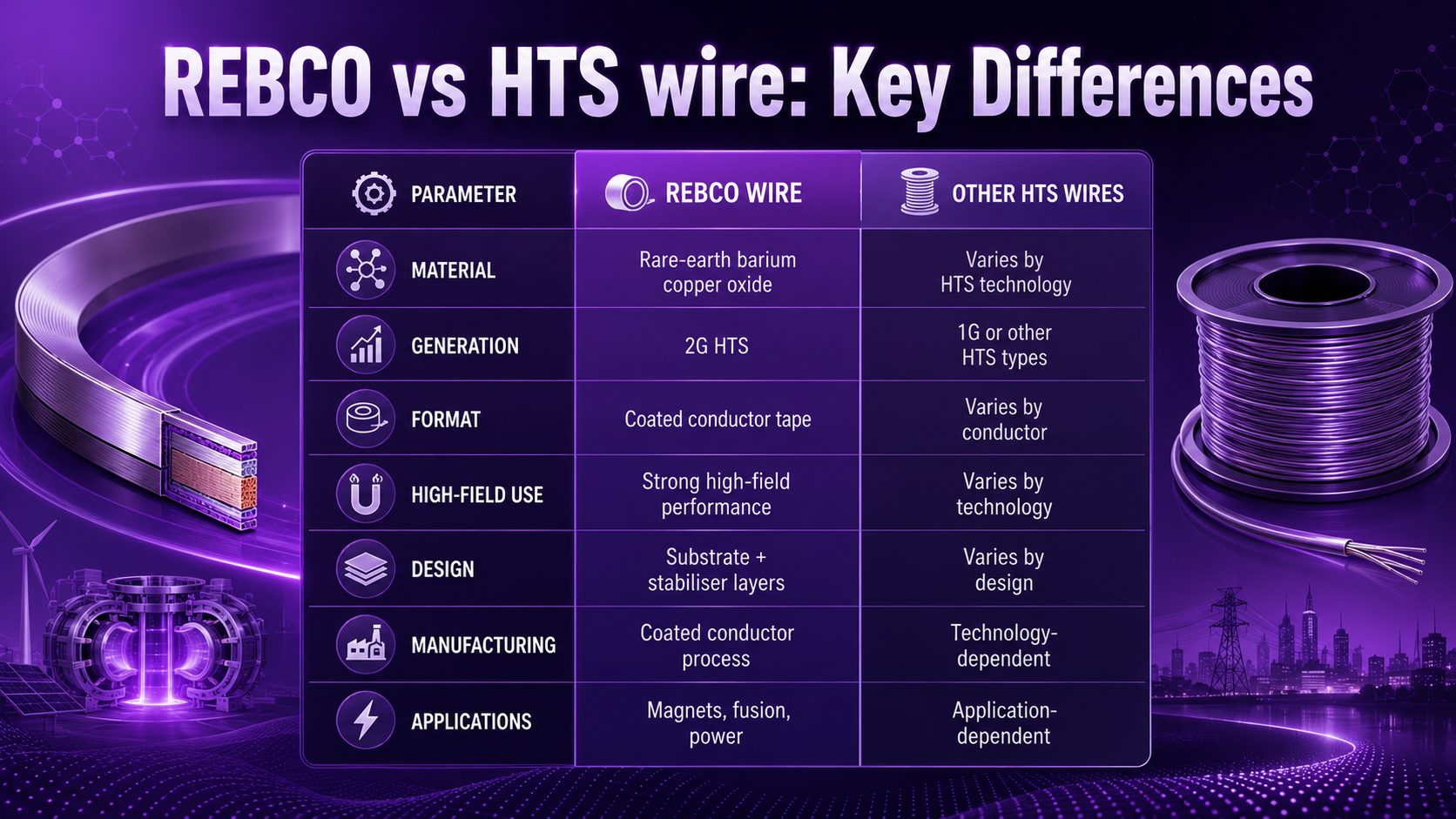
REBCO wire vs other HTS wire: Key differences
REBCO wire and other HTS wires: REBCO is itself a type of HTS wire, so this comparison looks at REBCO alongside other HTS conductor technologies, such as BSCCO.
| Parameter | REBCO wire | Other HTS wires |
| Material family | Rare-earth barium copper oxide. | Depends on the HTS technology. |
| Conductor generation | Commonly classified as 2G HTS. | May include 1G and other HTS technologies. |
| Typical format | Usually a coated conductor tape. | Format varies by conductor type. |
| High-field performance | Suitable for demanding high-field applications. | Performance varies by technology. |
| Mechanical design | Depends on the substrate, stabiliser, and reinforcement. | Varies by conductor design. |
| Manufacturing approach | Uses a coated conductor manufacturing process. | Depends on the technology used. |
| Typical applications | High-field magnets, fusion systems, and power applications. | Depends on the conductor and application. |
Material and design: Different HTS wires use different superconducting materials and conductor structures. These differences can affect how the wire performs in a specific application.
Application requirements: Engineers must consider the operating temperature, magnetic field, current requirement, and mechanical conditions before selecting a conductor.
Practical choice: The decision is not about whether REBCO is better than HTS wire. REBCO is already part of the HTS category. The real question is whether REBCO is the right HTS conductor for the required operating conditions.
Key REBCO and HTS wire specifications to check
Critical current
Critical current: This shows how much electrical current the wire can carry under specific conditions. Always check the test temperature and magnetic field used to measure it. A current rating from one supplier may not be directly comparable with another if the test conditions differ.
Wire width and thickness
Wire dimensions: REBCO and other HTS conductors are available in different tape widths and thicknesses. These dimensions affect winding, space requirements, and system design. Also check the dimensional tolerance allowed by the supplier.
Stabiliser and substrate
Conductor structure: REBCO wire can include copper or silver layers for added stability. The substrate provides mechanical support, while additional reinforcement may improve the wire’s strength for demanding applications.
Tensile strength and strain tolerance
Mechanical performance: Check how much force or stretching the wire can handle. This is important during magnet winding, handling, and operation, where the conductor may face mechanical stress and electromagnetic forces.
Operating temperature and magnetic field
Operating conditions: The datasheet should clearly state the temperature, magnetic field, and field orientation for the required application. Buyers should also specify the required critical current under these conditions.
For technical procurement, do not compare REBCO or HTS wires based on one specification alone. Review the full datasheet and check whether the quoted performance matches your actual operating conditions.
REBCO wire price and HTS wire cost: What affects the price?
REBCO wire price: REBCO and other HTS wires do not have a standard market price like steel, copper or conventional electrical wire. Manufacturers usually quote based on the required conductor design, performance and order quantity. Public product specifications also show that REBCO tapes can vary significantly in width, substrate thickness, stabiliser design, and critical current.
| Price factor | Why it matters |
| Critical current | Higher performance requirements can affect the conductor design and cost. |
| Width and thickness | Different tape sizes use different amounts and types of material. |
| Stabiliser design | Copper, silver, and other reinforcement options can change the conductor structure. |
| Substrate material | The substrate supports the superconducting layer and affects mechanical performance. |
| Length required | Longer continuous lengths and specific reel requirements can affect pricing. |
| Magnetic field performance | Applications that need proven performance under high magnetic fields may require specialised conductors. |
| Testing and qualification | Project-specific testing and documentation can add to the overall cost. |
| Order quantity | Small research orders and larger production requirements may receive different quotations. |
| Custom design | Special widths, stabilisation, or reinforcement can increase costs. |
| Import and logistics | Indian buyers may also need to consider freight, duties, taxes, and delivery costs. |
Performance requirements: Cryogenic testing and application-specific qualification can also add to the total procurement cost. The exact requirement depends on the project and end use.
Buyer takeaway: The lowest price per metre does not always mean the lowest system cost. Compare electrical performance, usable current, mechanical properties, and qualification requirements alongside the conductor price.
REBCO and HTS wire standards: IS code, IEC, and testing requirements

Is there an IS code for REBCO wire?
IS code for REBCO wire: As of October 2026, buyers should not assume that conventional Indian Standards for electrical wires apply to REBCO or other HTS conductors. REBCO wire is a specialised superconducting product with application-specific requirements. Before procurement, check the latest BIS standards database and the technical requirements of the project or customer.
IEC superconductivity standards
IEC standards: The IEC 61788 series covers measurement and testing methods for superconducting materials and conductors. Different parts of the series address different properties. For example, IEC 61788-25 covers room-temperature tensile testing for REBCO superconducting wires.
Manufacturer and project specifications
Technical requirements: Standards alone may not define every requirement for a specialised REBCO application. Manufacturers and project teams may specify the following:
| Requirement | What to check |
| Critical current | Test temperature, magnetic field, and measurement conditions. |
| Mechanical testing | Tensile strength and strain limits. |
| Dimensions | Tape width, thickness, and permitted tolerances. |
| Conductor design | Substrate, stabiliser, and reinforcement details. |
| Acceptance criteria | Minimum performance required for the project. |
| Traceability | Batch, reel, and test-record identification. |
Buyer takeaway: Ask for the applicable standard, test method, and acceptance criteria before placing an order. For specialised HTS projects, the project specification and manufacturer test data can be as important as the standard itself.
Applications of REBCO and HTS wires
REBCO and other HTS wires support applications where conventional conductors may not deliver the required performance. The final choice depends on the system and operating conditions.
| Application | How REBCO and HTS wires are used | Key users and buyers |
| High-field magnets | Used to develop powerful superconducting magnets for research and specialised equipment. | Research institutions, magnet manufacturers and laboratories. |
| NMR systems | Used in high-field magnet systems for scientific and analytical research. | Universities, laboratories, and scientific equipment developers. |
| MRI technology | Can support advanced superconducting magnet development for medical imaging systems. | Medical technology companies and magnet manufacturers. |
| Fusion energy | Used in superconducting magnets designed for magnetic confinement and other fusion systems. | Fusion programmes, energy companies, and magnet developers. |
| Superconducting power cables | Can carry high electrical currents in compact cable systems. | Utilities, power companies, and electrical equipment manufacturers. |
| Grid applications | Support specialised power transmission and grid technologies. | Transmission companies, utilities, and grid technology developers. |
| Fault current management | Used in superconducting fault current limiter systems designed to manage high fault currents. | Power utilities and electrical infrastructure companies. |
| Scientific research | Support experiments involving superconductivity, high magnetic fields, and advanced materials. | National laboratories, universities, and R&D centres. |
| Industrial research | Used in the development and testing of advanced electrical, energy, and magnet technologies. | Industrial R&D teams and deep-tech companies. |
| Aerospace and space | Can support research into compact, high-power electrical systems, and advanced magnet technologies. | Aerospace companies and space research organisations. |
| Advanced transport | Explored for superconducting motors, generators, and magnetic transport systems. | Rail, transport, and advanced mobility developers. |
| Defence applications | Used in research involving high-field magnets, electrical systems, and specialised technologies. | Defence R&D organisations and specialised manufacturers. |
Application focus: REBCO often receives particular attention in demanding high-field applications. Other HTS conductor technologies may suit different system designs and operating needs.
Buyer focus: Engineers and technical procurement teams should start with the application requirement, then select the conductor technology that best fits the system.
REBCO wire suppliers and HTS wire manufacturers: What buyers should check
REBCO and other HTS conductors are specialised products. Buyers should assess a supplier’s technical capability instead of selecting a product based only on the wire name or quoted price. Established HTS manufacturers may offer standard conductor designs, while specialised projects may require direct procurement and customised specifications.
What to check before selecting a supplier
| Supplier evaluation point | What buyers should ask or check |
| Product range | Does the supplier offer the required REBCO or other HTS conductor technology? |
| Standard or customised design | Is the conductor available in a standard format, or can the supplier modify the width, stabilisation, or other design features? |
| Minimum order quantity | What is the minimum quantity or reel length that can be ordered? |
| Product datasheet | Does the supplier provide complete technical details for the conductor? |
| Critical current data | What critical current does the wire achieve, and under what test conditions? |
| Test conditions | What temperature and magnetic field conditions were used during testing? |
| Mechanical properties | Are tensile strength, strain tolerance, and other mechanical data available? |
| Dimensions | What are the tape width, thickness, and permitted tolerances? |
| Stabiliser construction | What materials and conductor layers are used for stabilisation? |
| Manufacturing traceability | Can the supplier identify the production batch, reel, and related test records? |
| Quality documentation | What inspection reports, test certificates, and quality documents are available? |
| Available reel lengths | What continuous lengths can the supplier provide? |
| Lead time | How long will manufacturing, testing, and delivery take? |
| Technical support | Can the supplier support conductor selection, integration, and application-specific requirements? |
| Indian sourcing and delivery | For imported conductors, who handles shipping, customs clearance, and after-sales technical support? |
Like-for-like comparison: A manufacturer datasheet can show major differences in tape width, substrate thickness, stabilisation, critical current, and mechanical limits. Compare these values under the same test conditions before evaluating quotations.
Buyer takeaway: Ask for technical data first, then compare price, lead time and sourcing terms. A cheaper REBCO wire may not meet the required performance or qualification criteria.
How to choose the right HTS or REBCO wire
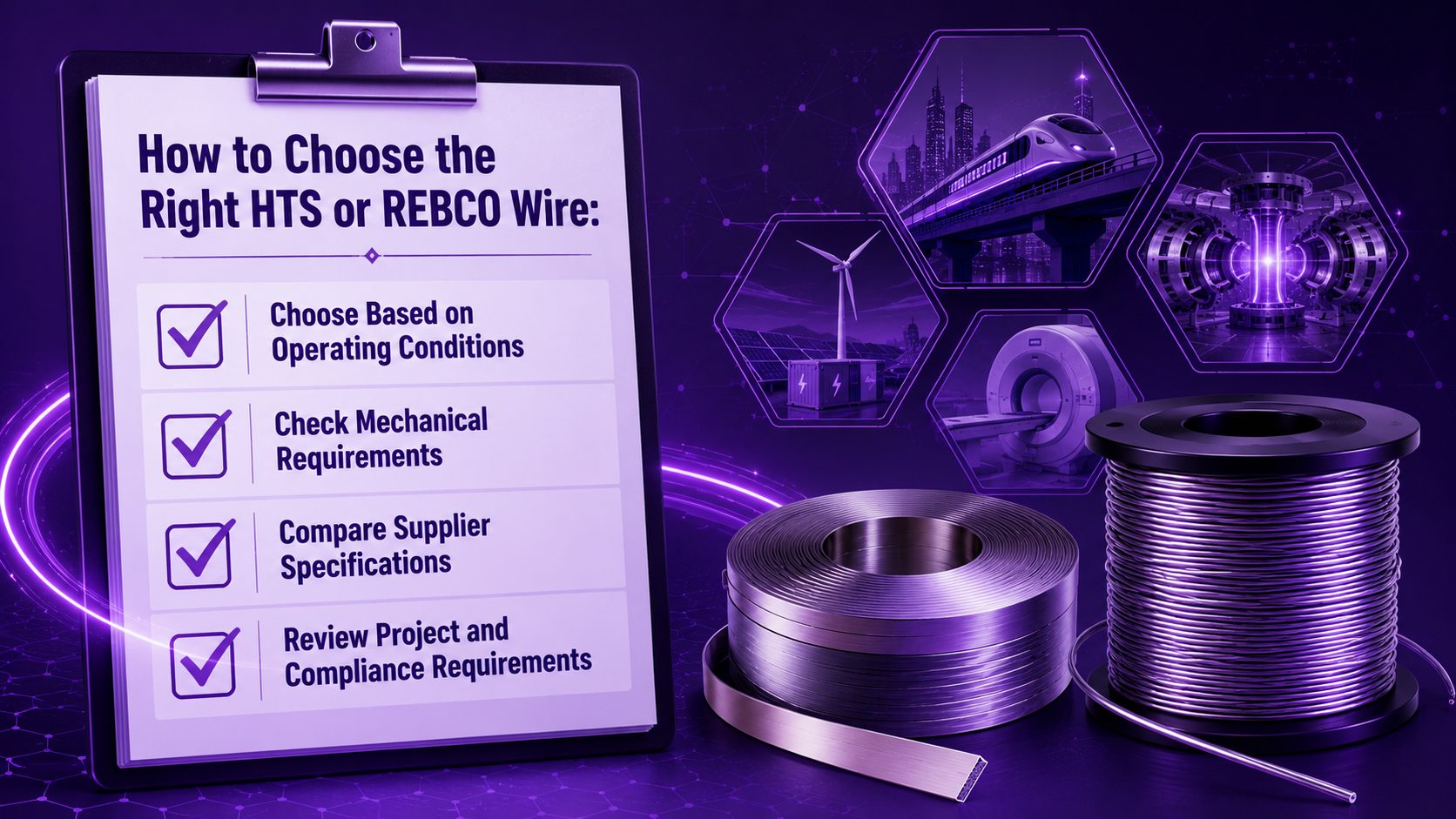
Choosing the right conductor starts with the application. REBCO and other HTS wires can perform differently under different operating conditions, so buyers should define their requirements before requesting a quotation.
Choose based on operating conditions
Check the required temperature, magnetic field, and current. These conditions directly affect conductor performance. State the exact operating requirements when comparing products or requesting technical data.
Check mechanical requirements
Consider tensile load, bending limits, and the winding process. Magnets and other systems can also expose the conductor to electromagnetic forces during operation. The wire must suit both the manufacturing process and the final application.
Compare supplier specifications
Do not compare wires based only on price per metre or nominal current. Check the critical current and other performance data under the same temperature and magnetic field conditions. A higher current value may not mean better performance if the test conditions differ.
Review project and compliance requirements
Check the applicable IEC standards, customer specifications, and testing requirements. Also review quality documents, test reports, and batch traceability before finalising the order.
Choose the HTS or REBCO wire that meets the required performance, mechanical, and compliance requirements at the right overall project cost.
REBCO and HTS wire market in India: Opportunities and challenges
India’s REBCO and HTS wire market remains specialised, but several sectors could drive future demand. Research institutions, fusion energy programmes, and advanced magnet projects are important areas. Medical imaging, power infrastructure, defence, and space research may also create opportunities for superconducting technologies.
Sourcing challenge: India has a limited domestic supply base for specialised REBCO coated conductors. Buyers may need to work with international manufacturers or authorised sourcing partners. They should also consider technical specifications, import logistics, delivery timelines, and project-specific testing before procurement.
Market outlook: Growth will depend on research funding, technology development, and the wider adoption of superconducting systems across energy, healthcare, and advanced engineering.
Conclusion
The REBCO wire vs HTS wire comparison is most useful when viewed in the context of the end application. Different HTS conductor technologies serve different technical needs. The right choice depends on how the conductor fits into the overall system and project goals. A clear understanding of the available options can help engineers and buyers make more informed decisions when evaluating superconducting technologies.
Looking to procure steel?
Tata nexarc helps manufacturers, builders and MSMEs source certified steel products, compare prices, and choose the right grade as per IS codes—with complete traceability and procurement confidence.
FAQs
What is the difference between REBCO wire and HTS wire?
Is REBCO wire the same as HTS wire?
What is REBCO wire used for?
Why is REBCO wire used in high-field magnets?
What are the key specifications of REBCO wire?
What is the price of REBCO wire in India?
Is there an IS code for REBCO wire?
Who supplies REBCO wire in India?
How do I choose the right HTS or REBCO wire?
Is REBCO wire better than other HTS wires?
A product manager with a writer's heart, Anirban leverages his 6 years of experience to empower MSMEs in the business and technology sectors. His time at Tata nexarc honed his skills in crafting informative content tailored to MSME needs. Whether wielding words for business or developing innovative products for both Tata Nexarc and MSMEs, his passion for clear communication and a deep understanding of their challenges shine through.