
 Check Price Now
Table of Contents
JSW Steel Limited, the flagship company of the US$22 billion JSW Group, is one of India’s leading private sector steel manufacturers in 2026. Headquartered in Mumbai, the company produces a wide range of steel products including TMT bars, hot rolled and cold rolled coils, galvanised and colour-coated sheets, wire rods, and special alloy steel.
With 14 operational plants in India and international facilities in the United States and Italy, JSW Steel serves infrastructure, construction, automotive, renewable energy, and MSME manufacturing sectors. Its flagship JSW Neosteel TMT bars are widely used in residential and commercial construction projects across India.
This article explores the JSW full form, company profile, plant locations, production capacity, product portfolio, growth strategy, and how JSW Steel compares with other leading steel manufacturers in 2026.
Update: 26 March 2025
Indian steel titan JSW Steel has emerged as the world’s most valuable steel company, reaching a $30.31 billion market cap and surpassing ArcelorMittal and Nucor. This milestone reflects JSW’s global expansion, innovation, and capacity boost plans. The company aims to hit 51.5 MT by FY31, reinforcing its market dominance.Extremely proud to share that @jswsteel has become the largest steel company in the world in terms of market capitalisation – so proud of all the hard work put in by papa @sajjanjindal Ma @SangitaSJindal and the entire @TheJSWGroup family – we are humbled and will not stop at…
— Parth Jindal (@ParthJindal11) March 25, 2025
Read the announcement here: https://x.com/ParthJindal11/status/1904497014265811445
About JSW
JSW Steel stands for Jindal South West. The company is led by Sajjan Jindal, Chairman and Managing Director, who has played a key role in expanding the business across domestic and global markets.
JSW Steel has a long-standing strategic partnership with JFE Steel, Japan. This collaboration enables access to advanced steelmaking technology, quality systems, and product innovation.
Anecdotes about JSW Steel
- JSW was established in 1982 as Jindal Iron and Steel Company.
- The first steel plant of JSW was built at Vasind near Mumbai, Maharashtra.
- Operates one of India’s largest integrated steel plants at Vijayanagar, Karnataka
- JSW has built the world’s largest conveyor system that travels ~24 km from the captive mines to its Vijayanagar plant. The objective of the conveyor system is to reduce transportation costs. The system is especially useful when logistics and transportation remains the key challenge of the steel industry.
- For the maiden IKEA store in India, JSW Steel provided 1,300 MT of steel plates, around 350 MT of GI coils and 5,000 MT of TMT bars.
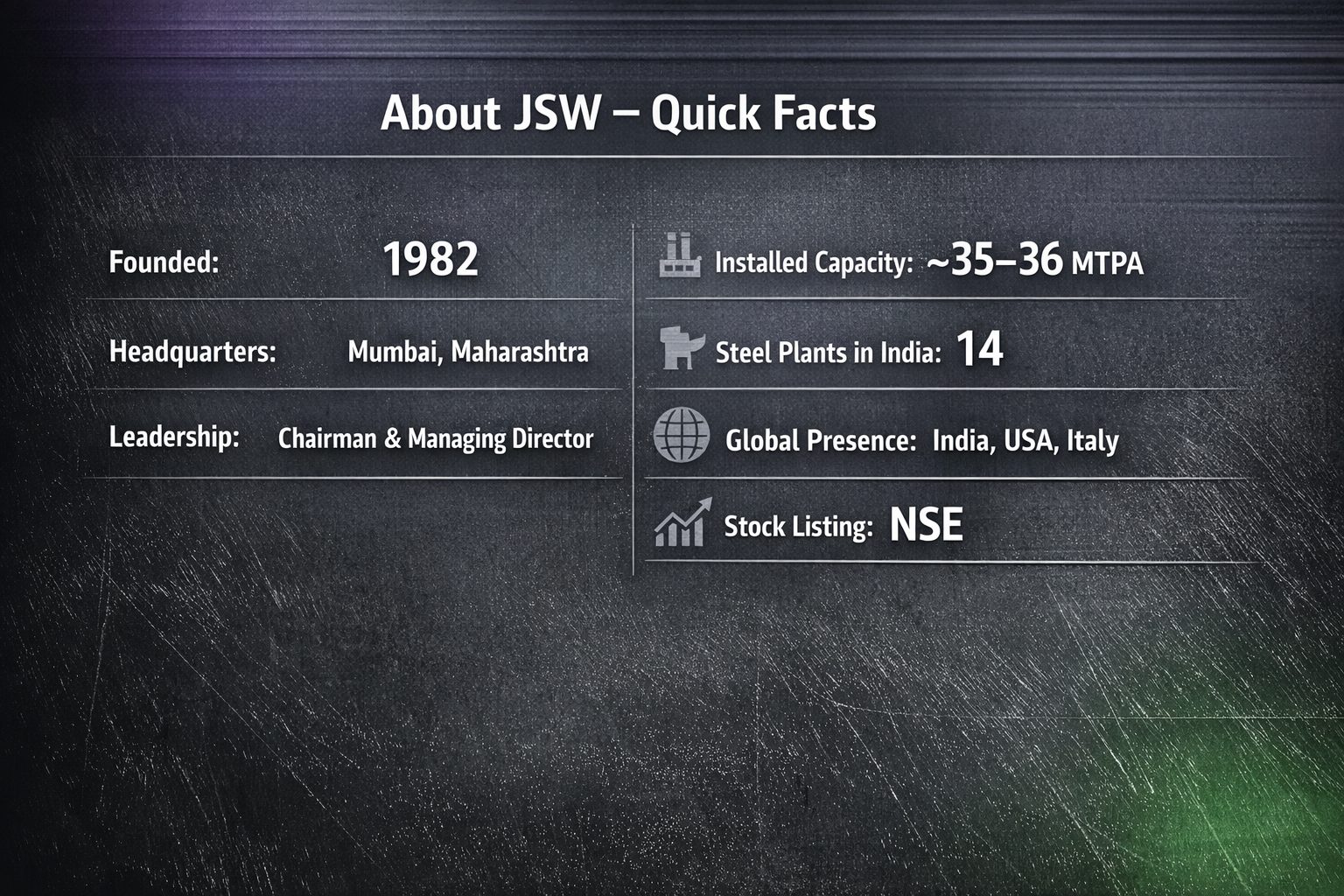
Quick facts (as of FY 2026)
| Category | Details |
| Founded | 1982 |
| Headquarters | Mumbai, Maharashtra |
| Leadership | Sajjan Jindal (Chairman & MD) |
| Crude Steel Capacity | ~31–32 MTPA (India & overseas) |
| Global Presence | India, USA, Italy; exports to 100+ countries |
| Stock Listing | NSE: JSWSTEEL |
| Share Price* | ₹1,254.80 (as of 11 February 2026) |
*Share prices are subject to market fluctuations.
Are Jindal Steel and JSW the same?
JSW and Jindal Steel are two different steel manufacturing companies in India.
JSW is a part of the JSW Group and is regarded as the second largest private sector steel producer in India. It offers a wide range of steel products, popular ones being JSW Neosteel TMT bars, JSW Vishwas premium GC sheets, and JSW Everglow advanced roofing technology.
Jindal Steel and Power (JSP), has its presence in steel, mining, infrastructure and other industries. It offers a range of customised and standardised quality steel products from its plants in Angul, Raigarh, and others. Its products include rails, beams and columns, plates and coils, angles and channels, round bars, and the highly popular Jindal Panther TMT Rebars.
JSW Steel production capacity & plant locations
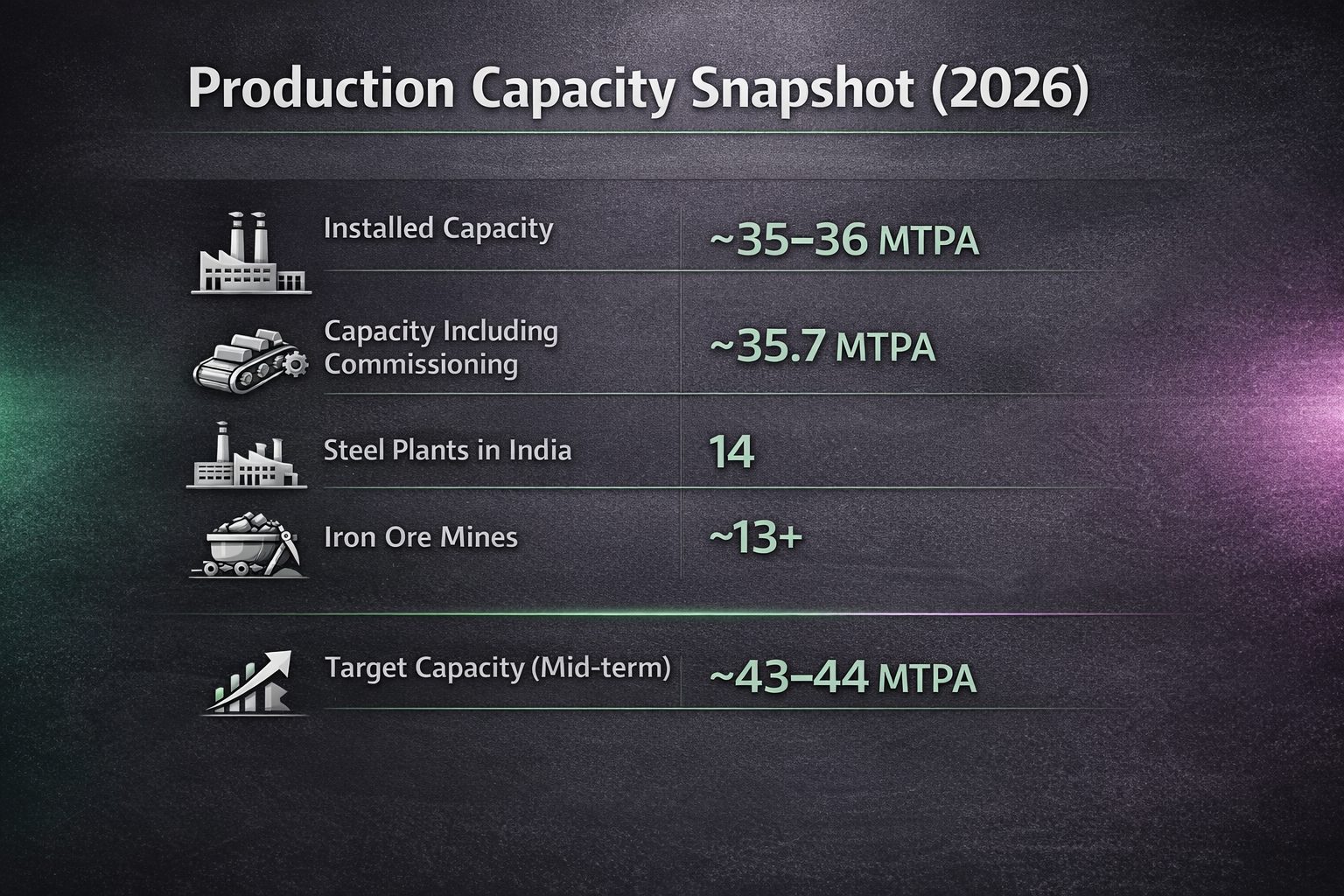
As of 2026, JSW Steel has an installed crude steel capacity of approximately 35-36 million tonnes per annum (MTPA) across India and overseas operations. Also, the company has 14 steel manufacturing facilities in India. Here are the company’s production capabilities in a glance.
Production Capacity Summary (As of 2026)
| Metric | Value |
| JSW Steel’s Production Capacity (India & USA) | ~35.7 MTPA (includes some capacity under commissioning) |
| Steel Plants in India | 14 (major integrated & downstream facilities) |
| Iron Ore Mines | ~13+ (captive, joint-use, and associated mines) |
| Target Capacity by Mid-2027 | ~43.5 MTPA (expansion under implementation) |
Key operational highlights:
- 14 major steel plants in India
- Captive iron ore mines supporting raw material security
- Integrated steelmaking facilities with port connectivity
- Overseas operations in the United States and Italy
JSW continues to expand capacity through brownfield projects and efficiency upgrades across key plants.
JSW Steel Plant Locations in India
Here is a list of JSW Steel plant locations:
- Vijayanagar Works, Karnataka: It is JSW Steel’s integrated steel plant. The plant sprawls over 10,000-acres. Moreover, it houses India’s largest blast furnace. The plant has the capability to produce hot rolled coils and sheets, billets, etc.
- Dolvi Works, Maharashtra: JSW’s Dolvi plant is situated at a strategic location in Western Maharashtra. It is well connected to a jetty that can handle cargo of up to 15 MTPA.
- Kalmeshwar Works, Maharashtra: The plant is located near the city of Nagpur, which is again a strategic location. The central location enables JSW Steel to supply products all over the country.
- Salem Works, Tamil Nadu: It is India’s largest Special Alloy Steel Plant (Long products).
- Tarapur Works, Maharashtra: The Tarapur Works plant produces galavnised products of JSW.
- Vasind Works, Maharashtra: It is the first plant of JSW Steel and has the capability to produce galvanising products, galvalume products and colour coated products.
- Bhushan Power & Steel plants: JSW Steel completed the acquisition of Bhushan Power and Steel in 2021. With this acquisition, the company now has plants in Chandigarh, Derabassi, Kolkata, and Odisha.
- Asian Colour Coated Ispat: JSW Steel completed the acquisition of Asian Colour Coated Ispat in 2020 and has acquired its steel plants located in the country.
In addition, JSW Steel operates international facilities in the USA and Italy, strengthening its global supply network.
JSW Steel Product Range
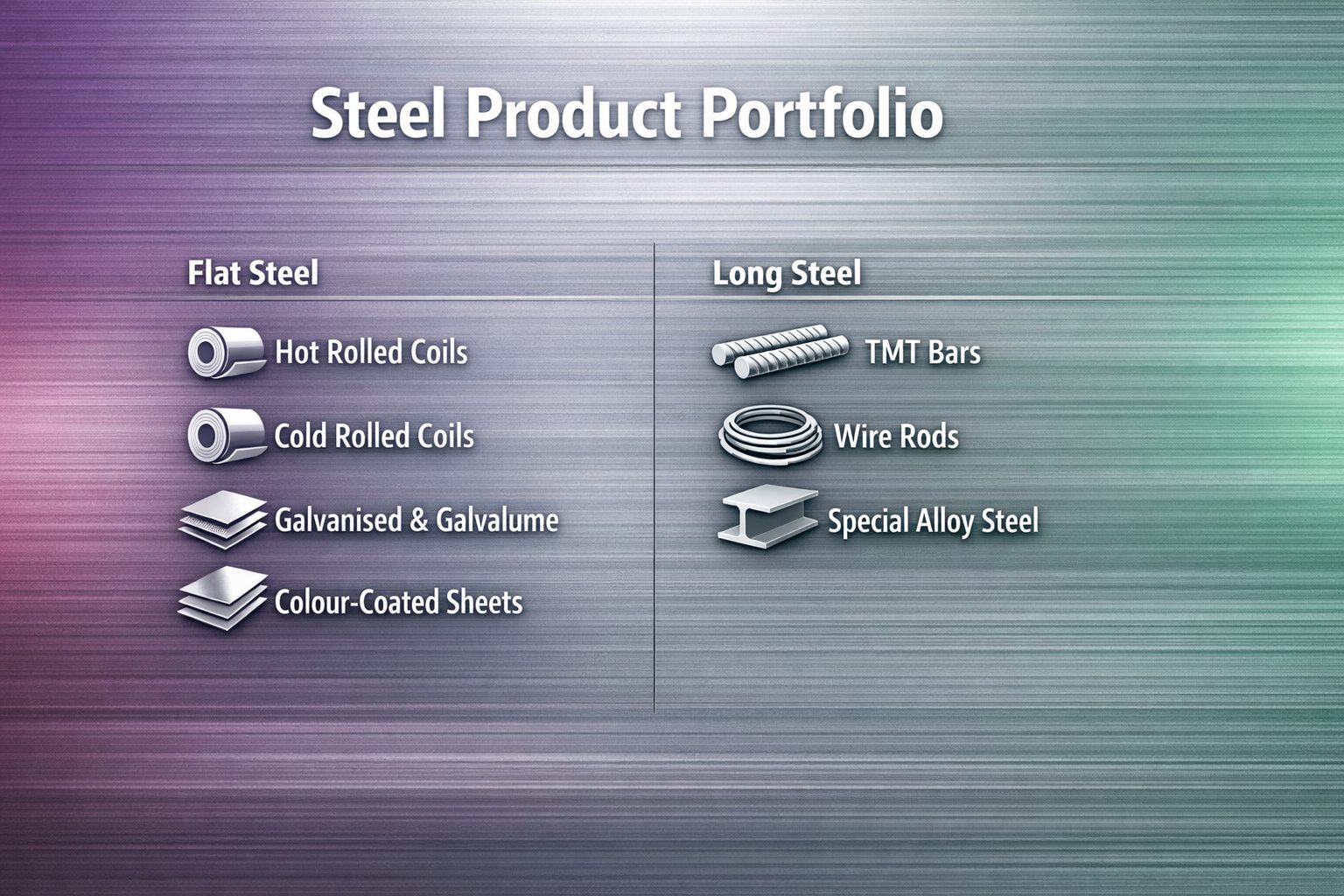
JSW Steel manufactures a wide portfolio of flat and long steel products used across construction, automotive, engineering, renewable energy and MSME manufacturing sectors. Here is a list of some of the steel products that the company offers.
Flat Steel Products
- Thickness up to ~25 mm
- Wide-width capability (up to ~2050 mm+)
- Manufactured mainly at Vijayanagar and Dolvi
- Used in infrastructure, heavy engineering and automotive components
Cold Rolled (CR) Coils
- Precision-finished steel for automotive and appliance sectors
- Suitable for fabrication and forming applications
Galvanised & Galvalume Products
- GI coils and sheets
- Corrosion-resistant roofing and structural applications
- Produced at facilities including Vijayanagar, Tarapur, Vasind and Kalmeshwar
- Pre-painted coils and sheets
- Available in multiple coating options and finishes
- Widely used in roofing, cladding and pre-engineered buildings
Long Steel Products
TMT Bars (JSW Neosteel)
- High-strength reinforcement bars for construction
- Used in residential, commercial and infrastructure projects
(Also read: JSW Neosteel price in India)
Wire Rods
- Used in automotive components, fasteners, welding and general engineering
- Manufactured using high-speed rolling mills
Special & Value-Added Products
- Special alloy steel (blooms, billets, rounds)
- Steel doors and customised solutions
- Products catering to automotive and high-end industrial segments
JSW Steel’s diversified product range allows buyers to source both flat and long steel under one brand, which is useful for MSME fabricators and contractors managing multi-category requirements.
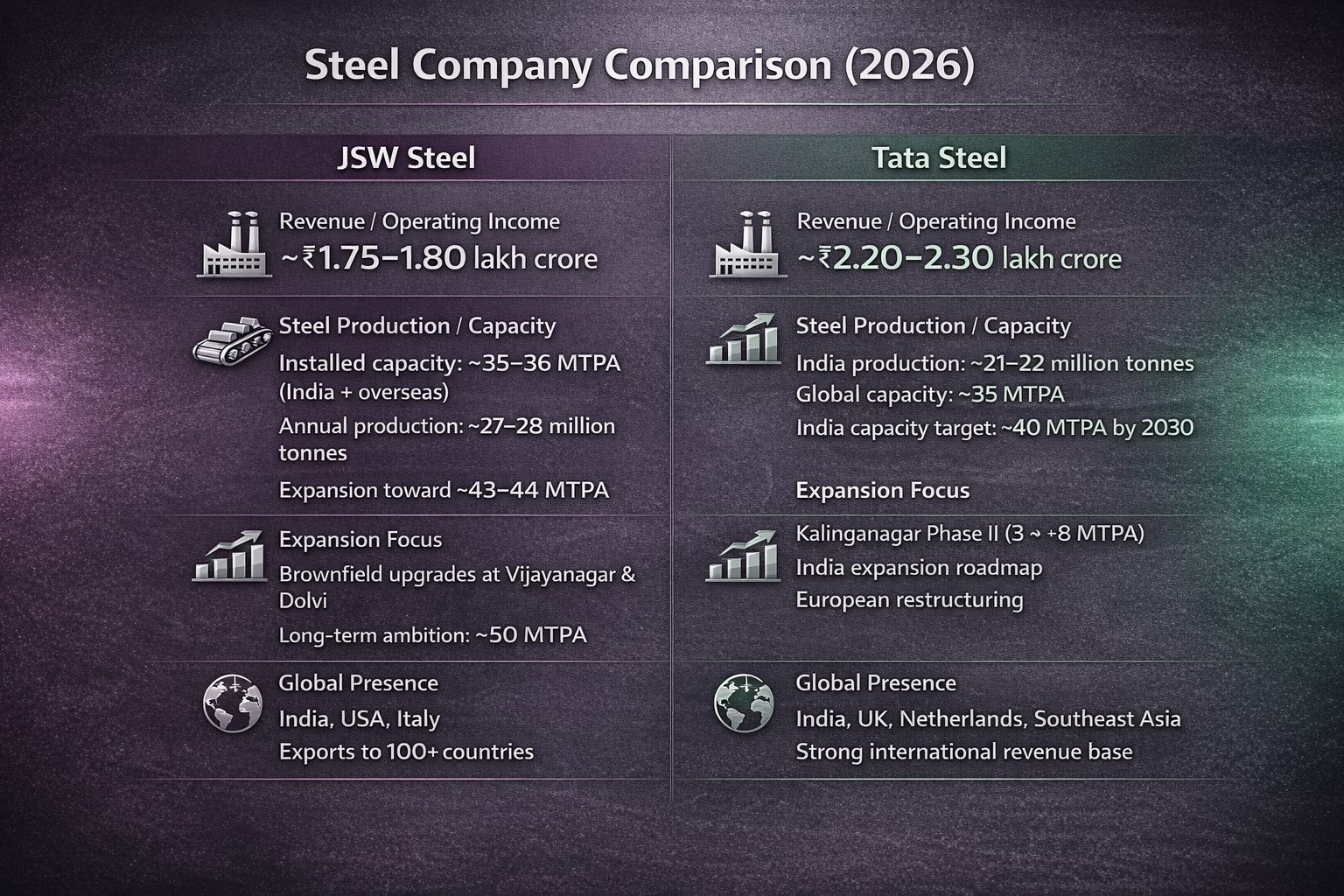
JSW vs. Tata Steel: Comparison (2026 Estimates & Targets)
Both JSW Steel and Tata Steel are among India’s largest steel producers. While both operate globally, their growth models and expansion focus differ.
| Metric | JSW Steel | Tata Steel | Notes |
| Revenue/ Operating Income | ~₹1.75-1.80 lakh crore (recent consolidated annual revenue range) | ~₹2.20-2.30 lakh crore (consolidated global revenue range) | Tata Steel has a larger consolidated global revenue base due to its European operations. JSW’s revenue is more India-focused. |
| Steel Production/ Capacity/ Volume | Installed crude steel capacity: ~35-36 MTPA (India + overseas).Recent annual crude steel production: ~27-28 million tonnes.Expansion underway toward ~43-44 MTPA in phases. | India crude steel production: ~21-22 million tonnes annually.Global crude steel capacity (group): ~35 MTPA.India capacity targeted toward ~40 MTPA by 2030. | JSW’s capacity expansion in India has been faster in recent years. Tata operates across more geographies. |
| Expansion/ Growth Targets | Brownfield expansions at Vijayanagar and Dolvi.Phased capacity growth toward ~43-44 MTPA.Long-term ambition around ~50 MTPA. | Kalinganagar Phase II expansion (3 MTPA → ~8 MTPA).India capacity expansion roadmap toward ~40 MTPA.Ongoing restructuring in Europe. | JSW’s expansion is concentrated in India. Tata balances India growth with European transition. |
| Sustainability/ Carbon/ Green Steel Goals | Increasing renewable energy integration (GW-scale projects).Focus on green hydrogen and low-carbon steelmaking initiatives.Reducing dependence on traditional blast furnace routes over time. | Net-zero target: 2045 (group).Transition to Electric Arc Furnaces (EAF) in UK operations.Emission intensity reduction targets for India operations by 2030. | Both companies are investing in decarbonisation, but Tata has higher legacy European assets to transition. |
| Exports/ Global Footprint | Operations in India, USA and Italy.Exports to 100+ countries.Stronger domestic revenue concentration. | Operations in India, UK, Netherlands and Southeast Asia.Significant international revenue exposure. | Tata has a broader global footprint. JSW has a stronger India-centric growth model. |
Top Reasons for JSW’s Fast Growth
Here are some key strategic and operational reasons why JSW is showing faster growth momentum compared to Tata (or can outpace in certain segments):
Focused expansion in India with newer plants
JSW is building new capacity (Dolvi, Salav, etc.) which are modern, efficient, and often located near ports/logistics hubs. It avoids some of the drag from legacy brownfield retrofits.
Lean cost structures and efficiency
Being newer, many of JSW’s plants use modern technologies and avoid inefficiencies present in older plants.
Sustainability premium/green steel positioning
JSW is investing early in green hydrogen, renewables, and low-carbon pathways — which may help it access premium markets or incentives.
Less global legacy drag
Tata has substantial legacy assets in Europe (UK, Netherlands) with blast furnace infrastructure. The cost of transitioning those is high.
Better balance between flat & long products
JSW has expertise in flat steel, galvanised, coated products, whereas Tata has to juggle between long steel and flat steel across geographies.
Capital allocation & discipline
JSW appears to be targeting aggressive growth in the near term (21% jump planned by 2026) while maintaining financial discipline (debt/EBITDA metrics).
Domestic market tailwinds
Strong infrastructure, housing, and manufacturing demand in India benefit both, but JSW’s proximity and scale advantage help capture more share in growing states.
Growth strategy & sustainability roadmap
JSW Steel’s recent growth has been driven by a combination of capacity expansion, operational efficiency and increasing focus on sustainable steel production.
Expansion Strategy
JSW Steel has focused on capacity expansion through brownfield upgrades and operational efficiency at key plants such as Vijayanagar and Dolvi. Its growth strategy is largely India-centric, supported by strong demand from infrastructure, housing, renewable energy and manufacturing sectors.
Key growth drivers include:
- Phased capacity expansion toward ~43–44 MTPA
- Port-based integrated facilities for cost efficiency
- Acquisitions and consolidation of domestic assets
- Increased focus on value-added and coated steel products
Sustainability & Decarbonisation
Like other major global steel producers, JSW Steel is investing in reducing carbon intensity and improving energy efficiency.
Key sustainability initiatives include:
- Increasing renewable energy usage across operations
- Exploring green hydrogen and low-carbon steel routes
- Improving raw material logistics to reduce emissions
- Water conservation and circular resource management
The company’s sustainability roadmap aligns with India’s broader industrial decarbonisation goals while maintaining production growth.
JSW Steel future expansion plans (2025–2030)
Looking ahead, JSW Steel has outlined a phased expansion roadmap focused on increasing capacity, improving efficiency and strengthening sustainability practices.
Capacity Expansion
JSW Steel plans to scale its installed crude steel capacity from the current ~35–36 MTPA toward ~43–44 MTPA in the near term, with a long-term ambition of reaching around 50 MTPA by the end of the decade. Expansion is primarily driven by brownfield upgrades at Vijayanagar, Dolvi and other integrated facilities.
Green Steel Transition
The company is investing in:
- Electric Arc Furnace (EAF) capacity
- Renewable power integration
- Low-carbon steelmaking technologies
- Reduction in emission intensity over the coming years
Sustainability & Global Focus
JSW continues to strengthen scrap recycling, water conservation and resource efficiency initiatives. It has articulated long-term decarbonisation goals aligned with its Net Zero roadmap.
Internationally, the company is expanding value-added exports and enhancing operations in the United States and Italy to support global customers.
What JSW Steel means for MSME buyers
For MSME manufacturers, contractors and fabricators, JSW Steel represents a widely accepted and certified steel brand across India.
Why MSMEs Consider JSW Steel
- Availability across major industrial and construction hubs
- Wide product mix (flat and long steel under one supplier ecosystem)
- Compliance with IS standards for construction and manufacturing
- Suitable for infrastructure, PEB, fabrication and automotive applications
JSW’s port-based plants and domestic distribution network help ensure relatively stable supply across regions. For MSMEs managing tight project timelines, supply consistency is often as important as pricing.
Procurement Considerations
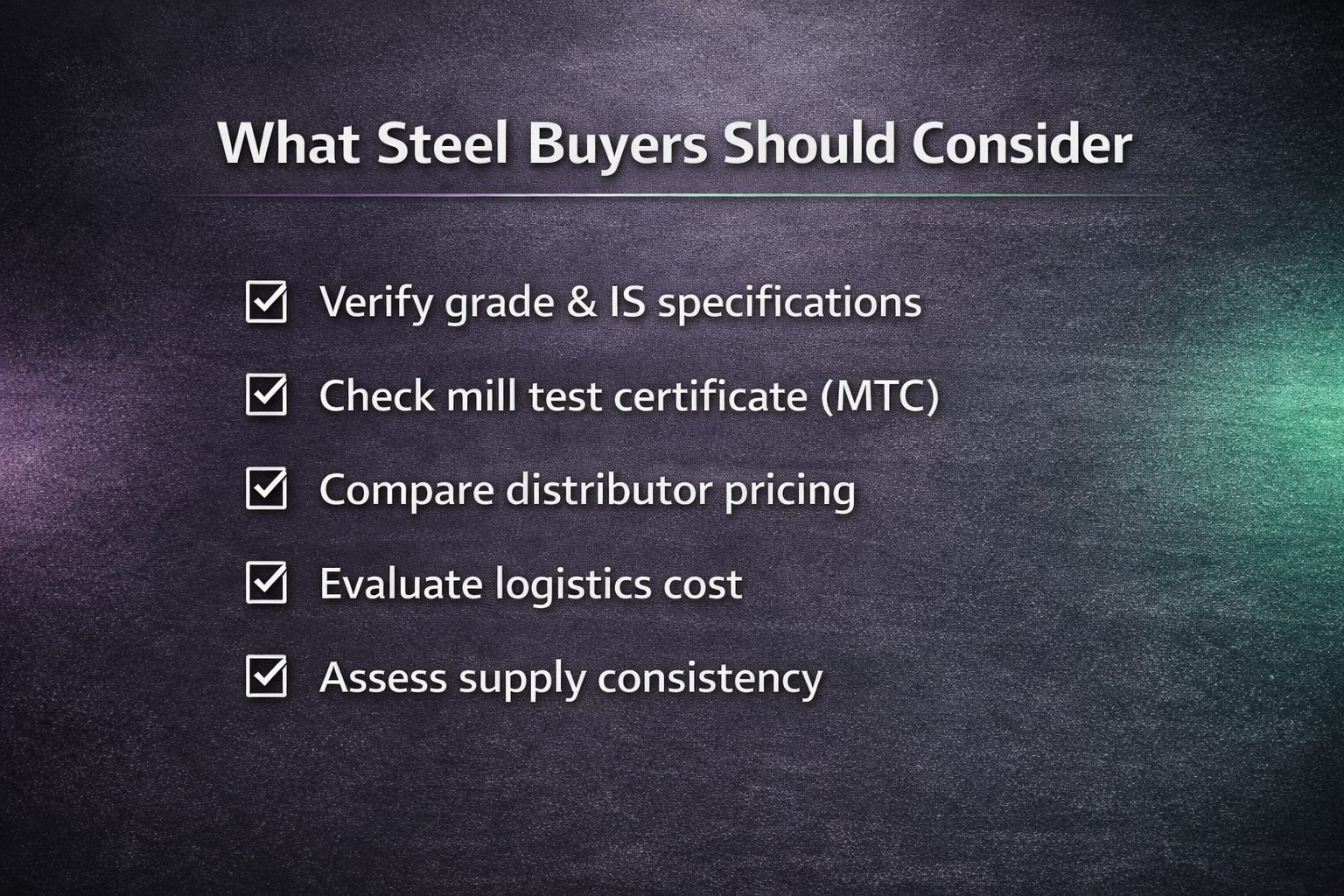
When sourcing JSW Steel products, MSME buyers should:
- Verify grade and IS specifications
- Check mill test certificates (MTC)
- Compare pricing across authorised distributors
- Assess logistics cost for bulk orders
Since steel pricing fluctuates based on raw material and market conditions, evaluating both brand reliability and total landed cost is essential.
For businesses sourcing TMT bars, HR coils, GI sheets or coated products, JSW remains one of the established options in India’s organised steel market.
Conclusion
JSW Steel has grown into one of India’s leading private steel producers through steady capacity expansion, operational efficiency and increasing focus on sustainability. With a diversified product portfolio covering flat, long and value-added steel, the company serves infrastructure, manufacturing, automotive and MSME sectors across India and overseas markets.
As it moves toward higher installed capacity and lower carbon intensity, JSW Steel remains an important player in India’s evolving steel ecosystem. For buyers, understanding its production scale, plant network and product mix helps in making informed procurement decisions in a competitive and price-sensitive market.
Looking to procure steel?
Tata nexarc helps manufacturers, builders and MSMEs source certified steel products, compare prices, and choose the right grade as per IS codes—with complete traceability and procurement confidence.
FAQs
What is the full form of JSW Steel?
Where are JSW Steel’s plants located in India?
What products does JSW Steel manufacture?
Is JSW Steel part of Jindal Group?
What is the difference between JSW Steel and Jindal Steel?
What is JSW Steel’s production capacity in 2025?
Who is the CEO of JSW Steel?
What is JSW’s plan for green steel or carbon reduction?
Why should MSMEs in India buy steel from JSW Steel?
How does JSW Steel compare with Tata Steel for MSMEs?
Swati is a passionate content writer with more than 10 years of experience crafting content for the business and manufacturing sectors, and helping MSMEs (Micro, Small and Medium Enterprises) navigate complexities in steel procurement, and business services. Her clear and informative writing empowers MSMEs to make informed decisions and thrive in the competitive landscape.


With 14 plants across India, JSW Steel seems like a reliable supplier for construction projects requiring large volumes of steel. Do they offer any discounts or programs for bulk purchases relevant to large construction projects?
We know about the rise of electric vehicles, how is JSW Steel adapting its product portfolio to cater to the needs of this growing market?
Recently JSW and Mahindra has done a joint venture to go ahead in the EV race.
We are wholesaler for GI SHEET .6 8OGSML
What is the GI Sheet rates in Bangalore? Pls share pricelist of different sizes and length.