Check Price Now
Table of Contents
- Strong demand, high output: India’s steel challenge
- Global oversupply: The China export surge
- Weak international steel prices
- Import pressures & safeguard duties
- More steel sold, less profit made
- Are input costs really helping?
- Short-term pricing outlook
- Actionable steps for steel producers and buyers
- Conclusion
- FAQs
India’s steel industry in 2026 is facing a clear contradiction. Production and consumption are at record highs. Infrastructure spending, housing projects, and manufacturing growth continue to drive strong steel demand. Yet steel pricing in India and global markets are near five-year lows. This disconnect is raising serious concerns across the sector.
If demand is strong, why are prices falling? The answer lies beyond domestic fundamentals. Global oversupply, aggressive Chinese steel exports, weak international benchmarks, and rising margin pressure are reshaping price dynamics. This anomaly matters. It affects producer profitability, investor confidence, and policy decisions at a time when steel is central to India’s economic growth.
1. Strong demand, high output: India’s steel challenge
India’s steel sector is expanding at an unprecedented pace in 2026. Crude steel production continues to rise as new capacities come on stream and existing plants run at high utilisation levels. Major producers are scaling up to meet long-term domestic demand, positioning India as a global steel powerhouse.
Key demand drivers remain strong:
- Infrastructure: Roads, metros, ports, and smart city projects.
- Housing and real estate: Urban housing and affordable housing schemes.
- Renewable energy: Solar structures, wind towers, and transmission lines.
- Railways: Track expansion, wagons, and station redevelopment.
- Automotive: Passenger vehicles, EVs, and commercial transport.
Government policy has reinforced this growth cycle. High public capex spending, the Make in India programme, and PLI schemes for steel and downstream manufacturing are lifting steel intensity across sectors. On paper, these fundamentals should support higher steel prices and stable margins.
Why the outlook should be positive:
- Strong domestic consumption growth
- Long-term visibility of infrastructure spending
- Rising steel usage per capita
- Policy support for domestic manufacturing
| Indicator | 2026 trend |
| Crude steel production | At record highs |
| Domestic steel demand | Strong and expanding |
| Capacity utilisation | Elevated |
| Government capex | Sustained and growth-oriented |
Yet pricing tells a different story. Despite this demand strength, steel prices remain under pressure. This widening gap between fundamentals and market reality sets the stage for deeper structural issues influencing the sector.
2. Global oversupply: The China export surge
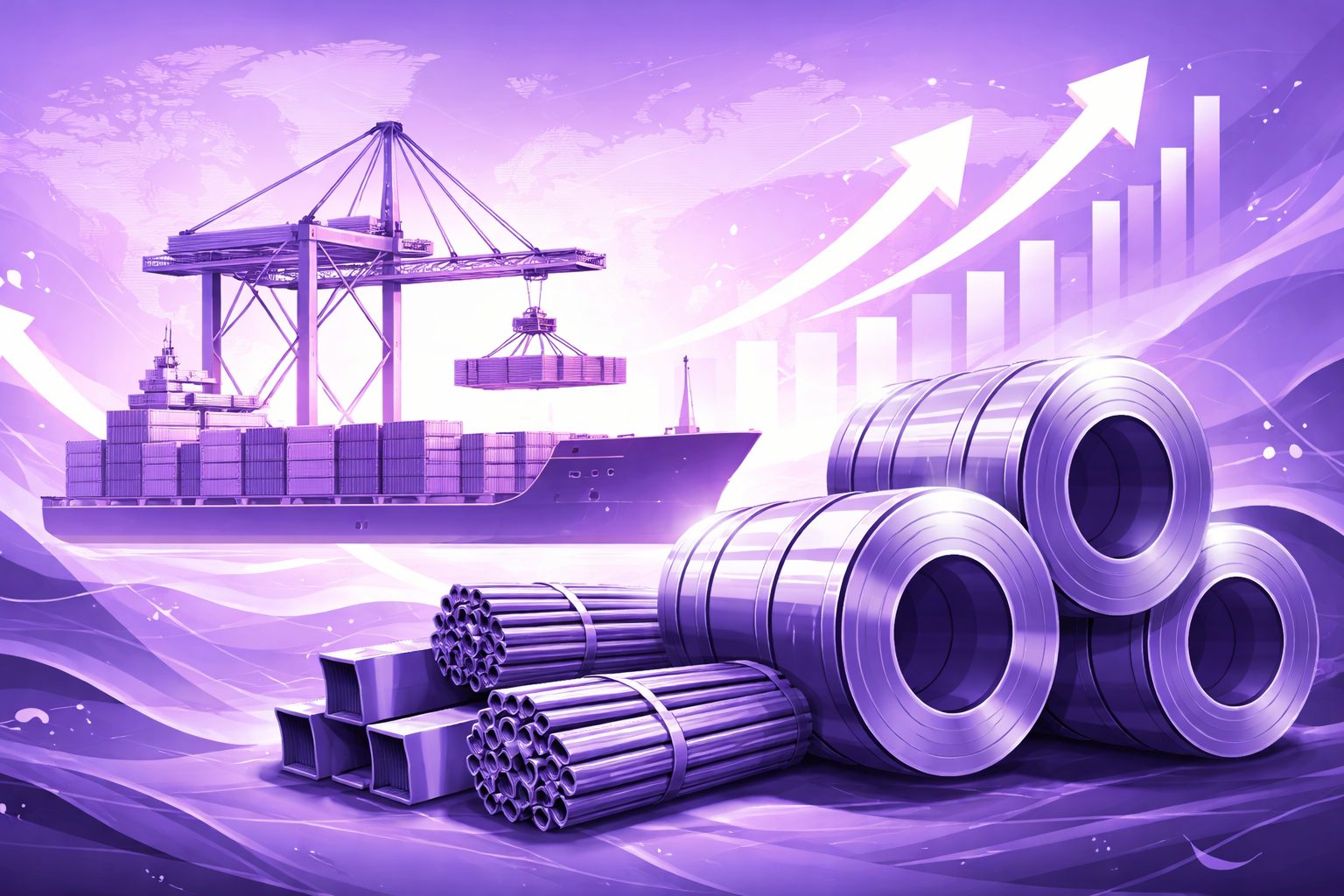
Global steel markets in 2026 are under pressure from persistent oversupply. The main source is China. A prolonged slowdown in Chinese real estate and infrastructure has reduced domestic steel consumption. To keep mills running and manage excess capacity, Chinese producers have shifted aggressively towards exports.
Low-priced Chinese steel is flowing into international markets at scale. Asia, the Middle East, and Africa have seen sharp increases in Chinese flat and long product shipments. These exports are often priced close to marginal cost, placing downward pressure on regional and global steel prices.
Key global developments shaping oversupply:
- Weak domestic demand in China
- High operating rates at Chinese steel mills
- Export-led pricing strategies to clear excess stock
- Limited capacity closures despite policy signals
This oversupply does not need to enter India directly to cause damage. Global steel benchmarks are set by international trade flows. When export prices from China fall, global HRC and billet prices adjust lower. Indian steel prices track these benchmarks closely, even when local demand remains strong.
| Factor | Impact on prices |
| China’s excess capacity | Sustained global oversupply |
| Low export prices | Depressed international benchmarks |
| Weak global demand | Limited pricing recovery |
| High trade volumes | Increased price competition |
As a result, Indian producers increasingly operate as price takers, not price makers. Domestic mills have limited ability to raise prices without risking import substitution or inventory build-up. This global imbalance keeps steel prices capped, regardless of India’s consumption strength, and continues to weigh on margins across the value chain.
3. Weak international prices: Five-year lows explained
International steel prices in 2026 remain under pressure, with several key benchmarks trading near five-year lows. Hot rolled coil (HRC), cold rolled coil (CRC), and billet prices across Asia and Europe have failed to recover meaningfully, despite production cuts in some regions. The main issue is weak end-user demand outside a few growth markets.
Europe continues to face slow industrial activity. Construction demand remains uneven, while manufacturing output is subdued. In the United States, higher interest rates and cautious capital spending have kept steel consumption soft. These trends have increased global competition for limited demand.
Key global factors weighing on prices:
- Weak construction and manufacturing demand in Europe
- Sluggish US industrial activity
- Ongoing fears of a broader global economic slowdown
- High export competition in Asia
Raw material prices have eased, but this has not delivered margin relief. Iron ore prices have corrected from earlier peaks, and coking coal remains volatile. Lower input costs are quickly passed on through lower steel prices, limiting benefits for producers.
| Factor | Price impact |
| Weak global demand | Depressed steel benchmarks |
| Lower raw material costs | Limited margin improvement |
| Strong US dollar | Pressure on emerging market prices |
| Freight rate volatility | Narrow export arbitrage |
Currency movements also play a role. A strong US dollar keeps global steel prices competitive, while freight economics reduce pricing power for exporters. As Indian steel prices remain linked to international benchmarks, domestic markets cannot fully decouple, even when local demand is robust.

4. Import pressures & safeguard duties
Steel imports into India continue to rise in 2026, even as domestic production capacity expands. Lower international prices have made imported steel attractive for buyers, especially in price-sensitive segments. This has added pressure on local producers already dealing with weak realisations.
Imports are concentrated in specific product categories. Flat steel products such as HRC and CRC face the highest pressure. These products are widely used in automotive, appliances, and construction, where buyers closely track global prices.
Key sources of import pressure:
- East Asian producers with surplus capacity
- Low-cost exports from China through indirect routes
- Competitive shipments from ASEAN countries
- Select inflows from Russia and the Middle East
India has trade protection tools in place, including safeguard duties and anti-dumping measures. However, their effectiveness remains mixed. Duties are often temporary, product-specific, or delayed. Exporters also find ways to bypass restrictions through changes in product classification or routing.
| Policy tool | Current challenge |
| Safeguard duties | Limited duration and scope |
| Anti-dumping duties | Slow investigation timelines |
| Quality controls | Uneven enforcement |
| Customs monitoring | Risk of circumvention |
A key concern for the industry is timing. By the time injury is formally recognised and duties are imposed, domestic prices have already fallen. Producers argue that India’s trade response remains largely reactive rather than proactive. This policy lag continues to weaken pricing power and reinforces downward pressure on steel prices in the domestic market.
5. More steel sold, less profit made
Steel producers in India are selling more in 2026, but earning less per tonne. Sales volumes remain strong across infrastructure, automotive, and manufacturing segments. However, falling price realisations have offset the benefits of higher dispatches. This has led to sustained margin compression across the industry.
Producers had expected fixed cost leverage to support profitability at higher utilisation levels. That support has been weaker than anticipated. Energy costs, logistics, maintenance, and compliance expenses remain elevated. As a result, operating leverage has not translated into stable margins.
Key pressures on profitability:
- Lower steel selling prices
- Limited relief from input costs
- High fixed and semi-fixed operating expenses
- Increased competition from imports
The impact is visible in EBITDA per tonne, which has declined across most steel segments. Balance sheets are coming under pressure, especially for companies with recent capital expenditure or higher debt levels. Cash flows remain positive, but headroom is shrinking.
| Producer type | Margin resilience |
| Integrated steel majors | Moderate to strong |
| Mid-sized producers | Under pressure |
| Secondary steel mills | High stress |
| Rerollers and traders | Most vulnerable |
Large integrated producers benefit from captive raw materials, diversified product mixes, and stronger pricing power. In contrast, mid-sized and secondary players face sharper margin erosion. For many producers, volume-led growth is no longer enough. Without price stability or stronger trade protection, higher output alone cannot secure sustainable profitability.
Are input costs really helping?
Input costs for steel producers in India in 2026 show a mixed picture. While some raw materials like iron ore have moderated, other costs remain high or volatile. This uneven cost environment affects profitability and limits the ability to pass on savings through prices.
| Input/cost | Current trend | Impact on producers |
| Iron ore | Moderate decline from peak; long-term contracts protect some. | Helps margins for integrated mills, less benefit for smaller players without contracts. |
| Coking coal | Highly volatile; global supply fluctuations. | Increases uncertainty and squeezes margins, especially for secondary mills. |
| Energy costs | Rising electricity and fuel tariffs. | Adds to fixed operating expenses, reducing leverage from higher production. |
| Logistics & freight | Fluctuating domestic and port freight costs. | Higher delivery costs reduce competitiveness for both exports and domestic sales. |
| Compliance & regulatory costs | Stable but significant. | Smaller mills feel proportionally higher impact, limiting cost relief. |
| Overall effect | Uneven cost advantage. | Margin benefits are inconsistent, complicating pricing recovery. |
Some producers benefit from long-term contracts or captive resources, while others face higher spot costs. Secondary mills and rerollers often see little relief, making pricing recovery harder. Even when global and domestic demand is strong, this uneven cost structure prevents widespread margin improvement and reinforces the pressure on steel prices in India.
Short-term pricing outlook: What happens next?

Infrastructure and construction demand
Domestic demand remains visible in the near term. Government projects, urban housing, and renewable energy construction continue to drive steel consumption, providing some support to prices.
Global price recovery risks
International steel prices are unlikely to rebound sharply soon. Weak demand in Europe and the US, coupled with persistent oversupply from China, keeps recovery uncertain. Any improvement depends on broader economic growth.
China policy shifts
China’s policies will be a major factor. Export controls, production cuts, or domestic stimulus could influence global prices. Sudden policy changes may either ease oversupply or further depress international benchmarks.
Inventory cycles
Domestic and global inventory levels affect pricing. Seasonal patterns, including construction peaks and end-of-quarter stocking, may cause short-term price fluctuations but are unlikely to trigger sustained recovery.
Likely price range
Given current trends, steel prices in India are expected to remain in a moderate range rather than see sharp increases. Producers should plan for margin management rather than relying on volume or price spikes.
This combination of domestic strength and global pressures suggests that short-term pricing will be steady but subdued, reinforcing the importance of cost control, trade measures, and strategic inventory management for Indian steel producers.
Actionable steps for steel producers and buyers
| Focus area | Practical actions | Expected benefit |
| Cost management | Optimise energy, logistics, and procurement; leverage long-term iron ore and coking coal contracts. | Reduces margin pressure and improves profitability per tonne. |
| Product diversification | Expand into value-added and niche steel products. | Maintains better pricing power and reduces exposure to commodity volatility. |
| Trade strategy | Monitor imports, use safeguard duties strategically, and engage in industry advocacy. | Mitigates import-related price pressure and improves domestic competitiveness. |
| Inventory & supply planning | Align production with demand cycles, optimise stock levels, and plan deliveries strategically. | Avoids inventory build-up and stabilises pricing in domestic markets. |
| Financial resilience | Strengthen balance sheets, manage debt prudently, and maintain liquidity. | Ensures ability to absorb short-term price shocks. |
| Buyer collaboration | Long-term contracts, forward pricing agreements, and demand forecasting with major buyers. | Provides revenue predictability and reduces reliance on spot prices. |
| Monitoring global trends | Track China exports, global demand patterns, and raw material prices. | Enables proactive decision-making and early response to market shifts. |
| Policy engagement | Collaborate with industry bodies for timely trade measures and regulatory guidance. | Improves policy responsiveness and reduces lag in protective measures. |
Conclusion
Despite record domestic demand, steel prices in India remain near five-year lows, driven by global oversupply, weak international benchmarks, and margin pressures. Volume growth alone is no longer enough to secure profitability for many producers. Strategic cost management, product diversification, and proactive trade and policy measures are essential to stabilise prices and margins. While 2026 may not see a price breakout, these steps can position the industry for sustainable growth and resilience in the coming years.
Looking to procure steel?
Tata nexarc helps manufacturers, builders and MSMEs source certified steel products, compare prices, and choose the right grade as per IS codes—with complete traceability and procurement confidence.
FAQs
Why are steel prices low in 2026 despite high demand?
Is India producing more steel than before?
How does China affect Indian steel prices?
Do import duties help Indian mills?
Which Indian producers are most at risk?
Are integrated steel majors safe?
Can higher production volumes improve margins?
Are raw material costs helping margins?
What can steel producers do to survive?
Is price recovery expected soon?
A product manager with a writer's heart, Anirban leverages his 6 years of experience to empower MSMEs in the business and technology sectors. His time at Tata nexarc honed his skills in crafting informative content tailored to MSME needs. Whether wielding words for business or developing innovative products for both Tata Nexarc and MSMEs, his passion for clear communication and a deep understanding of their challenges shine through.