
 Check Price Now
Table of Contents
316 stainless steel, or SS 316, is a strong and highly corrosion-resistant austenitic stainless steel. It contains chromium, nickel, and molybdenum, which give it better performance than standard grades. It is the second most popular stainless steel after SS 304.
SS 316 is used in harsh and demanding environments. This includes marine and coastal areas, chemical processing plants, food and pharmaceutical equipment, and medical devices. Its durability makes it suitable for long-term use in critical applications.
If you are a manufacturer, fabricator, contractor, or procurement buyer, knowing the exact properties and current price of SS 316 is important. Its price per kg in India changes often due to metal costs, demand, and product type.
In this guide, we explain what 316 stainless steel is, its composition, key properties, grades, and uses. We also cover the latest SS 316 price trends to help buyers make informed decisions.
What is 316 stainless steel?
Stainless steel is made of iron and chromium, which enhances its properties. Grade 316 SS is a special alloy steel that contains – chromium (16% – 18%), nickel (10% – 14%), and molybdenum (2% – 3%). Chromium helps in creating a metal oxide thin film on the surface of a metal to protect it against corrosive materials, especially chlorides.
The alloy is manufactured melting all these components together for uniformity of chemical properties. Once melted, it is formed into SS 316 sheets, bars, or any other. This versatility allows 316 grade SS to be used across multiple industries.
What material is 316 SS?
316 stainless steel is made up of chromium (16% – 18%), nickel (10% – 14%), molybdenum (2% – 3%) and small portions of carbon.
The presence of molybdenum makes it resistant to corrosion and oxidation making it a suitable metal for use in harsh conditions and coastal/saline and acidic environments. It’s also a highly strong metal and durable and used in high-stress situations where long-term performance is essential.
Chemical composition of 316 stainless steel
Stainless steel 316 is a popular stainless steel grade. Its unique blend of elements enhances its overall functionality and resilience.
Let’s take a look at its main chemical composition of SS 316:
| Element | % composition | Key features |
| Chromium | 16% – 18% | Forms a protective oxide layer and enhances resistance to corrosion. |
| Nickel | 10% – 14% | Improves strength and ductility and enables to maintain the structure even at high temperatures. |
| Molybdenum | 2% – 3% | Increases resistance to chloride pitting and corrosion on crevice. |
| Manganese | Up to 2% | Enhances the steel’s structural strength. |
| Silicon | Up to 1% | Enhances durability and resistance to wear. |
| Nitrogen | Up to 0.10% | Increases mechanical strength and resistance to corrosion. |
| Sulphur | Up to 0.03% | Improves machinability. |
*This is a general table. Please refer to your steel supplier for exact details on steel’s chemical compositions.
These elements collectively enhance the alloy’s performance in harsh environments and demanding applications. A comparison between the chemical composition of SS 316 with the composition of stainless steel (standard) will reveal that it is the percentage variation in elements that gives the grades its unique properties.
Corrosion resistance of 316 stainless steel
316 stainless steel is highly resistant to corrosion in chloride-rich environments, making it ideal for marine, chemical, and coastal applications. Its pitting resistance is enhanced by 2–3% molybdenum, with a Pitting Resistance Equivalent Number (PREN) of approximately 24–26. It performs well in seawater, mild acids, and caustic solutions, though extreme conditions may require specialised alloys. Its corrosion resistance is also maintained up to temperatures of around 870°C in intermittent use and 925°C in continuous service.
Properties of 316 SS
Mechanical properties of 316 stainless steel (ASTM A240/A276)
*Typical values; may vary by product form and manufacturer
| Property | 316 bar & section (ASTM A276) | 316 sheet (ASTM A240) | 316 plate (ASTM A240) |
| Tensile strength (MPa) | 500 – 700 | 520 – 680 | 520 – 670 |
| Yield strength / Proof stress 0.2% (MPa) | ≥ 200 | ≥ 240 | ≥ 220 |
| Elongation (A50 mm) | ≥ 40% | ≥ 40% | ≥ 45% |
| Hardness (Brinell) | ≤ 217 HB | ≤ 217 HB | ≤ 217 HB |
| Modulus of elasticity (GPa) | 193 | 193 | 193 |
| Corrosion resistance | Excellent resistance to chlorides, acids & marine environments. | Same as bar | Same as bar |
| Standards | ASTM A276 | ASTM A240 | ASTM A240 |
Physical Properties of 316 Stainless Steel
| Property | Value |
| Melting point | ~1,375 – 1,405°C |
| Density | 8.0 g/cm³ |
| Modulus of elasticity (Young’s modulus) | 193 GPa |
| Thermal conductivity | 16.3 W/m·K (at 100°C) |
| Thermal expansion coefficient | 15.9 × 10⁻⁶ /K (at 20–100°C) |
| Electrical resistivity | 74 micro-ohm·cm |
| Specific heat capacity | 500 J/kg·K |
| Magnetic behaviour | Non-magnetic in annealed condition; can become slightly magnetic after cold working. |
Certifications & standards for 316 stainless steel
When procuring 316 stainless steel, always check for compliance with recognised international and Indian standards. Common certifications include ASTM A240 for sheets and plates, ASTM A276 for bars, ASTM A312 for pipes, and ASTM A554 for tubes. Indian standards such as BIS (IS: 6911 / IS: 1570) may also apply. These certifications ensure the material meets required chemical composition, mechanical properties, and quality benchmarks, providing reliability for industrial and commercial applications.

Different grades of 316 SS
316 stainless steel is available in three main grades: 316L, 316H, and 316Ti. Each grade has unique properties suited for specific applications.
316L stainless steel
‘L’ stands for low-carbon. This grade has lower carbon content than standard 316, which reduces the risk of carbide precipitation during welding. It also offers excellent corrosion resistance after welding. 316L is commonly used in welded structures, tanks, and pipes in chemical and pharmaceutical industries.
316H stainless steel
316H contains higher carbon, giving it improved strength at elevated temperatures. It provides greater thermal stability and is suitable for boilers, heat exchangers, and other high-temperature applications where mechanical performance is critical.
316Ti stainless steel
316Ti is stabilised with titanium, which improves resistance to intergranular corrosion. It is designed for high-temperature environments and offers enhanced durability in applications such as chemical processing, industrial heaters, and heat exchangers.
Also read: Carbon steel vs Stainless steel – How is it different?
Which is stronger 316 or 316L?
| 316 stainless steel | 316L stainless steel |
| Contains chromium, nickel, molybdenum and small amount of carbon (0.08%). | Basic composition is similar to standard SS 316 but contains lesser carbon content (up to 0.03%). |
| Stronger and more hardness due to its higher carbon content (carbon strengthening) than 316L especially in high temperatures. | Less strong than SS 316. |
| Higher risk of forming carbide precipitation. | Lesser scope of carbide precipitation during welding due to low carbon content making it suitable for environments where corrosion resistance (after welding) is required. |
Applications of stainless steel 316
Compared to stainless steel 304, 316 stainless steel contains 2–3% molybdenum, which improves corrosion resistance against chlorides and industrial chemicals. Its strength and durability make it ideal for demanding applications across industries.
Chemical and manufacturing:
- Highly resistant to corrosion in high-saline and acidic environments.
- Used in chemical tanks, piping systems, heat exchangers, and marine equipment.
Medical and pharmaceutical:
- Non-reactive and hygienic, suitable for surgical instruments and medical implants.
- Commonly used in pharmaceutical equipment and laboratory devices.
Food and beverage industry:
- Resists corrosion from food acids, cleaning chemicals, and high-temperature washes.
- Used in food processing units, commercial kitchens, and brewing facilities.
Marine and coastal applications:
- Superior chloride resistance makes it ideal for boat fittings, shipbuilding, and coastal construction.
- Used in desalination plants and offshore equipment.
High-pressure and industrial systems:
- Suitable for pressure vessels, pipelines, and systems handling corrosive fluids under high temperature and pressure.
- Ensures long-term reliability in demanding industrial setups.
Architecture and construction:
- Used in façade cladding, handrails, balustrades, roofing, and structural components exposed to weather and pollution.
- Provides long-lasting durability and aesthetic appeal in exterior and interior projects.
Other engineering applications:
- Heat exchangers, condensers, and specialised engineering components where corrosion resistance and mechanical strength are critical.
- Suitable for high-performance industrial machinery, energy plants, and desalination equipment.
SS 316 price per kg in India
Note: The price of SS 316 per kg will depend on manufacturer, location, type, availability, dimensions (width, thickness, length), demand, transport, taxes, quality, and several other factors. Please check with your local steel supplier before purchasing.
| SS 316 type | Price per kg (₹) | Price per tonne (₹) |
| 316 stainless steel (standard) | ₹260 – ₹330/kg | ₹260,000 – ₹330,000/t |
| 316L stainless steel | ₹270 – ₹340/kg | ₹270,000 – ₹340,000/t |
| 316H stainless steel | ₹280 – ₹350/kg | ₹280,000 – ₹350,000/t |
| SS 316 coils | ₹290 – ₹360/kg | ₹290,000 – ₹360,000/t |
| SS 316 sheets | ₹270 – ₹380/kg | ₹270,000 – ₹380,000/t |
| SS 316 pipes | ₹290 – ₹360/kg | ₹290,000 – ₹360,000/t |
| Other 316 SS products (bars, plates, fittings, etc.) | ₹280 – ₹380/kg | ₹280,000 – ₹380,000/t |
*Prices are reflective and subject to change. Please check with your steel supplier for the latest and accurate price.
Alternatives to 316 stainless steel
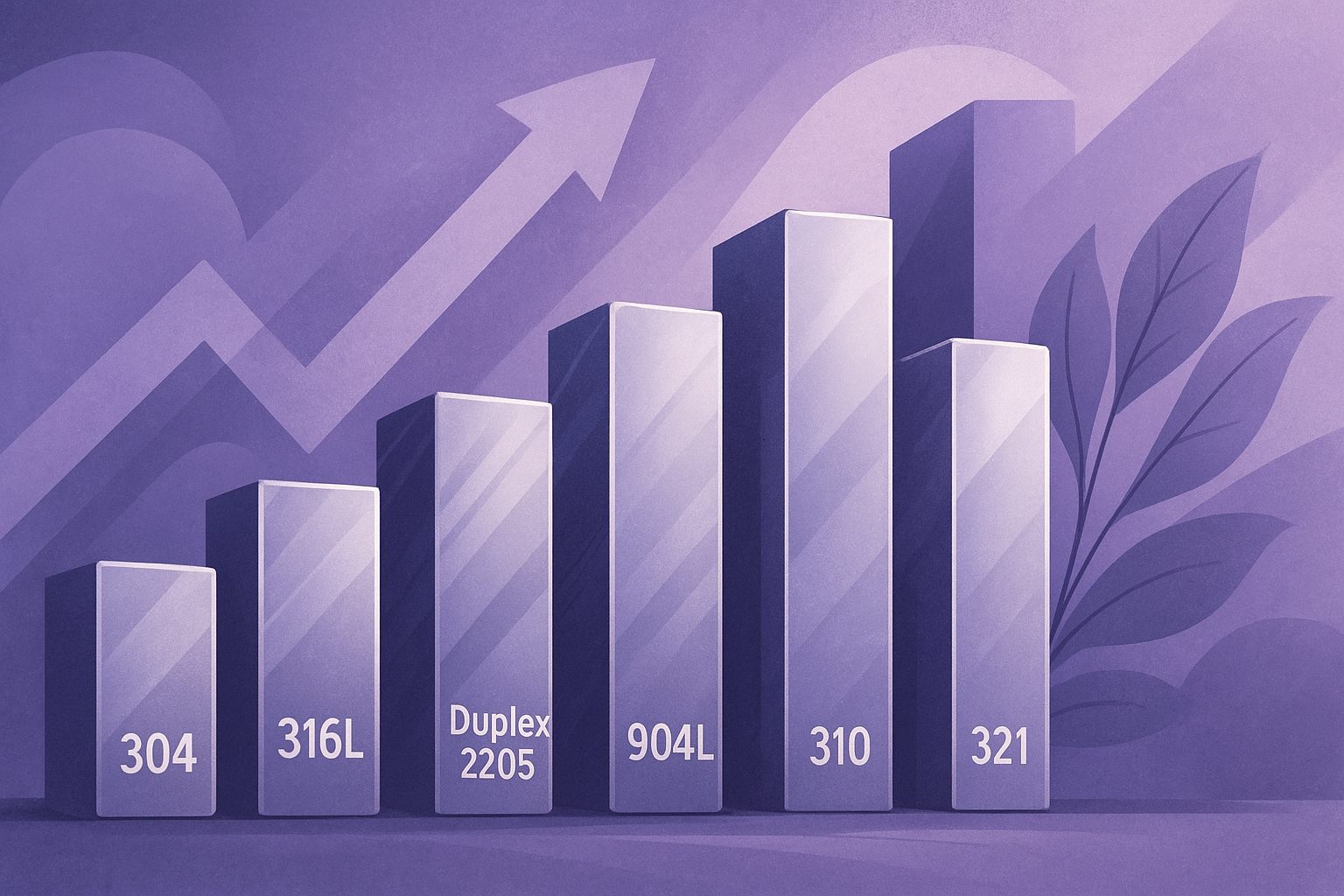
When selecting stainless steel, buyers often compare 316 with other grades that offer different levels of corrosion resistance, strength, and temperature tolerance. Grades such as 304, 316L, duplex 2205, 904L, 310, and 321 may be better suited depending on the operating environment and budget. Understanding these options helps buyers choose the right material for performance, longevity, and cost.
When to choose 304 stainless steel
Choose 304 if you need a cost-effective, versatile stainless steel for general use. It offers good corrosion resistance for indoor and mild outdoor environments and is suitable for food contact, kitchen equipment, basic fabrication, and architectural applications.
When to choose 316L stainless steel
Choose 316L for welding-heavy applications or environments where corrosion after welding is a concern. Its low-carbon content prevents carbide precipitation, making it ideal for pharmaceutical equipment, processing tanks, and pipelines.
When to choose duplex 2205
Choose duplex 2205 if you require much higher strength and superior resistance to chloride stress corrosion cracking. It performs well in marine environments, offshore structures, chemical plants, and desalination systems, often replacing 316 where higher durability is needed.
When to choose 904L stainless steel
Choose 904L for highly aggressive environments that contain strong acids, seawater, or high chloride levels. It offers exceptional corrosion resistance compared to 316, making it ideal for fertiliser plants, chemical processing, and high-end industrial components.
When to choose 310 stainless steel
Choose 310 if the application involves very high temperatures. Its high chromium and nickel content provide excellent oxidation resistance, making it suitable for furnaces, heat treatment equipment, and thermal processing industries.
When to choose 321 stainless steel
Choose 321 for applications exposed to continuous high heat where stabilised corrosion resistance is required. Its titanium content minimises carbide formation, making it ideal for exhaust systems, high-temperature pipelines, and thermal processing equipment.
Top stainless-steel manufacturers in India (2025)
- Jindal Stainless Ltd (JSL) – India’s largest stainless-steel producer, with a strong presence in coils, plates, and speciality alloys.
- Tata Steel Ltd – Major steelmaker, supplies stainless-grade products alongside other steel segments.
- JSW Steel Ltd – Leading steel conglomerate involved in flat, coil, and alloy products.
- Steel Authority of India Ltd (SAIL) – Public-sector steel producer, occasionally supplies stainless/alloy-grade steel.
- Rashtriya Ispat Nigam Ltd (RINL/Vizag Steel) – Integrated steel producer, produces plates and coils.
- Mukand Ltd – Manufactures stainless and alloy-steel products, including billets and industrial steels.
Buyer Guide for 316 stainless steel
- Choose the right grade (316, 316L, 316H, 316Ti) based on corrosion resistance, temperature, and welding needs.
- Verify supplier credentials and reputation for stainless-steel quality.
- Check for material certifications such as ASTM A240/A276, ISO 9001, or EN standards.
- Request mill test certificates (MTCs) to confirm chemical composition and mechanical properties.
- Inspect surface finish and dimensional tolerances as per application requirements.
- Confirm delivery forms and sizes (sheets, coils, pipes, bars) match your project needs.
- Ask about traceability and batch numbers to ensure consistent quality.
- Compare price per kg or tonne with market trends to avoid overpaying.
Conclusion
316 stainless steel is a durable, corrosion-resistant alloy used in chemical, pharmaceutical, food, marine, and industrial applications. Its superior performance in chloride-rich and high-temperature environments makes it ideal for demanding conditions. Buyers should consider grades, properties, and current market prices before procurement. Proper selection ensures long-term reliability and performance across industries.
Looking to procure steel?
Tata nexarc helps manufacturers, builders and MSMEs source certified steel products, compare prices, and choose the right grade as per IS codes—with complete traceability and procurement confidence.
FAQs
What is 316 stainless steel?
What are the main grades of 316 SS
How is 316 different from 304 SS?
What are common applications of 316 SS?
What forms is 316 stainless steel available in?
Is 316 SS suitable for welding?
What is the corrosion resistance of 316 SS?
What standards cover 316 stainless steel?
How to choose the right grade of 316 SS?
What affects the price of 316 stainless steel?
A product manager with a writer's heart, Anirban leverages his 6 years of experience to empower MSMEs in the business and technology sectors. His time at Tata nexarc honed his skills in crafting informative content tailored to MSME needs. Whether wielding words for business or developing innovative products for both Tata Nexarc and MSMEs, his passion for clear communication and a deep understanding of their challenges shine through.





I’m going to bookmark this page for future reference.” It’s a handy guide to have on hand whenever I’m working with stainless steel. I might even share it with my colleagues.
nice..like 316 stainless steel is used in various things, I want to know about the different finishes (polished, matte) that are available and if they impact the steel’s performance.