Check Price Now
Table of Contents
Introduction: Why understanding finished steel matters for MSMEs
Most Indian MSMEs handle steel almost every day. HR sheets, TMT bars, structural steel and pipes move through the yard as routine material. Yet many buyers still treat every finished steel product as if it behaves the same in cutting, welding and installation. That quiet assumption often shows up later as rework, delays or rejected lots.
In real steel procurement cycles, a small error in grade, thickness or coating can undo a full week of shop work. Many MSME steel buyers only realise the gap when a client or inspector flags a deviation from drawings or BIS standards.
Typical issues that come from weak clarity on finished steel products:
- Wrong thickness or surface finish arriving at site
- GI, PPGI or HR material mixed up in the same job
- Higher wastage than planned during cutting and fitting
- Disputes with stockists because purchase order (PO) descriptions were vague
Where MSMEs sit in the steel value chain
Mills think in semi-finished steel, billets and slabs. Large EPC firms think in codes, tender clauses and complex drawings. MSMEs stand in the middle and convert each finished steel product into frames, panels, racks and structures. Thus, clear understanding of types, uses and buying checks helps them bridge this gap, negotiate better with service centres and keep projects moving without surprise cost overruns.

What finished steel products are, in simple terms
For MSMEs, finished steel is the steel that can move straight from truck to cutting, bending, welding or installation. This section fixes a clear meaning and a basic grouping.
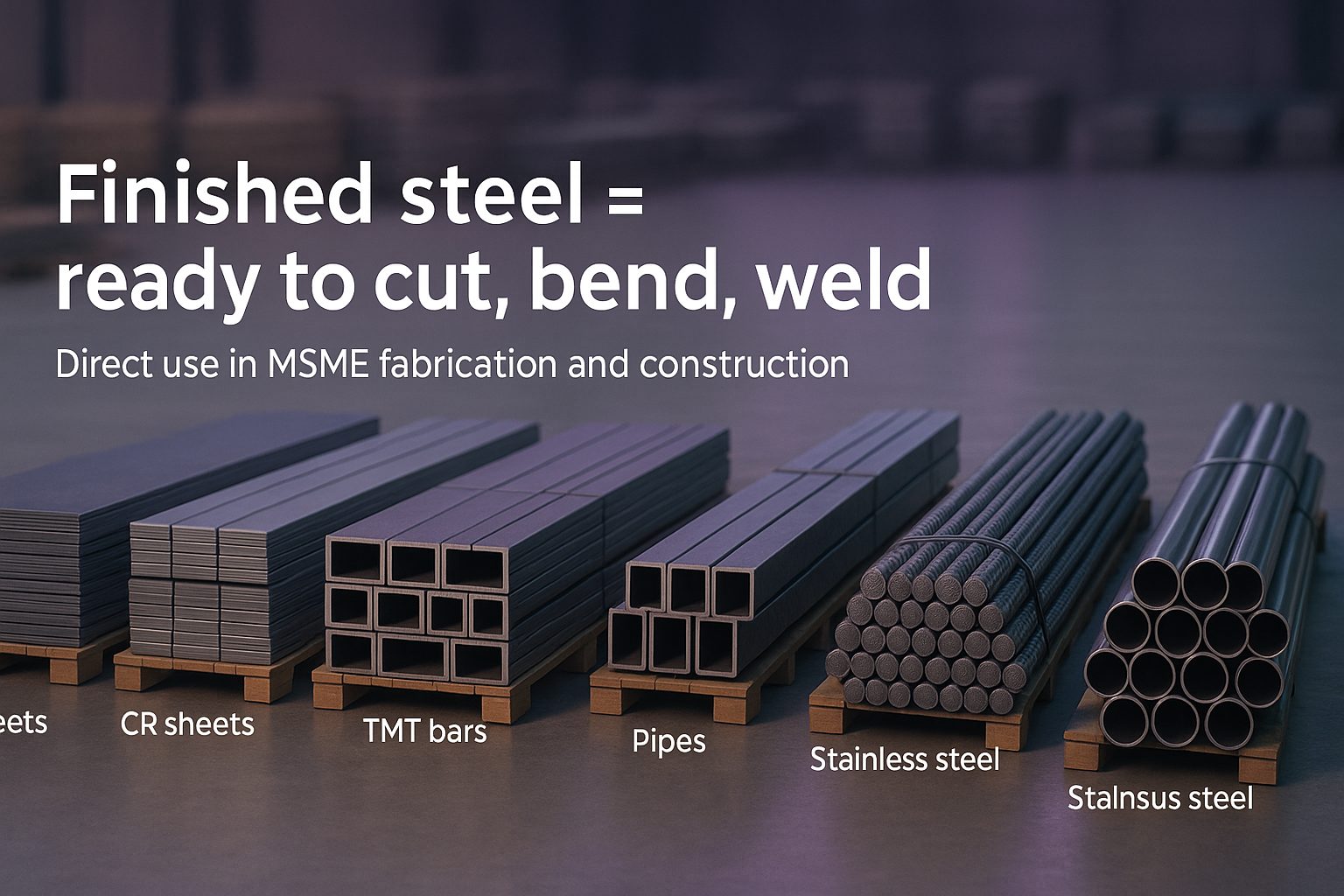
For MSME and steel buyers, a finished steel product is a steel item in its final rolled form that needs no further primary rolling. It has a defined size and grade and leaves the mill or service centre ready for direct use in fabrication or construction.
In MSME buying this usually means HR and corrugated roofing sheets, coated sheets, structural steel, TMT bars, pipes, tubes and stainless steel products. Semi finished forms such as billets and slabs sit earlier in the chain and remain within the mill or large trader ecosystem.
Flat, long and tubular products at a glance
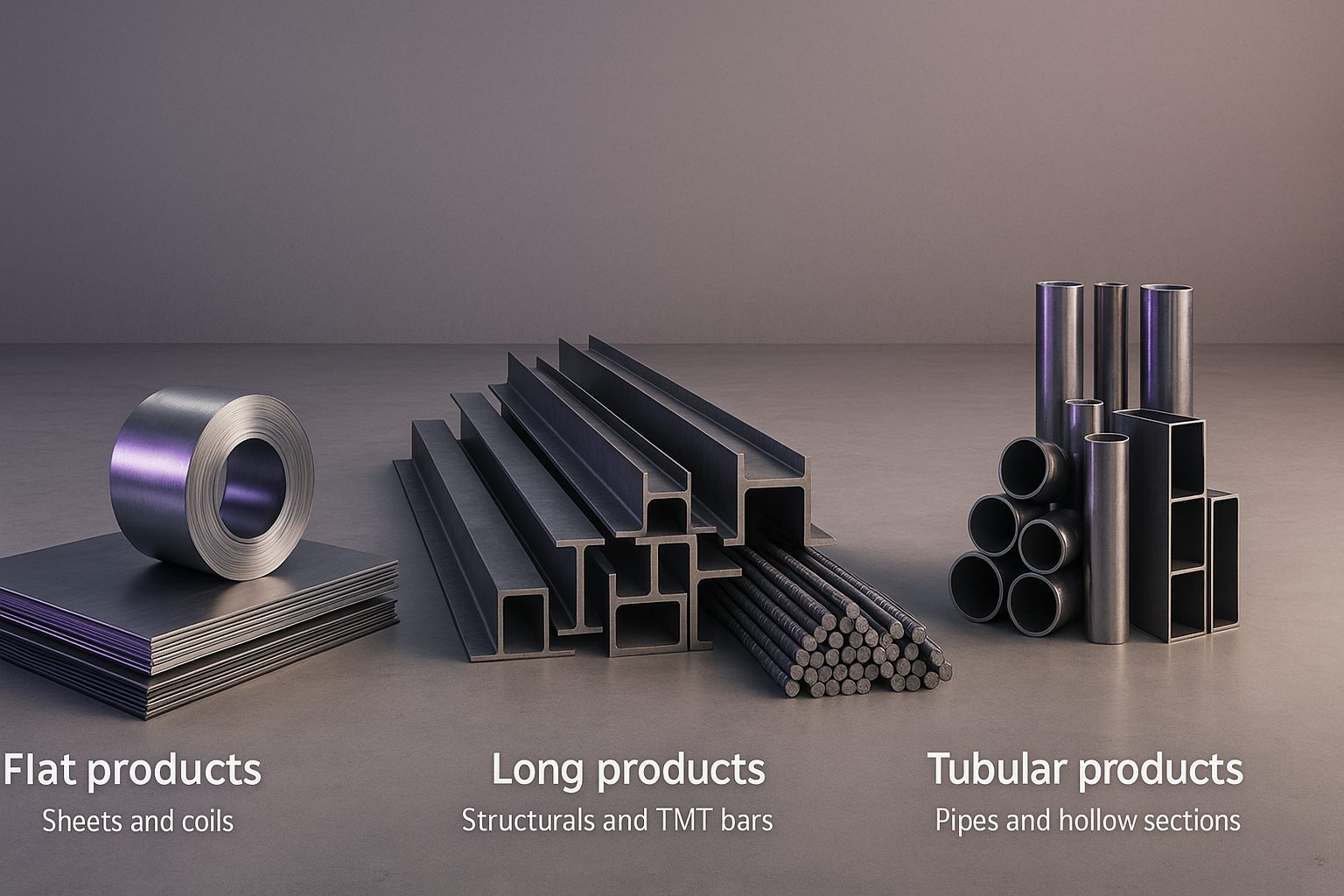
Most catalogues group finished steel into three broad families.
Flat products
- HR sheets, HR coils and plates
- CR sheets and CR coils
- Coated sheets such as GI, GP, PPGI and PPGL
Long and structural products
- Angles, channels, beams and joists
- TMT bars, reinforcement steel and wire rods
Pipes, tubes and hollow sections
- Round steel pipes
- Square and rectangular hollow sections
Why these terms matter in buying and planning
When a purchase order clearly names the correct finished steel product family, suppliers are less likely to send material that does not match drawings. Stores and quality teams also know which checks to apply at the gate, and commercial teams can follow market updates that use the same flat, long and tubular terms.
Types of finished steel products for MSMEs
Most small and mid sized units use a limited mix of finished steel products. Knowing the basics of each type helps buyers match material to the job instead of treating everything as the same steel.
Hot rolled steel for general fabrication
Hot rolled steel covers HR sheets, HR coils and plates. It suits frames, supports, brackets and heavy structures where appearance is less important and some thickness variation is acceptable.
- Choose grades suitable for load and welding
- Check plate thickness where parts mate with machined items
Cold rolled steel for neat panels and light parts
Cold rolled steel offers flatter, smoother CR sheets and coils for visible panels and light components. It costs more than hot rolled steel but often reduces work on grinding and painting.
- Use for doors, covers, cabinets and machine guards
- Prefer where tight bends or punch work are critical
Coated sheets for roofs, cladding and outdoor boxes
Coated flat products include GI sheets, GP sheets, PPGI sheets and PPGL sheets. Zinc and paint systems protect steel from rust and give colour options for roofs, facades and outdoor enclosures.
- Confirm coating class and base sheet thickness for the site
Structural sections for sheds, racks and platforms
Angles, channels, beams and joists form the skeleton of sheds, mezzanines, racks and platforms. For these sections, straightness, section weight and grade matter as much as price.
- Check section weight and visible straightness on random pieces
TMT bars and reinforcement steel on civil sites
TMT bars, reinforcement steel and wire rods carry the loads inside concrete members. Rate per tonne is important, yet bar diameter, rib pattern and consistency decide real performance.
- Check actual diameter against the nominal size
- Look at ribs and spacing on a few bars
Pipes, tubes and hollow sections for light structures
Round steel pipes and hollow sections shape gates, railings, frames and display fixtures. Wall thickness is the hidden factor that separates decorative members from load bearing ones.
- Specify both section size and wall thickness in the order
Stainless steel where hygiene and image are critical
Stainless steel sheets, coils and pipes appear in kitchens, food plants, pharma facilities and premium railings. Grade and surface finish decide how well the material resists corrosion, stains and scratching.
- Select grade for the exposure, for example 304 or 316
- Choose finish with cleaning and appearance in mind
Finished steel vs semi-finished steel
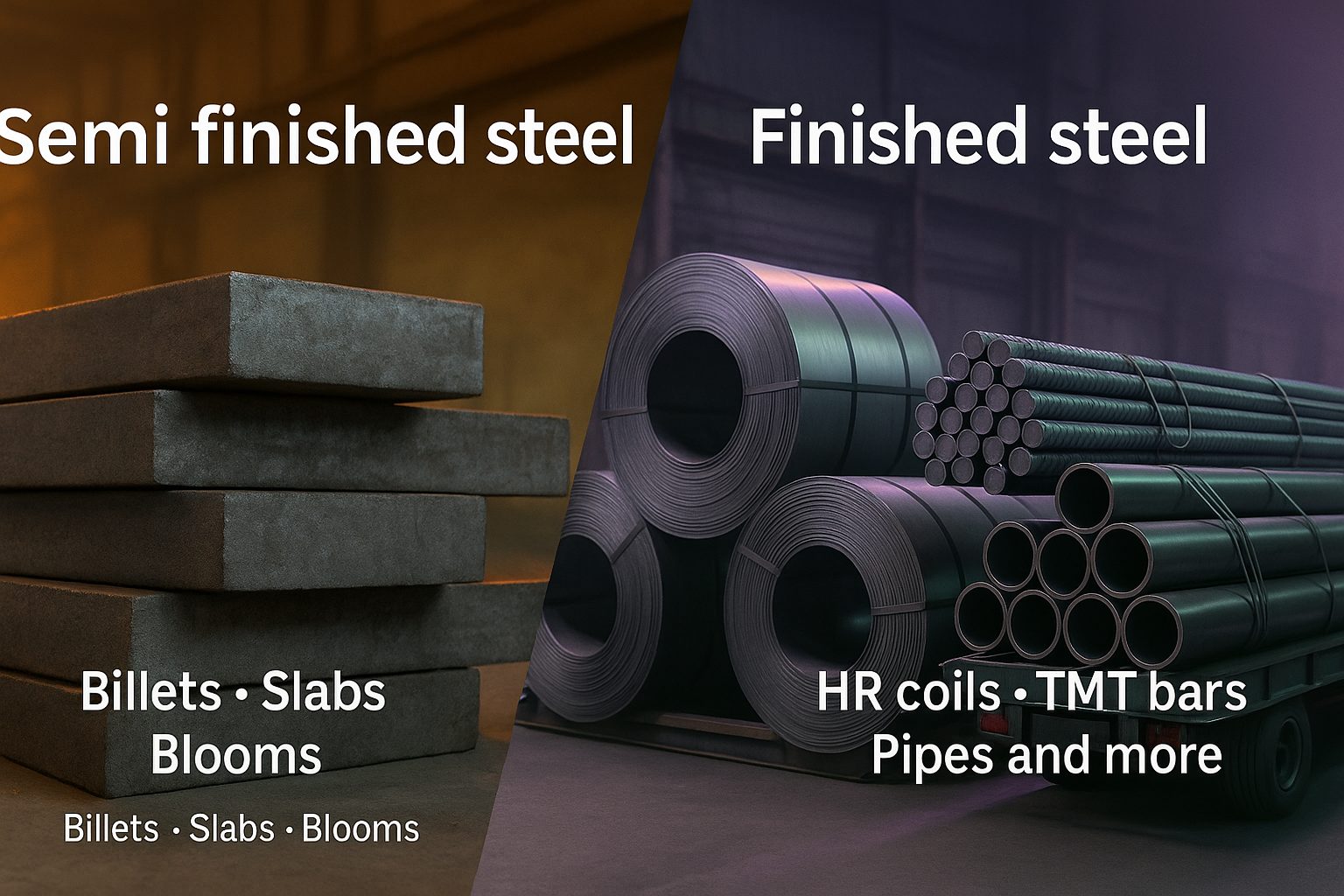
Many market updates, trader calls and news reports talk about billets and slabs, while MSME buyers mostly see HR coils, TMT bars and pipes. It helps to separate these two layers clearly.
Semi-finished steel in the production chain
Semi-finished steel sits between molten metal and the finished steel product. Mills cast steel into:
- Slabs for HR coils, plates and sheets
- Billets for bars, wire rods and some sections
- Blooms for heavy sections and rails
These forms are thick, rough and meant for rolling mills, not workshops. Large traders and mills track semi-finished prices closely because they drive conversion economics.
Finished steel as the usable input for MSMEs
A finished steel product is the result of rolling and basic finishing. It comes out as HR sheets, CR coils, coated sheets, structural sections, TMT bars, steel pipes, tubes or stainless-steel items. Sizes, grades and surface conditions are fixed and predictable.
MSMEs cut, bend, weld and install these products directly. Stores tag them. QC teams inspect them. Dispatch teams load them onto trucks. Semi-finished forms never enter this part of the chain.
Why this difference matters for timing and planning
Semi-finished prices usually move first, finished steel prices move later. When billets or slabs become tight, HR and TMT rates often firm up after a short lag. When semi-finished supply eases, traders get more flexible on finished stock.
An MSME that tracks both layers plans better. For example, if a regular supplier mentions billet shortages, a fabrication unit can bring forward orders for HR sheets and structural steel before the next price list change. The drawings stay the same, but the timing and quantity planning become sharper.
Common applications across MSME sectors
The same finished steel product looks very different once it reaches actual use. A TMT bar in a small housing project, a CR sheet in a control panel and a hollow section in a display rack all live in separate worlds, even if they came from the same mill. Seeing these patterns helps MSMEs plan stock and negotiate better.
Fabrication workshops
Fabrication units turn HR sheets, plates, angles, channels and tubes into frames, supports, machine bases and storage racks. Weldability and bending behaviour matter more than looks.
A typical job might use HR plates for base frames, angles for bracing and hollow sections for guard rails on the same skid.
General engineering and job shops
General engineering units mix HR and CR sheets with pipes and small structurals. They build brackets, guards, housings and enclosures in short runs.
Consistent thickness and flatness help when parts go for drilling, tapping or laser cutting, especially where one finished steel product must match many mating components.
Construction and infrastructure MSMEs
Civil contractors and site fabricators lean on TMT bars, beams, channels and HR plates. These become columns, rafters, purlins, platforms and support frames.
Here, strength, straightness and correct diameter matter most, along with bar bending schedules and safe lifting on cramped urban sites.
Appliance, electrical and panel manufacturers
Panel builders and appliance makers rely on CR sheets and coated sheets such as GI, GP, PPGI and PPGL. They need clean bends, accurate cut-outs and presentable surfaces.
Any thickness variation or poor coating shows up clearly in door alignment, gasket sealing and paint or powder finish.
Furniture, display and light fabrication
Office furniture makers, shopfitters and display fabricators use pipes, tubes, hollow sections and light CR sheets. Weight, appearance and easy assembly are key.
A common pattern is hollow sections for frames, CR sheet for shelves and minimal welding so that units can be packed and shipped efficiently.
Food, pharma and chemical MSMEs
Food units, dairies, breweries and pharma plants depend on stainless steel sheets, coils and pipes. Surfaces must clean easily and resist staining.
Wrong grade or rough finish can trap residue, fail hygiene checks and trigger costly rework on equipment already installed.
MSMEs working on government and PSU projects
Service providers on CPWD, rail or PSU jobs often use the full range of finished steel products, but under stricter standards and documentation.
A simple tender line such as “supplying and fixing GI sheets as per IS code” forces the MSME to match the correct product, thickness and BIS marking, or risk rejection at inspection.

How finished steel pricing works for MSMEs
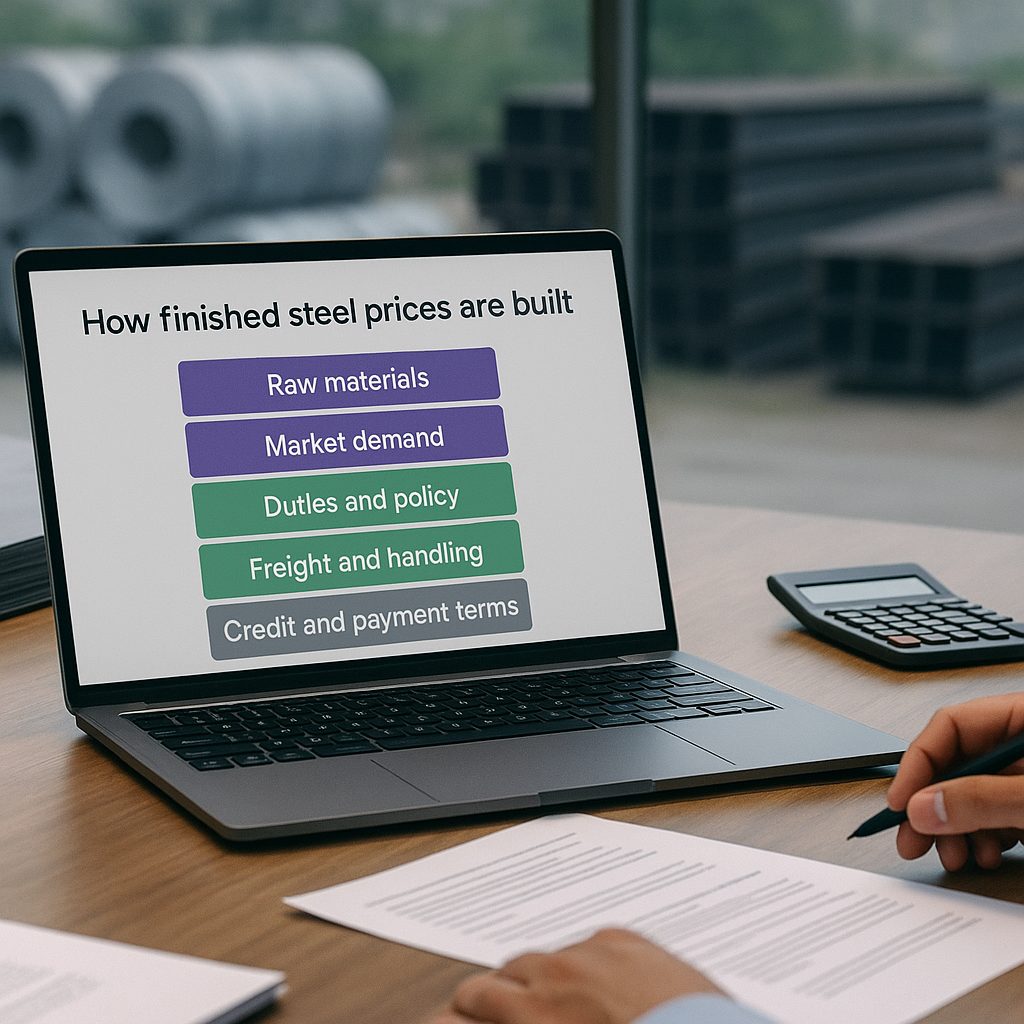
Finished steel prices rarely move for a single reason. MSME buyers usually see only the final rate from the stockist or service centre, yet that number reflects raw materials, demand, policy moves and local costs stacked together. A basic view of these layers makes negotiation and timing easier.
Market drivers behind finished steel prices
The first layer is the cost of iron ore, coking coal and scrap. When these inputs rise, mills pass on part of the increase to HR sheets, CR coils, TMT bars and structural steel.
Demand adds a second layer. Strong construction, infra and engineering activity keeps finished steel product prices firm. Slowdown in these sectors creates room for discounts, especially on standard sizes and grades.
Global cues also matter. If export markets become attractive, mills divert volumes and local supply tightens. When overseas demand softens, domestic buyers see more competitive offers.
Policy, duties and trade measures that shift costs
Import duties, safeguard measures and anti dumping decisions can change landed cost for finished steel in a short period. A duty hike makes imported coils and coated sheets costlier, which gives domestic mills more pricing power.
Quality rules also play a role. BIS standards and Quality Control Orders (QCO) limit how much non compliant finished steel product can enter the market. Compliance improves safety but narrows low cost options, which matters for price sensitive MSMEs.
Landed cost from mill to site, step by step
The final rate that MSME steel buyers pay includes more than the mill price. Typical components are:
- Basic mill or service centre price
- Processing charges such as cutting, slitting or bending
- Freight, loading, unloading and local handling
- Packing, taxes, levies and any TCS
- Credit cost for extended payment terms
A simple habit helps. When comparing offers on a finished steel product, buyers list these elements side by side for each supplier. The cheapest basic rate often stops looking cheapest once full landed cost to site is written down.
Factors MSMEs should consider when choosing finished steel
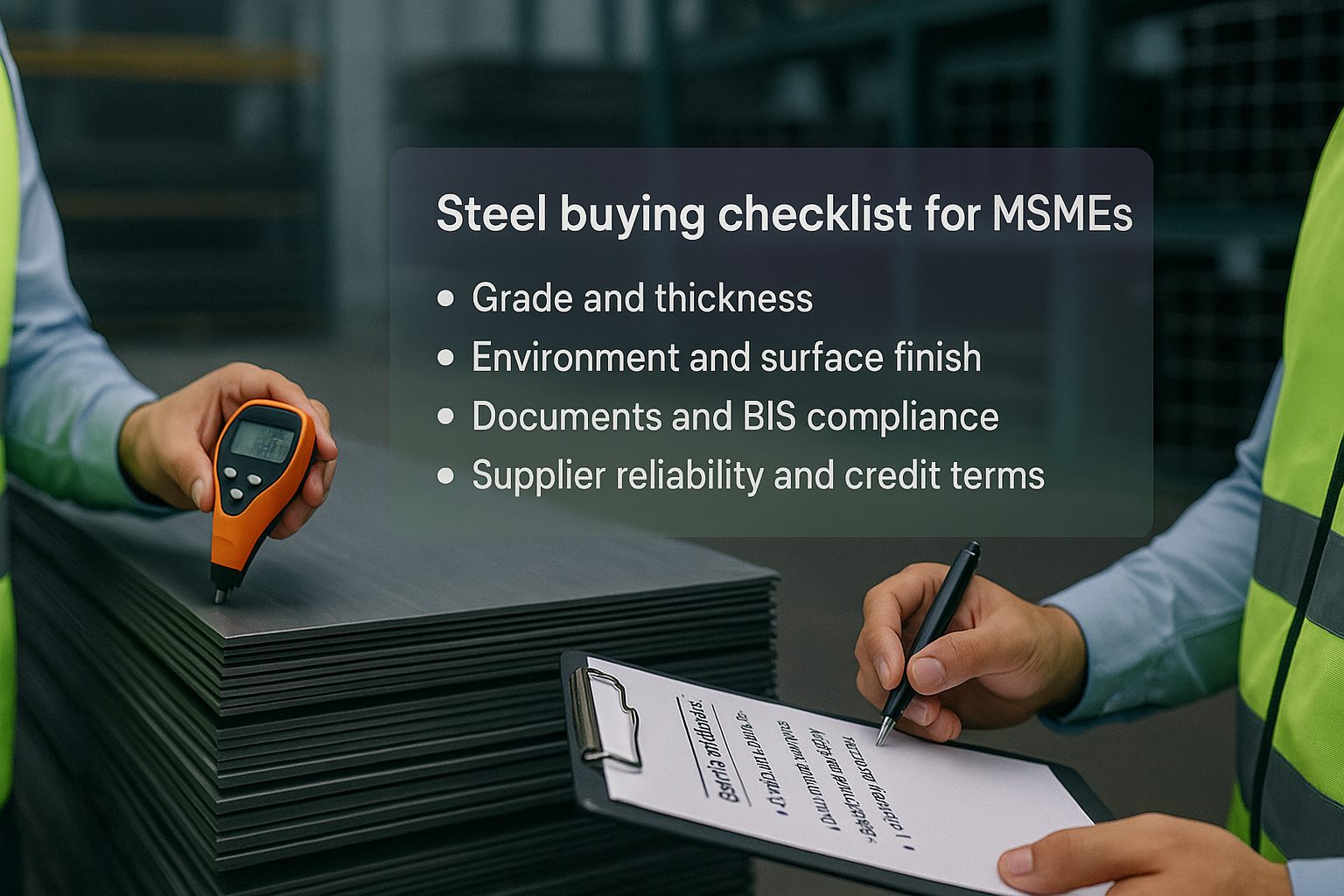
Choosing a finished steel product is more than matching size and rate. A few checks before placing the order can prevent rework, rejection and dispute later.
Technical checks before finalising a product
Start with how and where the material will work. The drawing, loading condition and exposure should guide grade and product type.
Key technical points to confirm:
- Grade and strength in line with drawing notes or customer standards
- Thickness, tolerance and flatness where parts mate with machined components or precision fixtures
- Surface finish for visible or painted parts, especially when choosing between HR, CR and coated sheets
- Service environment, such as indoor, outdoor, coastal, high temperature or chemical contact
Compliance and documentation checks
For many MSMEs, these checks make the difference between smooth delivery and a tender objection.
- Confirm if BIS standards or QCO apply to the finished steel product
- Ask for Mill Test Certificates where customers or contracts demand traceability
- Ensure bundle markings match PO details for grade, size and heat number
- Keep soft copies of invoices, test reports and certificates for audit and claim handling
Supplier, platform and credit considerations
Not all suppliers offer the same reliability, even at a similar rate. MSMEs benefit from looking beyond basic price.
- Past record on correct and timely deliveries
- Depth of stock in common finished steel products and sizes
- Clarity on claim handling, returns and quality issues
- Credit terms that align with project cash flow, not just maximum days
Conclusion: Making smarter steel choices as an MSME
Finished steel products sit at the heart of most MSME operations. HR and CR sheets, coated sheets, structural steel, TMT bars, pipes, hollow sections and stainless steel each have a specific role, and each behaves differently in cutting, welding and service. Treating everything as the same material leads to familiar problems: wrong thickness at site, poor surface finish, early corrosion or bars that fail basic checks.
A little structure solves a large part of this. Clear use of product names, awareness of flat, long and tubular families, and basic knowledge of how pricing builds up which give steel buyers better control. When technical checks, compliance checks and supplier checks sit together in one simple routine, buying decisions become more predictable and less stressful.
Practical next steps for MSME steel buyers
The first step is to turn this understanding into repeatable practice. Many units benefit from a short internal checklist that covers grade, thickness, product type, documentation and payment terms before any finished steel product order is placed. The same list can support store teams and site teams when material arrives.
Next, buyers can link these checks to better timing and vendor choice. Comparing full landed cost instead of headline rate, tracking basic policy and duty changes, and working with suppliers who keep proper test reports all reduce risk in tenders and project work. Over time, these small habits help MSMEs cut waste, avoid disputes and use finished steel products with far more confidence.
Looking to procure steel?
Tata nexarc helps manufacturers, builders and MSMEs source certified steel products, compare prices, and choose the right grade as per IS codes—with complete traceability and procurement confidence.
FAQs
How can an MSME reduce working capital locked in finished steel stock?
What is the benefit of consolidating finished steel buying across multiple plants?
When should an MSME sign an annual rate contract for finished steel?
How should an MSME decide minimum order quantities for finished steel products?
Why do some MSMEs prefer consignment stock arrangements for steel?
What reporting should a purchase head review for finished steel every month?
How can finished steel scrap be turned into a business advantage?
Why is standardisation of sections and thickness across drawings important?
What is the risk of frequent spec changes for finished steel in ongoing projects?
Can vendor-managed inventory work for finished steel in MSMEs?
What is a sensible KPI to track for finished steel buying efficiency?
Charul is a content marketing professional and seasoned content writer who loves writing on various topics with 3 years of experience. At Tata nexarc, it has been 2 years since she is helping business to understand jargon better and deeper to make strategical decisions. While not writing, she loves listing pop music.