Check Price Now

Table of Contents
If you are looking to source aluminium coils, you first need to know how to determine their quality. This depends on several factors, such as the aluminium grade, formability, ease of machining, corrosion resistance, and surface finish. You also need to look for reputed aluminium coil suppliers who can provide quality products that meet your technical and application requirements.
This article explains the features, grades, uses, and applications of aluminium coils in today’s industrial setting, with information relevant to buyers and manufacturers in India as of 2026.
What is an aluminium coil?
An aluminium coil is a continuous, flat-rolled aluminium sheet wound into a cylindrical coil for easy storage, handling, and transportation. The width of the aluminium sheet is much greater than its thickness. These coils have a hollow centre and tightly wound layers of aluminium, making them suitable for large-scale industrial applications.
Since individual aluminium sheets can be difficult to store, handle, and transport in large quantities, industries use aluminium coils to improve material handling and production efficiency. As of 2026, aluminium coils remain an important raw material across manufacturing, construction, automotive, packaging, and electrical industries.
Key characteristics of aluminium coils include:
- Lightweight construction: Aluminium coils offer a high strength-to-weight ratio, making them suitable for applications where weight reduction is important.
- Corrosion resistance: Aluminium naturally forms a protective oxide layer that helps resist corrosion.
- Excellent formability: Aluminium sheets can be cut, bent, stamped, rolled, and shaped to manufacture different components.
- Thermal and electrical conductivity: Aluminium coils are used in applications that require efficient heat transfer or electrical conductivity.
- Multiple grades and tempers: Aluminium coils are available in different alloys and tempers to meet specific strength, flexibility, and fabrication requirements.
- Customisable dimensions: Buyers can source aluminium coils in different thicknesses, widths, and finishes, depending on the intended application.
- Efficient storage and transportation: The coiled format allows manufacturers to handle and transport long lengths of aluminium sheet more efficiently than individual flat sheets.
- Recyclability: Aluminium can be recycled repeatedly, making it useful for manufacturers seeking to improve material efficiency and reduce waste.
These properties make aluminium coils suitable for manufacturing roofing sheets, cladding panels, heat exchangers, automotive components, electrical products, and packaging materials. The appropriate aluminium coil grade, thickness, and temper depend on the application and the required mechanical properties.
How is aluminium coil manufactured?
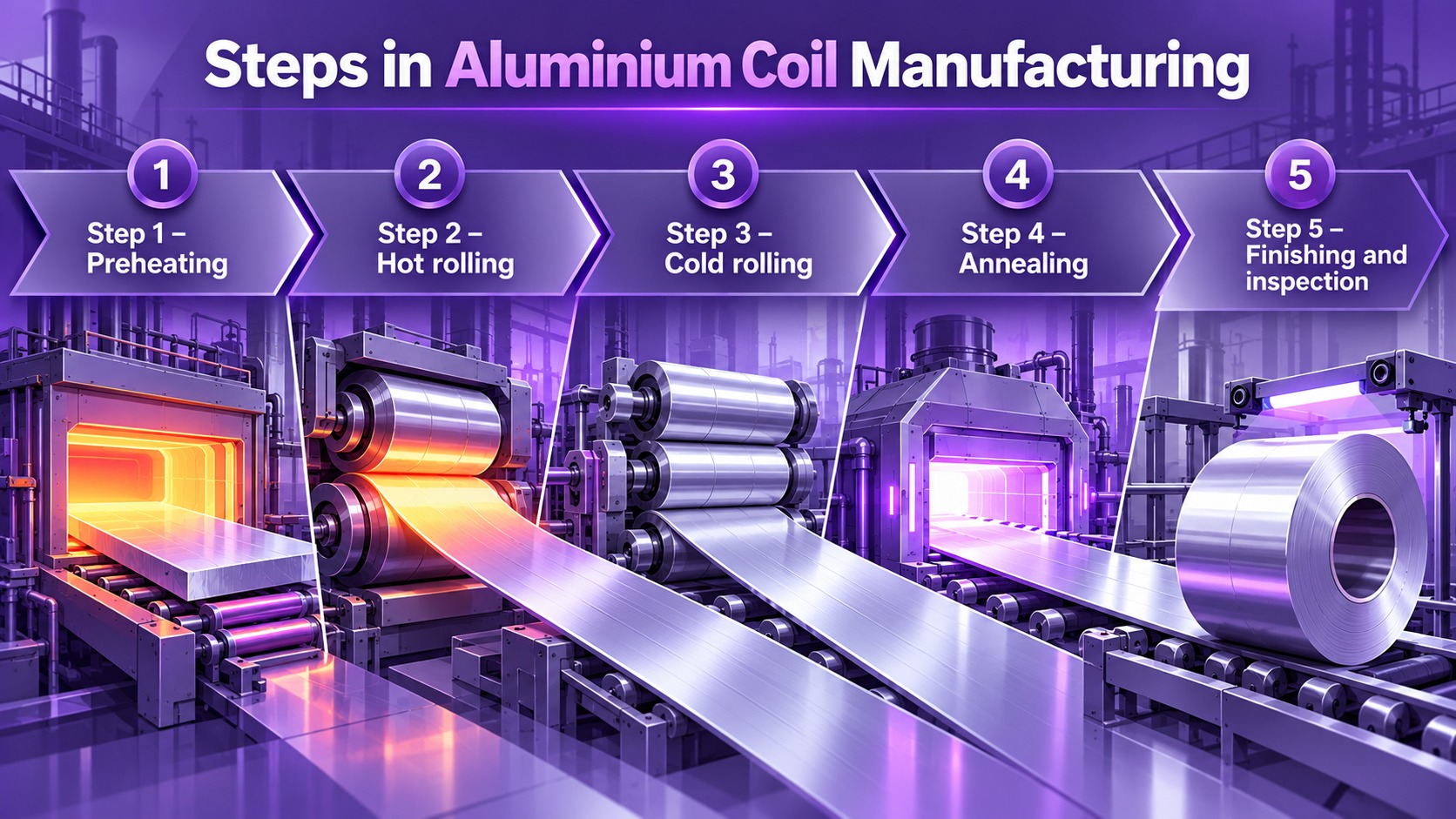
Aluminium coil manufacturers process aluminium slabs through a series of rolling and heat-treatment operations to achieve the required thickness, surface finish, and mechanical properties. The ends of the slabs are sawn off, and the surfaces are scalped to remove imperfections before rolling begins. The exact manufacturing process depends on the aluminium alloy, temper, and intended application.
Given below are the key steps in aluminium coil manufacturing:
Step 1 – Preheating: The scalped aluminium slab is placed inside a preheating furnace to reach the required temperature and prepare it for the hot rolling process.
Step 2 – Hot rolling: The heated aluminium slab passes through a hot rolling mill several times to reduce its thickness and form a long, thinner aluminium sheet. The sheet is then coiled for further processing.
Step 3 – Cold rolling: The hot-rolled aluminium coil undergoes cold rolling to achieve the required thickness, dimensional accuracy, and surface finish. Multiple rolling passes may be used, depending on the final product specifications.
Step 4 – Annealing: The cold-rolled aluminium coil may be sent to an annealing furnace to adjust its mechanical properties, such as softness, ductility, and formability, to meet customer requirements. Annealing is not required for every aluminium coil, as the process depends on the specified alloy and temper.
Step 5 – Finishing and inspection: The aluminium coil may undergo slitting, trimming, levelling, or surface treatment, depending on the application. Manufacturers inspect the finished coil to check its dimensions, surface quality, and compliance with the required specifications before dispatch.
What are the uses of aluminium coil?
Aluminium coils are used in various industries, mainly in manufacturing, construction, automotive, electronics, and packaging. Their lightweight construction, corrosion resistance, durability, and formability make them suitable for numerous industrial applications. Here are some of the key aluminium coil uses across different industries:
- Automotive industry: Aluminium coils are used to manufacture vehicle body panels, camper bodies, heat exchangers, and other automotive components. Their lightweight nature, formability, and corrosion resistance make them suitable for applications where weight reduction and durability are important.
- Modern building construction: Aluminium coils are widely used in modern architecture for roofing sheets, wall cladding, ceiling panels, gutters, and facade systems. Aluminium can be rolled, cut, and bent into different shapes, making it suitable for curved surfaces and geometric architectural designs.
- Electronic components: Aluminium coils are used to manufacture electrical enclosures, heat sinks, cable components, and other electronic and electrical products. Aluminium’s electrical and thermal conductivity, low weight, and corrosion resistance make it useful for these applications.
- Food containers and packaging: Aluminium coils are processed into foil, food containers, beverage can stock, and other packaging materials. Their formability and barrier properties help protect food from moisture, light, and external contaminants. Food-contact applications require aluminium products that meet the relevant safety and regulatory requirements.
- HVAC and refrigeration: Aluminium coils are used in heat exchangers, air-conditioning units, evaporators, and condenser fins. Their thermal conductivity and lightweight construction support efficient heat transfer.
- Industrial equipment: Manufacturers use aluminium coils to produce machine covers, enclosures, insulation facings, and fabricated components. The appropriate alloy and temper depend on the required strength, formability, and operating conditions.
- Transportation and logistics: Aluminium coils are used to manufacture components for trailers, commercial vehicles, and transport equipment. Their low weight helps reduce vehicle mass, while their corrosion resistance supports durability.
The choice of aluminium coil depends on its intended application, alloy grade, temper, thickness, surface finish, and required mechanical properties. Buyers should check these specifications before selecting an aluminium coil for industrial or commercial use.
What are the different grades of aluminium coils?
There are different aluminium coil grades depending on the aluminium alloy used in the rolling process. The aluminium coil price, required mechanical properties, and intended application determine which grade is suitable for a particular project.
Aluminium alloys are broadly classified into two categories: wrought aluminium alloys and cast aluminium alloys. Wrought alloys are mechanically processed into sheets, plates, and coils, while cast alloys are primarily shaped by pouring molten metal into moulds. Therefore, wrought aluminium alloys are the main grades used for manufacturing aluminium coils.
Wrought aluminium alloys are classified into eight main series, from 1xxx to 8xxx, based on their principal alloying elements. Each series contains individual grades with specific properties, such as strength, formability, corrosion resistance, and thermal conductivity.
Common aluminium coil grades and their properties
The following table summarises some commonly used aluminium grades and their typical applications.
| Aluminium grade | Main composition | Key properties | Common applications |
|---|---|---|---|
| 1100 aluminium | Minimum 99.0% aluminium | Excellent corrosion resistance, ductility, and thermal conductivity. | Chemical equipment, heat exchangers, fin stock, and nameplates. |
| 3003 aluminium | Aluminium with manganese as the principal alloying element | Good formability, corrosion resistance, and weldability. | Cooking utensils, roofing, cladding, and heat exchanger components. |
| 5052 aluminium | Aluminium with magnesium as the principal alloying element | Good corrosion resistance, particularly in marine environments, and good formability. | Fuel tanks, marine components, pressure vessels, and enclosures. |
| 6061 aluminium | Aluminium alloyed primarily with magnesium and silicon | Good strength, corrosion resistance, and machinability; heat-treatable. | Structural components, machinery parts, and fabricated products. |
| 8011 aluminium | Aluminium alloy with iron and silicon as principal alloying elements | Good formability and suitability for thin-gauge products. | Packaging foil, pharmaceutical foil, and household foil. |
The availability of each grade in coil form depends on the manufacturer, alloy specification, thickness, and temper. Buyers should verify these details before placing an order.
1100 aluminium
1100 aluminium is a commercially pure aluminium grade with a minimum aluminium content of 99.0%. It offers excellent workability, ductility, corrosion resistance, and thermal conductivity. However, it has relatively low strength compared with many alloyed aluminium grades and cannot be strengthened significantly through heat treatment.
The versatility of 1100 aluminium coil makes it suitable for demanding forming operations and applications requiring good thermal conductivity. Common uses include chemical equipment, heat exchanger fins, dials, nameplates, and certain fabricated components.
3003 aluminium
3003 aluminium is a widely used general-purpose aluminium-manganese alloy. Manganese improves its strength compared with commercially pure aluminium while retaining good formability and corrosion resistance. The alloy is also readily weldable and suitable for several sheet-metal fabrication processes.
3003 aluminium coil is commonly used in cooking utensils, pot lids, roofing sheets, cladding, and heat exchanger components. Its combination of workability, durability, and cost-effectiveness makes it suitable for general-purpose applications. The appropriate temper and thickness should be selected according to the required forming process and operating conditions.
5052 aluminium
5052 aluminium is a non-heat-treatable alloy containing magnesium as its principal alloying element. It offers good strength, formability, and corrosion resistance, particularly in marine and other demanding environments.
5052 aluminium coil is used in fuel tanks, marine equipment, pressure vessels, electrical enclosures, and fabricated industrial components. It is a suitable choice when an application requires better strength than commercially pure aluminium grades while retaining good corrosion resistance.
6061 aluminium
Often described as a versatile structural aluminium alloy, 6061 contains magnesium and silicon as its principal alloying elements. It offers good strength, corrosion resistance, and machinability. Unlike 1100, 3003, and 5052, 6061 aluminium is heat-treatable, allowing its mechanical properties to be adjusted through suitable heat treatment.
6061 aluminium is commonly used for structural components, machinery parts, and fabricated products. Although it can be supplied in certain sheet and coil forms, its suitability for bending, deep drawing, or stamping depends on the temper, thickness, and forming requirements.
8011 aluminium
8011 aluminium is commonly used in thin-gauge aluminium foil and packaging applications. Its composition and processing characteristics make it suitable for rolling into thin sheets and foil products.
8011 aluminium coil is used in pharmaceutical packaging, household foil, food packaging, and other applications where thin, formable aluminium material is required. Buyers should check the relevant product specifications and food-contact requirements for their intended use.
Aluminium coil vs steel coil
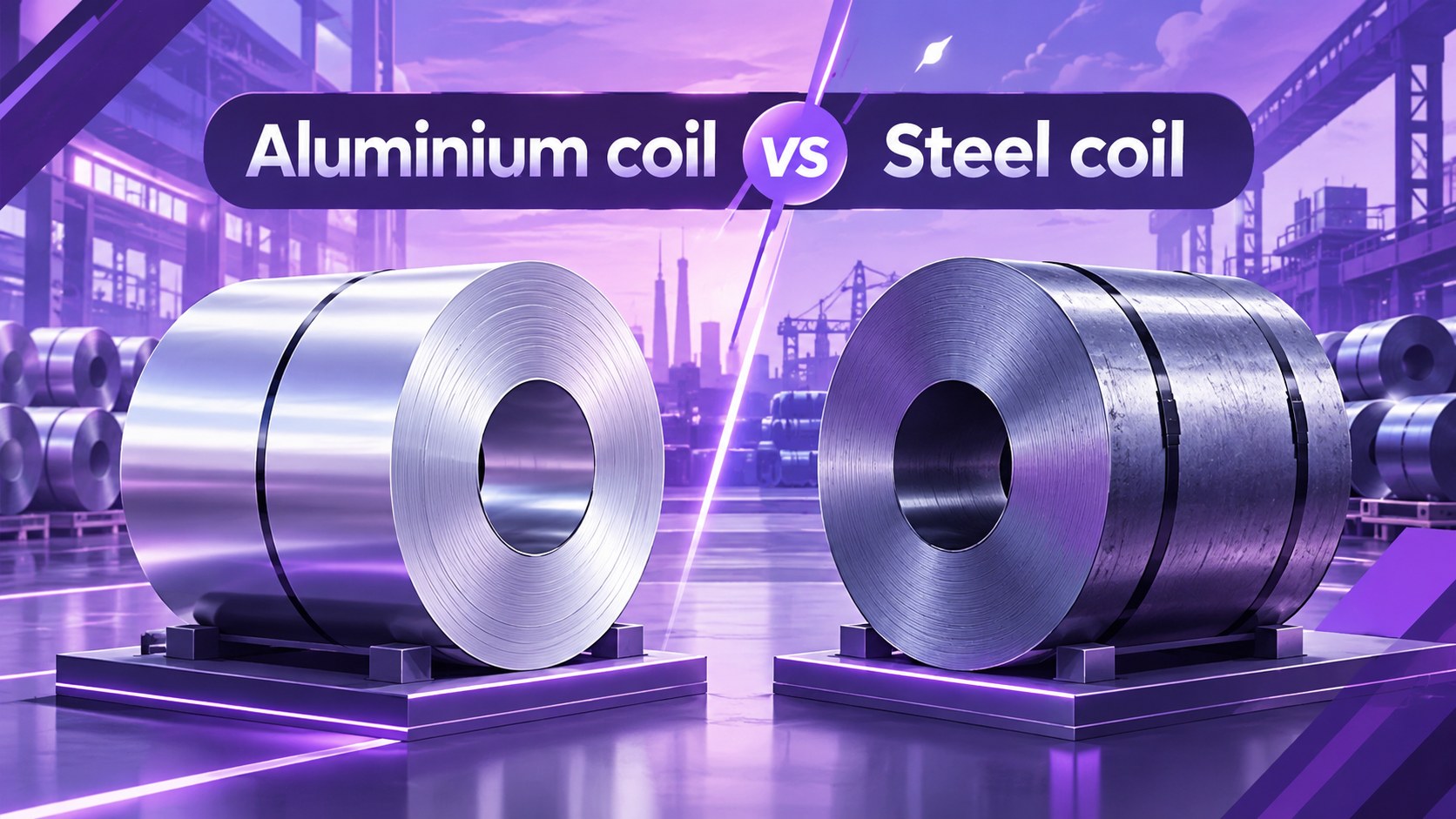
Aluminium coils are flat-rolled aluminium sheets wound into coils, while steel coils are made from flat-rolled steel. Both materials are available in different grades, thicknesses, widths, and surface finishes. Hot-rolled and cold-rolled steel coils are two common types available in the market.
Like aluminium coils, steel coils are used across industries to manufacture automotive parts, electrical components, construction materials, and industrial equipment. However, the two materials differ in weight, strength, corrosion resistance, and cost.
| Parameter | Aluminium coil | Steel coil |
|---|---|---|
| Weight | Lower density, making it lighter for the same volume. | Higher density |
| Strength | Varies by alloy and temper | Varies by steel grade and processing |
| Corrosion resistance | Naturally forms a protective oxide layer | Depends on the steel type, coating, and protective treatment. |
| Formability | Generally good, depending on the alloy and temper. | Depends on the grade and rolling condition |
| Thermal conductivity | Generally higher than that of ordinary carbon steel | Generally lower than that of aluminium |
| Cost considerations | Depends on alloy, thickness, finish, and market prices. | Depends on steel grade, thickness, finish, and market prices. |
| Common applications | Roofing, cladding, packaging, heat exchangers, and lightweight components. | Construction, automotive manufacturing, machinery, and industrial fabrication. |
The choice between aluminium coil and steel coil depends on the required strength, weight, corrosion resistance, fabrication process, and project budget.
Aluminised steel coil
An aluminised steel coil is a steel coil coated with aluminium or an aluminium-silicon alloy to improve its resistance to oxidation and corrosion under suitable operating conditions. It is different from an aluminium coil because steel forms the base material, while aluminium provides the protective coating.
Aluminised steel combines the structural strength of steel with the heat resistance and protective properties of an aluminium-based coating. However, the coating does not make the material completely immune to corrosion. Its performance depends on the coating type, thickness, operating environment, and exposure conditions.
Here are some key features of aluminised steel coils:
- Strength of steel: The steel substrate provides structural strength and rigidity.
- Oxidation and corrosion resistance: The aluminium-based coating helps protect the steel surface under suitable conditions.
- High-temperature performance: Certain aluminised steel products are suitable for applications involving elevated temperatures.
- Thermal properties: The coating and steel substrate influence heat transfer and thermal expansion.
- Formability: Aluminised steel can be cut, bent, folded, and corrugated, subject to the coating specifications and fabrication requirements.
Aluminised steel coils are commonly used in automotive exhaust systems, heating equipment, industrial ovens, and other applications requiring heat and oxidation resistance.
If you are looking for aluminium coil manufacturers in India, compare suppliers based on alloy grade, temper, thickness, width, surface finish, quality certifications, and delivery requirements. Request a technical datasheet and confirm that the material meets the specifications required for your application before placing an order.
Aluminium coil price in India (2026)
The aluminium coil price in India depends on the alloy grade, thickness, width, surface finish, order quantity, and supplier location. Prices also vary with aluminium market rates, processing costs, freight charges, and applicable taxes.
As of October 2026, supplier listings provide indicative prices for different aluminium coil products. However, these are asking prices rather than confirmed transaction rates. Buyers should request a current quotation based on their required specifications before placing an order.
Aluminium coil price per kg in India
The following table presents indicative supplier-listed prices available during October 2026. These prices are not a uniform market rate and may relate to different specifications and finishes.
| Aluminium coil type | Indicative price (₹/kg) | Price reference |
|---|---|---|
| General-purpose aluminium coil | ₹175–₹185 | Industrial-use supplier listing |
| Aluminium coil, 0.5–3 mm thick | ₹250–₹300 | Industrial coil listing |
| Polished aluminium coil | Around ₹280 | Supplier listing |
| Aluminium coil in continuous rolled form | ₹280–₹380 | Bulk supplier listing |
| Aluminium sheet coil, Grade 8011 | Around ₹415 | Supplier listing for a specific product |
*These are indicative online supplier listings as of October 2026 market averages. Specifications, minimum order quantities, taxes, and delivery terms differ between listings. Confirm the latest price directly with the supplier before purchasing.
Factors affecting aluminium coil prices
| Price factor | How it affects the aluminium coil rate |
|---|---|
| Aluminium grade | Different alloys, such as 1100, 3003, 5052, and 6061, have different material and processing requirements. |
| Thickness and width | Dimensions affect production, yield, and processing costs. Non-standard sizes may attract additional charges. |
| Surface finish | Mill-finish, polished, embossed, anodised, and colour-coated coils can have different prices because of additional processing. |
| Order quantity | Bulk purchases may qualify for negotiated rates, depending on the supplier’s minimum order quantity and production capacity. |
| Supplier location | Freight, handling, distance from the production facility, and local availability can affect the delivered price. |
| Market movements | Changes in aluminium benchmark prices, energy costs, and supply and demand can influence supplier quotations. |
| Taxes and delivery terms | GST, packaging, transport, and other charges affect the final landed cost. Check whether the quotation includes these expenses. |
How to get an accurate aluminium coil quotation
Before comparing aluminium coil suppliers, specify the required alloy grade, temper, thickness, width, finish, and order quantity. Ask suppliers to provide a written quotation that states the base price, GST, freight, delivery timeline, and any minimum order requirements.
Comparing quotations on the same specification and delivery basis will help you assess the actual aluminium coil price per kg and avoid comparing products that are not equivalent.
Also read: Aluminium Coil, Hot rolled steel coil, Colour coated steel coil, Stainless steel coil.
Conclusion
Aluminium coils are versatile materials that support manufacturing, construction, automotive, and packaging applications across India. Selecting the right product requires matching its specifications with operational requirements and long-term performance expectations.
For businesses sourcing aluminium coils in 2026, comparing supplier quotations, checking technical documentation, and assessing material quality can help improve procurement decisions. Buyers should also consider consistency of supply, customisation options, and delivery timelines when evaluating aluminium coil manufacturers. A specification-led purchasing approach helps businesses balance product performance, reliability, and overall sourcing costs.
Looking to procure steel?
Tata nexarc helps manufacturers, builders and MSMEs source certified steel products, compare prices, and choose the right grade as per IS codes—with complete traceability and procurement confidence.
FAQs
What is an aluminium coil?
What are the main uses of aluminium coils?
What are the common aluminium coil grades?
What is the aluminium coil price per kg in India?
What factors affect aluminium coil prices?
How is aluminium coil manufactured?
Which aluminium coil grade is best for industrial use?
What is the difference between aluminium coil and steel coil?
What is colour-coated aluminium coil?
How do you choose a reliable aluminium coil supplier?
Priyanka is a seasoned content marketing professional with more than 6 years of experience crafting various forms of business and technology sector content. Her insightful writing tackles critical issues faced by small-scale manufacturing businesses. Priyanka's clear and concise communication empowers businesses to make informed decisions and thrive in today's dynamic business environment.