Check Price Now
Table of Contents
- Rebar Coupler Meaning
- IS Code and Compliance Requirements
- Rebar Coupler vs. Lap Splice
- Rebar Coupler Types
- Rebar Coupler Installation Process
- Uses of Rebar Coupler
- Rebar Coupler Manufacturers in India
- Rebar Coupler Size Chart
- Rebar Coupler Price in India (2026)
- Advantages of Rebar Coupler
- Conclusion
- FAQs
A rebar coupler is a mechanical splice that connects two TMT bars without overlapping them. It makes a direct connection between steel and permits full load transmission in structures made of reinforced concrete. India’s infrastructure is growing quickly, and there is a greater need for reliable splicing systems in high-rise buildings, metro projects, bridges, and industrial operations.
Understanding rebar coupler price in India is important for contractors, manufacturers, and bulk steel buyers. Couplers often reduce overall steel use compared to lap splicing and are compatible with Fe500 and Fe550 grade TMT bars.
Rebar coupler meaning
A rebar coupler, also called a mechanical rebar splice, is a device used to connect two reinforcing bars to form a continuous load path. It replaces traditional lap splicing and transfers force directly from one bar to another through a threaded or mechanical sleeve. It is used to maintain structural continuity in reinforced concrete members such as columns, beams, slabs, bridges, and foundations.
Unlike lap joints, which rely on bond strength between steel and concrete over a development length, a coupler provides a direct steel-to-steel connection. This allows the joint to achieve full tension capacity, provided it is properly installed and tested.
IS code and compliance requirements for rebar couplers

Rebar couplers used for mechanical splicing in India must comply with structural design and performance standards. While IS 456:2000 governs reinforced concrete design, mechanical splice performance is evaluated under IS 16172, which specifies requirements for mechanical splices of reinforcing bars.
Under IS 16172, a full-strength rebar coupler must develop at least 125 percent of the specified yield strength of the parent bar. This ensures that during tensile testing, failure occurs in the bar and not in the splice. Elongation and slip limits are also tested to confirm joint reliability.
For seismic applications, especially in Zones IV and V, project specifications may require additional ductility verification and cyclic loading tests.
From a procurement perspective, contractors should request:
- Manufacturer test certificates
- Third-party laboratory test reports
- BIS or ISO quality documentation
- Batch traceability records
Selecting a code-compliant rebar coupler strengthens structural safety, improves approval from consultants, and reduces risk during project audits and inspections.
Rebar coupler vs. lap splice
Rebar couplers provide a direct steel-to-steel connection, while lap splices rely on bond strength between steel and concrete over a specified development length.
Couplers reduce reinforcement congestion, improve concrete compaction, and offer more predictable load transfer. Lap splicing increases steel consumption due to overlap length and may create crowding in heavily reinforced columns. Although couplers have a higher per-piece cost, they often lower total project steel usage and improve installation speed, especially in high-rise and infrastructure projects.
| Parameter | Rebar coupler | Lap splice |
| Load transfer | Direct steel connection | Through concrete bond |
| Steel usage | Lower overall | Higher due to overlap |
| Congestion | Reduced | Higher |
| Development length | Not required | Required (40-60d typical) |
| Quality control | Factory-controlled | Site-dependent |
Lap splicing increases reinforcement congestion and requires additional bar length. Couplers eliminate long overlaps and help improve concrete compaction.
Compliance and technical standards
In India, mechanical splices are generally designed in line with project specifications referencing IS 456:2000 and related structural codes. Mechanical splicing systems are covered under performance-based requirements such as those referenced in IS 16172. Most full-strength couplers are designed to achieve at least 125% of the specified yield strength of the parent bar. This ensures that failure, if any, occurs in the bar and not in the splice.
For contractors and consultants, selecting a certified coupler system ensures structural safety, reduced material wastage, and consistent performance across projects.
Rebar coupler types
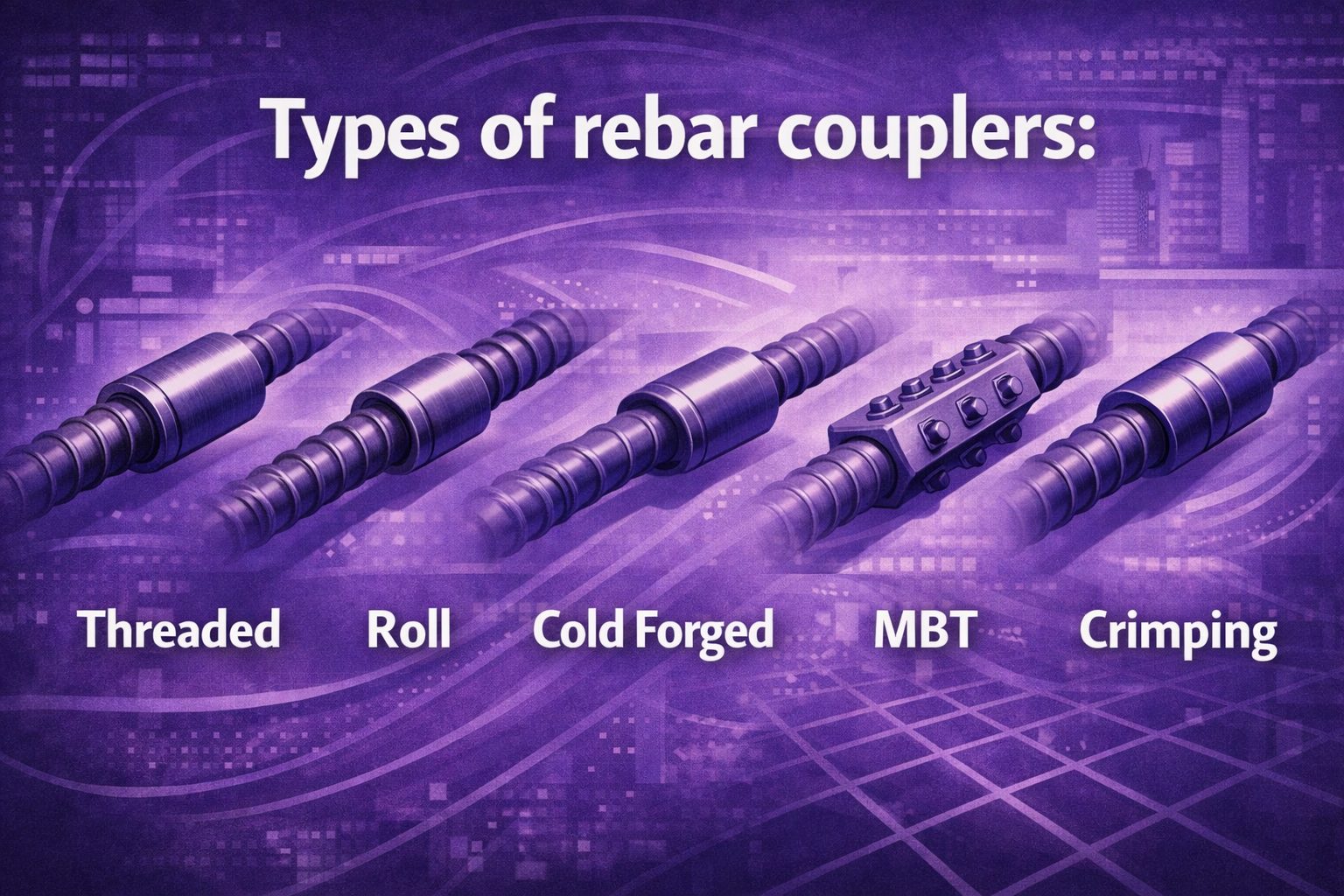
Rebar couplers are broadly divided into threaded and non-threaded systems. The choice depends on structural demand, site conditions, and budget.
Threaded rebar coupler
A threaded rebar coupler connects two bars using machine-cut or roll-formed threads at the bar ends. This is the most widely used system in India because it offers reliable performance and easier inspection. It is preferred in high-rise buildings, metro pillars, and heavily loaded columns where full strength continuity is required.
Roll thread coupler
In this method, threads are formed on the bar without reducing the core diameter. The coupler is then screwed onto both ends. Roll threading is cost-effective and suitable for most residential and commercial projects. It offers good strength and consistent alignment and is commonly used with Fe500 and Fe550 TMT bar grades.
Cold forged coupler
A cold forged coupler involves forging the bar end under hydraulic pressure before threading. This increases the bar-end diameter and improves thread engagement. Cold forged systems typically provide higher performance than basic roll-thread systems. They are preferred in high-rise columns, bridge piers, and seismic structures. The cost is slightly higher due to additional processing.
MBT (Mechanical Bolted Type) coupler
MBT couplers do not require threading. Bars are inserted into a sleeve and tightened using multiple bolts. They are suitable for retrofitting works, repair projects, and sites where threading machines cannot be used. MBT coupler price is generally higher than standard threaded systems because of the sleeve and bolt assembly.
Crimping coupler
Crimping couplers use hydraulic compression to lock bars inside a sleeve. These are less common today but may still be used in specific infrastructure projects.
Strength and cost comparison
Roll thread systems are economical and suitable for most structures. Cold forged systems offer higher strength and are better for critical load areas. MBT systems provide installation flexibility but at a higher cost. The correct type should be selected based on structural design, project scale, and budget.
Rebar coupler installation process
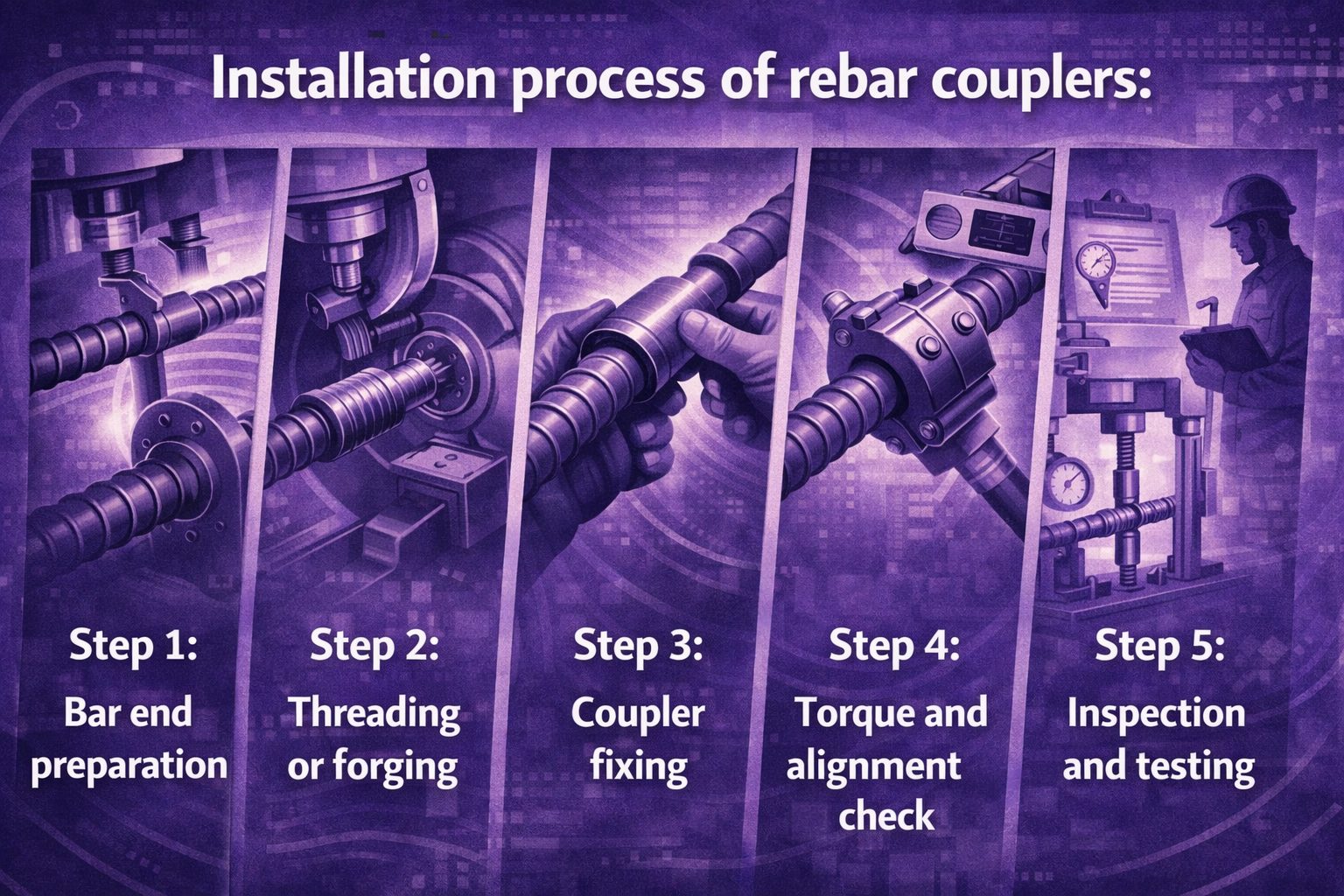
The rebar coupler installation process must follow manufacturer guidelines to ensure full strength performance. Proper installation is critical to achieving the required tensile capacity under IS-compliant testing.
Step 1: Bar end preparation
Cut the TMT bar end square using a bar cutting machine. The face must be clean and free from rust, oil, or damage.
Step 2: Threading or forging
For threaded systems, the bar end is processed using a roll threading or cold forging machine. Threads must match the coupler’s internal profile exactly. Dimensional checks are carried out to confirm accuracy.
Step 3: Coupler fixing
Screw the rebar coupler onto the first bar until it reaches the centre stop. Insert the second bar and tighten manually or with a pipe wrench, as specified.
Step 4: Torque and alignment check
Ensure proper axial alignment of both bars. Some projects require torque verification as per site quality control procedures.
Step 5: Inspection and testing
Random samples are tested for tensile strength. The joint should achieve at least 125 percent of the bar’s yield strength, with failure occurring in the parent bar.
Compared to lap splicing, mechanical installation is faster and reduces reinforcement congestion, improving productivity and inspection control on site.
Uses of rebar coupler
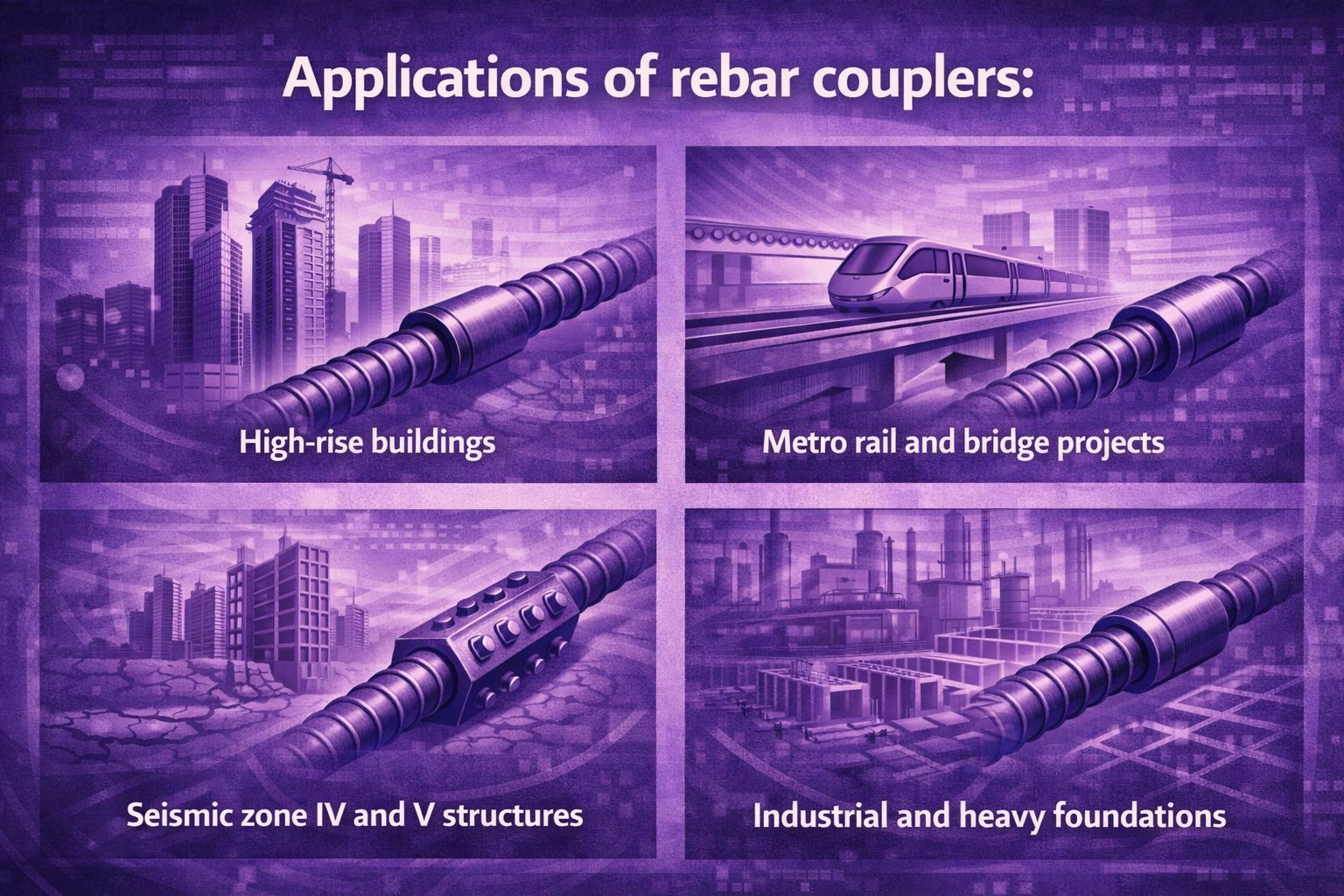
The primary applications of rebar coupler systems are in reinforced concrete structures where continuity, strength, and space efficiency are critical. They are used to join reinforcing bars while maintaining full tension and compression capacity.
High-rise buildings
Rebar couplers are widely used in high-rise residential and commercial towers. In structural cores and vertical columns, reinforcement density is high. Couplers reduce congestion and eliminate long lap lengths, improving concrete flow and compaction quality.
Metro rail and bridge projects
In large infrastructure projects such as metro rail corridors, flyovers, and bridges, mechanical splicing ensures consistent load transfer across long structural members. These projects often demand strict quality control and faster construction cycles, making couplers a preferred option.
Seismic zone IV and V structures
In seismic zone IV and V regions, structural performance is critical. Properly designed mechanical splices help maintain bar continuity and improve ductility under dynamic loading. When installed as per specification, they support reliable performance during earthquake-induced stresses.
Industrial and heavy foundations
Power plants, factories, dams, and heavy machine foundations use couplers to manage large bar diameters and high load demands. They simplify reinforcement detailing in thick raft slabs and pile caps.
Productivity and material efficiency
Using couplers reduces the need for long overlap lengths, which can lower overall steel consumption by approximately 8-15 percent, depending on design. Contractors also benefit from reduced labour time and faster bar fixing, improving overall site productivity.
For engineers and project managers, selecting the right mechanical splice system improves structural safety, material optimisation, and construction efficiency across diverse project types.
Rebar coupler manufacturers in India
The top rebar coupler manufacturers in India supply threaded and mechanical splice systems for residential, commercial, and infrastructure projects. Manufacturing hubs are concentrated in Gujarat, Mumbai, Delhi NCR, and Kolkata, serving both domestic and export markets.
| Company | Location | Business type | Export markets | Notes |
| Griptech Rebar Couplers | India | Manufacturer | Middle East, Africa. | Known for infrastructure and high-rise project supply. |
| Technofix Rebar Couplers | India | Manufacturer | Domestic & selective exports. | Supplies engineered mechanical splice systems. |
| Vruddhi Engineering Works Limited | Gujarat | Manufacturer & Supplier | Domestic & regional. | ISO 9001 certified; IS 16172 compliant systems. |
| Radhe Industries | Rajkot, Gujarat. | Manufacturer & Supplier | Domestic | Threaded and reducer couplers. |
| PVH Engineering | Ahmedabad, Gujarat. | Manufacturer & Exporter | Yes | Wide coupler range with export capability. |
| SNTP Technologies | India | Manufacturer | Domestic | BIS ISI marked couplers; high tensile performance. |
| Scintilla Advanced Materials | India | Manufacturer | Domestic | Supplies IS-compliant mechanical splice systems. |
| Surya Engineering/ Surya Splicing | Mumbai, Maharashtra | Manufacturer & Supplier | Domestic | Regional threaded coupler supplier. |
| Prime Steeltech (I) Pvt. Ltd. | Maharashtra | Manufacturer & Supplier | Domestic | Active western India supplier. |
| Premier Galvanizers | Maharashtra | Supplier | Domestic | Regional stockist and distributor. |
Many Indian manufacturers export mechanical splice systems to the Middle East and African markets due to competitive pricing and improved quality control standards.
OEM vs. trader
| Parameter | OEM manufacturer | Trader/dealer |
| Production control | In-house | Outsourced |
| Custom sizes | Possible | Limited |
| Quality traceability | Higher | Depends on source |
| Bulk pricing | Better margins | Moderate |
For large infrastructure projects, working directly with an OEM ensures better quality consistency and technical support.
Buyer checklist
Before selecting a supplier, check:
- BIS or relevant project compliance documentation
- ISO-certified manufacturing process
- Tensile test reports meeting 125 percent yield criteria
- Production capacity for bulk orders
- Availability of installation support and technical guidance
Production capacity and consistent quality control are critical for high-rise and infrastructure projects where supply delays can affect construction timelines.
Rebar coupler size chart
Rebar couplers are manufactured to match the nominal diameter and grade of the parent TMT bar. Sizes generally range from 12 mm to 40 mm for standard building projects, with larger diameters available for heavy infrastructure works.
Always verify the exact dimensions with the manufacturer before procurement. If you are checking a 12mm rebar coupler price, ensure the thread specification matches the bar grade.
Standard threaded rebar coupler dimensions (Indicative – 2026)
| Bar diameter (mm) | Typical coupler length (mm) | Outer diameter (mm) | Approx. weight (grams) | Standard thread pitch (mm) | Compatible bar grades |
| 12 | 35–40 | 20–22 | 60–75 | 2.0–2.5 | Fe500/Fe550 |
| 16 | 40–45 | 24–26 | 90–110 | 2.5 | Fe500/Fe550 |
| 20 | 48–52 | 30–32 | 150–180 | 2.5 | Fe500/Fe550 |
| 25 | 60–65 | 38–40 | 320–360 | 3.0 | Fe500/Fe550 |
| 28 | 65–70 | 42–44 | 430–480 | 3.0 | Fe500/Fe550 |
| 32 | 72–78 | 48–50 | 600–680 | 3.0 | Fe500/Fe550 |
| 36 | 80–85 | 52–55 | 850–950 | 3.0 | Fe500/Fe550 |
| 40 | 90–100 | 58–60 | 1100–1250 | 3.0 | Fe500/Fe550 |
Important technical notes
Strength requirement: Mechanical splices are typically designed to achieve at least 125 percent of the specified yield strength of the parent bar. This ensures failure occurs in the bar and not in the coupler.
Thread tolerance: Threads are precision machined. Manufacturing tolerance is usually within ±0.1 mm, depending on the producer and quality control system.
Larger diameters: Couplers of 50 mm and above are available for heavy infrastructure projects such as bridges, dams, metro corridors, and large industrial foundations.
Custom sizes: Reducer couplers and transition sizes can be supplied on request where two different bar diameters need to be connected.
Grade matching: The coupler size, thread profile, and internal machining must match the exact bar diameter and grade, such as Fe500 or Fe550, to ensure proper load transfer and structural safety.
Rebar coupler price in India (2026)
Rebar coupler price in India depends on bar diameter, manufacturing process, raw material cost, and order volume. Buyers often search for rebar coupler price per piece, mechanical splice price, or threaded coupler price India when estimating project budgets.
Indicative rebar coupler price per piece
| Bar diameter (mm) | Approx. price range (₹/piece) | Typical application |
| 12 | ₹22–30 | Residential slabs and beams |
| 16 | ₹38–48 | Columns and mid-rise buildings |
| 20 | ₹55–70 | Commercial structures |
| 25 | ₹75–95 | High-rise columns |
| 32 | ₹110–140 | Infrastructure and heavy load areas |
| 40 | ₹170–220 | Bridges and industrial foundations |
Prices may vary across regions such as Mumbai, Gujarat, and Delhi NCR due to logistics and supplier concentration.
Cost factors in 2026
- Steel price fluctuations directly affect coupler rates, as most are manufactured from alloy or carbon steel.
- Cold forged systems cost more than roll-thread couplers.
- MBT couplers are typically priced higher due to bolt assemblies.
Coupler vs. lap splice cost comparison
At first glance, mechanical splice price appears higher than lap splicing. However, lap joints require additional steel length, increasing total consumption. In many high-rise projects, couplers reduce overall steel usage by 8–15 percent, which can offset the higher per-piece cost.
Bulk orders and GST
Large infrastructure projects often receive bulk discounts of 5–12 percent depending on quantity and supplier capacity. Prices quoted by manufacturers are generally exclusive of GST, which is applicable as per prevailing tax rates.
For accurate procurement planning, buyers should request batch test certificates and confirm final landed cost, including transport and taxes, before placing bulk orders.
Rebar coupler cost analysis and regional price trends (2026)
In a typical high-rise project using 10,000 joints of 20 mm bars, lap splicing may require an additional 800–1,000 kg of steel due to development length. At ₹60–70 per kg, that adds ₹48,000–70,000 in steel cost alone. In comparison, using couplers at ₹55–70 per piece may appear expensive upfront, but total material optimisation often offsets the difference.
Per kg vs. per piece: Couplers are sold per piece, while lap splice cost is calculated per kg of extra steel.
12 mm rebar coupler price: Typically ₹22–30 per piece in March 2026.
State variation: Mumbai prices may be 3–5% higher than Gujarat; Delhi NCR remains competitive due to supplier density.
Import vs. domestic: Imported couplers can cost 15–25% more due to logistics and certification premiums.
Advantages of rebar coupler

Understanding the advantages of mechanical splice systems helps contractors and consultants make better design and procurement decisions. Compared to traditional lap splicing, rebar couplers offer structural, commercial, and operational benefits.
Full strength performance
A properly installed coupler is designed to achieve full tension capacity. The load transfers directly from one bar to another, reducing dependence on concrete bond strength. This improves reliability in critical structural members.
Reduced reinforcement congestion
Unlike lap splice joints, couplers eliminate long overlap lengths. This reduces steel crowding in columns and beams, improving concrete flow and compaction. Better compaction enhances structural integrity and finish quality.
Lower steel consumption
Lap splicing requires additional development length, which increases total steel usage. Couplers can reduce overall reinforcement consumption by 8–15 percent in large projects. This directly improves material efficiency.
Lifecycle cost benefit
Although the initial mechanical splice price may appear higher, savings in steel quantity and labour can improve overall project economics. Reduced rework and faster installation also support better return on investment for contractors.
Improved site safety and quality control
Mechanical splices are factory manufactured and easier to inspect than site-dependent lap joints. Fewer overlapping bars reduce handling complexity, lowering the risk of placement errors.
Environmental and durability benefits
Using less steel lowers embodied carbon, contributing to reduced project carbon footprint. A well-installed coupler system also provides consistent long-term performance, supporting structural durability over the building lifecycle.
Conclusion
Rebar couplers are now a standard solution in modern reinforced concrete construction. Understanding rebar coupler price in India, technical performance, and correct selection criteria is essential for cost control and structural safety. Compared to lap splicing, mechanical systems offer better strength consistency and material efficiency.
As infrastructure growth continues in 2026 and beyond, demand for certified systems will increase. Contractors and bulk buyers should choose certified rebar coupler manufacturers who provide test reports, quality assurance, and technical support for long-term project reliability.
Looking to procure steel?
Tata nexarc helps manufacturers, builders and MSMEs source certified steel products, compare prices, and choose the right grade as per IS codes—with complete traceability and procurement confidence.
FAQs
What is a rebar coupler?
What is a rebar coupler used for?
How is a rebar coupler different from a lap splice?
What is the rebar coupler price per piece in 2026?
What is the 12 mm rebar coupler price?
Are rebar couplers compatible with Fe500 and Fe550 bars?
Which IS code applies to rebar couplers?
Do rebar couplers require special installation equipment?
Can rebar couplers be used in seismic zones?
Do couplers reduce overall steel consumption?
Charul is a content marketing professional and seasoned content writer who loves writing on various topics with 3 years of experience. At Tata nexarc, it has been 2 years since she is helping business to understand jargon better and deeper to make strategical decisions. While not writing, she loves listing pop music.