Check Price Now
Table of Contents
- Why PEB Building Cost Feels Confusing in India
- What PEB Building Cost Actually Includes—and What It Doesn’t
- Key Cost Drivers That Change Your ₹/sq ft
- A Scope-First Cost Breakup MSMEs Can Use to Budget Confidently
- A Practical Checklist to Compare PEB Vendor Quotes
- PEB Building Cost in India per sq ft (December 2025)
- Approvals and Compliance Factors That Influence Cost and Timelines
- How Contracting Structure and Price Volatility Affect Final Cost
- Conclusion: How MSMEs Can Plan PEB Costs with Clarity
- FAQs
Introduction: Why “PEB cost” feels confusing in India
PEB building cost estimation in India rarely comes as one clean number. One vendor quotes ₹/sq ft, another quotes a total value, and a third quotes steel weight in kg per sq ft. Each format hides different assumptions. The same shed can look cheaper or costlier, just because the unit changed.
Scope gaps create the real budget shocks for MSMEs
A quote may cover the steel structure and sheeting, but exclude what makes the site usable. Civil and foundations, flooring, MEP, and fire safety often sit outside the base scope. Approvals can also add time and spend, especially when drawings and submissions move slowly. This is where “low cost” projects start bleeding.
Quick reality checks before trusting any ₹/sq ft number
- Ask what the ₹/sq ft covers, steel only, shed-ready, or fully operational facility.
- Confirm erection scope, crane, safety, bolts, grouting, and site access needs.
- Check roofing and cladding specs, sheet thickness, coating, insulation, and accessories.
- Separate civil and flooring, treat them as a different budget bucket.
- Lock what counts as “included” in writing, before negotiation starts.

What this guide helps MSMEs do
This guide breaks the pre engineered building cost into practical buckets. It shows how to compare quotations without confusion. It also helps fix scope early, so cashflow stays predictable and approvals do not derail the plan.
What “PEB building cost” actually includes, and what it does not
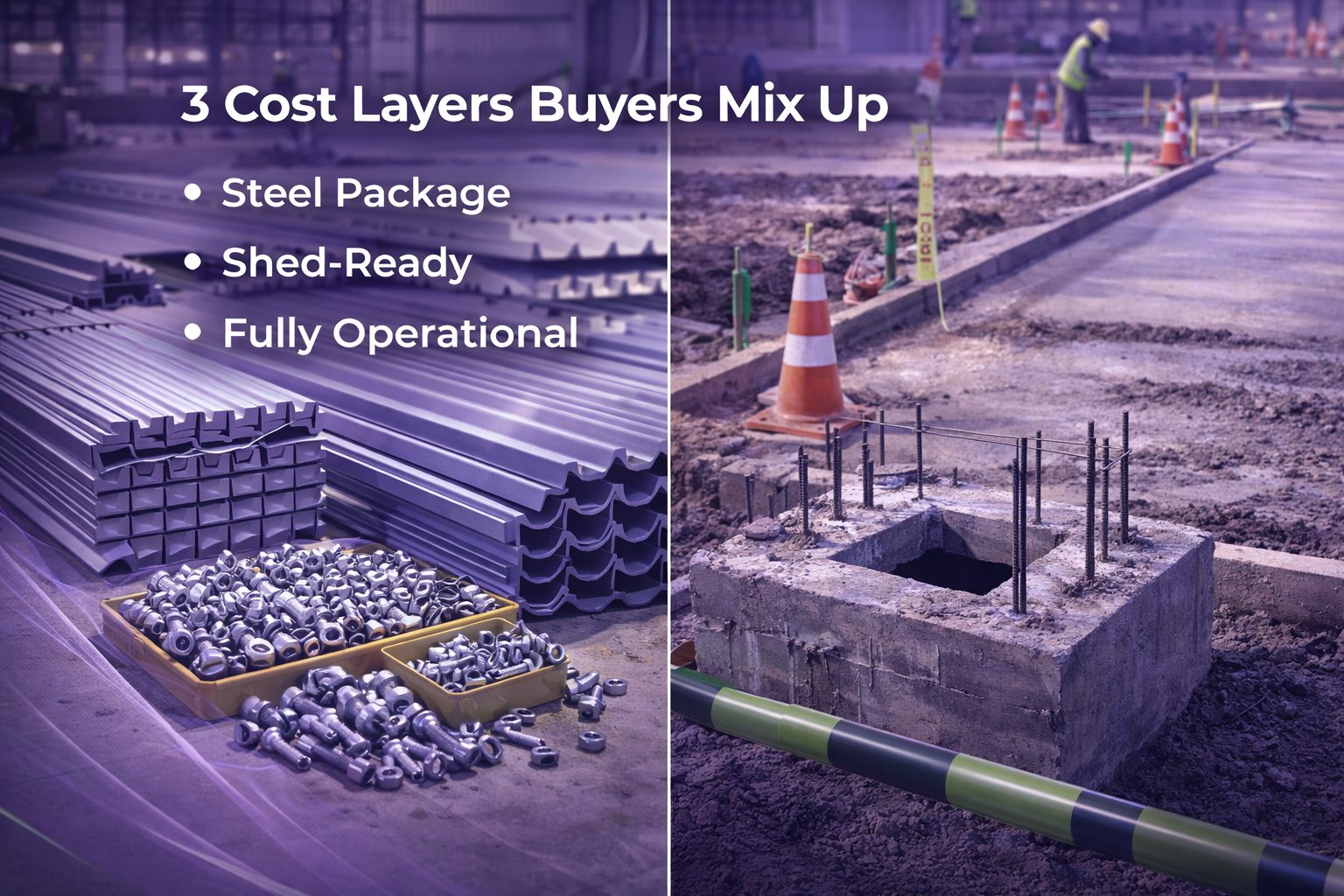
PEB building cost in India usually gets quoted in three layers, but most discussions mix them. That is why two vendors can both be “right” and still sound far apart. Clarity starts by naming the layer before looking at the number.
Layer 1, Steel package cost
This is a structure-led price, usually covering primary framing, secondary members (purlins and girts), and fasteners. Paint systems and basic accessories may be included based on scope, while erection is typically excluded.
Layer 2, Shed-ready cost
This is where roofing and wall cladding enter. Roof sheeting cost, wall cladding cost, gutters and downpipes, ridge ventilator or turbo ventilator, and skylight sheet cost may be added here. Many vendors also add peb erection cost in this layer, but the scope varies, so it needs checking line by line.
Layer 3, Fully operational facility cost
This is what most MSMEs actually need. It adds civil work cost for peb shed, foundation cost for peb building, flooring cost for warehouse or VDF flooring cost, basic utilities, and compliance-driven items. This layer is closer to a real project budget, not just a shed price.
What is commonly included in a “PEB quote”
Most mid-market quotations bundle the steel structure cost and building skin, then present a ₹/sq ft number. It looks clean, but it is not complete unless the scope sheet is complete. Many vendors keep some line items flexible to protect themselves against site and execution risks.
Typical inclusions to expect in writing
- Primary framing, columns and rafters, bracing cost, connection plates
- Secondary members purlins and girts, sag rods, flange braces
- Roof and wall sheeting, trims, flashing, ridge pieces
- Fasteners, sealants, and basic accessories
- Paint system cost, sometimes epoxy painting cost for steel structure as an upgrade
- Basic erection charges for peb shed, if explicitly mentioned with methodology
What is often excluded, and later billed as an “extra”
This is the part that creates budget fights. The quotation may be honest, but the buyer assumed a wider scope. For MSMEs evaluating vendors, exclusions matter more than the base rate.
Quick exclusions checklist to surface early
- Anchor bolt cost, grouting, and template setting
- Civil works, excavation, PCC, RCC pedestals, plinth beam cost
- Flooring, hardener, VDF flooring, drainage, internal roads
- Electrical and lighting, earthing, panel rooms, basic utilities
- Fire safety system cost for warehouse and fire NOC readiness items
- Transportation and unloading, crane availability, storage at site
- Mezzanine floor cost in peb, crane runway beam cost, EOT crane shed cost
- Insulation cost for peb shed, sandwich panel cost, and vapor barriers
The single question that prevents most confusion
Ask the vendor to label the quote clearly as steel-only, shed-ready, or fully operational. Then insist on a one-page scope matrix. This simple step makes peb cost per sq ft India comparable across vendors and reduces change orders during execution.
Cost drivers that change your ₹/sq ft, with real-world examples
PEB building cost in India changes mainly due to steel weight, design loads, and execution conditions. A small change in specs can move the final budget more than a
Geometry changes steel weight, and steel weight drives cost
Steel weight per sq ft rises when span increases, when eave height goes up, or when bay spacing changes. Vendors often quote a clean ₹/sq ft number early, then the kg per sq ft in PEB shifts after design finalisation. That change flows directly into steel structure cost and fabrication and erection cost.
Example seen in MSME projects
A 30 m clear span shed with higher eave height usually needs heavier primary framing than a 20 m span shed of similar area. The built-up area looks similar, but the member sizes and bracing change, so the pre engineered building cost per sq ft rises.
Loads and location add hidden cost through design
Wind load design cost and seismic load design cost rarely appear as separate line items. They show up in heavier sections, more bracing, and stronger connections. Coastal sites also push corrosion protection choices, which affects paint system cost and material life.
What to confirm in the design basis
- Wind zone and exposure category used
- Seismic zone assumptions and bracing layout
- Corrosion approach for coastal or industrial belts
- Site access for trailers, crane placement, and safe unloading
Roofing, cladding, and insulation change both capex and comfort
Roof sheeting cost and wall cladding cost move the ₹/sq ft quickly. Thicker sheets and better coatings cost more, but reduce leakage risk and maintenance. Insulation cost for PEB shed or sandwich panel cost can lift the budget, but it also improves working conditions and lowers HVAC load in many factories.
Common trade-offs
- Basic sheeting for storage, lower cost, higher heat and condensation
- Insulated roof for production, higher cost, smoother operations
- Ridge ventilator or turbo ventilator for airflow, needs correct detailing
Erection realities often decide the final bill
Execution conditions can change the peb erection cost even when the rate stays the same. Tight plots increase handling time. Poor approach roads delay unloading. Monsoon days reduce productive erection hours. These issues convert into extra crane shifts, labour days, and rework.
Checklist when a quote says “erection included”
- Confirm if crane hire is included or excluded
- Confirm unloading, shifting, and storage responsibility
- Confirm safety gear, scaffolding, and working platform assumptions
Add-ons that should be priced early
Some features look optional, but they often become necessary later. Pricing them early reduces change orders and avoids delays.
- Mezzanine floor cost in PEB, load rating and decking scope
- Crane runway beam cost and EOT crane shed cost, column and bracing upgrades
- Skylight sheet cost, gutters and downpipes cost, accessory scope
A scope-first cost breakup MSMEs can use to budget confidently
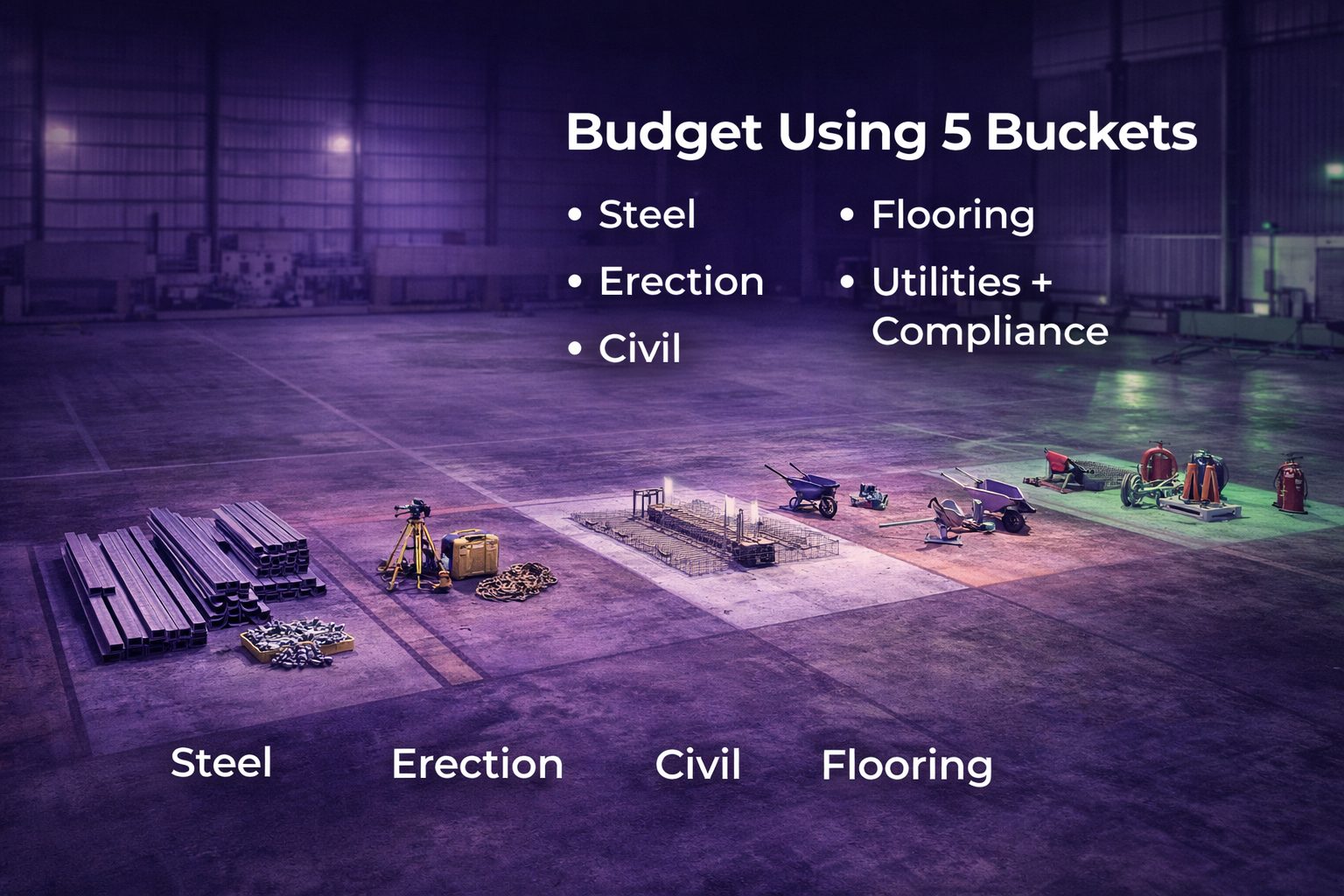
A realistic PEB building cost in India becomes easier to control when each cost bucket is separated. This approach also makes vendor quotations comparable, because steel, civil, flooring, and compliance do not get mixed into one vague ₹/sq ft number.
Steel structure and building shell
This bucket covers steel structure cost plus the building skin. It typically includes primary framing cost, secondary members purlins and girts cost, bracing, fasteners, roof sheeting cost, and wall cladding cost. Paint system cost also sits here, unless the quote is steel supply only.
What to ask vendors to show in this bucket
- Steel weight per sq ft PEB and total steel tonnage
- Section list for primary and secondary members
- Sheeting specs, thickness, coating, and accessories
- Scope for gutters, downpipes, ridge pieces, trims, and sealants
Erection and execution costs
Erection charges for PEB shed should be treated as a separate bucket, even if the vendor bundles it. Site realities change erection outcomes, so this needs clear inclusions. If the quote is turnkey PEB solutions cost, this bucket still needs definition.
Typical items that belong here
- PEB erection cost with methodology, shifts, and duration
- Crane and lifting plan, who provides crane and when
- Unloading, shifting, storage, and safety provisions
- Bolting, alignment, grouting scope, and handover checks
Civil and foundations
Foundation cost for PEB building and civil work cost for PEB shed often surprises first-time buyers. Soil conditions, plinth height, drainage needs, and local contractor rates can change this bucket a lot. Keeping it separate reduces disputes with the PEB vendor.
Core civil elements that affect cost
- Excavation, PCC, RCC pedestals, and plinth beam cost
- Anchor bolt setting, templates, base plate grouting
- Plinth wall, backfilling, and apron work
- Rainwater drainage and site slope corrections
Flooring and yard development
For warehouses and factories, flooring often matches or exceeds the steel package in impact. Flooring cost for warehouse depends on load class, traffic, and usage. VDF flooring cost rises with higher forklift cycles and heavier point loads.
Common flooring and yard line items
- Plain concrete, hardener flooring, VDF flooring based on use
- Joint cutting, curing method, and flatness requirement
- Internal roads, turning radius, and approach for trucks
- Storm water drains and loading area strengthening
Utilities and compliance readiness
This bucket is the silent budget killer when ignored early. Fire safety system cost for warehouse, documentation, and approvals influence timeline and cost. Even when vendors do not execute these items, the project cannot operate without them.
What to budget separately
- Fire NOC readiness items and basic fire systems as required
- Electrical, lighting, earthing, and panel rooms
- Ventilation and daylight choices, ridge ventilator, skylights
- Building plan approval cost and statutory approvals for industrial shed
A simple MSME budgeting method that avoids shocks
Use a three-number budget, not one number. Keep a base cost, a realistic cost, and a contingency buffer. This helps when design changes, site work slows down, or steel prices move during procurement.
- Base: steel package plus basic shed-ready scope
- Realistic: add civil, flooring, utilities, and compliance needs
- Buffer: keep a contingency for site issues and execution delays
Vendor quote comparison checklist, how to avoid the “cheap quote” trap
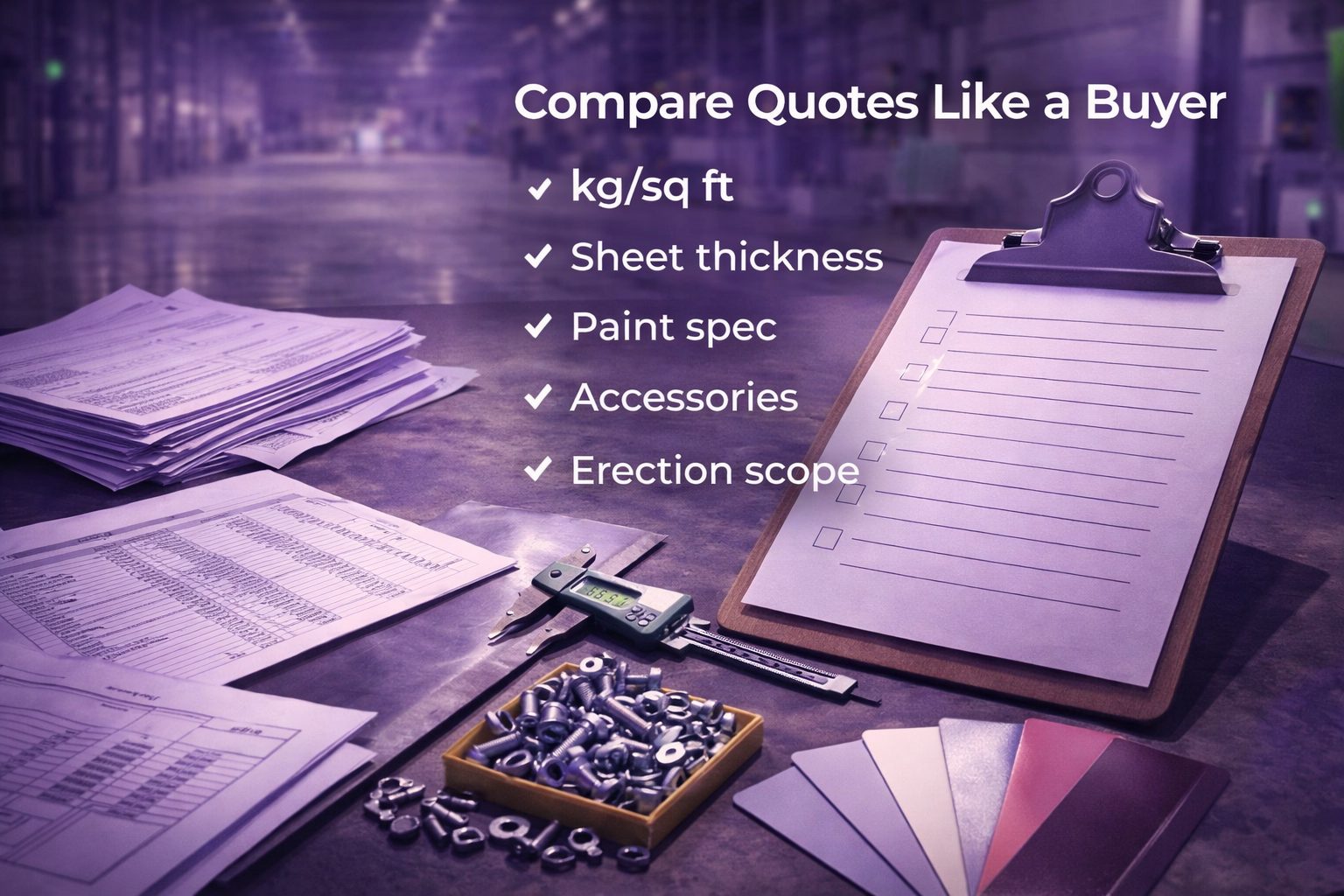
A low ₹/sq ft quote looks attractive, but it can hide scope cuts. For MSMEs, the safest way to compare vendors is to compare specifications and inclusions, not just the headline price.
Step 1: Make quotes comparable before negotiating
Start by forcing the same input for every vendor. Share one brief scope note with the same span, length, eave height, bay spacing, and intended use. Ask every vendor to quote on that, with a clear inclusions list. This reduces the “cheap quote” trick where one vendor assumes a lighter spec.
Quick RFQ inputs that must stay fixed
- Clear span, length, eave height, and bay spacing
- Use case, warehouse, fabrication, or production
- Openings, shutters, skylights, ventilators, and canopies
- Insulation requirement, if any, and preferred cladding type
Step 2: Compare the steel weight and section list
Steel weight per sq ft PEB is one of the strongest indicators of what is being delivered. If two quotes differ sharply in kg per sq ft in PEB, the cheaper quote may be lighter on steel, bracing, or connections. Ask for a section list, not only a total weight.
What to check in the steel package
- Primary framing member sizes and steel grade
- Secondary members purlins and girts, gauge and finish
- Bracing layout and connection philosophy
- Paint system cost, coating type, DFT, and surface prep
Step 3: Compare the building skin and accessories
Roof sheeting cost and wall cladding cost vary because sheet thickness and coating vary. Accessories also add up. Many disputes start at gutters, trims, sealants, and flashing, because they are assumed, not listed.
Building skin checks that prevent leakage and rework
- Sheet thickness, coating type, and warranty terms
- Ridge, flashing, corner trims, and sealant scope
- Gutters and downpipes cost, layout, and discharge points
- Skylight sheet cost, percentage, and placement
Step 4: Confirm what “erection included” really means
PEB erection cost depends on what is included. Some vendors include labour but not cranes. Some cover structural erection but leave out sheeting. Others exclude unloading and site shifting.
Erection scope checklist
- Crane hire included or excluded, number of shifts assumed
- Unloading, shifting, and storage responsibility
- Bolting, alignment, grouting, and touch-up painting
- Safety provisions, scaffolding, working platforms
Step 5: Price common add-ons separately, before award
Mezzanine floor cost in PEB, crane runway beam cost, and EOT crane shed cost change the whole structure design. If these are “future scope,” the vendor may underquote now and revise later. Price them early, even if they are optional.
- Mezzanine, decking, stairs, and load rating
- Crane runway beams, brackets, and column upgrades
- Insulation upgrades, sandwich panels, and vapor barriers
The red flags that usually signal a cheap quote trap
These signals show up often in PEB vendor quotation comparisons. They do not always mean fraud, but they do mean higher risk.
- No section list, only a total ₹/sq ft number
- No mention of kg per sq ft in PEB or total steel tonnage
- Vague wording like “all accessories included” without listing
- Erection included, but crane and unloading not clarified
- No design basis for wind and seismic loads
PEB Building cost in India per sq ft (December 2025)
| City | Typical quote band (₹/sq ft) | What this usually reflects |
| Delhi NCR | 250 to 500 | Basic PEB shed package, scope varies a lot by vendor |
| Mumbai | 290 to 400 | Similar scope, slightly higher labour and site handling |
| Bengaluru | 250 to 280 | Standard shed rates, scope drives the final number |
| Chennai | 250 to 280 | Similar to Bengaluru for basic shed specs |
| Hyderabad | 250 to 500 | Wide spread, insulation and accessories change the band fast |
| Pune | 250 to 650 | Mix of basic and industrial-grade sheds listed |
| Kolkata | 250 to 450 | Mid-band quotes, check what is included in erection and sheeting |
Note: The prices are indicative and may vary based on the order quantity, dealer, and location. For precise and up-to-date pricing, contact the authorised distributors.
Approvals and compliance that influence cost and timeline
Approvals do not feel like “construction cost” at first. They still decide whether the shed starts on time, and whether scope changes hit later with extra bills.
Building plan approval sets the baseline scope
Local building plan approval usually needs a clean set of drawings and a site layout that matches land use and setbacks. When the plan changes late, vendors revise drawings, steel weight, and erection schedule. That revision raises the PEB building cost in India, even if the ₹/sq ft rate stays steady.
Common triggers for redesign
- Change in eave height or mezzanine requirement
- Added shutters, docks, canopies, or office block
- Road width and turning radius adjustments for trucks
- Drainage slope and plinth height corrections
Fire readiness changes both design and procurement
Warehouses and industrial sheds often need fire safety readiness before operations start. Many MSMEs discover this after the structure goes up. Fire changes typically touch exits, ventilation, and equipment layout. These changes push civil work, MEP work, and sometimes structural detailing.
What to budget for early
- Basic fire safety system provision as per intended use
- Space planning for hydrant lines, tank room, pump room
- Access paths for fire tender movement
- Documentation support for fire NOC submissions
Documentation is not a formality, it protects payments and handovers
A solid vendor will support documentation that proves compliance and quality. This matters in audits, insurance, and many buyer onboarding checks. It also matters when a project needs third-party certification for a client site.
Ask for this documentation pack
- GA drawings and as-built drawings after erection
- Design calculations and load assumptions summary
- Material test certificates, bolt specs, and coating specs
- Quality plan and inspection checkpoints for fabrication and erection
Tender and buyer onboarding often fails due to small compliance misses
Many MSMEs lose time because certificates expire or uploads stay incomplete. This shows up during tenders and large buyer onboarding. It also creates last minute rush costs.
- Track document expiry dates, renew before submission windows
- Keep vendor certificates and test reports in one folder
- Match the scope in drawings with what got installed
Contracting and price volatility, how to protect the budget
A PEB building cost in India stays under control when contract terms match how fabrication and dispatch actually work. Most cost blowups come from unclear scope, weak price validity, and payment terms that push risk to one side.
Steel price movement needs rules, not arguments
Steel prices move, and vendors protect themselves with short validity windows. MSMEs should not rely on verbal assurance. A clean clause helps both sides. It defines what stays fixed and what can change, and when.
Contract points that reduce disputes
- Quote validity period, written, with dispatch timeline
- Escalation rule, base steel reference and revision trigger
- Freeze point after drawing approval and BOQ sign-off
- Change order process, rates and lead time impact
Payment milestones should match project progress
Many projects suffer when payments do not align with fabrication stages. Vendors delay dispatch due to payment uncertainty. Buyers delay payments due to unclear deliverables. A milestone plan linked to measurable outputs reduces friction.
A practical milestone structure MSMEs can use
- Advance linked to design start and GA submission
- Payment on drawing approval and material booking
- Payment on fabrication completion and inspection clearance
- Payment on dispatch, with packing list and invoice
- Balance after erection completion and snag closure
Delivery, unloading, and site readiness impact final cost
Transportation cost for steel structure and site handling often get treated casually. That creates last minute add-ons. For MSMEs, the goal is to define responsibility early, so dispatch does not get blocked.
Confirm these execution realities
- Who bears loading, transport, unloading, and stacking
- Crane availability dates and approach road readiness
- Storage space at site to prevent sheet damage
- Rain protection plan for sheeting and fasteners
Turnkey contracts need sharper scope control
Turnkey PEB solutions cost can look higher, but it reduces coordination load for smaller teams. It still needs a strict scope matrix. Without that, turnkey becomes a blank cheque with repeated variations.
- List inclusions and exclusions on one page
- Fix specs for sheeting, insulation, paint, and accessories
- Lock delivery and erection timelines with penalties both ways
The simple rule that protects MSME budgets
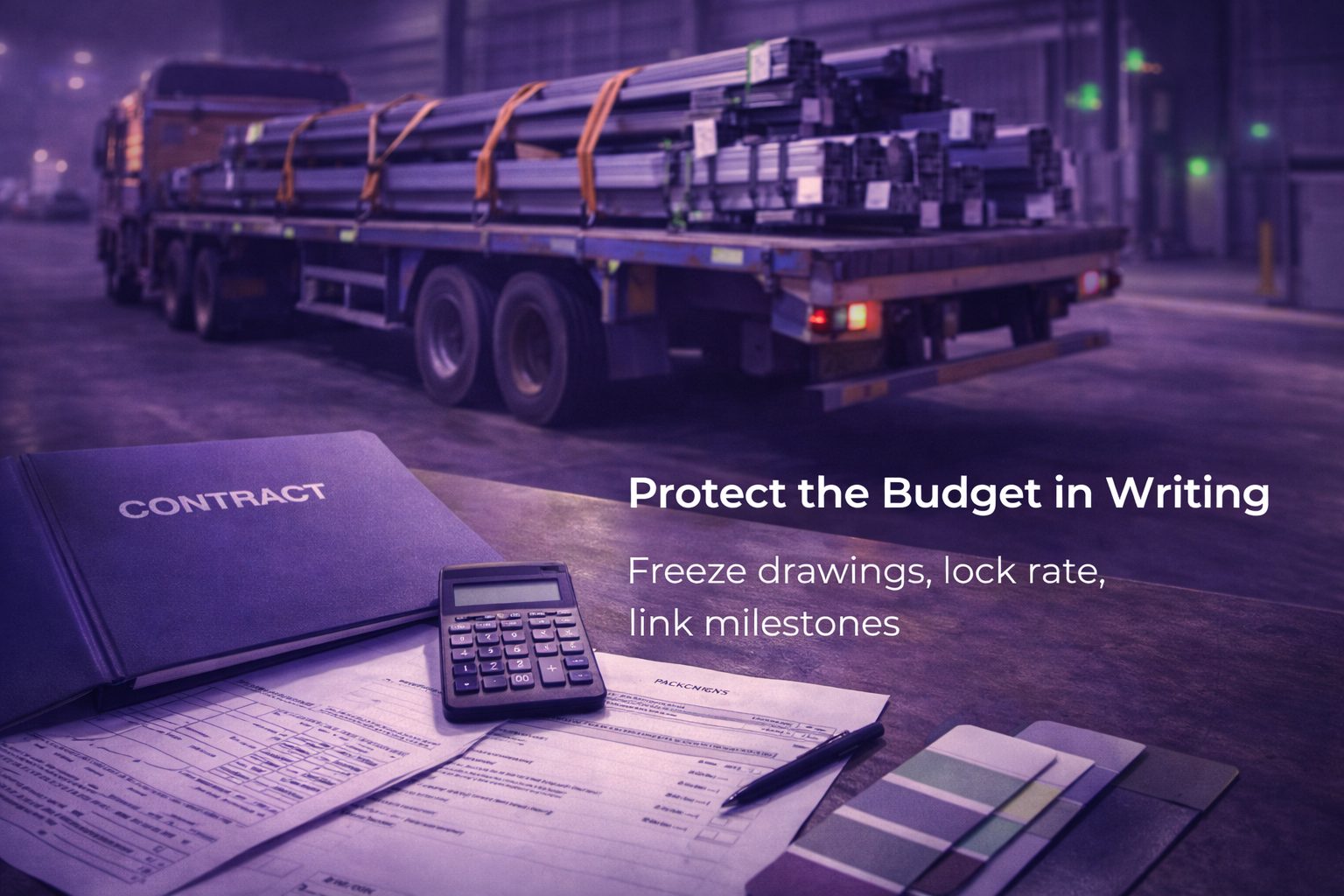
Fix the scope early, then freeze drawings, then lock the rate. This order prevents procurement confusion and reduces surprise claims during erection.
Conclusion: A cost number is useful only when scope is fixed
PEB building cost in India becomes predictable when scope stays stable. A low ₹/sq ft quote helps only after the quote clearly states what is included and what is excluded. This is why MSMEs get better results when they separate steel, erection, civil, flooring, utilities, and compliance into different budget buckets.
The practical way to move forward is simple. Fix the building specs, lock drawings, then compare vendor quotations using steel weight per sq ft, sheeting specs, paint system, and erection scope. Add approvals and fire readiness early, not after the shed stands. This approach reduces change orders, prevents delivery delays, and keeps the project aligned with the real operational start date.
Looking to procure steel?
Tata nexarc helps manufacturers, builders and MSMEs source certified steel products, compare prices, and choose the right grade as per IS codes—with complete traceability and procurement confidence.
FAQs
What payment term reduces vendor delays without increasing buyer risk?
Which line item is most likely to trigger post-order cost escalation?
How can procurement teams avoid vendor lock-in after placing an order?
What is the best way to structure penalties fairly in a PEB contract?
How should buyers evaluate if a vendor can deliver on time?
What commercial check prevents “rate revision” calls after advance payment?
How can companies reduce damage and shortages during dispatch and unloading?
What should be included in an RFQ to reduce back-and-forth?
How can a firm prevent vendor claims due to site readiness issues?
What document reduces disputes at handover the most?
How should a company plan procurement if steel prices are volatile?
What is the fastest way to detect under-scoped accessory pricing?
Charul is a content marketing professional and seasoned content writer who loves writing on various topics with 3 years of experience. At Tata nexarc, it has been 2 years since she is helping business to understand jargon better and deeper to make strategical decisions. While not writing, she loves listing pop music.