Check Price Now
Table of Contents
- What is DRI (Direct Reduced Iron)?
- Production Process of DRI
- Types of DRI in Steel Plants
- Role of DRI in India’s Steel Industry
- Advantages of Using DRI in Steel Production
- Challenges in DRI Implementation in India
- Comparative Analysis: DRI vs. Traditional Ironmaking
- DRI Pricing and Supply Trends in India
- Conclusion
- FAQs
Direct Reduced Iron (DRI) is a significant raw ingredient for making steel. DRI, or sponge iron, is what you get when you take oxygen out of iron ore without melting it. In the direct reduced iron steel industry in India, sponge iron furnishes iron units to Electric Arc Furnaces (EAFs) and Induction Furnaces (IFs). India is the world’s biggest producer of sponge iron, hence it is a great replacement for steel scrap in many steel factories.
What is DRI (Direct Reduced Iron)?
It is a metallic iron product made by removing oxygen from iron ore without melting it. Its full form is Direct Reduced Iron, and the process used is known as the direct reduction process. In this method, iron ore pellets or lumps are reduced using natural gas or non-coking coal at temperatures of about 800–1,100°C.
Because the iron ore reduction occurs without melting, the final product retains a porous structure. This gives the material a sponge-like appearance, which is why DRI is commonly called sponge iron in the steel industry. Direct reduced iron is widely used as a feedstock in Electric Arc Furnaces (EAFs) and Induction Furnaces (IFs), where it replaces or supplements steel scrap.
Key characteristics of DRI
- Produced through the direct reduction of iron ore
- Solid metallic iron with a porous sponge-like structure
- Metallisation rate: typically 90–96%
- Used as a scrap substitute in secondary steelmaking
- Common feedstock for EAF and induction furnace steel plants
Typical composition of Direct Reduced Iron
| Parameter | Typical range |
| Iron (Fe) content | 84–94% |
| Metallisation | 90–96% |
| Carbon | 1–4% (varies by process) |
| Gangue (impurities) | Low |
India plays a major role in the global sponge iron market. The country is the largest producer of sponge iron, supplying raw material to hundreds of EAF and induction furnace-based steel plants across the secondary steel sector.
Production process of DRI
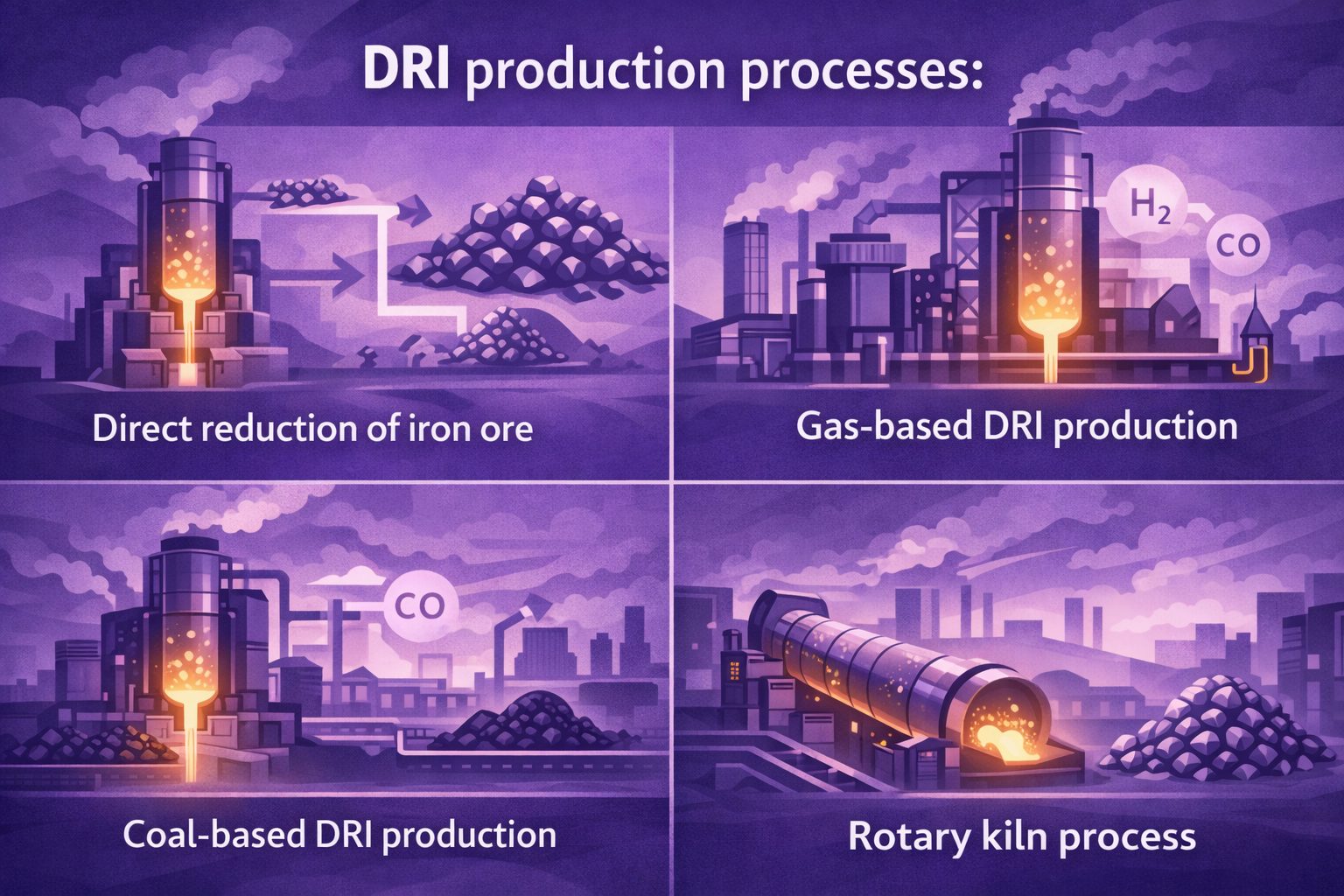
Direct reduction of iron ore
The direct reduced iron production process is based on the direct reduction of iron ore, where oxygen is removed from iron ore without melting the metal. Iron ore in the form of pellets or lumps reacts with reducing gases such as carbon monoxide (CO) and hydrogen (H₂) at temperatures of about 800–1,100°C. Since the iron does not reach its melting point, the product remains solid and forms a porous material known as sponge iron. This method is widely used in sponge iron manufacturing because it consumes less energy than traditional blast furnace ironmaking.
Gas-based DRI production
In gas based DRI, natural gas is converted into reducing gases (mainly hydrogen and carbon monoxide). These gases react with iron ore inside a shaft furnace, removing oxygen and leaving behind metallic iron.
The most widely used industrial technologies include MIDREX and HYL (Energiron) processes. These technologies are common in regions with reliable natural gas supply. Gas-based plants produce high metallisation DRI, and the material can also be compacted into Hot Briquetted Iron (HBI) for safer transport.
Coal-based DRI production in India
In India, coal based direct reduced iron production is more common due to the availability of non-coking coal and limited natural gas infrastructure. This method is widely used by the secondary steel sector, which includes many induction furnace-based steel plants.
Rotary kiln process
The rotary kiln method is the dominant technology for coal based direct reduced iron India production. In this process, iron ore, coal, and flux are fed into a long rotating kiln furnace. As the kiln rotates slowly, coal generates reducing gases and heat, allowing the iron ore to gradually convert into sponge iron.
This process is widely used across major sponge iron producing states such as Odisha, Chhattisgarh, and Jharkhand, supporting India’s position as the largest sponge iron producer in the world.
Types of DRI in steel plants
Direct reduced iron is available in different physical forms depending on temperature, handling method, and carbon content. These types of DRI are used by steel plants based on furnace technology, logistics, and energy efficiency requirements. Most sponge iron types are used as feedstock in Electric Arc Furnaces (EAFs) and Induction Furnaces (IFs).
| Type | Description | Typical use in steel plants |
| Cold DRI (CDRI) | Sponge iron cooled to near ambient temperature after the reduction process. It has a porous structure and must be stored carefully to avoid oxidation. | Commonly used in induction furnace (IF) steel plants and smaller secondary steel producers in India as a substitute for steel scrap. |
| Hot DRI (HDRI) | DRI discharged at high temperature (around 600–800°C) and directly transferred to the furnace. This preserves thermal energy. | Used mainly in integrated steel plants with EAFs, helping reduce electricity consumption and improving furnace efficiency. |
| Hot Briquetted Iron (HBI) | Densified form of hot DRI compressed into briquettes. The process removes porosity and improves stability during storage and transport. | Widely traded internationally and used in EAF steelmaking where consistent iron units are required. |
| Cold Briquetted Iron (CBI) | Produced by compressing cooled sponge iron into briquettes to improve handling and reduce dust generation. | Used in domestic transport and localised steelmaking operations where loose CDRI handling is difficult. |
| High-Carbon vs. low-carbon DRI | Carbon content varies depending on the reduction process. High-carbon DRI contains about 2–4% carbon, while low-carbon DRI has much lower levels. | High-carbon DRI improves melting efficiency in EAFs. Low-carbon DRI is used when tighter control of steel chemistry is required. |
Selecting the right sponge iron type helps steel producers optimise energy use, furnace productivity, and steel quality.
Role of DRI in India’s steel industry
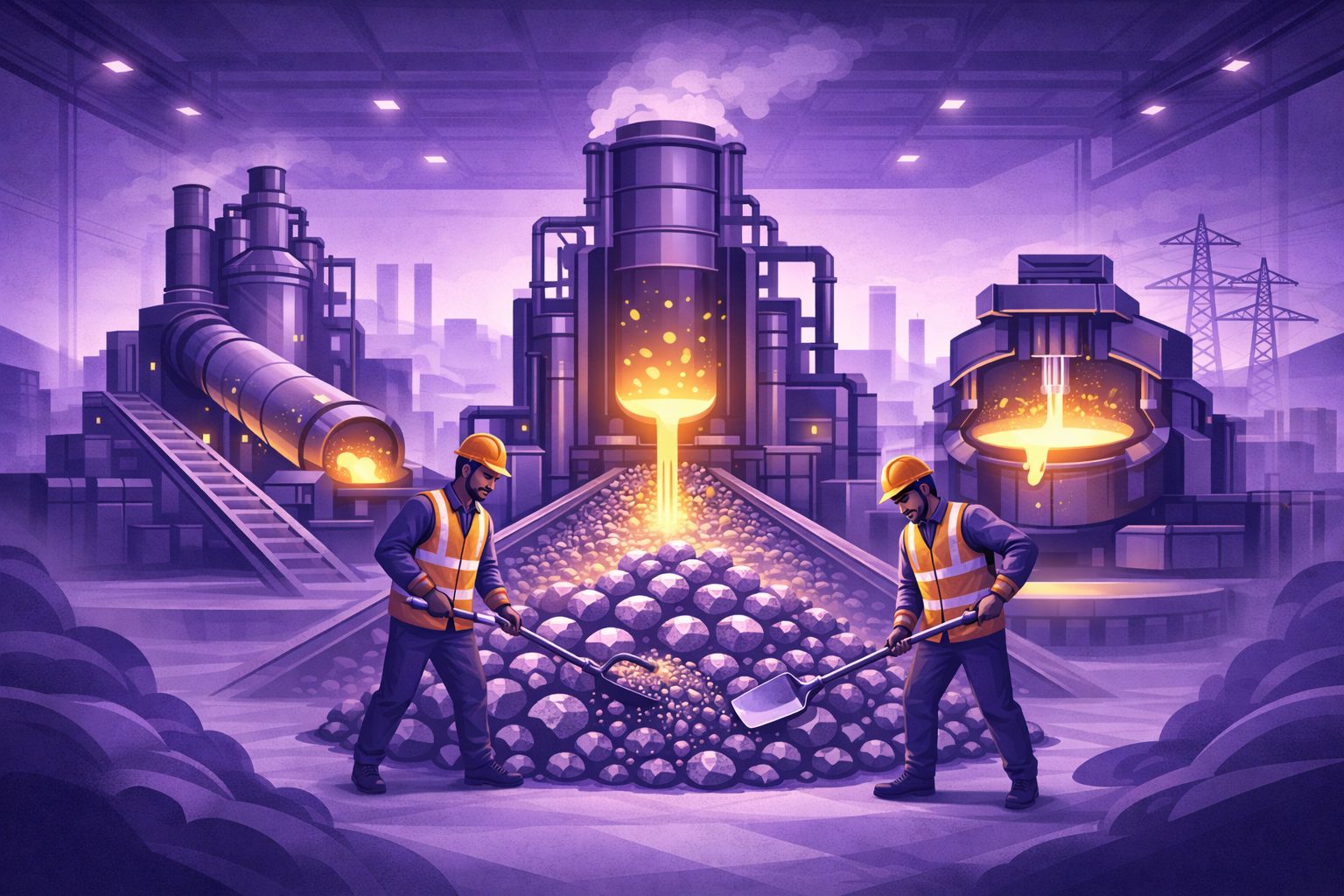
The DRI India steel industry plays a major role in global steel supply. India is the largest producer of sponge iron, accounting for roughly 40% of global sponge iron production. The availability of iron ore reserves and non-coking coal has supported the growth of coal-based DRI plants across the country. This strong production base ensures a steady supply of metallic feedstock for the domestic steel industry.
Major sponge iron producing states
Most sponge iron production in India is concentrated in mineral-rich states with access to iron ore and coal. The key production hubs include:
- Odisha
- Chhattisgarh
- Jharkhand
- Karnataka
These regions host many rotary kiln sponge iron plants, supplying DRI to nearby steel mills and rolling mills. Industrial clusters around Raipur, Rourkela, and Bellary are major centres for sponge iron manufacturing.
Importance for the secondary steel sector
DRI is especially important for India’s secondary steel sector, which includes Electric Arc Furnaces (EAFs) and Induction Furnaces (IFs). Many smaller and mid-sized steel producers depend on sponge iron as their primary iron source. The DRI use in induction furnaces helps maintain consistent iron input and supports flexible steel production.
Substitute for steel scrap
India imports a large share of its steel scrap. As scrap prices fluctuate in global markets, DRI acts as a reliable scrap substitute. Steel producers often use a mix of sponge iron and scrap to control steel chemistry, improve yield, and stabilise raw material costs.
Advantages of using DRI in steel production
Consistent quality and high metallisation
One of the main benefits of DRI is its consistent chemical composition. Direct Reduced Iron typically has a metallisation rate of 90–96%, meaning most of the iron is already in metallic form. This improves melting efficiency and helps steelmakers maintain stable furnace operations compared to variable scrap quality.
Lower residual elements than scrap
In the DRI vs. scrap comparison, DRI offers better control over impurities. Steel scrap may contain unwanted residual elements such as copper, tin, and chromium, which are difficult to remove during melting. DRI contains lower residual elements, allowing producers to manufacture cleaner steel grades and maintain better product quality.
Energy efficient steelmaking
DRI supports energy efficient steelmaking, especially when used in Electric Arc Furnaces (EAFs). When Hot DRI (HDRI) is directly charged into the furnace, it retains heat from the reduction process. This reduces electricity consumption during melting and improves furnace productivity.
Better control of steel chemistry
DRI allows steelmakers to precisely control the metallic charge mix. By blending sponge iron with scrap, producers can maintain the required balance of iron, carbon, and other alloying elements. This flexibility is important for producing long products, billets, and specialty steel grades.
Lower environmental impact
Compared with traditional blast furnace ironmaking, gas-based DRI production generates lower carbon emissions. As steel producers focus on cleaner processes, DRI is increasingly seen as a key raw material for low-carbon steel production.
Challenges in DRI implementation in India

Technical challenges
Several DRI production challenges arise from raw material and process requirements. Sponge iron production typically requires high-grade iron ore (Fe content above 65%) with low impurities. Such ore quality is not always available in sufficient quantities, which can limit production efficiency. In addition, Cold DRI (CDRI) is highly porous and reactive. If exposed to moisture and air, it can oxidise quickly and create storage or fire risks, requiring careful handling and dry storage conditions.
Economic challenges
Energy availability and costs play a major role in sponge iron manufacturing. Both gas-based and coal-based DRI plants depend heavily on energy inputs. Fluctuations in natural gas prices, coal prices, and electricity tariffs can significantly impact production costs. For smaller producers, the capital investment required for DRI plants and furnace infrastructure can also be a barrier to expansion.
Environmental and logistics challenges
Some sponge iron limitations are related to emissions and transportation. Coal-based DRI production, which is widely used in India, can generate higher CO₂, SO₂, and particulate emissions compared to gas-based systems. Logistics can also be challenging because loose sponge iron is reactive and generates dust during transport. To address DRI logistics issues, many producers convert hot DRI into Hot Briquetted Iron (HBI) for safer storage and long-distance shipping.
Comparative analysis: DRI vs. traditional ironmaking
The main difference in DRI vs blast furnace steelmaking lies in how iron ore is reduced and how the iron is used in steel production. Direct Reduced Iron is used mainly in Electric Arc Furnaces (EAFs) and Induction Furnaces (IFs), while traditional ironmaking produces pig iron in blast furnaces for Basic Oxygen Furnace (BOF) steelmaking.
| Parameter | Direct Reduced Iron (DRI) | Traditional ironmaking (Blast Furnace – BOF) |
| Process type | Iron ore reduction without melting using gas or coal | Iron ore melted with coke in a blast furnace |
| Main product | Sponge iron/DRI | Pig iron (hot metal) |
| Furnace used in steelmaking | EAF/Induction Furnace | Basic Oxygen Furnace (BOF) |
| Operating temperature | ~800–1,100°C | ~1,500–1,600°C |
| Carbon emissions | Lower, especially in gas-based DRI | Higher due to coke combustion |
| Raw material requirements | Requires high-grade iron ore (Fe >65%) | Can process lower-grade ore with beneficiation |
| Steel quality | Lower residual elements, better chemistry control. | Can contain impurities from coke and hot metal |
| Cost structure | Lower capital for small plants; flexible production | Very high capital investment for integrated plants |
| Typical iron unit price (India, indicative 2025–2026) | Sponge iron: ₹25,000–₹35,000 per tonne depending on region and coal prices | Pig iron: ₹35,000–₹45,000 per tonne depending on grade |
Overall, the sponge iron vs pig iron route offers different advantages. The DRI–EAF route provides flexibility, lower emissions, and suits smaller steel plants. The blast furnace–BOF route remains dominant for large integrated steel producers with high-volume output.
DRI pricing and supply trends in India
Key price drivers
The sponge iron price in India depends mainly on the cost of iron ore, non-coking coal, and natural gas. Since many plants use coal-based rotary kilns, fluctuations in thermal coal and iron ore prices directly affect the DRI price per ton. Energy costs, transportation, and regional demand from steel mills also influence market prices.
Regional price differences
Prices in the sponge iron market in India vary across regions due to logistics and raw material availability. Major production clusters such as Odisha, Chhattisgarh, and Jharkhand often have relatively competitive prices because plants are located close to iron ore mines and coal sources. In contrast, steel plants located farther from mining regions may face higher delivered sponge iron costs.
Demand from secondary steel plants
Demand for DRI largely comes from induction furnace and electric arc furnace steel plants. These producers rely on sponge iron to supplement or replace scrap, making DRI pricing closely linked to scrap availability and steel demand in India’s secondary steel sector.
Conclusion
DRI (Direct Reduced Iron) has become a key input for modern steel production, particularly in regions with a large secondary steel sector. Its ability to provide consistent iron units, reduce reliance on scrap, and support flexible furnace operations makes it valuable for many steel producers.
Looking ahead, the future of DRI steelmaking will be closely linked to cleaner technologies and efficiency improvements. Developments such as hydrogen based DRI are gaining attention as the industry works toward lower emissions. These innovations could play an important role in advancing green steel in India in the coming decades.
Disclaimer: The information provided is for informational purposes only. Industrial decisions regarding Direct Reduced Iron (DRI) in Steel Plant should be based on expert consultation.
Looking to procure steel?
Tata nexarc helps manufacturers, builders and MSMEs source certified steel products, compare prices, and choose the right grade as per IS codes—with complete traceability and procurement confidence.
FAQs
What is Direct Reduced Iron (DRI)?
Why is DRI also called sponge iron?
How is DRI different from traditional ironmaking?
What are the main types of DRI used in steel plants?
What are the advantages of using DRI in steel production?
What is the difference between gas-based and coal-based DRI production?
What is Hot Briquetted Iron (HBI), and why is it important?
What are the environmental benefits of DRI in steelmaking?
A product manager with a writer's heart, Anirban leverages his 6 years of experience to empower MSMEs in the business and technology sectors. His time at Tata nexarc honed his skills in crafting informative content tailored to MSME needs. Whether wielding words for business or developing innovative products for both Tata Nexarc and MSMEs, his passion for clear communication and a deep understanding of their challenges shine through.