Table of Contents
- Overview of national GST collection
- Economic context of GST collection growth
- State-wise GST revenue: Growth leaders
- State-wise GST revenue: Lower growth & contractions
- Sectoral drivers behind GST collections
- Factors influencing January 2026 GST collections
- Fiscal implications for India
- Policy responses & administrative measures
- Future outlook
- Conclusion
- FAQs
India’s GST collection in January 2026 recorded steady growth, signalling stable economic activity. The country collected around ₹1.93 lakh crore in gross GST revenue, a year-on-year rise of over 6%. Higher compliance, consistent domestic consumption, and strong import-related taxes supported this increase. Monthly GST data is a key indicator of India’s economic health, government revenue strength, and state finances. January 2026 figures provide early insight into demand trends, sector performance, and regional growth across India.

Overview of national GST collection January 2026
India’s GST collection in January 2026 remained strong, reinforcing the trend of stable tax revenue growth seen through the financial year. The data reflects improving compliance, steady consumption, and healthy import activity.
Key GST figures for January 2026
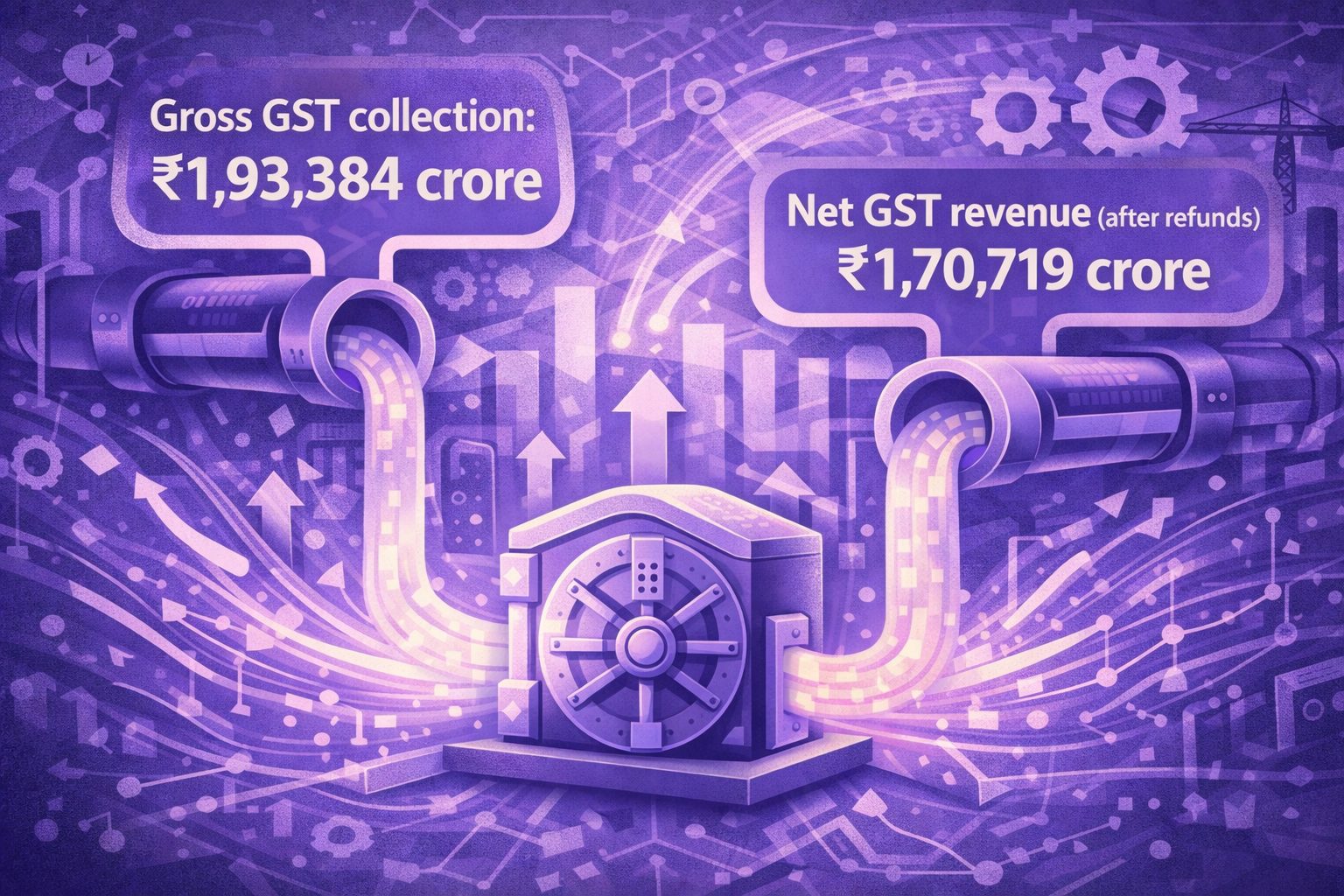
- Gross GST collection: ₹1,93,384 crore
(6.2% year-on-year growth compared to January 2025) - Net GST revenue (after refunds): ₹1,70,719 crore
(7.6% YoY increase, showing better tax realisation)
These numbers place January 2026 among the stronger GST months of the year, despite the absence of major seasonal demand drivers.
GST performance so far in FY 2025-26 (April-January)
| Metric | Amount | Growth |
| Gross GST collections | ₹18.43 lakh crore | +8.3% |
| Net GST revenue | — | ~6.8% |
The year-to-date growth shows that GST revenue trends in India are broadly aligned with nominal economic growth and government expectations.
Component-wise GST breakdown
- Domestic GST: Up by ~4.8%
Indicates steady internal demand and services activity. - Import-linked GST: Up by ~10.1%
Suggests higher imports and improved customs-linked tax collection. - Refunds: Down by ~3.1%
Lower refunds directly supported higher net GST revenue.
Fiscal context and revenue targets
January’s GST figures support the Centre’s FY 2025–26 revenue targets, helping both the Union and states manage expenditure without added fiscal stress. Consistent monthly GST collections also improve predictability for budget planning, state transfers, and infrastructure spending.
Overall, the January 2026 GST collection confirms a stable tax base rather than a one-off spike, pointing to sustainable revenue momentum going forward.
Economic context of GST collection growth
GDP linkage
GST trends are widely used as a proxy for India’s GDP growth, as they reflect real-time private consumption and business activity. Higher GST collections in January 2026 point to stable performance in key sectors such as manufacturing, construction, trade, and services.
Consumption demand
Despite GST rate rationalisation and slab restructuring implemented from September 2025, domestic consumption remained resilient. Household spending on goods, services, and essentials continued to support GST revenue growth, indicating demand stability rather than price-led inflation.
Impact of policy changes
Recent GST reforms simplified tax structures and reduced or removed select cesses, particularly on certain luxury and discretionary items. While this moderated growth in specific segments, it improved compliance and transparency, resulting in more balanced and sustainable GST collections.
Inflation and compliance
Moderate inflation levels, combined with stronger enforcement, e-invoicing expansion, and digital return filing, helped widen the tax base. Improved reporting reduced leakages and increased net GST realisation across states.
Seasonal factors
January typically benefits from post-holiday consumer purchases, year-end corporate invoicing, and inventory restocking. These seasonal factors provided additional support to January 2026 GST collections, even in the absence of major festival-driven demand.
State-wise GST revenue: Growth leaders

Haryana
Recorded one of the highest state-wise GST growth rates at around 27%, supported by strong manufacturing activity, logistics hubs, and high compliance levels.
Maharashtra
Posted a ~15% year-on-year increase in GST collections. As India’s largest industrial and services economy, the state benefited from manufacturing, financial services, and urban consumption.
Gujarat
GST revenue rose by around 13% YoY, with SGST collections of about ₹7,742 crore. Growth was driven by exports, industrial production, and import-linked GST.
Himachal Pradesh
Reported ~18% growth, aided by pharmaceuticals, FMCG manufacturing, and improved tax reporting.
Punjab
Saw ~12% growth, reflecting stable trade activity, agriculture-linked processing industries, and better compliance.
Mid-tier performing states:
- Tamil Nadu: ~5%
- Karnataka: ~7%
- Uttar Pradesh: ~2%
- Delhi: ~3%
- West Bengal: ~1%
These states delivered positive but uneven growth, influenced by sector mix, urban demand, and local economic conditions.
State-level GST growth in January 2026 was shaped by industrial structure, import-export exposure, and compliance enforcement. Manufacturing-heavy and trade-linked states outperformed, while consumption-driven states showed steadier but slower gains.
State-wise GST revenue: Lower growth & contractions
West Bengal
Recorded around 1% growth, reflecting slower industrial activity and moderate urban consumption.
Uttar Pradesh
Posted ~2% growth, impacted by a large informal sector and uneven GST compliance across districts.
Delhi
Saw ~3% growth, as its services-heavy economy offers limited scope for sharp GST expansion without manufacturing support.
Kerala
Reported low single-digit growth, driven mainly by consumption and services, with limited large-scale industrial output.
Rajasthan
Showed subdued growth, influenced by seasonal slowdown in trade, mining, and construction-related activity.
North-Eastern states
Experienced flat to marginal growth, due to smaller tax bases and higher dependence on central transfers.
Union Territories
Most UTs recorded flat or volatile GST collections, reflecting narrow economic activity and low transaction volumes, except those with tourism or port-led trade.
Context:
Lower or slower GST growth in January 2026 was largely structural. States with weaker manufacturing bases, slower consumption cycles, or higher informal sector presence tended to underperform. Administrative capacity and compliance enforcement also played a role in shaping state-level GST outcomes.
Sectoral drivers behind GST collections in January 2026
| Sector | Impact on GST collection | Key drivers |
| Manufacturing & exports | Higher GST and IGST inflows | States such as Maharashtra and Gujarat benefited from strong manufacturing output, export activity, and supply-chain-linked taxation. |
| Services & domestic consumption | Stable GST growth | Services-led states like Delhi and Karnataka saw consistent collections supported by urban spending, professional services, and hospitality. |
| Import-linked GST | Strong year-on-year growth | Higher import GST collections point to robust cross-border trade, steady global demand, and improved customs-linked tax compliance. |
| E-commerce & retail | Noticeable contribution | Post-holiday sales, digital platforms, and online retail transactions continued to add significantly to GST receipts. |
| Logistics & warehousing | Indirect support | Growth in goods movement and warehousing activity supported GST through transport and storage services. |
January 2026 GST collections were supported by a mix of manufacturing strength, steady services demand, rising imports, and digital retail activity. Sectoral diversity helped maintain revenue stability despite regional variations.
Factors influencing January 2026 GST collections
GST rate rationalisation: The move towards a simplified two-slab GST structure and selective cess changes altered the revenue mix. While some categories saw lower tax incidence, overall collections remained stable due to better compliance and broader coverage.
Policy environment: Ongoing GST 2.0 reforms, tighter enforcement, and wider use of e-compliance tools such as e-invoicing and data matching improved collection efficiency and reduced leakages.
Refund changes: Lower GST refunds during the month helped lift net GST revenue, even as gross collections grew at a moderate pace.
External macro factors: Global commodity prices, foreign exchange movements, and supply chain conditions continued to influence import-linked GST, supporting overall collections in January 2026.
Fiscal implications for India
Budget planning: Higher GST collections strengthen fiscal buffers and support government spending without widening deficits ahead of Budget 2026.
Revenue predictability: Consistent monthly GST data improves forecasting of quarterly and annual tax receipts.
State finances: Strong SGST growth supports state budgets, especially in economically stronger and industrialised states.
Policy responses & administrative measures
| Area | Key developments |
| GST Council response | The GST Council is monitoring uneven state-wise GST growth and reviewing compliance gaps using return and e-invoicing data. |
| Compliance and enforcement | Increased focus on data matching, e-invoicing expansion, and audits to improve tax realisation and reduce leakages. |
| Rate and structure review | Ongoing discussions on GST rate rationalisation and selective adjustments to balance revenue and affordability. |
| State revenue support | Several states have raised concerns over slower growth and are seeking revenue support mechanisms and improved settlement timelines. |
| Centre-state fiscal coordination | Inter-governmental discussions continue on tax devolution, allocation formulas, and GST settlement efficiency following January 2026 data. |
Policy actions remain focused on improving compliance, addressing regional imbalances, and ensuring predictable GST revenue for both the Centre and states.
Future outlook
Short-term: GST collections are expected to show moderate growth, with scope for acceleration if domestic consumption and private investment improve.
Medium-term: Continued GST reforms, wider digital compliance, and better enforcement could expand the tax base and reduce revenue leakages.
Risks: Potential economic slowdowns, global uncertainty, commodity price volatility, or policy misalignment such as abrupt rate changes may impact future GST growth.
Conclusion
The GST collection in January 2026 reflects resilient revenue growth and improving tax stability. Consistent monthly collections, better compliance, and steady domestic demand have supported both Centre and state finances. While growth varied across states and sectors, the overall trend points to a broadening tax base rather than short-term volatility. If current reforms and enforcement measures continue, GST is likely to remain a reliable pillar of India’s fiscal framework in the coming months.
Empowering MSMEs to grow smarter
Tata nexarc delivers powerful solutions for MSMEs—discover tenders, logistics solutions, and streamline procurement. Everything your business needs, all in one place.
FAQs
What was India’s total GST collection in January 2026?
How much was the net GST revenue?
What was the year-on-year growth?
Which states recorded the highest GST growth?
Which states had slower growth?
What sectors contributed most to GST?
Did refunds affect net GST revenue?
How does GST link to India’s economy?
What factors influenced January 2026 collections?
What is the outlook for GST collections?
A product manager with a writer's heart, Anirban leverages his 6 years of experience to empower MSMEs in the business and technology sectors. His time at Tata nexarc honed his skills in crafting informative content tailored to MSME needs. Whether wielding words for business or developing innovative products for both Tata Nexarc and MSMEs, his passion for clear communication and a deep understanding of their challenges shine through.